Concrete work options and costs in Dawson Creek
Dawson Creek sees a lot of concrete flatwork work—driveways, patios, walkways, and garage slabs—because most local homeowners are in single-detached homes (61.1% of dwellings) and the majority of households own their homes (58.2%). With a population of 12,323 (Statistics Canada, 2021 Census), the Peace River district has a steady demand for “keep-it-dry” upgrades that can handle long winters and repeated freeze–thaw cycles.
In the Northeast British Columbia market, pricing is shaped by deep frost risk, short seasonal work windows, and the reality that good concrete durability requires more than just pouring and finishing. Footings and foundation work must be built below local frost depth to prevent frost heave and slab cracking, and that usually means deeper excavation (and more backfill/compaction) than milder regions. Exterior slabs also rely on air-entrained concrete and tight control-joint patterns to manage cracking caused by cycling moisture and temperature. When we pour close to cold snaps, crews add cold-weather protection—curing blankets, insulation, and sometimes temporary heat—to reach design strength, which increases labour and materials.
In Dawson Creek, we often get the highest driveway and walkway demand in neighbourhoods like Brookside and the older residential pockets near downtown, where many homes were built before 1981 (58.8%) and concrete surfaces are reaching the point where replacement or major resurfacing is cheaper than ongoing patching. If you’re comparing options, the best next step is to look at typical sizes and specs across common applications—see the table below.
| Application |
Typical Size |
Key Spec |
Finish Option |
Price Range |
| Concrete driveway (standard broom finish) |
18’ x 20’ (360 sq ft) |
Air-entrained exterior mix; granular base; control joints |
Broom finish |
$6,480–$10,080 |
| Exposed aggregate driveway |
18’ x 20’ (360 sq ft) |
Air-entrained exterior mix; exposed surface prep; proper curing |
Exposed aggregate (retarder + washing) |
$8,640–$12,960 |
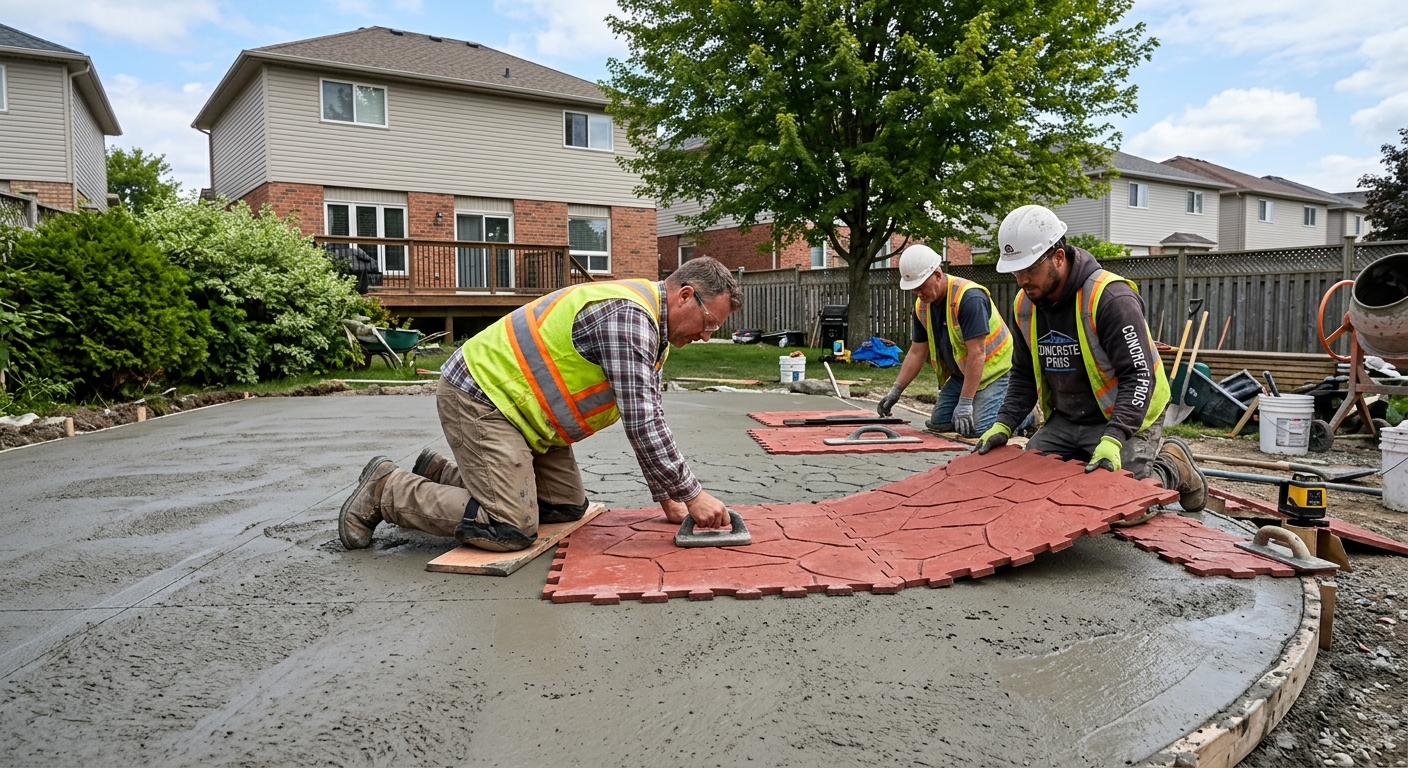
| Stamped concrete driveway or patio |
16’ x 20’ (320 sq ft) |
Air-entrained mix; stamped release + proper jointing |
Stamped pattern + sealer (where included) |
$8,000–$12,800 |
| Plain concrete patio or walkway |
10’ x 16’ (160 sq ft) |
Exterior base prep; air-entrained mix; joint layout |
Float + broom or light broom finish |
$2,400–$4,000 |
| Garage floor (interior slab) |
20’ x 22’ (440 sq ft) |
Vapour barrier (if required); mesh or rebar where specified |
Standard broom/steel-trowel hybrid |
$8,800–$13,200 |
| Foundation footings (structural, below frost) |
Typical house perimeter (variable) |
Engineered footing dimensions; below frost excavation; rebar per design |
Structural finish (not decorative) |
$4,400–$7,600 |
Prices are estimates only and vary by project scope, site access and material selection.
What affects the price of concrete work in Dawson Creek
In Dawson Creek and the wider Northeast region, two quotes for the “same” concrete job can still differ by 30–50% once you account for frost depth requirements, site conditions, and the concrete specs needed for long-term durability. In cold-climate areas, excavation and base prep usually aren’t optional—footings must extend below design frost depth to prevent frost heave and slab cracking, and the freeze–thaw cycle forces us to use air-entrained concrete for exterior slabs. That design discipline can cost more upfront, but it prevents repeat repairs that are common on poorly specified pours.
Cold weather also compresses the pour season, which pushes seasonal demand and labour pricing higher. When concrete is at risk of early freezing, crews must use cold-weather curing precautions such as insulation blankets, enclosures, or heaters to protect set and strength gain. If the surface will face de-icing salts (very common on driveways in Northeast BC), the mix design and later sealing become more important; otherwise, you’ll see faster scaling and spalling. That’s one reason air-entrainment and proper curing can swing the total cost.
Local examples: (1) if your driveway removal includes hauling away thicker, old base materials, disposal and re-compaction can push the project toward the higher end of the $18–$28 per sq ft driveway band; (2) if you want stamped or exposed aggregate, extra labour for forms, texture tooling, and finishing tends to move you into the $25–$40 per sq ft decorative range; and (3) if your site has limited truck access (narrow lanes, soft shoulders), smaller pours and more labour for wheelbarrowing can add real cost even before rebar and concrete volume are considered. With many homes built before 1981 (58.8%), older drainage patterns may also require new granular base and subdrain work to stabilize the surface for freeze–thaw.
| Price Factor |
Why It Matters |
Cost Impact |
| Frost line depth — determines footing depth and form height |
Deeper footings mean more excavation, concrete, and backfill/compaction |
Often the single biggest driver for foundation pricing in Northeast BC |
| Site preparation — excavation, grading, compacted granular base |
Concrete longevity depends on stable, well-drained base under the slab |
Adds labour and equipment time; poor soil can raise costs quickly |
| Reinforcement — rebar or wire mesh requirement |
Reduces cracking and improves structural performance where required |
Material + install labour; may be mandatory for garage slabs/footings |
| Mix design — air-entrainment and compressive strength spec |
Air-entrainment helps resist freeze–thaw damage and scaling |
Premium materials, plus tighter batching/inspection |
| Finish type — broom vs. stamped vs. exposed aggregate |
Texture and surface prep increase labour and require more careful curing |
Decorative finishes typically raise price versus standard broom |
| Pour size and concrete truck access to site |
Long carries, multiple trips, or pumping affect labour and concrete logistics |
More trips/time can add measurable cost even if volume is similar |
| Cold-weather curing precautions — heating and blankets |
Protects strength gain and prevents early freezing in short summers |
Higher material and crew time during shoulder-season pours |
| Control joint pattern and sealing cost |
Manages cracking locations and reduces moisture intrusion from de-icing salts |
Sealer and saw-cut labour can add cost but improves durability |
Permits & regulations in British Columbia
In British Columbia, concrete work can be “permit-required” or “typically no permit,” depending on how structural it is and whether it affects grading or surfaces that regulate drainage and impervious coverage. Structural concrete work—like footings, foundation walls, and grade beams—usually requires a building permit and, in many cases, engineered drawings that the municipality reviews. Concrete flatwork such as patios, walkways, and driveways is often exempt from a permit, unless it impacts lot grading, drainage patterns, right-of-way considerations, or impervious surface limits. Before you break ground, confirm specifics with the local authority in Dawson Creek so your project matches the applicable municipal requirements.
For contractor accountability, verify insurance and coverage before any work begins. In practice, you should ask for: (1) proof of liability insurance, naming you/your property as an additional insured if offered; and (2) confirmation the contractor is covered under WSBC/WCB for workers (or that coverage is in place through their business). Next, request references for similar-scale Northeast BC projects—especially exterior flatwork exposed to freeze–thaw cycles and de-icing salts.
To verify a contractor: check for their business credentials via the provincial contractor licensing/registration listing (if applicable to their trade), then review their certificate of insurance (COI) for active coverage dates, and confirm workers’ compensation clearance. If they can’t provide current documents quickly, treat that as a serious warning and move on.
Getting concrete right in Dawson Creek's freeze-thaw climate
Concrete fails in Dawson Creek when the slab can’t move with winter forces—or when it’s built to crack and then let water in. Freeze–thaw cycling, moisture, and de-icing salts expand the risk for scaling and spalling, particularly when air-entrainment and curing aren’t handled correctly. To spec the job right, you want the “system”: (1) base preparation to a properly compacted granular sub-base depth for your site and soil, plus drainage considerations; (2) a mix design that includes air-entrainment suitable for exterior exposure and a minimum compressive strength target; (3) control joints laid out to create predictable crack locations; (4) curing long enough to achieve strength and protect surfaces; and (5) sealing after cure to repel moisture and salt penetration.
On the mix side, exterior flatwork should typically target 5–7% air content and a minimum 32 MPa compressive strength specification. Skipping or under-specifying air-entrainment is a common cause of spalling in cold-weather northern BC jobs because the paste can’t tolerate repeated freezing water expansion. Control joints also matter: without an engineered or at least well-measured joint pattern, random cracking can develop and become water pathways.
As an example of where cost differences are justified: if you choose a basic broom-finish driveway only to save on curing protection, you might land near the lower end of the driveway band (around $18–$28 per sq ft equivalent pricing), but if surface scaling begins a season or two later, repairs often end up costing more than doing proper curing and later sealing the first time. Proper curing and sealing isn’t the cheapest option—it’s the option that usually avoids the repeated patch-and-reseal cycle.
| Spec |
Why It Matters in Dawson Creek |
What to Ask For |
Impact if Skipped |
| Compacted granular base (depth?) |
Stable support reduces settlement and pumping under freeze–thaw loads |
Base thickness based on soil and frost considerations; proof of compaction |
Cracking, uneven slabs, early deterioration |
| Air-entrained concrete mix (target air %?) |
Helps concrete resist freeze–thaw damage in Northeast BC winters |
Specify target air content (commonly 5–7% for exterior flatwork) |
Scaling and spalling, especially with de-icing salt exposure |
| Compressive strength (MPa rating) |
Strength gain supports durability and load capacity |
Minimum 32 MPa (or project-specific design value) |
Weaker surface prone to wear, cracking, and premature failure |
| Control joints (spacing per ACI guidelines) |
Controls where cracks form as temperature changes |
Joint layout and saw-cut timing plan (tell you spacing and locations) |
Random cracking and water ingress |
| Minimum 7-day curing period |
Cold nights and early freezing can interrupt strength development |
Curing method (blankets/insulation if needed) and protection plan |
Surface weakness, dusting, and reduced long-term durability |
| Penetrating sealer (when applied after cure) |
Repels moisture and helps reduce salt-driven surface scaling |
Confirm sealer type and timing—typically after full cure (around 28 days) |
More water and salt penetration, leading to faster spalling |
How to choose a concrete work contractor in Dawson Creek
Choosing the right contractor in Dawson Creek starts with documentation and clarity. In British Columbia, always verify the contractor’s liability insurance before work begins—ask for a current certificate of insurance and confirm coverage dates. Next, confirm workers’ compensation coverage through the WSBC/WCB system (they should be able to provide proof or a clearance letter/confirmation). For licensing and trade credentials, check the applicable provincial registry for the contractor’s business and trade authorization when required, and ask what specific scopes they’re licensed/qualified to perform (especially for structural elements).
Then get 2–3 itemised written quotes—not just a lump sum. You want line items for demo/removal, excavation and hauling, granular base supply and compaction, reinforcement (mesh/rebar), concrete supply and air-entrainment mix design, finishing labour, saw cutting and jointing, curing protection, and any sealing. Also verify what’s excluded: is permit work included (when required), is disposal included, and are you responsible for any additional grading or landscaping reinstatement? Ask for the start date and completion estimate in writing.
For payment scheduling, a safe rule is to never pay more than 10–15% upfront; hold back a portion until the job is complete and cleanup is done. Warranty should be in writing: workmanship warranty length, what product/manufacturer warranties apply (if any), and whether warranty terms are transferable if you sell the home.
- Ask for references on similar Dawson Creek exterior concrete (driveways, patios, garage slabs).
- Confirm liability insurance is active and the COI matches the legal business name.
- Verify WSBC/WCB coverage for workers before the first pour.
- Get quotes broken into labour, materials, and equipment (not a single “all-in” number).
- Clarify what happens with old concrete removal and disposal (and where it’s hauled).
- Ask for the base prep plan: excavation depth, granular type, and compaction standard.
- Request mix design details: air-entrainment targets and minimum strength (e.g., 32 MPa).
- Confirm whether rebar/mesh is included where appropriate (garage slabs, structural work).
- Get the joint plan: spacing and saw-cut timing.
- Ask how they handle cold nights—blankets, insulation, heating, and curing logs.
- Confirm sealing approach if you’re in a salt-exposed driveway/steps scenario (timing matters).
- Use a payment schedule tied to milestones; avoid large upfront deposits.
Concrete contractor red flags in Dawson Creek: refusing to provide insurance/WSBC proof, quoting without discussing air-entrainment and curing, leaving out a base prep description (depth/compaction), using vague “we’ll do whatever it takes” language for joints and sealing, or pushing full payment upfront before cleanup and final finish.
Frequently asked questions — concrete work in Dawson Creek
What causes concrete to spall in Dawson Creek winters?
Spalling is the breaking off of the concrete surface, and in Dawson Creek it’s usually tied to moisture getting into the slab and then freezing and expanding. The big drivers are freeze–thaw cycling, inadequate air-entrainment, and curing that didn’t achieve proper strength before cold nights hit. De-icing salts add another layer: once water and salt penetrate microscopic pores, the freeze–thaw action accelerates surface scaling. That’s why exterior flatwork pricing in Northeast BC often includes an air-entrained mix and better curing protection—otherwise you might get a lower initial cost (for example, standard broom driveway work can sit around the $18–$28 band), but you’re more likely to see early surface failure. Sealing after proper cure can significantly reduce salt-driven deterioration.
What is rebar and when is it required in British Columbia?
Rebar (reinforcing steel) is used to strengthen concrete and control cracking by tying the concrete into a reinforced system. In British Columbia, whether rebar is required depends on the engineered design and the structural role of the concrete element. Structural work like footings and many foundation components typically require rebar per engineering drawings, especially when supporting loads or resisting frost and soil movement. For non-structural slabs (like many interior garage floors or exterior flatwork), reinforcement may still be specified based on slab thickness, soil conditions, and expected loads, but it’s not “one-size-fits-all.” The correct approach is to ask your contractor for the thickness, reinforcement type (mesh vs. rebar), and whether an engineer’s spec applies. A competent Dawson Creek contractor will align reinforcement with the project requirements, not guess based on a budget.
How long does a concrete project take in Dawson Creek?
Time in Dawson Creek depends on weather windows and scope, because concrete finishing and curing must be protected from early freezing. Typical driveway or patio work often takes 1–3 days of on-site work (demo/excavation, base prep, pour, finishing), but the schedule doesn’t end at the pour. You should plan for protected curing and restrictions on heavy loads after casting—then allow full cure before sealing if included. If you’re in an early/late season pour window, curing blankets or enclosures can add setup time. Decorative work (like stamped concrete) can also take longer due to texture setup and careful finishing. Even if you’re aiming for something in the lower driveway band (around $18–$28 pricing), a proper curing plan can extend calendar time to durability milestones. Always ask for start date, pour date, and completion estimate in writing.
What is a concrete overlay and is it suited to Dawson Creek?
A concrete overlay is a new concrete layer placed over an existing slab—sometimes using bonding methods, surface profiling, and patching of failing areas first. It can be suited to Dawson Creek when the underlying concrete is still structurally sound (not severely heaved, heavily cracked, or failing base conditions) and when preparation is done correctly. If water has been pumping under the slab due to poor base drainage or frost movement, an overlay can fail because the movement continues underneath. Overlays also need the right mix and finishing to handle freeze–thaw and salt exposure. If the existing driveway is already scaling/spalling badly, full replacement may be the more durable option, even if the initial outlay is higher. Because Northeast BC has deep frost exposure and frequent freeze–thaw cycles, the best choice depends on inspecting the base and crack pattern—not just surface appearance.
How do I seal concrete to protect it in Dawson Creek?
Sealing is meant to reduce moisture and salt penetration, which helps slow scaling and spalling during Dawson Creek winters. The key rule is timing: most penetrating sealers should be applied after the concrete has fully cured—commonly around 28 days post-pour—so you don’t trap excess moisture inside the slab. Before sealing, the surface must be clean and dry, and repairs should be completed and allowed to cure. If your project is within reach of the $18–$28 driveway band, sealing often costs extra but can be a smart durability step when de-icing salts are used. Ask your contractor what sealer they use, whether it’s penetrating (typical for exterior freeze–thaw durability), and how they prep and schedule application. In Northeast BC, the wrong product or early sealing can reduce performance.
What is the difference between concrete and cement?
Cement is an ingredient; concrete is the full mixture. In simple terms, cement (typically Portland cement) is what binds the aggregate together. Concrete is cement + water + fine and coarse aggregates (and, for exterior work in British Columbia, often additives such as air-entraining admixtures). That distinction matters because “cement quality” is only one part of what you’re paying for. For Dawson Creek exterior slabs and driveways, the practical performance depends on the entire concrete mix design—especially air-entrainment and curing—rather than only the cement brand. Contractors may price “standard broom” driveways around the $18–$28 range, while decorative options (like stamped concrete) often move toward the $25–$40 range due to finishing demands and system specs. A good quote will describe the mix spec and finish details, not just the word “concrete.”