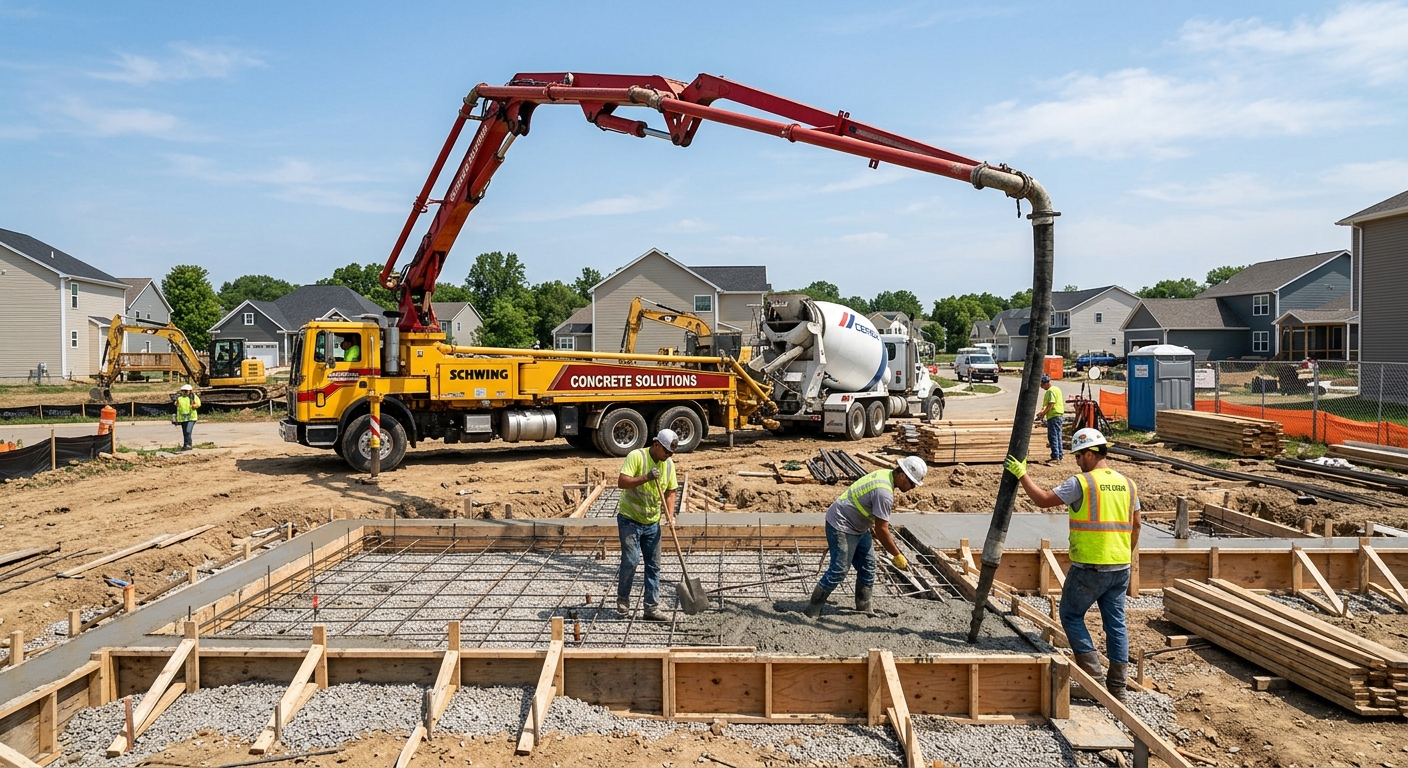
Concrete work options and costs in Lantzville
Lantzville homeowners typically call for concrete flatwork because it lasts—when it’s built for our Vancouver Island and Coast freeze–thaw swings. In this area, single-detached homes make up 94.1% of dwellings, and that housing pattern drives steady demand for driveways, patios, walkways and interior slabs. With 87.2% of households owning their homes (Statistics Canada, 2021 Census), many projects are planned upgrades: replacing aged asphalt, expanding entry pads, or adding step-down patios that match existing landscaping.
Costs here are shaped by climate and scheduling. Even though winters are milder than the interior, repeated wetting and cooling can still trigger surface scaling and random cracking if the contractor skips the air-entrained mix, proper granular base, or a disciplined control-joint plan. On Vancouver Island and the Coast, crews also price in weather contingency—heavy rain and cold snaps can slow subgrade preparation and concrete curing, especially on residential sites with limited truck access.
In Lantzville—particularly around the Denman/Highway 19 corridor and the busy residential pockets near the Lantzville village area—concrete work is especially in demand during spring and early summer when excavation and forming move faster and curing is more consistent. From an estimating perspective, the biggest cost swings usually come from thickness, reinforcement, finish complexity (broom versus stamped or exposed aggregate), and whether we need to rebuild base due to soft subgrade.
Here’s a practical comparison of common options to help you line up scopes before you request quotes.
| Application |
Typical Size |
Key Spec |
Finish Option |
Price Range |
| Concrete driveway (standard broom finish) |
400–600 sq. ft. |
Air-entrained exterior mix, control joints, compacted granular base |
Broom finish, edging included |
$7,000–$13,000 |
| Exposed aggregate driveway |
350–550 sq. ft. |
Air-entrained mix, exposed aggregate wash, proper curing protection |
Exposed aggregate with border options |
$10,000–$18,000 |
| Stamped concrete driveway or patio |
300–550 sq. ft. |
Air-entrained mix, control joints, release agent and stamping process |
Stamped pattern (wood/stone look), optional color hardener |
$9,500–$20,000 |
| Plain concrete patio or walkway |
150–350 sq. ft. |
Air-entrained mix, slope to drain, compacted base |
Float-and-broom, light broom or brushed texture |
$2,500–$6,500 |
| Garage floor (interior slab) |
400–600 sq. ft. |
Vapour barrier as needed, saw-cut joints, standard interior mix |
Plain smooth-trowel or light broom finish |
$7,500–$15,000 |
| Foundation footings (structural, below frost) |
Per linear foot: 30–80 ft. typical |
Excavation, formwork, steel as specified, pour below frost depth |
Structural concrete standard finish |
$6,000–$14,000 |
Prices are estimates only and vary by project scope, site access and material selection.
What affects the price of concrete work in Lantzville
In Lantzville and across Vancouver Island and Coast, it’s common to see quotes for the “same” concrete job swing by 30–50%. The variance usually isn’t the concrete itself—it’s the prep and the conditions around it. In practice, different crews account for freeze–thaw risk, drainage detailing, truck access, subgrade remediation, and the weather downtime that affects curing. On top of that, newer or more complex finishes (like stamped or exposed aggregate) require additional labour and specialized materials.
Two local variables drive much of the specification: frost depth and freeze–thaw cycles. For coastal BC, design assumes frost depth roughly in the 0.5–1.2 m range, but we still place footings and exterior foundation elements below the design frost to prevent heave. Exterior slabs and driveways also require air-entrained concrete to survive repeated wetting and freezing. When cold weather hits during a pour window, contractors may need heating and insulated blankets; that’s a direct add to labour and equipment cost. Finally, de-icing salts accelerate surface spalling if the mix, air content, finishing, and sealing aren’t done right—so sealing may be priced as an essential durability step rather than an upsell.
Real-world Lantzville examples: if your subgrade has soft spots from drainage or past landscaping, excavation and granular base replacement can move a plain patio from the $2,500–$6,500 range toward the higher end. If you’re choosing stamped work instead of broom-finished concrete, the added labour for stamping and curing protection can justify the jump from typical driveway pricing (often within $7,000–$13,000) into higher finish tiers when patterns, borders, and colour are included.
| Price Factor |
Why It Matters |
Cost Impact |
| Frost line depth |
Determines footing depth and form height to reduce frost heave risk |
$1,500–$6,500 swing on structural concrete |
| Site preparation |
Excavation, grading, and compaction quality affect long-term cracking |
Often $500–$4,000 for common remediation |
| Reinforcement |
Rebar or mesh requirements control shrinkage and load cracking |
$800–$3,500 depending on thickness and design |
| Mix design |
Air-entrainment and compressive strength specs drive durability in freeze–thaw |
$300–$1,500 for exterior air-entrained upgrades |
| Finish type |
Broom vs. stamped vs. exposed aggregate changes labour and curing steps |
$1,500–$7,500 for finish upgrades |
| Pour size and concrete truck access to site |
Smaller pours, narrow access, and pump needs increase crew time |
$300–$2,500 for access and placement |
| Cold-weather curing precautions |
Heating blankets and protection slow strength gain and protect surfaces |
$400–$3,000 depending on conditions |
| Control joint pattern and sealing cost |
Joint spacing reduces random cracking; sealing helps resist salt scaling |
$250–$1,500 |
Permits & regulations in British Columbia
In British Columbia, structural concrete work typically requires a building permit and is often tied to engineered drawings reviewed by the municipality. That includes concrete foundations, footings, foundation walls, grade beams, and other structural elements designed to support the building. For concrete flatwork—patios, walkways and driveways—permits are usually not required by default, but they can be triggered if the work affects lot grading, drainage, impervious surface coverage limits, or the municipal right-of-way. Always confirm the specifics with the local authority before breaking ground, especially if you’re changing drainage patterns or reworking approach areas near a property line.
Before hiring in Lantzville, verify your contractor’s basics the right way. Step 1: check the contractor’s credentials through the province’s contractor licensing/regulatory listings (the goal is to ensure they’re properly authorized for the work they’re advertising). Step 2: request a certificate of liability insurance showing it’s active for your project period and that coverage limits are adequate for residential jobsite risk. Step 3: ask for proof of workers’ compensation coverage (WSIB/WCB coverage in BC terms will be documented on their paperwork; you should see it clearly on their certificate). Step 4: ask for references on similar-scale Lantzville projects and confirm they’ve handled winter scheduling and curing protection successfully.
Getting concrete right in Lantzville's freeze-thaw climate
Concrete failures we see in Lantzville winters usually come down to three things: weak base prep, an exterior mix that doesn’t have the right air-entrainment, and curing/finishing shortcuts during cool or wet periods. Our Vancouver Island and Coast freeze–thaw cycles can repeatedly expand and contract moisture in the surface paste. If the mix isn’t air-entrained or if finishing is rushed while bleed water is still present, you can get spalling and scaling that show up months later—often worst around edges, slopes, and areas exposed to de-icing salts.
To spec the job correctly, start with base preparation: a compacted granular sub-base to the design depth for your site’s soil and drainage profile. Next, the mix design: for exterior flatwork, target 5–7% air content (air-entrained) and minimum 32 MPa compressive strength, with the contractor confirming the mix matches the exposure. Third, control joints: plan saw-cut or tooled joints to limit random cracking—don’t rely on “it’ll crack somewhere evenly.” Fourth, curing: allow a minimum 7 days of curing under proper conditions; if it’s cold or wet, curing protection matters even more because strength gain slows. Fifth, sealing: apply a penetrating sealer after proper cure—commonly around 28 days post-pour—so the surface resists salt and moisture intrusion.
Ask pointed questions to avoid the most common failure. For example, if you’re choosing between a broom-finished driveway and stamped concrete, the price difference (broom-driveway typically within $7,000–$13,000, versus stamped often in the $9,500–$20,000 band) is usually justified by additional labour for formwork, stamping, and extended protection. It’s not worth paying for a decorative look if the base, air content, and joint layout aren’t handled to match our local freeze–thaw reality.
| Spec |
Why It Matters in Lantzville |
What to Ask For |
Impact if Skipped |
| Compacted granular base (depth?) |
Controls settlement and cracking through wet/dry cycles and frost influence |
Specified granular depth and compaction method to suit your soil |
Early cracking, uneven surfaces, and higher repair likelihood |
| Air-entrained concrete mix (target air %?) |
Protects surface against freeze–thaw saturation and scaling |
Confirm air content target (typically 5–7% for exterior flatwork) |
Spalling, surface pop-outs, and faster deterioration |
| Compressive strength (MPa rating) |
Strength gain supports long-term durability under Canadian loading |
Minimum 32 MPa specified for exterior applications |
Surface wear, cracking, and reduced durability |
| Control joints (spacing per ACI guidelines) |
Limits random cracking from shrinkage and thermal movement |
Joint spacing plan and exact saw-cut timing |
Wider, unsightly cracks and costly patching |
| Minimum 7-day curing period |
Cold/wet weather slows strength development and increases surface damage risk |
Protection approach if temperatures drop (blankets/covering as needed) |
Lower strength and surface defects |
| Penetrating sealer (when applied after cure) |
Helps repel moisture and reduce salt-driven deterioration |
Schedule sealer application around 28 days post-pour after curing |
Faster staining, salt scaling, and reduced surface resilience |
How to choose a concrete work contractor in Lantzville
Start by verifying the contractor’s British Columbia authorization and insurance—then confirm coverage details match the real risk on your job. Licensure matters because it ties to the contractor’s ability to legally perform the scope and manage jobsite practices. Ask for (and review) their certificate of liability insurance and confirm it’s active for your project dates. For workers on site, confirm workers’ compensation coverage documentation is current; if you only get a verbal promise, pause—papers should be provided.
Next, demand 2–3 itemised written quotes rather than one lump number. You want a breakdown of labour and materials (concrete, granular base, reinforcement, forms, finishing, saw-cutting, sealing), plus line items for equipment and access. Read the scope carefully: what’s excluded (demo, hauling away spoil, subgrade remediation, permit pulling if required for structural work)? Is disposal included? If a permit is needed for foundations/footings, make sure the quote states who submits and what’s included.
Warranty should be specific. Ask for workmanship warranty length, whether it covers cracking/spalling due to installation issues, and whether any product/manufacturer warranty applies to sealers or additives. Also ask if warranties are transferable if you sell your home. For payment, never pay more than 10–15% upfront; hold back enough to ensure completion and final finishing. Finally, insist on a start date and realistic completion estimate in writing—winter conditions on Vancouver Island can extend timelines even when crews are ready.
- Confirm BC authorization for the specific concrete scope (structural vs flatwork) before signing.
- Request certificate of liability insurance and verify policy dates and project coverage.
- Verify workers’ compensation coverage paperwork (don’t rely on verbal statements).
- Ask for 2–3 recent references in Lantzville or nearby Vancouver Island communities with freeze–thaw exposure.
- Get itemised quotes: concrete, excavation/granular base, reinforcement, forming, finishing, joints, sealing.
- Clarify exclusions: demo, haul-away, regrading, drainage corrections, and any engineering requirements.
- Ensure the quote mentions air-entrained mix for exterior slabs/driveways and control joints.
- Ask how they handle cold snaps: blankets/heating plan and curing protection wording.
- Verify whether sealing is included and when it’s applied relative to cure time.
- Confirm reinforcement plan (wire mesh vs rebar; thickness and tie details if applicable).
- Review warranty terms in writing, including what “workmanship” covers.
- Keep payment schedule conservative (max 10–15% upfront) with a completion holdback.
Concrete red flags in Lantzville: crews promising “no need for air-entrainment,” refusing to discuss joint spacing; providing only a lump-sum quote with no base prep or reinforcement details; skipping curing protection language for cool or rainy weeks; and pushing large deposits without a written scope, schedule, or warranty terms.
Frequently asked questions — concrete work in Lantzville
What causes concrete to spall in Lantzville winters?
Concrete spalling in Lantzville usually happens when moisture repeatedly enters the surface and freezes, expanding inside tiny pores and weakening the surface paste. The most common triggers are inadequate air-entrainment (the mix isn’t built for freeze–thaw), poor finishing/finishing timing, and weak base drainage that keeps water near the slab edges. If de-icing salts are used, they can intensify scaling and spalling—especially if the surface wasn’t sealed after cure. Another factor is skipping or mismanaging control joints, which allows random cracking pathways for water to penetrate.
What is rebar and when is it required in British Columbia?
Rebar (reinforcing steel bars) is used to strengthen concrete against cracking from shrinkage, bending, and loads. In British Columbia, whether rebar is required depends on the design and structural role of the concrete: typical interior slabs or lightly loaded flatwork may use wire mesh or fibre reinforcement, while driveways, slabs-on-grade, and especially structural foundation elements often need rebar based on thickness, soil support, and expected loads. For structural work like footings and grade beams, engineered drawings commonly dictate reinforcement placement. If you’re told “it’s decorative so no steel,” ask for thickness and reinforcement rationale in writing—freeze–thaw exposure on Vancouver Island makes crack control and durability planning important.
How long does a concrete project take in Lantzville?
Timelines vary mainly by scope, weather, and site access. A typical broom-finished patio or walkway can be poured and finished quickly (often within a day), but curing and protection still determine usable timelines. Most exterior flatwork is not considered fully cured until at least 7 days, and sealing is usually planned after cure—commonly around 28 days. Driveways can require longer due to base prep, forming, and joint planning, especially if subgrade remediation is needed. In cool or wet Lantzville conditions, crews may add time for curing protection, which is why reputable contractors build weather contingencies into their schedule.
What is a concrete overlay and is it suited to Lantzville?
A concrete overlay is a new concrete layer placed over an existing slab after preparation (typically scarifying, patching, and ensuring the surface is sound). It can be suited to Lantzville when the original base is stable and you’re improving appearance or correcting minor surface issues without full replacement. However, overlays aren’t a cure-all—if the existing slab is moving, heavily cracked, or has drainage problems, the overlay can still crack or spall because moisture pathways remain. In our freeze–thaw environment, proper surface prep and bonding are critical, and you should discuss air-entrainment and joint planning. If your existing driveway is failing structurally, replacement may be the better long-term value even if it’s higher upfront (for example, broom-finished driveway projects are often in the $7,000–$13,000 band depending on scope).
How do I seal concrete to protect it in Lantzville?
Sealing helps protect concrete from moisture and salt-driven deterioration, but the timing matters. In Lantzville, plan for a penetrating sealer applied after the concrete has properly cured—commonly around 28 days post-pour. Before sealing, the surface should be clean and dry (no construction debris, curing residue, or standing moisture). Use a product intended for exterior concrete exposure and make sure the contractor follows coverage rates and temperature/humidity limits. Sealing works best when paired with the right air-entrained mix and control joints, because a sealer can’t compensate for poor base prep or insufficient freeze–thaw durability.
What is the difference between concrete and cement?
Cement is an ingredient, while concrete is the finished building material. Cement is the binder that reacts with water to create strength. Concrete includes cement plus aggregates (sand and stone), water, and sometimes admixtures like air-entrainment for freeze–thaw durability—critical in British Columbia’s coastal cycle. When quotes mention “air-entrained mix,” they’re referring to the concrete formulation, not cement alone. Homeowners typically don’t need to choose between cement and concrete; instead, focus on the contractor’s specified mix for your exposure (exterior flatwork versus interior slab), curing protection in cool weather, and the durability steps that reduce spalling and cracking.