Concrete work options and costs in McMillan
Concrete work in McMillan is usually the finish people notice most—especially on driveways, patios, and the flatwork that ties a home together. In a city profile centred on a family-oriented housing mix, it’s helpful to know that the broader Lower Mainland–Southwest area has a strong base of single-detached homes (Statistics Canada, 2021 Census). That matters because the most common concrete projects homeowners request—driveways, garden walkways, and backyard patios—are typically tied to those property types and the need for durable, low-maintenance surfaces.
McMillan also sits within a Lower Mainland–Southwest market where mild winters and a shallow frost line still don’t mean “no frost.” Local practice typically assumes a design frost depth around 450 mm / 18", so footings, piers and thickened edges are placed below that level to help prevent frost heave. At the same time, the area’s frequent freeze–thaw cycles, saturated soils, and coastal rainfall drive up the importance (and cost) of proper drainage and an air-entrained concrete mix for exterior slabs and any foundation-related work.
Labour availability is another pricing lever. The Vancouver–Surrey–Abbotsford corridor is busy for concrete crews, and when rain or cool nights compress the pour schedule, projects often require additional coordination, curing attention, and sometimes more crew time. Concrete flatwork is especially in demand in neighbourhood pockets like Tsawwassen-by-the-Newton/Boundary area (including adjacent streets where access and drainage constraints are common), where new drive approaches and patio replacements are frequent.
Below are realistic options you’ll see in McMillan quotes—use them as a starting point before comparing detailed scope and specs.
| Application |
Typical Size |
Key Spec |
Finish Option |
Price Range |
| Concrete driveway (standard broom finish) |
400–600 sq ft |
Air-entrained exterior slab; compacted granular base |
Broomed |
$18,000–$28,000 |
| Exposed aggregate driveway |
400–600 sq ft |
Air-entrained exterior slab; controlled surface set |
Exposed aggregate |
$22,000–$34,000 |
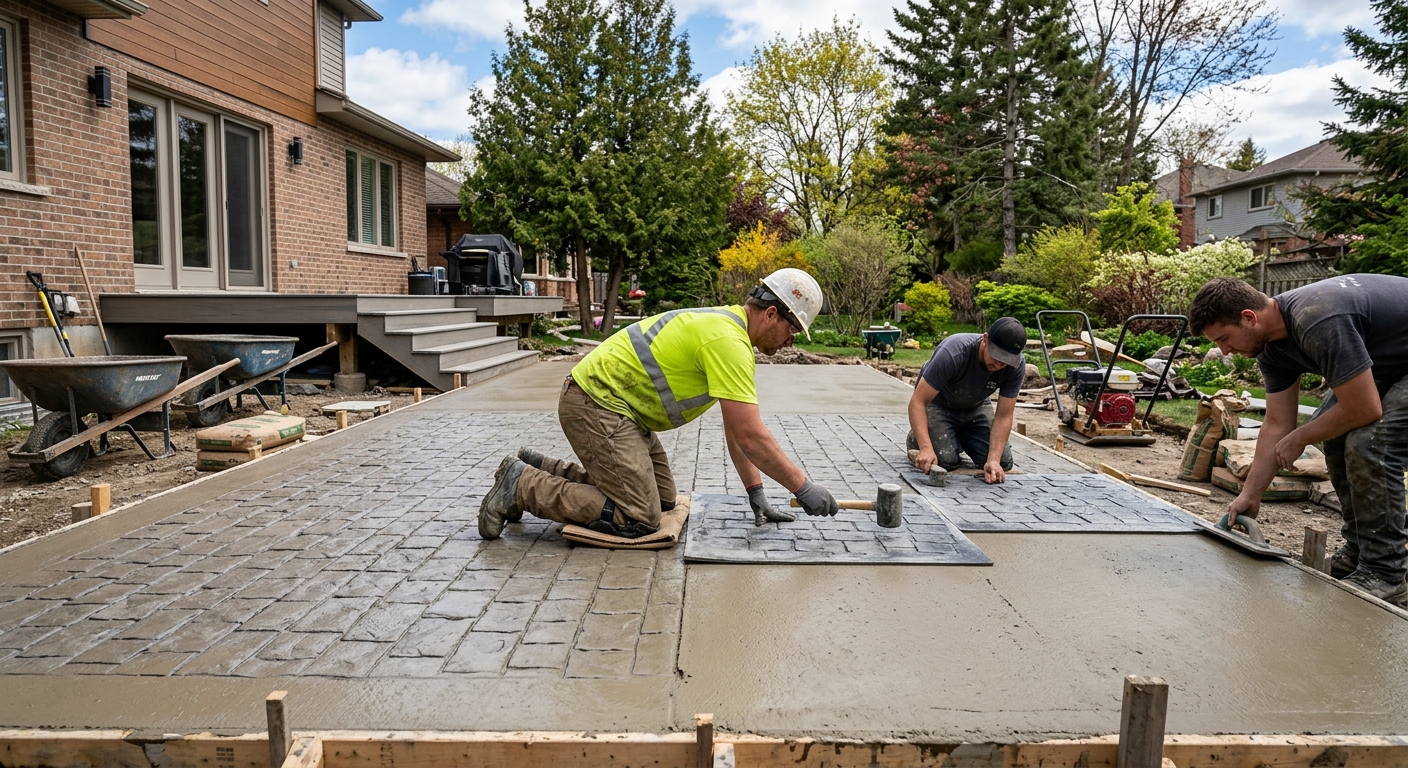
| Stamped concrete driveway or patio |
300–600 sq ft |
Air-entrained mix; integral colour + sealer plan |
Stamped (stone/brick pattern) |
$22,000–$36,000 |
| Plain concrete patio or walkway |
150–350 sq ft |
Air-entrained exterior slab; proper thickness + joints |
Smooth to light broom |
$16,000–$26,000 |
| Garage floor (interior slab) |
300–500 sq ft |
Slab with vapour/underslab prep; control joints |
Light broom/steel trowel (by spec) |
$14,000–$24,000 |
| Foundation footings (structural, below frost) |
Varies by house design |
Excavate below design frost line; engineered rebar cage |
Reinforced concrete |
$200,000–$350,000 |
Prices are estimates only and vary by project scope, site access and material selection.
What affects the price of concrete work in McMillan
When two homeowners compare “the same” concrete job in McMillan, Lower Mainland–Southwest, or elsewhere in British Columbia, it’s common to see a 30–50% spread in quotes. The reason usually isn’t the concrete itself—it’s the full spec: excavation depth, base preparation, reinforcement quantity, mix design (especially air-entrainment), and the time spent controlling curing in cool, wet conditions. In practice, contractors price for risk. If the soil is saturated or drainage is poor, base work and waterproofing-related coordination add labour. If the schedule forces a pour during cold nights or light rain, crews must protect and cure longer to hit design performance.
Frost line depth and freeze–thaw cycles dictate nearly every exterior foundation and slab detail in our region. Local practice often assumes frost depth around 450 mm / 18", so footings and thickened edges are set below that level to reduce frost heave. Exterior slabs also require air-entrained concrete mixes to better survive repeated freezing and scaling. In colder regions, the pour season shrinks and heating/blankets are often needed, which raises excavation, forming and curing costs; even here in coastal BC, prolonged cool spells can trigger the same protective steps.
In McMillan specifically, saturated subgrade after heavy coastal rainfall can increase the granular base thickness and compaction effort. A driveway approach that ties into an existing sidewalk with tight access can also add trucking and downtime. As an example, moving from a $18,000–$28,000 standard broom driveway to a $22,000–$36,000 stamped design is typically justified by integral colour, stamp labour, and an engineered sealer plan—not by “more concrete” alone. Your home’s age can also matter: older foundations may require additional excavation and re-grading to manage water, which affects both base prep and the cost of rework.
| Price Factor |
Why It Matters |
Cost Impact |
| Frost line depth |
Determines footing depth and form height |
More excavation and rebar volume; higher labour and equipment time |
| Site preparation |
Excavation, grading, compacted granular base |
Higher if soil is soft, wet, or requires drainage upgrades |
| Reinforcement |
Rebar or wire mesh requirement |
Cost rises with engineer-spec rebar cages or heavier mesh |
| Mix design |
Air-entrainment and compressive strength spec |
Exterior air-entrainment adds material cost; tighter specs reduce tolerance |
| Finish type |
Broom vs. stamped vs. exposed aggregate |
Stamped/exposed require specialized labour, release agents, and extra sealing steps |
| Pour size and concrete truck access to site |
Distances, access, pump needs, and crew setup |
More if pump/extra labour is required or access is constrained |
| Cold-weather curing precautions |
Heating and blankets |
Adds materials and time; increases supervision and curing duration |
| Control joint pattern and sealing cost |
Limits random cracking and protects from de-icing and moisture |
Sealer and saw-cut patterning add line-item cost but reduce premature surface failures |
Permits & regulations in British Columbia
In British Columbia, structural concrete work such as footings, foundation walls, grade beams, and foundation-related structural elements typically requires a building permit, and engineered drawings are often reviewed as part of the permitting process. For concrete flatwork—patios, walkways, and driveways—a permit is frequently not required on its own, unless the work affects lot grading, impervious surface coverage limits, or municipal right-of-way (for example, where you tie into sidewalks or alter drainage patterns). Because bylaw interpretations can vary and because water management is a big deal in the Lower Mainland–Southwest, it’s smart to confirm with your local authority before any excavation begins.
Before signing a contract in McMillan, verify three basics: (1) the contractor’s business licence and trade eligibility for the scope they’re advertising, (2) liability insurance, and (3) proper coverage for workers—commonly handled through WCB/WorkSafe arrangements in BC. Then ask for references on similar-scale projects (driveways, patios, or below-frost foundation work) so you can judge workmanship and curing discipline.
Step-by-step homeowner checks:
- Search the BC government/online contractor registry listings (or the contractor’s own licensing reference page) for the licence status matching the company name.
- Request a certificate of insurance showing current dates, liability limits, and your job’s scope noted if applicable.
- Ask whether the contractor is in good standing with WCB/WorkSafe; request clearance details if they provide them.
- Confirm in writing which party handles any required permits and inspections.
Getting concrete right in McMillan's freeze-thaw climate
Concrete failures in McMillan’s freeze–thaw climate usually trace back to one of five weak links: base preparation, mix design, cracking control, curing, and surface protection. The most common homeowner-visible problem is spalling—tiny pieces popping off the surface—often caused by inadequate air-entrainment for exterior exposure and repeated wetting/freezing. Because the Lower Mainland–Southwest experiences coastal-wet conditions alongside cool snaps, water gets into the surface and joints, then cycles with temperature.
To spec the job correctly, start with (1) base preparation: use a compacted granular sub-base to the right thickness for the soil conditions and to support slabs through seasonal saturation. (2) Mix design should include proper air-entrainment (for exterior flatwork, target about 5–7% air) and a minimum 32 MPa compressive strength. (3) Control joints should be planned and cut to reduce random cracking as the slab shrinks and expands. (4) Curing matters here: plan for at least 7 days under proper conditions, and be ready to use curing blankets or protective measures if nights are cool or rain is persistent. Finally, (5) sealing should be done after adequate cure (commonly around 28 days post-pour) with a penetrating sealer to help repel moisture and de-icing salts.
How does price connect to performance? For example, a standard broom driveway might come in around the $18,000–$28,000 band, while a higher-spec stamped driveway often lands in the $22,000–$36,000 band. The difference is usually justified when the contractor includes the right air-entrainment spec, disciplined jointing, controlled stamp finishing timing, and a proper sealer plan—steps that help the surface last through wet winters and freeze–thaw cycles.
| Spec |
Why It Matters in McMillan |
What to Ask For |
Impact if Skipped |
| Compacted granular base (depth?) |
Supports the slab and manages drainage through coastal-wet conditions |
Granular depth and compaction method to match soil and slab thickness |
Settlement, cracking, and premature scaling from trapped moisture |
| Air-entrained concrete mix (target air %?) |
Improves freeze–thaw durability in exterior exposure |
Air content target around 5–7% for exterior flatwork |
Higher risk of spalling, scaling, and surface deterioration |
| Compressive strength (MPa rating) |
Design strength supports loading and long-term performance |
Minimum 32 MPa specified at placement |
Greater chance of weakness, defects, and reduced longevity |
| Control joints (spacing per ACI guidelines) |
Controls shrinkage cracking and keeps cracks in predictable lines |
Joint spacing and saw-cut timing plan |
Random cracks and water infiltration into the slab edges |
| Minimum 7-day curing period |
Cool/wet weather affects early strength gain |
How curing will be protected if it’s cool or rainy |
Reduced strength, surface defects, and increased cracking risk |
| Penetrating sealer (when applied after cure) |
Helps repel moisture and de-icing chemicals |
Sealer application after adequate cure (commonly ~28 days) |
Faster water/chemical penetration and earlier surface deterioration |
How to choose a concrete work contractor in McMillan
Choosing the right concrete contractor in McMillan is less about flashy photos and more about proof: coverage, documentation, and the ability to build to the right spec for the Lower Mainland–Southwest climate. Start by verifying British Columbia trade/contractor eligibility for the work they’re quoting. Then check liability insurance by requesting a certificate of insurance with current dates and adequate limits. For worker coverage, confirm their standing with WCB/WorkSafe—ask directly and request clearance details when available.
Next, get 2–3 itemised written quotes, not a single lump-sum line. You want a breakdown that shows excavation and disposal, granular base preparation, reinforcement, concrete supply and air-entrainment, finishing labour, curing protection, and sealing (if included). Compare scope exclusions carefully: some contractors omit saw-cutting, omit proper base compaction, or exclude sealer and extended curing protection. Also confirm whether permits are included for structural work and whether inspections (when required) are handled.
For warranty, ask for two parts: a workmanship warranty length and a clear note on any manufacturer/product warranty for sealers or admixtures. Ask whether the warranty is transferable if you sell the home. On payment, never pay more than about 10–15% upfront; hold back the final payment until the job is complete and cleaned up to spec. Finally, require a written timeline: start date, weather-dependent delays, and a completion estimate tied to curing requirements.
- Verify company name matches the insurance and any licence documentation.
- Ask for certificate of liability insurance before signing.
- Confirm WCB/WorkSafe clearance/coverage for workers.
- Require an itemised quote (labour + materials, including base and reinforcement).
- Ask what air-entrainment target and compressive strength they specify for exterior slabs.
- Confirm joint locations, saw-cut timing, and sealing plan.
- Check whether disposal, trucking distance, and site protection are included.
- Ask if they will protect the pour during cool nights or rain (blankets/curing compound).
- Confirm reinforcement type (mesh vs. rebar) and where it’s placed (chairs/spacers).
- Request a clear warranty statement in writing.
- Avoid large deposits; use a staged payment plan tied to milestones.
- Confirm cleanup, restoration, and any turf/landscaping regrading after the pour.
Concrete red flags I see around McMillan include: vague “we’ll pour it properly” language with no air-entrainment or curing plan, quotes that lump excavation/grade without stating granular base depth, missing joint details, refusing to provide a certificate of insurance/WCB clearance, and “too-good-to-be-true” stamped or exposed aggregate pricing that skips sealer or proper curing protection.
Frequently asked questions — concrete work in McMillan
How long does a concrete driveway last?
In McMillan and across the Lower Mainland–Southwest, a well-built driveway often lasts 20–30 years, sometimes longer, but the lifespan depends heavily on what’s underneath the concrete. Exterior flatwork needs a compacted granular base and a proper mix design with air-entrainment to handle our wet winters and freeze–thaw cycles. Control joints also matter because they keep cracking predictable instead of letting water infiltrate and undermine edges. The finish you choose influences maintenance: a standard broom driveway can be durable, while stamped or exposed aggregate surfaces typically need a disciplined sealing routine to protect against moisture and salts. If your driveway is in the $18,000–$28,000 range, that’s often where you’ll see the essentials (base, proper mix, joints) included—while better-specified decorative work usually sits higher, often around $22,000–$36,000, because it includes more finishing and protection.
What is air-entrained concrete and why does it matter here?
Air-entrained concrete is mixed with tiny, evenly distributed air bubbles that allow freezing water to expand safely inside the concrete. In British Columbia’s Lower Mainland–Southwest, even though winters are mild, our region still experiences repeated freeze–thaw cycles and coastal-wet exposure. That combination is exactly why air-entrainment is a must for exterior slabs and any foundation elements exposed to moisture. Without it, concrete can develop scaling and spalling—little flakes or pieces breaking away—especially where de-icing salts and water get into the surface. When you get a quote in McMillan, ask for the exterior mix spec (air content target) and confirm they’re not substituting a non-air-entrained product to save cost. A good contractor will also plan joints and sealing so water doesn’t find its way into the edges and cracks.
How do I prepare the base for a concrete slab?
Base prep is where quality is either won or lost in McMillan. The contractor should excavate to the correct depth, remove soft/organic material, and install a compacted granular base designed for local soil conditions. In the Lower Mainland–Southwest, drainage and moisture control are critical because the ground can stay saturated after coastal rainfall. The base should be graded for drainage and compacted in lifts to reduce voids—otherwise the slab may settle and crack. Ask your contractor to specify the granular material type, compaction approach, and how they’ll handle wet subgrade (for example, whether they’ll wait, adjust base thickness, or improve drainage). For exterior work, the base should support the slab across its thickness and help keep water from pooling near edges, which is a common precursor to freeze–thaw damage.
How do I compare concrete quotes?
To compare concrete quotes in McMillan, focus on scope and spec, not just total dollars. Ask for itemised pricing that separates excavation/disposal, granular base and compaction, reinforcement (mesh vs. rebar), concrete supply (including air-entrainment and strength spec), finishing labour, curing protection, and sealing (if included). A broom-finished driveway might land around the $18,000–$28,000 band when the essential items are included, while stamped decorative work typically climbs into the $22,000–$36,000 band because of integral colour, stamp labour, and added protection steps. If one quote is much lower, it may be omitting reinforcement, base prep depth, air-entrainment, curing blankets, saw-cut timing, or sealer. Finally, verify the contractor’s insurance/WCB coverage and confirm what’s excluded (site restoration, permit pull, disposal, and truck access costs), because those differences are often the real reason quotes vary.
Can concrete be poured in cold weather in McMillan?
Yes—concrete can be poured in cold weather in McMillan, but it requires the right cold-weather precautions. Lower Mainland–Southwest winters are mild compared to inland BC, yet cool nights and prolonged damp conditions still affect early curing. The key is maintaining adequate temperature and protecting the slab so it reaches strength properly before freeze conditions impact hydration. Contractors may use insulating blankets, curing covers, and (when appropriate) heating strategies to protect formwork and the slab surface. Ask specifically how they’ll handle the curing period and what happens if the forecast turns colder or rainy during placement. A responsible contractor will build in time for curing and protection, and will not treat “seven days” as a marketing promise—curing must occur under proper conditions to achieve the intended performance.
How do I maintain concrete in McMillan's freeze-thaw climate?
Maintenance in British Columbia’s Lower Mainland–Southwest is mainly about protecting the surface and keeping water out. For exterior slabs, timely sealing (commonly about 28 days after pour, once curing is complete) helps repel moisture and de-icing chemicals. In McMillan, where freeze–thaw cycles and coastal-wet exposure are common, a sealed surface slows water penetration into pores and joints, reducing scaling and spalling risk. Keep gutters and downspouts directing water away from slab edges. Sweep debris and avoid piling snow directly on the slab—especially if it contains a lot of salt. If you notice small cracks, address them according to the product and joint design rather than ignoring water intrusion. Finally, follow your contractor’s recommendations for re-sealing intervals and cleaning methods to avoid damaging the finish.