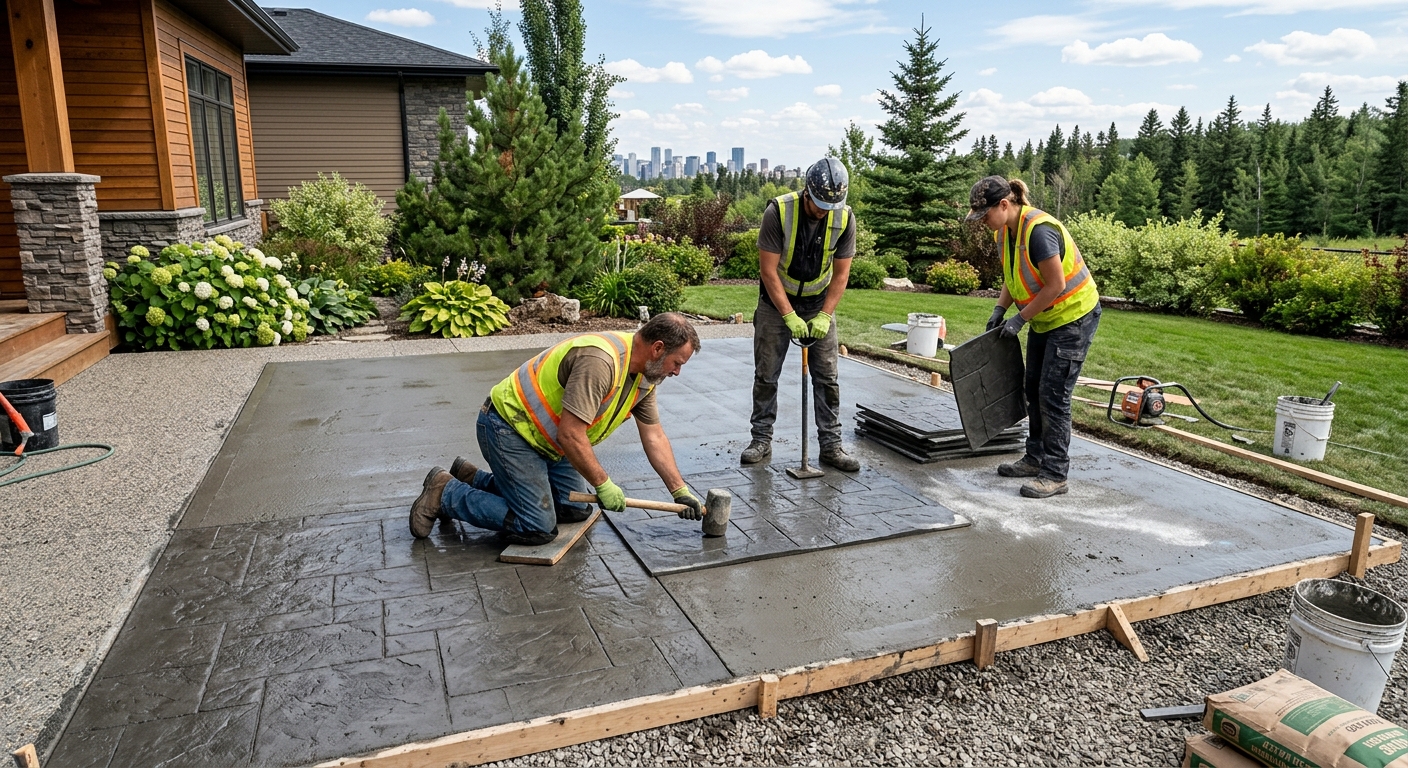
Concrete work options and costs in Fraser Heights
Fraser Heights homeowners typically choose concrete because it gives a clean, permanent finish for driveways, patios and foundations—especially in a neighbourhood where a lot of housing stock is settled and accessibility upgrades are common. In the 2021 Census, Fraser Heights has a population of 25,000 (Statistics Canada, 2021 Census). That scale supports steady demand for concrete flatwork, and most households are in established, single-detached areas where new driveways, walkway renewals and small landscape pads are frequent. In the Lower Mainland–Southwest, the climate is a major cost driver: winters are mild, but we still see freeze–thaw cycles and heavy coastal rainfall, so concrete needs frost protection and durable surface chemistry. Local practice assumes a frost depth around 450 mm / 18", and footings and thickened edges are placed below that to reduce frost heave risk. Because the ground can stay saturated, excavation and drainage work tend to be more involved than in drier regions. Scheduling also matters: prolonged rain and cool, high-humidity conditions often slow curing, which affects labour productivity and may require blankets or sealers to hit performance targets. In Fraser Heights—especially around popular family corridors like the Fraser Heights community area near 160 Street—concrete contractors often get booked quickly once rain forecasts clear up.
Below are realistic cost bands for common projects so you can compare quotes apples-to-apples before the site visit.
| Application |
Typical Size |
Key Spec |
Finish Option |
Price Range |
| Concrete driveway (standard broom finish) |
400–600 sq. ft. |
Air-entrained mix, compacted granular base, control joints |
Broomed, saw-cut joints, optional sealer |
$18,000–$28,000 |
| Exposed aggregate driveway |
400–600 sq. ft. |
Air-entrained mix, proper finishing timing, cured then sealed |
Exposed chips with broom/brush blend, joints match pattern |
$22,000–$34,000 |
| Stamped concrete driveway or patio |
300–550 sq. ft. |
Air-entrained mix, integral colouring (or colour hardener), joints planned |
Stamp mats, release agent, border accents |
$22,000–$36,000 |
| Plain concrete patio or walkway |
200–450 sq. ft. |
Air-entrained mix, compacted base, edging and joints |
Broom finish or trowel-light finish, optional sealer |
$6,000–$14,000 |
| Garage floor (interior slab) |
300–500 sq. ft. |
Vapour control + base prep (as required), fibres or mesh if specified |
Float/steel-trowel finish, optional densifier |
$7,500–$16,000 |
| Foundation footings (structural, below frost) |
Per project (typ. 1–2 storey) |
Excavation to frost, rebar placement, formwork, engineered specs |
Standard structural concrete |
$200,000–$350,000 |
Prices are estimates only and vary by project scope, site access and material selection.
What affects the price of concrete work in Fraser Heights
In Fraser Heights and across the Lower Mainland–Southwest, it’s normal to see concrete quotes for the “same” job differ by 30–50%. The difference usually isn’t the concrete itself—it’s the thickness, base preparation, drainage details, reinforcement, and the time needed to cure in wet, cool weather. Even within British Columbia, pricing can shift because cold snaps and the risk of early freezing change how crews schedule pours and how contractors protect the slab to reach the specified strength. Where interior or northern regions face deeper frost and longer, harsher seasons, you often pay more for excavation and for cold-weather curing precautions; in the Lower Mainland, the shallow frost depth (around 450 mm / 18") helps, but freeze–thaw cycles and saturated soils still demand engineered base prep and air-entrained concrete for exterior slabs. Another big lever is surface protection: de-icing salts (used on driveways and entries) accelerate spalling if the mix and finishing aren’t right—so sealing is frequently recommended.
Concrete examples from Fraser Heights that move the number up or down: (1) a standard broom driveway on firm, well-draining soil may land in the $18–$28 band; (2) adding exposed aggregate or heavy brushing costs more because the finish process takes tighter labour control and extra curing/aftercare, often pushing totals toward the $22–$36 decorative bands; (3) if your site is clayey and groundwater-laden, expect more granular excavation, underdrain or revised base depth, and longer setup time—those can outweigh finish upgrades. In practical terms, a 400–600 sq. ft. driveway can look “simple,” but the difference between good drainage and marginal drainage can mean thousands in base and scheduling work.
| Price Factor |
Why It Matters |
Cost Impact |
| Frost line depth — determines footing depth and form height |
Footings and thickened edges must extend below the design frost depth to prevent frost heave. |
Higher excavation and taller formwork can add thousands on structural work. |
| Site preparation — excavation, grading, compacted granular base |
Saturated or soft subgrade needs more granular removal/placement and compaction control. |
Extra truckloads, labour time and potential drainage work increase cost. |
| Reinforcement — rebar or wire mesh requirement |
Reinforcement control crack width and supports slab capacity for traffic loads. |
Material and labour to place chairs/spacers can raise the budget. |
| Mix design — air-entrainment and compressive strength spec |
Exterior slabs need air-entrainment to handle freeze–thaw; strength affects durability and schedule. |
Proper air-entrainment and strength often costs slightly more but prevents failures. |
| Finish type — broom vs. stamped vs. exposed aggregate |
Decorative finishes require additional steps, timing and finishing labour. |
Stamped/exposed aggregate typically adds a premium over plain broom. |
| Pour size and concrete truck access to site |
Small pours may require more mobilization; tight access can limit truck size or timing. |
Extra labour for placement and equipment access can increase total price. |
| Cold-weather curing precautions — heating and blankets |
Cool nights slow strength gain; curing protection helps reach design strength safely. |
Blankets, heaters or insulating materials add line-item cost. |
| Control joint pattern and sealing cost |
Joints manage cracking; sealing improves surface durability against moisture and de-icing salts. |
Good joint layout and sealer can add cost but reduce long-term spalling risk. |
Permits & regulations in British Columbia
In British Columbia, structural concrete work—like foundation footings, foundation walls, grade beams and any scope that supports the building—typically requires a building permit and often engineered drawings that the municipality reviews. Concrete flatwork (driveways, patios, walkways) usually does not require a permit by default, unless the project impacts lot grading, drainage, impervious surface coverage limits, or the municipal right-of-way (for example, if you’re altering a curb approach or changing how water sheds). Even then, requirements vary by site and municipality, so it’s smart to confirm with the local authority before breaking ground.
For Fraser Heights homeowners, the safest workflow is: (1) ask the contractor whether the scope is permit-triggering; (2) confirm who pulls any required permit; (3) verify the contractor carries liability insurance and the required workplace coverage (WSIB/WCB). Then you can check legitimacy step-by-step. First, verify the contractor’s business credentials using the Province’s online business registry/contractor listings where available. Second, request a current certificate of insurance (COI) showing general liability—call the insurer if anything looks off or expired. Third, obtain clearance/coverage documentation for WSIB/WCB status from the contractor, typically provided as a clearance letter or account confirmation. Finally, ask for references from similar-scale Lower Mainland projects with photos, including base prep and curing in wet/cool conditions.
Getting concrete right in Fraser Heights's freeze-thaw climate
Concrete fails in Fraser Heights most often due to moisture movement and freeze–thaw action: water gets in, freezes, expands, and then surface scaling or spalling starts—especially on exterior slabs that also see de-icing salt and coastal rainfall. The way to avoid this is to spec the job for the local exposure, not for “typical” weather. Start with base preparation: compacted granular sub-base needs the right depth and compaction for your soil conditions, with drainage attention so the slab doesn’t sit on a saturated sponge. Next, mix design: exterior flatwork should use an air-entrained concrete mix with proper air content (commonly targeted in the 5–7% range) and a minimum compressive strength such as 32 MPa, so freeze–thaw cycling won’t quickly damage the paste. Control joints are also critical; they guide where shrinkage cracks form rather than allowing random cracking. Curing is where homeowners often get surprised—plan for at least 7 days under proper conditions, and if you pour during cool, damp stretches, ask about curing blankets or a sealer strategy to protect strength gain. Finally, use a penetrating sealer after full cure (typically applied around 28 days post-pour) to repel moisture and salts.
When you’re comparing options, the price difference is sometimes worth it. For example, upgrading from a plain broom driveway to stamped concrete can move you from the $18–$28 band toward the $22–$36 decorative range—this extra cost is justified because the finishing process and labour time are higher, and joints must be planned carefully to keep the decorative surface looking clean. What’s not worth it is cutting corners on air-entrainment or base prep; that’s where spalling risk shows up and leads to costly repairs.
| Spec |
Why It Matters in Fraser Heights |
What to Ask For |
Impact if Skipped |
| Compacted granular base (depth?) |
In Fraser Heights, saturated soils and freeze–thaw movement make the base and drainage the first line of defence. |
Ask for the granular base depth (based on your soil), compaction method, and how drainage is handled. |
Settlement, uneven surface, and accelerated cracking. |
| Air-entrained concrete mix (target air %?) |
Air voids let ice expansion occur without destroying the paste during freeze–thaw cycles. |
Confirm target air content (commonly 5–7% for exterior flatwork) and that the mix is air-entrained. |
High risk of scaling and spalling in wet/cool periods. |
| Compressive strength (MPa rating) |
Enough strength is needed for durable performance under traffic and moisture exposure. |
Ask for the minimum compressive strength, such as 32 MPa, and mix/curing notes. |
Surface weakness, dusting, and premature wear. |
| Control joints (spacing per ACI guidelines) |
Joints control where shrinkage cracks form, reducing random cracking that can open pathways for water. |
Ask for joint spacing and saw-cut timing that matches slab thickness and exposure. |
Random cracks and more water intrusion. |
| Minimum 7-day curing period |
Curing in Lower Mainland humidity/cool nights can be slower than homeowners expect. |
Confirm curing plan and protection if temperatures are cool or rain is forecast. |
Reduced strength gain and higher surface damage risk. |
| Penetrating sealer (when applied after cure) |
Sealers help repel moisture and de-icing salt, improving durability against scaling. |
Ask for a penetrating sealer and timing after full cure (commonly ~28 days post-pour). |
Faster deterioration and higher long-term maintenance costs. |
How to choose a concrete work contractor in Fraser Heights
Choosing the right contractor in Fraser Heights starts with verification. In British Columbia, ask for proof of liability insurance (COI) showing the right insured parties and coverage limits for the scale of your job. Then confirm required workplace coverage for the contractor’s workers (WSIB/WCB) and request current clearance documentation—don’t accept “we’re covered” without paperwork. If a contractor can’t provide both quickly, treat that as a red flag.
Next, get 2–3 itemised written quotes. You want a labour and materials breakdown—separate line items for excavation, forms, reinforcement, concrete supply, finish materials, curing/blankets, joint work, and sealing—so you can see what’s actually included. Pay close attention to exclusions: is disposal of excess soil included? Are you getting the right granular base depth, and is drainage addressed if your soil is wet? Is the permit pull included if the scope triggers a structural permit?
Warranty should be specific. Ask for workmanship warranty length (and what it covers), plus product/manufacturer warranty details where applicable (for example, sealers or specialty admixtures). Clarify whether warranties are transferable to a future owner—many homeowners care about resale in Fraser Heights. For payment scheduling, never agree to more than 10–15% upfront; use progress payments tied to completed stages and hold back an appropriate portion until finish quality and documentation are complete. Finally, insist on a written timeline with a start date and completion estimate, recognizing that rain forecasts and curing conditions in the Lower Mainland can shift schedules.
- Request current COI for liability insurance and confirm coverage limits.
- Verify WSIB/WCB clearance documentation and ask when it was last issued.
- Get an itemised quote (labour + materials), not a one-line lump sum.
- Ask for base prep details: granular type, depth, compaction method.
- Confirm reinforcement plan: rebar/wire mesh and placement method.
- Require an air-entrained mix spec for exterior slabs.
- Clarify control joint spacing and saw-cut timing.
- Ask how curing will be handled in cool nights or rain forecasts.
- Confirm sealing type (penetrating) and application timing (about 28 days after pour).
- Make disposal and site clean-up part of the written scope.
- Review access logistics: concrete truck route, chute placement, staging area.
- Use a payment schedule with a holdback until final inspection and cleanup.
Concrete red flags specific to Fraser Heights: vague promises about “proper mix” without stating air-entrainment; no mention of curing protection during cool/wet spells; quotes that don’t describe base depth or drainage; skipping control joint planning (or insisting joints are optional); and a contract that asks for most money upfront before base work begins.
Frequently asked questions — concrete work in Fraser Heights
How long does concrete take to cure?
In Fraser Heights and across the Lower Mainland–Southwest, curing time depends on temperature and moisture, but the practical rule is: concrete needs time to gain strength, not just time to “dry.” Many homeowners are surprised that even after the surface looks set, the slab continues building strength for weeks. For durability, plan for at least 7 days of proper curing conditions before treating the surface as fully stable, and allow longer for full performance. In cool, damp weather, crews may use blankets or other curing protection so the concrete can reach the required strength. If the job includes sealing, plan for application after full cure—commonly around 28 days post-pour—so you get proper penetration and better protection against wetting and de-icing salt exposure.
Do I need a permit for concrete work in British Columbia?
In British Columbia, structural concrete such as footings, foundation walls and grade beams typically requires a building permit and often engineered drawings reviewed by the municipality. For concrete flatwork like patios, walkways and most driveways, permits are usually not required unless your work affects lot grading, drainage, impervious surface rules, or the municipal right-of-way. For a Fraser Heights driveway replacement, for example, you may not need a permit if you’re staying within the existing footprint and drainage plan, but it’s still worth confirming with the local authority if water flow changes. Before breaking ground, ask your contractor whether a permit is required and who will submit it if needed—reputable contractors will tell you up front and won’t guess.
Concrete vs pavers for a patio in Fraser Heights?
Both concrete and pavers can work well in Fraser Heights, but freeze–thaw and heavy rainfall influence maintenance choices. Concrete patios, when built with a compacted granular base, air-entrained mix, and proper control joints, generally perform with fewer moving parts and less shifting. Pavers can look great, but they rely on perfect sub-base leveling and restraint edging; if drainage isn’t managed, you can get settlement that shows up quickly as uneven joints. If you’re comparing budgets, plain concrete patio/walkway projects commonly land in the $16–$26 range per the regional band, while decorative options like stamped concrete typically push toward the $22–$36 band. Pavers may cost more once you include excavation depth, base, edging, and re-leveling risk.
How long does a concrete driveway last?
A well-built concrete driveway in British Columbia often lasts decades, but “last” depends on base prep, air-entrainment, joints, curing and how the surface is protected. In Fraser Heights, freeze–thaw cycling and wet winters mean the driveway must resist moisture movement; that’s why exterior slabs should use air-entrained concrete and have correctly spaced control joints. Sealing after cure (commonly around 28 days after the pour) helps repel water and de-icing salts that can accelerate spalling. A driveway built with a solid granular base and good drainage may be maintenance-light for years; one built on marginal subgrade can develop cracking sooner even if it looks fine initially. If you’re budgeting, remember that a standard broom driveway often sits around the $18–$28 band; paying for proper spec usually costs less over the long run than frequent patching.
What is air-entrained concrete and why does it matter here?
Air-entrained concrete is designed for freeze–thaw environments. During freezing, water expands; air voids in the mix give ice space to expand safely, reducing scaling and spalling. In Fraser Heights and the Lower Mainland–Southwest, we don’t always get deep, long freezes, but we do get repeated freeze–thaw cycles and coastal rainfall. That combination means exterior concrete stays wet and then cycles through cold conditions, which can damage paste if the mix isn’t right. For exterior driveways, patios and walkways, it’s common to use a target air content in the 5–7% range and confirm the mix is air-entrained. If a contractor can’t clearly state air-entrainment and curing details, it’s a sign they may be cutting corners—often the difference between a $18–$28 driveway that performs and one that needs early repairs.
How do I prepare the base for a concrete slab?
Base prep is where concrete success starts in Fraser Heights. First, the contractor should excavate to the required subgrade depth and remove soft or unsuitable material. Next comes grading and compaction: a properly compacted granular sub-base is essential so the slab doesn’t settle or pump water through the interface. Because the area can stay saturated, drainage and proper granular placement matter as much as slab thickness. The exact base depth varies by soil and the project thickness, but ask for the granular depth, compaction method and whether any drainage improvements are included. For exterior slabs, ensure the design accounts for frost protection; local practice assumes a frost depth around 450 mm / 18", so exterior footings and thickened edges should be placed below that. A good contractor will tie the base prep details directly to durability and cracking control.