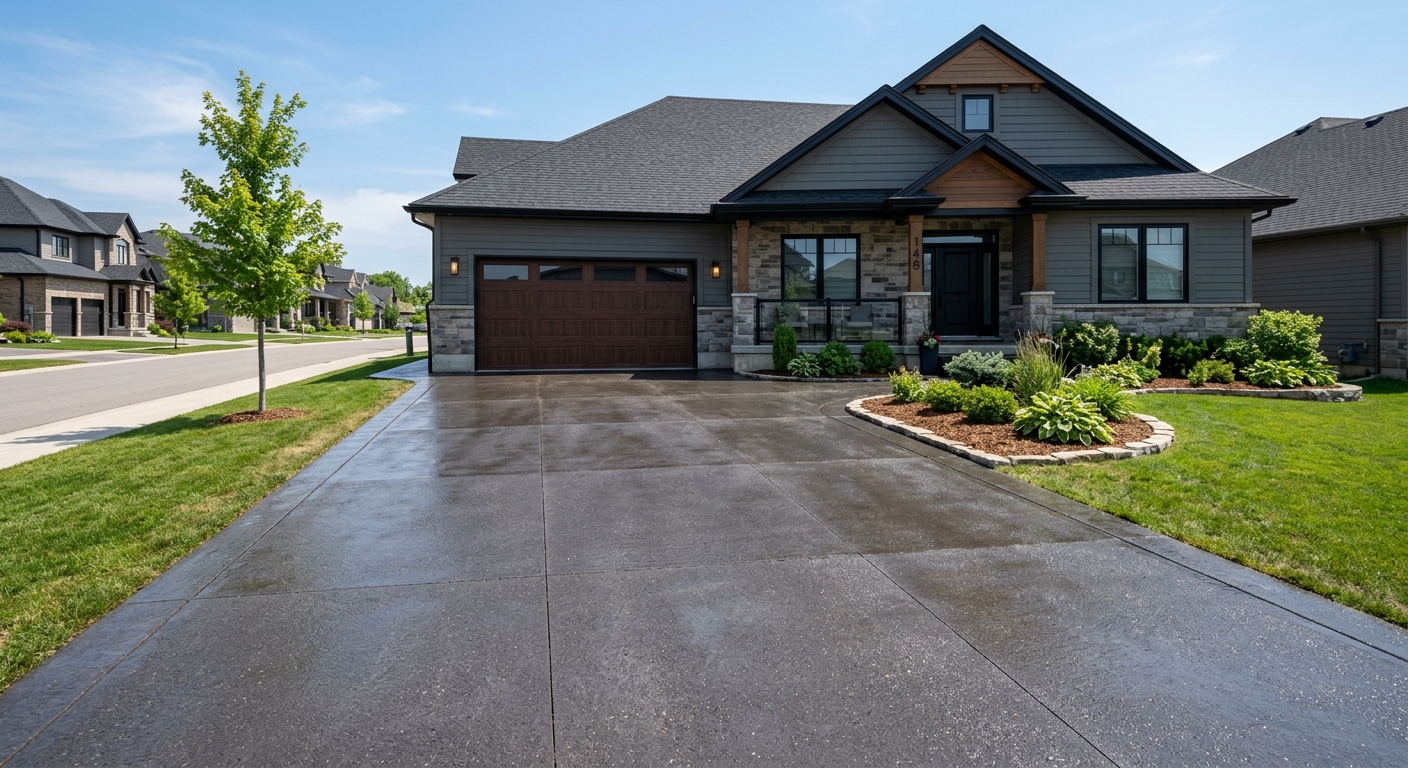
Concrete work options and costs in Fort St. John
Concrete work is a big part of home maintenance and upgrades in Fort St. John, BC, especially as many residents look to replace worn flatwork before winter. With 49.9% of dwellings in the area being single-detached homes (Statistics Canada, 2021 Census), you’ll often see driveways, front steps, patios, and walkways needing repair or expansion. Another reason demand stays consistent is that 42.0% of homes were built before 1981 (Statistics Canada, 2021 Census), which means there are plenty of older pads, settling approaches, and aging drainage details that can’t handle today’s freeze–thaw intensity.
In Northeast BC, the climate drives the cost structure. Deep frost penetration and frequent freeze–thaw cycles require footing excavations and slab specs that are more involved than in milder parts of the province—often meaning extra granular base, more reinforcement where needed, and stricter cold-weather curing. The short pour season around Fort St. John and the Peace River district can also tighten contractor schedules, particularly during late spring and early fall, when lots of homeowners book at once.
Concrete work is especially in demand in neighbourhoods with high numbers of older properties and active renos, such as the downtown core and the growing areas near the university and north-end residential lots, where driveways and entrances are frequently updated for drainage and durability. If you’re planning a new pour or replacing cracked sections, it helps to compare the common options and what they typically cost in our local market before you contact contractors—see the table below for practical ranges.
| Application |
Typical Size |
Key Spec |
Finish Option |
Price Range |
| Concrete driveway (standard broom finish) |
500 sq. ft. |
Air-entrained exterior mix; compacted granular base |
Broomed surface; control joints |
$18,000–$28,000 |
| Exposed aggregate driveway |
500 sq. ft. |
Air-entrained mix; exposed surface requires tighter finishing control |
Exposed aggregate; sealed for salt resistance |
$22,000–$34,000 |
| Stamped concrete driveway or patio |
300 sq. ft. |
Air-entrained mix; color hardeners/vinyl release |
Stamp pattern + coloring; sealed |
$15,000–$25,000 |
| Plain concrete patio or walkway |
200 sq. ft. |
Air-entrained exterior mix; slope to drainage |
Broom finish or light trowel; control joints |
$3,000–$5,000 |
| Garage floor (interior slab) |
600 sq. ft. |
Vapour barrier (as applicable); reinforcement to spec |
Light broom finish; sealed optional |
$14,000–$22,000 |
| Foundation footings (structural, below frost) |
Per linear ft. (typical 1–2 storey house) |
Excavate below design frost; reinforced concrete |
Structural concrete (engineered); form & pour |
$55–$90 |
Prices are estimates only and vary by project scope, site access and material selection.
What affects the price of concrete work in Fort St. John
In Fort St. John and across Northeast British Columbia, it’s common to see quotes for the same concrete job swing by 30–50% between contractors—or between “almost the same” scopes. The biggest driver is that the Northeast frost environment and freeze–thaw cycles dictate the specs: footings must be set below the local design frost depth to prevent frost heave and slab cracking, and exterior flatwork generally needs air-entrained concrete to survive repeated moisture movement and expansion. When contractors price “cheap” mix or skip curing protection, you might save today and pay later through spalling, heaving, and rework.
Cold weather also compresses the effective pour window. Even when temperatures look “manageable,” we still have to protect set and curing so the concrete reaches design strength. That can mean heating, insulation blankets, windbreaks, and schedule adjustments—especially on exposed driveways and streets where wind chill and early frost can be brutal. Surface durability is another Northeast factor: de-icing salt accelerates deterioration, so sealing isn’t just cosmetic. A sealed broom-finish driveway typically holds up better than an unprotected one when winter maintenance is frequent.
Two examples of how local conditions move the price up or down: (1) deeper excavations and additional backfill under footings can push foundation work closer to the higher end of the $55–$90 per-linear-ft band; (2) if your driveway design needs tighter control joints, thicker edges, and more robust base prep due to frost-susceptible soils, the flatwork can land closer to $18,000–$28,000 for a standard broom-finished driveway. Meanwhile, if access is straightforward and you’re replacing like-for-like on a well-drained lot, you can sometimes land nearer the lower end—especially on plain patios and walkways in the $15–$25 per-square-foot range.
| Price Factor |
Why It Matters |
Cost Impact |
| Frost line depth |
Determines footing depth and form height |
Higher excavation and concrete volume; can shift foundation pricing significantly |
| Site preparation |
Excavation, grading, compacted granular base |
More base and compaction work adds labour and materials; poor soil increases scope |
| Reinforcement |
Rebar or wire mesh requirement |
Material and labour to install; sometimes required for thicker slabs or wider pours |
| Mix design |
Air-entrainment and compressive strength spec |
Premium mix and quality control; helps prevent freeze–thaw spalling and cracking |
| Finish type |
Broom vs. stamped vs. exposed aggregate |
Decorative options require extra steps, materials, and more skilled finishing time |
| Pour size and concrete truck access to site |
Shorter access routes reduce labour and time |
Limited access may require pumping or more labour for handling and placement |
| Cold-weather curing precautions |
Heating and blankets to protect early curing |
Can add significant daily setup cost, especially on exposed slabs |
| Control joint pattern and sealing cost |
Joints manage cracking; sealer protects against de-icing salts |
More layout and materials; usually worth it in salted Northeast winters |
Permits & regulations in British Columbia
In British Columbia, many structural concrete tasks require a building permit, and they often start with engineered drawings reviewed by the municipality. In practice, permit work commonly includes foundation components such as footings, foundation walls, grade beams, and other elements that form part of the building’s structural system. For concrete flatwork—driveways, patios, and walkways—permits are usually not required unless the work changes site grading, touches impervious surface coverage limits, or affects drainage and the use of municipal right-of-way. Even when a permit isn’t expected, it’s smart to confirm with the local authority before breaking ground, particularly in neighbourhoods where drainage rules or setbacks are strict.
Here’s a simple step-by-step approach for Fort St. John homeowners to verify a contractor’s credentials in BC. First, confirm the contractor’s business information and any required registration status using the relevant provincial online resources (often a licensing or contractor registry portal). Next, request a current certificate of liability insurance showing adequate coverage for concrete work—don’t accept an expired certificate. Third, ask for proof of WSIB/WCB coverage and ensure it matches the company doing the work on site (not only a subcontractor’s paperwork). Finally, ask for references on similar-scale projects—ideally in northern or freeze–thaw regions—so you can see how they manage curing protection, joints, and salt exposure.
Getting concrete right in Fort St. John's freeze-thaw climate
Concrete failures in Fort St. John usually come from a predictable set of problems: the base isn’t properly compacted to the right depth for frost protection, the mix isn’t air-entrained enough for freeze–thaw exposure, control joints aren’t placed to control where cracks happen, or curing protection is rushed because the calendar is tight. To spec the job correctly, you want a clear scope that matches Northeast BC conditions.
1) Base preparation: the granular sub-base needs to be excavated and compacted to a depth that suits local soil and frost risk. If the base is thin or poorly compacted, the slab can settle and crack, and water will find its way underneath—then freeze–thaw magnifies the movement.
2) Mix design: for exterior flatwork, insist on air-entrained concrete. We typically target about 5–7% air content depending on the aggregate and exposure, and we specify minimum compressive strength around 32 MPa for durability. This is where many “cheap” quotes underperform.
3) Control joints: joints should be laid out to limit random cracking. If you don’t like cracks, you plan for them—engineered joint patterns reduce ugly, uncontrolled fissures.
4) Curing: plan on minimum 7-day protected curing under proper conditions. In cold snaps, curing blankets or insulation may be necessary to prevent early freezing.
5) Sealing: apply a penetrating sealer about 28 days after the pour so de-icing salts and meltwater are resisted. Sealing is a practical step for Fort St. John, where winter maintenance is constant.
A dollar example: upgrading a standard broom-finished driveway to an exposed aggregate surface can cost more—often landing in the $22,000–$34,000 band for a typical 500 sq. ft. pour—but the exposed surface and better finish resistance can justify the difference if your current driveway is already pitted or heavily salted. If the base and air content aren’t done right, though, neither broom nor decorative finishes will solve spalling—air-entrainment and curing do.
| Spec |
Why It Matters in Fort St. John |
What to Ask For |
Impact if Skipped |
| Compacted granular base (depth?) |
Controls settlement and frost movement under the slab |
State the granular base depth and compaction method |
Heaving, cracking, and water pumping under the slab |
| Air-entrained concrete mix (target air %?) |
Improves freeze–thaw durability and reduces spalling |
Ask for target air content (commonly 5–7% for exterior flatwork) |
Surface scaling and premature deterioration from freeze–thaw |
| Compressive strength (MPa rating) |
Ensures durability through cold-season exposure |
Confirm minimum 32 MPa (or engineered design strength) |
Weaker surface and higher risk of scaling and cracking |
| Control joints (spacing per ACI guidelines) |
Limits random cracking under expansion and contraction |
Ask for joint spacing plan and locations at transitions |
Uncontrolled cracks and appearance problems |
| Minimum 7-day curing period |
Protects strength gain during cold or damp conditions |
Require protected curing plan; describe cold-weather precautions |
Early freezing reduces strength and increases surface damage |
| Penetrating sealer (when applied after cure) |
Repels salt/meltwater penetration in winter maintenance |
Ask for sealer application timing (about 28 days post-pour) |
Faster salt-related spalling and staining |
How to choose a concrete work contractor in Fort St. John
Choosing the right concrete contractor in Fort St. John starts with verifying credentials and then getting scopes you can compare line-by-line. In British Columbia, you should confirm licensing/registration where applicable, but also confirm that the contractor can legally work safely on your site. Ask for a current certificate of liability insurance (including coverage amounts) and confirm the policy covers concrete construction activities. For worker protection, verify WSIB/WCB coverage: request proof and match it to the company that will be on your site—not just a general corporate parent or a past subcontractor.
Next, get 2–3 itemised written quotes that separate labour, materials, excavation, reinforcement, and any decorative products or sealing. You want clear inclusions and exclusions: is demolition included? Is disposal of concrete included? Is the granular base specified? Is the pour schedule aligned with cold-weather curing needs? A quote that only lists “concrete and finishing” without detailing air-entrainment, compressive strength, base prep, and curing protection is hard to trust.
On warranty, ask for workmanship warranty length in writing, plus product/manufacturer warranty for decorative systems or sealer (and whether it’s transferable if you sell the home). For payment, never pay more than 10–15% upfront; hold back until key milestones are complete (base prep verified, steel placed as required, and final surface finishing done). Finally, insist on a written timeline with a start date and completion estimate—Northeast BC schedules can shift, but good contractors manage those changes proactively.
- Verify the contractor’s BC registration/licensing status using the provincial registry.
- Request certificate of liability insurance and confirm coverage is active and adequate.
- Confirm WSIB/WCB coverage matches the company doing the work.
- Ask for 2–3 recent references for driveways/patios in northern freeze–thaw conditions.
- Require quotes to be itemised (labour, materials, excavation, rebar/mesh, base, disposal).
- Confirm the concrete spec: air-entrainment and minimum compressive strength (typically 32 MPa for exterior work).
- Ask who supplies and places reinforcement (and whether it’s tied/secured correctly).
- Confirm base prep depth and compaction requirements, not just “granular base.”
- Ask for joint layout: control joints at appropriate spacing and locations.
- Confirm curing method and cold-weather precautions (blankets/insulation/heating if needed).
- Clarify sealing: product type and timing (often about 28 days post-pour).
- Agree on payment milestones and retainage; avoid large upfront payments.
In Fort St. John, concrete contractor red flags include: refusing to provide itemised specs for air content or base prep; quoting without discussing curing blankets/heating during cold snaps; vague language like “we’ll seal it if needed” (or skipping sealing without explanation); promising “no cracks” with no joint plan; and requesting large upfront payments or avoiding written timelines.
Frequently asked questions — concrete work in Fort St. John
How long does a concrete driveway last?
In Fort St. John and the broader Northeast BC area, a properly built concrete driveway commonly lasts 25+ years, but the real answer depends on whether the base was prepared correctly and whether the mix was made for freeze–thaw durability. For exterior work, air-entrained concrete and correct curing are essential to reduce spalling from winter moisture and salt. If drainage is poor and water sits at the edges, you may see settlement and cracking sooner. Decorative finishes can last just as long when the underlying slab is correct, but the surface still benefits from sealing after curing. Cost-wise, a standard broom-finished driveway typically falls around $18,000–$28,000 depending on size, excavation, and access. Paying for proper base and air content usually protects that long service life more than chasing the cheapest finish.
What is air-entrained concrete and why does it matter here?
Air-entrained concrete contains microscopic air bubbles created during mixing. In Fort St. John’s freeze–thaw climate, those bubbles give expanding water somewhere to go when it freezes, reducing the stress that causes scaling and spalling. That’s why exterior slabs and driveways are usually specified with an air-entrained mix rather than a standard interior concrete. If a contractor shortcuts the mix design, the surface may look fine initially but can degrade quickly as de-icing salt and moisture cycle through the winter months. When you’re comparing quotes, ask for the air-entrainment target and the minimum compressive strength requirement. For reference, your local market pricing for driveways often aligns with the $18–$28 per-square-foot band for standard work, but durability comes from specs, not just the number on the estimate.
How do I prepare the base for a concrete slab?
Base preparation is where concrete projects either succeed or fail in Northeast BC. Typically, preparation involves excavating to the correct depth, removing unsuitable material, grading for proper slope, and compacting a granular sub-base in lifts so it reaches the needed density. The depth and structure depend on your soil conditions and the frost protection requirements for the slab thickness and exposure. For driveways and patios, you should expect granular base prep and drainage detailing so meltwater doesn’t sit under the slab. Ask your contractor to explain the planned base depth and compaction approach, and confirm they’re using freeze-aware specs rather than a generic “standard” build. If you’re budgeting, base work is one of the reasons quotes vary widely—getting your driveway into the $18,000–$28,000 range with correct base prep is usually more reliable than cutting back and risking rework later.
How do I compare concrete quotes?
To compare concrete quotes in Fort St. John fairly, don’t start with the lowest total price—start with scope details. Ask each contractor to provide an itemised quote showing excavation and disposal, granular base thickness and compaction, reinforcement (if required), concrete mix specs (air-entrainment and compressive strength), finishing method (broom, stamped, exposed aggregate), and curing/cold-weather protection plan. Also confirm whether sealing is included and when it will be applied (often around 28 days after the pour). If one quote is for an exposed aggregate driveway and another is “standard broom,” compare like-for-like. Typical price bands for this city tier include standard driveway work around $18,000–$28,000 and stamped/decorative work usually running higher (for stamped driveways/patios, you may see figures in the broader $25–$40 per-square-foot band depending on complexity). Clear inclusions protect you from surprise costs and prevent durability issues.
Can concrete be poured in cold weather in Fort St. John?
Yes, concrete can be poured in cold weather in Fort St. John, but it must be done with the right cold-weather curing precautions. Early freezing can seriously weaken concrete and increase the risk of surface scaling and cracking. Contractors typically use methods such as insulation blankets, heated enclosures when practical, wind protection, and admixtures where appropriate—plus scheduling the pour to ensure strength gain before temperatures drop too far. The right approach depends on daily temperatures, wind, slab thickness, and whether the pour is exposed. If a contractor offers “no problem” pours without discussing curing protection, that’s a concern. This is one reason quotes can vary: cold-weather measures add labour and materials. If you’re budgeting, cold-weather protection can be a meaningful cost line item, but it helps protect the investment in a driveway, patio, or garage slab that would otherwise be vulnerable during freeze–thaw cycles.
How do I maintain concrete in Fort St. John's freeze-thaw climate?
Maintenance in Fort St. John is mostly about reducing water intrusion and preventing salt damage. First, apply a penetrating sealer at the right time—commonly about 28 days after the pour—so meltwater and de-icing salts can’t penetrate as easily. Keep edges clear and ensure water drains away rather than pooling at the slab perimeter; if you see a low spot, address it early. Use de-icing practices carefully: heavier salt use can increase spalling risk over time, especially on unsealed surfaces. Regularly inspect for early signs of deterioration such as hairline cracking, scaling, or small chips—repairs done early are far cheaper than waiting for structural settlement. For homeowners, it also helps to match the finish to your winter routine: sealed broom finishes are generally practical, while decorative surfaces like stamped or exposed aggregate still need sealing and normal inspection. Proper sealing and joint maintenance are often as important as the initial concrete price.