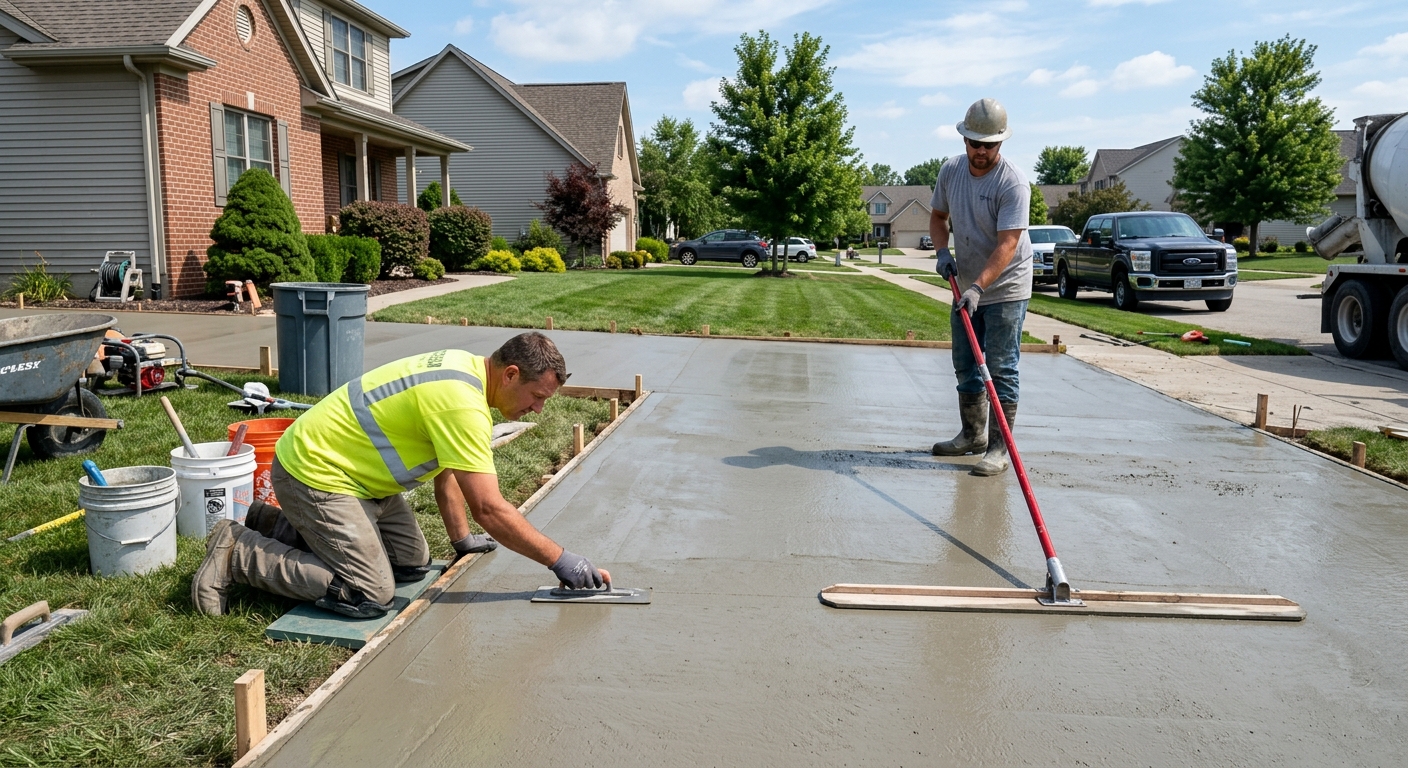
Concrete work options and costs in Renfrew Heights
Renfrew Heights is a close-in community in the Lower Mainland–Southwest where most homeowners want durable concrete flatwork that can handle wet winters, cool nights, and the freeze–thaw cycles that push on exterior slabs. With a population of 20,570 (Statistics Canada, 2021 Census) and a housing mix that leans heavily toward single-detached neighbourhood streets, concrete driveways, patios, and walkway replacements are some of the most common home improvements we price year-round. Demand is especially strong around the more established residential pockets near the commercial corridors and school routes, where older homes often need regrading, new base, and a replacement slab that looks good and performs for years.
Pricing in the Lower Mainland–Southwest is shaped by our relatively shallow frost depth (commonly planned around about 450 mm / 18") and the requirement to still protect against frost heave during shoulder-season swings. Even though frost depths are shallower than interior or northern BC, we still design footings and thickened edges below the design frost level, and we detail drainage and air-entrained mixes so the surface doesn’t scale when it repeatedly saturates and freezes. Wet weather also affects scheduling: contractors plan pours around prolonged rain and high humidity, and often use curing blankets and longer cure times to reach design strength.
The result is that a “simple” broom-finished driveway can cost meaningfully less than stamped or decorative systems—but the biggest jump usually comes from base prep, access, and how much thickness and reinforcement you need. Use the table below to compare typical installed ranges before you request a quote.
| Application |
Typical Size |
Key Spec |
Finish Option |
Price Range |
| Concrete driveway (standard broom finish) |
16' x 20' (320 sq. ft.) |
Air-entrained exterior mix, compacted base |
Broomed surface, control joints |
$7,000–$9,000 |
| Exposed aggregate driveway |
16' x 22' (352 sq. ft.) |
Proper curing and reveal timing |
Exposed aggregate finish |
$8,500–$12,000 |
| Stamped concrete driveway or patio |
12' x 20' (240 sq. ft.) |
Colour integral + hardened sealer |
Stamped pattern (e.g., slate/brick look) |
$6,000–$10,000 |
| Plain concrete patio or walkway |
10' x 16' (160 sq. ft.) |
Air-entrained mix, compacted granular base |
Float/trowel with light broom |
$2,700–$4,200 |
| Garage floor (interior slab) |
20' x 22' (440 sq. ft.) |
Vapour retarder (if needed), fibre or mesh |
Light broom or smooth trowel top |
$8,800–$13,200 |
| Foundation footings (structural, below frost) |
Typical single foundation bay |
Excavation to frost line, formwork, rebar |
Structural placement |
$5,000–$9,000 |
Prices are estimates only and vary by project scope, site access and material selection.
What affects the price of concrete work in Renfrew Heights
In Renfrew Heights and across the Lower Mainland–Southwest, two quotes for the same “driveway size” can differ by 30–50% once you dig into base prep, thickness, and mix/curing requirements. The big reason is that our coastal-wet climate and freeze–thaw cycling force contractors to build the slab as a system: excavate and compact the right granular depth, install drainage where needed, use air-entrained concrete, and control cracking with correct joints and curing. In colder regions of BC, the pour season shortens and contractors may add heating and insulation—those precautions can raise costs compared with typical Lower Mainland projects.
Frost protection dictates specs. Footings and thickened edges must be placed below the design frost depth to prevent frost heave; for Lower Mainland designs, practice often assumes a shallow target around 450 mm / 18", but local soil moisture and drainage still determine how much granular thickness and protection you need. Exterior slabs also require air-entrainment to survive the freeze–thaw cycle; without it, you’re more likely to see scaling and spalling. And when weather turns cool or rains persist, curing blankets and longer cure times help the concrete reach design strength before it’s exposed to repeated temperature swings.
Concrete options also price differently even when the square footage is the same: a broom-finished driveway often lands in the mid range of the regional band (commonly $18–$28 per sq. ft.), while stamped & decorative systems typically run higher because of formwork tolerances, colour hardeners, release agents, and extra finishing labour (often $22–$36 per sq. ft. equivalent for these finishes). In older Renfrew Heights homes, we frequently see uplift and settlement from inadequate drainage—fixing that base and slope to manage water can add dollars upfront, but it prevents repeating the same problem.
| Price Factor |
Why It Matters |
Cost Impact |
| Frost line depth — determines footing depth and form height |
Footings and thickened edges must sit below the design frost level to stop frost heave |
Higher excavation and more rebar/formwork when deeper protection is required |
| Site preparation — excavation, grading, compacted granular base |
Drainage and compaction determine settlement; wet soils need careful granular placement |
Extra labour if soils are soft, if there’s poor drainage, or if haul/disposal is needed |
| Reinforcement — rebar or wire mesh requirement |
Crack control and load capacity depend on reinforcement and spacing |
Cost increases with mesh/rebar quantities and tying labour |
| Mix design — air-entrainment and compressive strength spec |
Exterior freeze–thaw durability relies on correct air content and strength |
Materials cost rises; incorrect mix can cause premature scaling/spalling |
| Finish type — broom vs. stamped vs. exposed aggregate |
Decorative finishes require more steps, precision, and curing/sealer timing |
Labour and material add-ons can move the job from standard to premium pricing |
| Pour size and concrete truck access to site |
Limited access increases pumping, labour, or reduces batch efficiency |
May require pump costs, extra crew time, or staged pours |
| Cold-weather curing precautions — heating and blankets |
Cool nights and rain affect hydration and surface strength development |
Added rental and labour for blankets/heaters to meet cure expectations |
| Control joint pattern and sealing cost |
Joint layout controls random cracking; sealing helps repel de-icing salts and moisture |
Often small per sq. ft., but essential in exterior durability planning |
Permits & regulations in British Columbia
In British Columbia, the requirement is not “concrete,” it’s the type of concrete work and whether it changes structural loads or affects how the site is serviced. Structural concrete work—such as footings, foundation walls, grade beams, and any other elements that support the building—typically requires a building permit, often with engineered drawings reviewed by the municipality. Concrete flatwork (driveways, patios, and walkways) usually does not require a permit unless your work triggers municipal considerations like lot grading changes, impervious surface coverage limits, or impacts to drainage, setbacks, or the municipal right-of-way. Because rules can hinge on the exact scope, confirm with the local authority before breaking ground.
Before you hire anyone in Renfrew Heights, verify the contractor carries liability insurance and has the required workers’ coverage (WSIB/WCB coverage for workers). Then ask for references on similar-scale structural and exterior projects in the Vancouver–Surrey–Abbotsford corridor—especially jobs involving drainage corrections and air-entrained exterior mixes.
Step-by-step homeowner checks:
- Licence/credentials: look up the contractor in the applicable online registry tools referenced by the province and any contractor listing platforms they provide.
- Certificate of Insurance: request a current certificate showing general liability and ensure it’s valid for the start date.
- Workers’ coverage: ask for proof of WSIB/WCB coverage (or a clearance letter if their paperwork uses that format).
- References: request 2–3 projects similar in size and exposure (exterior slabs, drainage upgrades, or foundation-related work).
- Written scope: ensure the permit responsibility is clearly assigned if structural work is included.
Getting concrete right in Renfrew Heights's freeze-thaw climate
Concrete failures in Renfrew Heights usually come from one of five issues: poor base support, incorrect mix air content, weak curing, missing or poorly spaced control joints, or sealing too late (or not at all). In our Lower Mainland–Southwest climate, exterior slabs sit in a cycle of saturation during wet stretches and cracking/expansion during cold snaps; if the concrete isn’t air-entrained and detailed properly, water can enter micro-cracks, freeze, expand, and start scaling or spalling. That’s why the “cheap” option can look fine for a short period, then deteriorate around edges, joints, and surface high spots.
To spec the job correctly, start with base preparation: compacted granular base to the right depth and grading for drainage. Next, require an air-entrained exterior mix (commonly 5–7% air content) and a minimum 32 MPa compressive strength for durability and predictable performance. Third, use control joints to limit random cracking—joint layout matters as much as the pour. Fourth, enforce curing: a minimum 7-day curing period under proper conditions, with curing blankets or protection during cool, damp weather. Fifth, plan sealing: apply a penetrating sealer after the cure period (often around 28 days) so the surface repels water and de-icing salt intrusion.
Ask technical questions like: “What air content is being targeted?” and “How are you achieving consistent compaction and drainage?” If you want a dollar example: upgrading a 160 sq. ft. patio from basic finishing to an air-entrained mix and properly sealed surface may cost only a few hundred dollars in total, but it protects the slab from the early scaling that often shows up on coastal-wet, freeze–thaw-exposed surfaces.
| Spec |
Why It Matters in Renfrew Heights |
What to Ask For |
Impact if Skipped |
| Compacted granular base (depth?) |
Supports the slab and manages water before it reaches concrete |
Granular base depth and compaction standard for your site soil conditions |
Settlement, edge cracking, and premature joint failure from water-laden subgrade |
| Air-entrained concrete mix (target air %?) |
Helps concrete resist freeze–thaw scaling in exterior exposure |
Target air content around 5–7% for exterior flatwork |
Higher risk of spalling and surface scaling during cold snaps |
| Compressive strength (MPa rating) |
Strength development affects durability and wear resistance |
Minimum 32 MPa compressive strength specified |
Surface wear, increased cracking, and reduced long-term performance |
| Control joints (spacing per ACI guidelines) |
Controls where cracks occur instead of random cracking |
Planned joint spacing and alignment at corners/changes in geometry |
Random cracks that telegraph through the finish and reduce watertightness |
| Minimum 7-day curing period |
Ensures hydration and strength gain under cool/wet conditions |
Protection plan for rainy or cool nights |
Surface weakness, reduced durability, and poor bonding at joints/edges |
| Penetrating sealer (when applied after cure) |
Repels moisture and helps resist de-icing salt intrusion |
Penetrating sealer applied after cure (commonly after 28 days) |
Faster water absorption, staining, and accelerated scaling at joints |
How to choose a concrete work contractor in Renfrew Heights
Choosing the right concrete contractor in Renfrew Heights starts with verification, not just a low number. In British Columbia, you should confirm the contractor’s eligibility to work and ensure they carry liability insurance. Ask for proof of workers’ coverage (WSIB/WCB) and keep an eye out for paperwork that matches the job timeline (certificate validity dates). If they can’t provide insurance documents or recent clearance/coverage proof, that’s a red flag.
Next, insist on 2–3 itemised written quotes. You want a breakdown that separates labour, excavation/grading, granular base, reinforcement, concrete supply, finishing steps, and finishing protection like curing blankets and sealer. Avoid quotes that bundle everything into one number without showing thickness assumptions and drainage/base scope.
Read your scope carefully for exclusions: is disposal included for excess soil? Is permit handling included if structural work is involved? Are truck access, pumping (if required), and sawcutting/jointing included? Also ask about warranty: look for a workmanship warranty length and understand whether it covers crack appearance, joint performance, and surface scaling issues related to curing and mix selection. Product/manufacturer warranties should be clearly distinguished from workmanship.
Payment schedule matters too. A good practice is never paying more than 10–15% upfront, with the remaining balance tied to milestones and a holdback until the work is complete and cleanup is done. Finally, get the start date and completion estimate in writing, with a rain/cold contingency plan—important in the Lower Mainland–Southwest where scheduling around prolonged rain can shift timelines.
- Request COI (certificate of insurance) and verify it covers the correct project address.
- Ask for WSIB/WCB proof (or clearance letter) before signing.
- Confirm who pulls permits for structural work (footings/foundation elements).
- Get itemised pricing (labour vs materials vs disposal vs pump/sawcutting).
- Verify assumed slab thickness and base thickness are written into the quote.
- Ask for mix design details: air-entrainment and target strength.
- Confirm reinforcement type (mesh vs rebar) and placement plan.
- Ask about joint layout and sealing timing after cure.
- Require weather/protection plan for rain and cool nights.
- Clarify truck access, hose/pump usage, and staging of pours.
- Confirm cleanup and disposal are included (or priced separately).
- Review warranty terms in writing and whether it’s transferable to new owners.
Renfrew Heights-specific red flags: contractors who won’t name the air-entrained mix or target air %, who refuse to discuss curing blankets for cool/rainy periods, who propose skipping compaction and drainage because “it’ll be fine,” who under-explain joint layout (or skip sawcut timing), and who ask for a large upfront payment before any site preparation is completed.
Frequently asked questions — concrete work in Renfrew Heights
How long does concrete take to cure?
In Renfrew Heights (and across British Columbia’s Lower Mainland–Southwest), curing time depends on temperature, rain exposure, and whether the contractor uses curing protection. As a baseline, exterior slabs should not be subjected to heavy loading until the concrete has reached adequate strength, and we plan for a minimum 7-day cure under proper conditions for typical flatwork. For full design strength and best durability—especially important in our freeze–thaw cycle—expect longer development, and we often treat sealing as a separate milestone. For example, a penetrating sealer is commonly scheduled after the cure period (often around 28 days) so the surface is dry enough and the concrete has stabilized. If there’s prolonged rain or cool nights, reputable crews add curing blankets and keep the slab protected longer.
Do I need a permit for concrete work in British Columbia?
Usually, patio and driveway concrete in British Columbia does not require a permit by default, but it can depending on how the work affects site conditions. In Renfrew Heights, a permit is more likely when the concrete is structural—such as footings, foundation walls, or grade beams—or when the work changes lot grading, drainage patterns, or impervious surface coverage rules. Concrete flatwork that doesn’t alter grading or drainage often proceeds without a permit, but you should confirm with the local authority because decisions can turn on details like slope changes and runoff direction. Before hiring, ask the contractor to specify whether they will handle permit requirements (if structural work is included) and ensure you get that responsibility in writing along with the scope.
Concrete vs pavers for a patio in Renfrew Heights?
For many homeowners in Renfrew Heights, concrete wins on longevity and overall cost predictability when drainage and base prep are done correctly. A plain concrete patio typically falls in the regional band of $16–$26 per sq. ft., which is often competitive with pavers once you factor in excavation depth, sub-base, edge restraints, and long-term maintenance. Pavers can look excellent and allow easier partial repairs, but they can shift if the base and drainage aren’t right—an issue in our coastal-wet conditions. Concrete, on the other hand, relies on air-entrained mix, correct curing, and control joints to manage cracking and resist freeze–thaw scaling. If you expect de-icing salts or heavy wetting, insist on proper air-entrainment and consider sealing after cure. In many cases, both choices work well—the deciding factor is whether you can get the right base and drainage plan for your lot.
How long does a concrete driveway last?
A well-built concrete driveway in British Columbia’s Lower Mainland–Southwest commonly lasts decades. In Renfrew Heights, performance is strongly tied to how the base is prepared, whether the concrete is air-entrained, and how joints and drainage are handled during wet/cold cycles. If the driveway was installed with adequate compacted granular base, correct thickness, and proper control joint pattern, it typically holds up well against freeze–thaw and moisture saturation. Many homeowners see issues earlier when air-entrainment is skipped or curing/finishing is rushed, leading to scaling at the surface and cracking along edges. If you’re pricing replacement, compare options carefully: a standard broom-finished driveway is often in the $18–$28 per sq. ft. range, while decorative systems typically cost more (often $22–$36 per sq. ft.). Paying for the durability details usually protects the lifespan more than paying for a higher-looking finish alone.
What is air-entrained concrete and why does it matter here?
Air-entrained concrete is a mix designed with tiny, evenly distributed air bubbles that give water room to freeze without destroying the concrete’s surface. In Renfrew Heights and the Lower Mainland–Southwest, we experience repeated wetting and temperature swings, so exterior slabs can be exposed to freeze–thaw stresses even when our frost depth is relatively shallow (often planned around about 450 mm / 18"). That’s why we specify air-entrainment for driveways, patios, and exterior foundation elements. When air content isn’t right, the concrete becomes more vulnerable to scaling and spalling—often starting at edges and joints where water collects. Ask your contractor what air-entrainment target they use for exterior work (commonly 5–7% air content) and whether they plan curing protection in cool, rainy weather. It’s one of the most cost-effective durability choices you can make.
How do I prepare the base for a concrete slab?
Base prep is where durable concrete starts, and it’s especially important in British Columbia’s coastal-wet, freeze–thaw environment. For a slab in Renfrew Heights, the contractor should excavate to the planned grade, remove unsuitable material, and place compacted granular sub-base to the correct depth for your site conditions and intended thickness. They should also address drainage so water doesn’t pond under or against the slab—ponding is one of the drivers of settlement and freeze-related stress. Proper compaction is critical, and the contractor should use appropriate material and compaction practices for the soil they find. Before the pour, the crew should confirm reinforcement placement (if required) and ensure the base is firm, level, and properly sloped. If you’re comparing quotes, make sure the granular depth, compaction process, and drainage measures are described—these details often explain why pricing differs between “same size” projects.