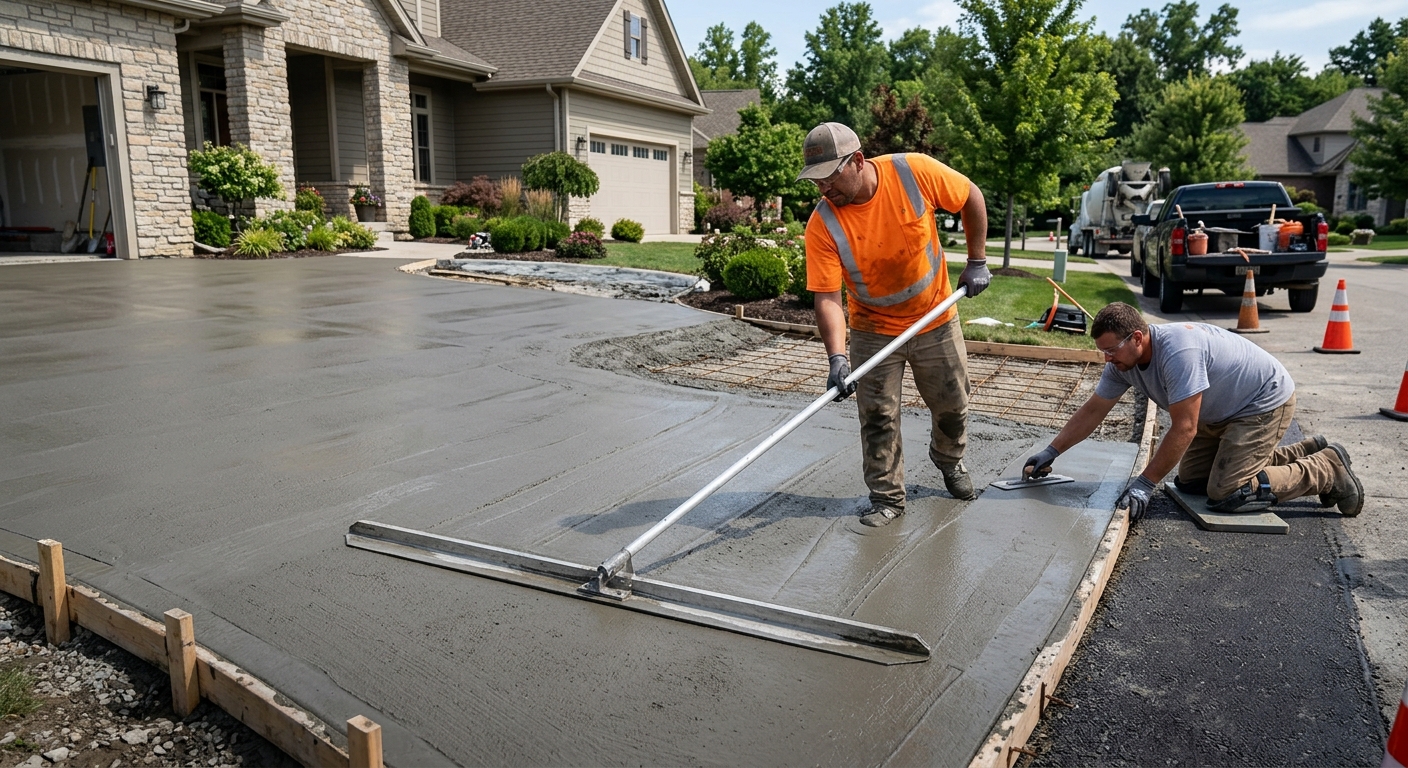
Concrete work options and costs in Garden City
Garden City, British Columbia is a compact community in the Lower Mainland–Southwest where concrete flatwork is a big part of how homes handle wet weather and seasonal temperature swings. With Garden City’s population at 5,885 people (Statistics Canada, 2021 Census), the supply of experienced crews can be tighter on peak weeks, so timing and site readiness strongly influence final pricing. Most local demand comes from established neighbourhoods and typical single-detached homes, which translates into frequent requests for driveways, patios, walkways and garage slabs—jobs that need a well-built base and the right mix for exterior durability.
Lower Mainland–Southwest concrete costs aren’t driven by freezing every day; they’re driven by freeze–thaw cycles and saturated ground. Even with a shallow design frost depth (commonly assumed around 450 mm / 18"), footings and thickened edges still need to sit below the frost line to help prevent freeze-related movement. In coastal-wet conditions—think coastal rainfall, cool nights and high humidity—contractors also plan longer curing windows, use curing blankets or sealers when needed, and pay close attention to drainage. That means more base prep, better materials control (including air-entrainment for exterior slabs) and careful scheduling—especially in areas around Garden City Road and the surrounding residential blocks, where driveway replacement and backyard patio work tends to be in constant rotation.
Below is a practical comparison of common options and typical price ranges so you can understand how finish type, preparation, and structural depth affect your budget.
| Application |
Typical Size |
Key Spec |
Finish Option |
Price Range |
| Concrete driveway (standard broom finish) |
400 sq. ft. |
6" slab, reinforced, proper drainage + granular base |
Broom finish, control joints |
$7,200–$11,200 |
| Exposed aggregate driveway |
400 sq. ft. |
6" slab, reinforced, wash/retard finish prep |
Exposed aggregate, sealed for durability |
$9,600–$14,400 |
| Stamped concrete driveway or patio |
300 sq. ft. |
4–6" slab, reinforcement as required |
Stamped pattern + colour hardener + release + sealing |
$6,600–$11,700 |
| Plain concrete patio or walkway |
200 sq. ft. |
4–5" slab, compacted granular base |
Broom/steel-trowel finish, light texture |
$3,200–$5,200 |
| Garage floor (interior slab) |
360 sq. ft. |
4" slab, vapour barrier (if required), mesh/rebar |
Standard float/trowel, control joints |
$6,000–$9,900 |
| Foundation footings (structural, below frost) |
Varies by foundation footprint |
Engineered footing size/depth, below frost line |
Reinforced concrete, formwork + inspection-ready |
$12,000–$22,000 |
Prices are estimates only and vary by project scope, site access and material selection.
What affects the price of concrete work in Garden City
In Garden City and across the Lower Mainland–Southwest, quotes for what looks like the “same” concrete job can swing by 30–50% because contractors price the full system: excavation, subgrade preparation, drainage, reinforcement, mix design, scheduling and curing—not just the pour. The biggest differences typically come from frost-related specs, moisture management in a coastal-wet climate, and how much labour is needed to keep quality consistent on a short season when weather is unfavourable.
Here’s the key: even though coastal BC generally has a shallower frost line than many interior regions, practice still assumes a design frost depth around 450 mm / 18" for exterior support design. Footings and thickened edges are placed below the design frost depth to reduce frost heave risk. Because freeze–thaw cycles and saturated soils can cause scaling and spalling, exterior slabs usually require air-entrained concrete mixes and a tight control-joint plan. If cold conditions slow curing, crews add curing blankets and plan for longer protection time; that labour and material time affects the final number. Also, de-icing salt use accelerates surface deterioration—so sealing becomes part of keeping the surface durable, not an afterthought.
Concrete examples in Garden City that move costs up or down: (1) replacing an older driveway where poor drainage is discovered can add excavation and granular base work; (2) choosing stamped or exposed aggregate can add finish materials and skilled labour—often pushing you toward the stamped band near $22–$36 per sq. ft., while a basic broom-finish driveway more often aligns closer to the $18–$28 per sq. ft. range. (3) Pouring a wide area with limited access can mean extra time for pump set-up or multiple truck movements.
| Price Factor |
Why It Matters |
Cost Impact |
| Frost line depth — determines footing depth and form height |
Footings must sit below design frost depth to reduce frost heave |
Can add major excavation + formwork time; often shifts structural costs |
| Site preparation — excavation, grading, compacted granular base |
Wet soils need proper drainage and engineered base compaction |
Large swing if old asphalt/footings must be removed or regraded |
| Reinforcement — rebar or wire mesh requirement |
Controls cracking and improves performance under loads |
Additional materials + labour; higher for driveways and structural works |
| Mix design — air-entrainment and compressive strength spec |
Air entrainment helps resist freeze–thaw scaling and surface spalling |
Higher material cost but prevents early failure and callbacks |
| Finish type — broom vs. stamped vs. exposed aggregate |
Finish system changes labour time, materials and curing/handling |
Stamped/exposed typically increases cost per sq. ft. materially |
| Pour size and concrete truck access to site |
Access dictates pour efficiency, pump needs and haul time |
Poor access can add labour hours and equipment rentals |
| Cold-weather curing precautions — heating and blankets |
Cool nights slow strength gain; protection helps reach design strength |
Can increase labour/materials and schedule length |
| Control joint pattern and sealing cost |
Joints limit random cracking; sealing helps resist salt-driven scaling |
Added line items that are cheaper than premature repairs |
Permits & regulations in British Columbia
In British Columbia, structural concrete work generally needs a building permit—especially when it involves components that affect the integrity of the building. That means footings, foundation walls, and grade beams typically require a permit and often engineered drawings that the municipality reviews through the permitting process. On the other hand, concrete flatwork such as patios, walkways, and driveways usually does not require a permit by default, unless the work changes lot grading, creates or increases impervious surface beyond what the property is allowed to handle, or touches municipal right-of-way constraints.
Before breaking ground in Garden City, confirm the scope with your municipal office or the permitting process linked to your property. Also verify the contractor’s paperwork: a contractor should carry liability insurance and workers’ compensation coverage (WSIB/WCB equivalent coverage requirements for the province), and they should be able to provide clear proof. Ask for references from similar-scale projects—especially exterior work where air-entrainment, base prep and drainage are critical in our wet/coastal conditions.
Step-by-step for a homeowner: (1) Ask the contractor for their licence/registration info and proof of liability insurance; (2) Request a certificate of insurance showing the policy period and that you’re an interested party where applicable; (3) Confirm workers’ compensation clearance/coverage—your contractor should provide a clearance letter or proof; (4) Match the insurance and coverage names to the legal business name on the bid.
Getting concrete right in Garden City's freeze-thaw climate
Concrete failures in Garden City usually trace back to one of three things: poor base prep, the wrong mix for freeze–thaw conditions, or curing and joint/sealer details that were rushed or skipped. In the Lower Mainland–Southwest, exterior slabs can repeatedly get saturated from coastal rainfall and then experience temperature drops that trigger freeze–thaw cycles. That’s why the specs matter: base should be properly excavated and compacted granular with drainage attention, and exterior concrete should be air-entrained to survive repeated freeze–thaw exposure. Without air entrainment, water expands as it freezes inside the paste, leading to scaling and spalling—often visible within a few winters, and it’s expensive to fix.
To spec the job correctly, start with (1) base preparation: compacted granular sub-base to the correct thickness for local soil and frost considerations; (2) mix design: for exterior flatwork, target 5–7% air content with a minimum 32 MPa compressive strength; (3) control joints: layout to limit random cracking—don’t “eyeball” spacing; (4) curing: aim for at least 7 days of proper curing conditions, with added protection when it’s cool or damp; (5) sealing: apply a penetrating sealer about 28 days post-pour to improve resistance to de-icing salt and moisture intrusion.
Budget-wise, you’ll sometimes see cheaper bids that reduce reinforcement or omit sealers. For example, a stamped patio may price around the stamped band (often roughly $22–$36 per sq. ft.), but that’s where extra prep, hardened colours and careful curing are justified—especially since you’re paying for aesthetics and durability. Skipping the air-entrainment spec or sealing can make a “savings” turn into a costly re-do.
| Spec |
Why It Matters in Garden City |
What to Ask For |
Impact if Skipped |
| Compacted granular base (depth?) |
Helps prevent pumping, settlement and trapped moisture under exterior slabs |
State granular depth and compaction method for your subgrade |
Premature cracking, uneven surface, and faster deterioration |
| Air-entrained concrete mix (target air %?) |
Resists freeze–thaw scaling and spalling in coastal-wet cycles |
Target 5–7% air for exterior flatwork and confirm mix on delivery |
Surface scaling/spalling within a few seasons |
| Compressive strength (MPa rating) |
Strength gain affects durability and long-term performance |
Minimum 32 MPa at specified age (as stated in the quote) |
Soft, weaker concrete that wears and cracks sooner |
| Control joints (spacing per ACI guidelines) |
Controls where cracks happen during shrinkage |
Joint spacing plan and layout before the pour |
Random cracking and unsightly “failure” appearance |
| Minimum 7-day curing period |
Cold nights and humidity can slow curing and strength development |
Protection plan (covers/blankets) during cool or wet periods |
Reduced strength, higher risk of scaling and surface damage |
| Penetrating sealer (when applied after cure) |
Repels moisture and helps manage salt exposure on driveways |
Penetrating sealer after full cure (typically ~28 days) |
Faster absorption, staining, and surface wear |
How to choose a concrete work contractor in Garden City
When you’re hiring a concrete contractor in British Columbia, I recommend verifying three things up front: licensing/registration (for the work they’re proposing), liability insurance, and workers’ compensation clearance. Start by asking for the contractor’s legal business name, then confirm their coverage documents match that name. For liability insurance, request a current certificate of insurance that shows limits and effective dates. For workers’ compensation, ask for a clearance letter or proof of coverage for the period the job will be underway—if they can’t provide it promptly, that’s a sign to slow down.
Next, get 2–3 itemised written quotes rather than one lump sum. You want a labour + materials breakdown that covers excavation/granular base, reinforcement (mesh/rebar type and placement), concrete supply details (mix design and air entrainment for exterior), finishing (broom vs stamped vs exposed), and curing/sealing. Also ask what’s excluded: disposal of old material, permit pull (if required), location of spoil, sawcutting for joints, and any patching beyond the concrete outline.
Warranty is another make-or-break item. Ask for workmanship warranty length, whether product/manufacturer warranties apply to integral admixtures/sealers, and whether anything is transferable to future homeowners. For payment, avoid large deposits—typically keep upfront payment to about 10–15% and hold back until the job is complete and properly cured. Finally, demand a written timeline with a start date and completion estimate that includes weather contingency for curing in the Lower Mainland–Southwest climate.
- Use a detailed scope of work with dimensions, slab thickness and finish type.
- Confirm exterior mixes are air-entrained and list target air content.
- Verify base prep depth and compaction method (not just “we’ll prep the base”).
- Ask what reinforcement is included (mesh vs rebar) and where it’s placed.
- Request joint spacing and control-joint layout before the pour.
- Ask about curing method (blankets, covers, seal timing).
- Confirm sealing type and when it will be applied (around 28 days after pour).
- Check liability insurance certificate dates and coverage limits.
- Check workers’ compensation clearance/proof before any work starts.
- Get disposal/disruption details in writing (haul away included or not?).
- Confirm concrete truck access, pump needs, and where staging will occur.
- Ask for 2–3 recent references from similar Garden City projects.
Concrete red flags I commonly see in the Garden City area: (1) bids that omit air-entrainment language for exterior slabs, (2) no clear joint plan or joint spacing, (3) promises of “we’ll pour whenever” without cure/weather protections, (4) unclear base thickness/compaction details, and (5) big deposits or no written scope with inclusions and exclusions.
Frequently asked questions — concrete work in Garden City
Why does concrete crack in Garden City and how is it prevented?
Concrete in Garden City can crack even when it’s “good concrete” because slabs move—shrinkage as it dries, thermal contraction, and subgrade movement from moisture or weak base. In the Lower Mainland–Southwest, freeze–thaw cycles and saturated soils make base prep and drainage especially important, and that’s where many failures start. Prevention comes from a combination: compacted granular sub-base, a properly designed slab thickness and reinforcement, and a control joint layout that tells the slab where to crack. Air-entrainment is also essential for exterior durability because moisture + freeze–thaw can drive freeze damage and surface scaling. If you’re budgeting, a plain broom-finish patio or walkway typically lands around $16–$26 per sq. ft., and paying for the right base/joints is usually cheaper than living with random cracking.
Stamped vs broom-finish concrete — cost difference?
Stamped concrete costs more than broom-finish mainly because it adds labour time and materials: colour hardeners, release agents, stamping mats and extra finishing care, plus sealing for long-term colour stability. In Garden City and the Lower Mainland–Southwest, weather and curing discipline also matter—cool nights and high humidity can slow finishing, so quality stamped work takes more attention. If you’re comparing options, broom-finish driveway work often sits closer to the $18–$28 per sq. ft. range, while stamped & decorative concrete often trends around $22–$36 per sq. ft. Your final number depends on slab size, reinforcement needs, and base prep—especially if the site requires regrading or improved drainage. The safest way to compare quotes is to ensure both options include the same base preparation, same slab thickness, and an exterior-rated mix.
When is the best time to pour concrete in Garden City?
The best time to pour concrete in Garden City is when you can protect the slab during curing. In the Lower Mainland–Southwest, that usually means avoiding heavy rain windows and planning around cool nights and persistent damp conditions. Mild winters help compared to colder regions, but freeze–thaw cycles still occur, so contractors schedule for consistent curing and joint cutting/surface finishing. If the weather turns unexpectedly, experienced crews will use curing blankets or other cold-weather precautions to maintain proper strength gain. Practically, late spring through early fall often makes scheduling easier, but the right approach matters more than the calendar date. Ask your contractor how they’ll handle rain, how they’ll cure for at least a week, and what sealing plan they’ll follow afterward (often around 28 days). Good scheduling helps keep driveway and patio costs from creeping upward due to delays.
How long does concrete take to cure?
Concrete curing has two “timelines”: strength gain and surface readiness. For most residential concrete in Garden City, crews plan for at least 7 days of curing under proper conditions before expecting regular use of a slab. That’s the minimum practical window for protecting the slab, especially outdoors where temperature swings and moisture are common. Full design strength is typically reached later, but after a week the concrete is much more stable. Surface durability improves further with controlled curing and proper sealing. For exterior flatwork exposed to wet weather and de-icing salt, a penetrating sealer is commonly applied around 28 days after the pour once curing is complete—this is part of managing long-term scaling risk. Your contractor should include the curing method in the scope (covers/blankets when needed) so the job quality doesn’t depend on luck.
Do I need a permit for concrete work in British Columbia?
In British Columbia, permits are often required for structural concrete work such as footings, foundation walls, and grade beams, because these affect building integrity and typically involve engineered drawings. For concrete flatwork—like patios, walkways and driveways—permits usually aren’t required unless the work affects lot grading, impervious surface limits, or municipal right-of-way considerations. In Garden City, the practical advice is to confirm with the municipality before you start, because “no permit” can still depend on where the slab sits and how it changes drainage. A reliable contractor will ask the right questions, clarify whether a permit pull is needed, and won’t start structural excavation without verification. If you’re reviewing a quote, ask whether permit costs (if applicable) and inspections are included.
Concrete vs pavers for a patio in Garden City?
Concrete and pavers can both work well in Garden City, but they fail differently. Concrete flatwork is often more cost-predictable on labour and provides a monolithic surface when the base and joints are done right. Pavers can look great and may allow easier replacement of small sections, but they still need a well-constructed base and proper edging to avoid shifting in wet conditions. In the Lower Mainland–Southwest climate, drainage and base compaction are critical for both systems because saturated subgrade leads to uneven settlement. If you’re comparing budgets, plain concrete patios and walkways often fall in the $16–$26 per sq. ft. range, while stamped or decorative concrete can be higher. For most homeowners, the best choice comes down to your look preference and how much you want to plan around joints vs individual unit replacement.