Concrete work options and costs in Upper Lynn
In Upper Lynn, British Columbia, homeowners usually start with two things in mind: a finish that looks right and a slab that holds up through our wet winters. With a population of 3,381 (Statistics Canada, 2021 Census), Upper Lynn is a smaller community within the Lower Mainland–Southwest, where crews are busy in peak season around nearby centres and turnaround times can affect scheduling. Most concrete flatwork demand comes from the area’s common low-rise housing pattern, including many single-detached properties that rely on concrete driveways, patios and walkways.
Pricing here reflects our local climate realities: mild winters and a shallow frost depth mean we don’t excavate as deep as interior/northern BC, but we still design for freeze–thaw and heavy coastal rainfall. Typical code-based practice assumes a frost depth around 450 mm (18"), so footings and thickened edges are placed below that to reduce frost heave. In saturated soils, base prep and drainage are often where the budget moves—because the cheapest job is rarely the one that stays flat after the first winter.
Concrete availability also changes the number of crews available for short-notice pours when the rain window shifts. In Upper Lynn, trade activity tends to be especially noticeable in the core residential blocks off the main roads, where contractors commonly schedule driveway replacements, small additions and patio upgrades. From there, it’s easiest to compare options side-by-side, so you can match the finish to your goals and your site conditions.
| Application |
Typical Size |
Key Spec |
Finish Option |
Price Range |
| Concrete driveway (standard broom finish) |
240 sq. ft. (22 ft × 11 ft) |
Air-entrained exterior slab, control joints |
Broom finish |
$4,320–$6,720 |
| Exposed aggregate driveway |
240 sq. ft. (22 ft × 11 ft) |
Air-entrained mix, proper base drainage |
Exposed aggregate finish |
$5,280–$7,680 |
| Stamped concrete driveway or patio |
200 sq. ft. (20 ft × 10 ft) |
Air-entrained mix, release agent, seal system |
Stamped patterns + sealer |
$4,400–$7,200 |
| Plain concrete patio or walkway |
180 sq. ft. (18 ft × 10 ft) |
Air-entrained exterior slab, edges/thickenings as required |
Smooth/float + light broom |
$2,880–$4,680 |
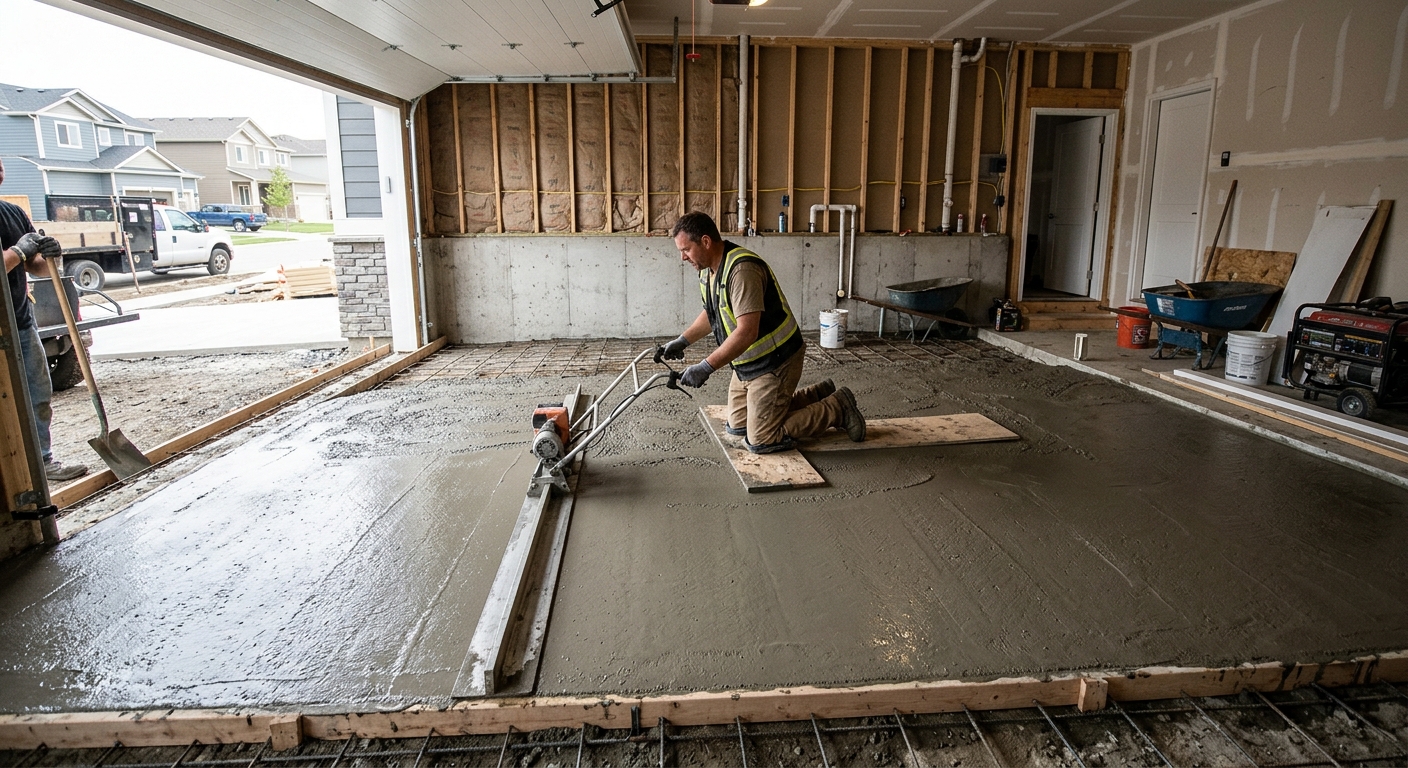
| Garage floor (interior slab) |
420 sq. ft. (21 ft × 20 ft) |
Vapour barrier, wire mesh/rebar as needed |
Light broom/smooth trowel (as specified) |
$7,980–$11,340 |
| Foundation footings (structural, below frost) |
Varies (estimate per linear ft + forming) |
Below-design frost depth, rebar/cage, engineering |
Structural concrete only |
$2,000–$3,500 |
Prices are estimates only and vary by project scope, site access and material selection.
What affects the price of concrete work in Upper Lynn
In the Lower Mainland–Southwest, it’s common to see quotes for the “same” concrete job vary by 30–50% once you compare the details behind the slab. That range usually comes down to three things: how deep the crew must go for frost protection, what’s included in base preparation and drainage, and whether the mix and curing plan are designed for freeze–thaw and coastal wetting—not just “pour and go.” Availability also matters: when scheduling tightens after rainy stretches, crews may price the risk of weather delays and longer curing timelines.
Here’s the climate-driven truth: frost line depth and freeze–thaw cycles dictate every exterior spec. In Lower Mainland–Southwest, typical practice targets a frost depth around 450 mm (18"), so footings and thickened edges sit below that to prevent frost heave. All exterior slabs should use air-entrained concrete to survive repeated wetting and freezing. And while our winters are milder than much of BC, we still plan for cool nights and high humidity—so curing may take longer, and crews may use curing blankets or seal planning to protect surfaces.
Two quick examples from Upper Lynn pricing: (1) A standard broom driveway might land closer to the $18–$28 per sq. ft. band when base prep is straightforward and truck access is easy; (2) a stamped driveway often moves toward the $22–$36 band because it requires more labour time for forming texture, colour integration and a robust seal system. If your soil is saturated or drainage is poor, excavation and granular underlay can cost more even when the surface finish is “simple.” If you’re working around older foundations typical of many established residential blocks, uneven elevations can also increase forming labour.
| Price Factor |
Why It Matters |
Cost Impact |
| Frost line depth |
Determines footing depth and form height |
More excavation/raising forms can add thousands on structural work |
| Site preparation |
Excavation, grading, compacted granular base |
Loose or wet subgrade increases granular, labour and time |
| Reinforcement |
Rebar or wire mesh requirement |
Extra steel + placement labour raises the slab cost, especially in larger areas |
| Mix design |
Air-entrainment and compressive strength spec |
Correct exterior air content reduces failure risk; wrong mix can be “cheaper” initially |
| Finish type |
Broom vs. stamped vs. exposed aggregate |
Labour and materials for stamps/aggregate tend to increase unit pricing |
| Pour size and concrete truck access to site |
Traffic, distance, and lift requirements |
Tighter access may mean smaller truck pours, extra labour and staging |
| Cold-weather curing precautions |
Heating and blankets |
Insulation blankets, thermal protection and monitoring add direct costs |
| Control joint pattern and sealing cost |
Controls cracking and improves durability |
Sealing and correct joint layout can add line-item cost but reduces premature spalling |
Permits & regulations in British Columbia
In British Columbia, most structural concrete work needs a building permit, and it’s often supported by engineered drawings. That typically includes footings, foundation walls and grade beams. For those components, the municipality commonly reviews drawings and expects the work to meet structural and drainage requirements—particularly important in freeze–thaw conditions and areas with saturated soils.
Concrete flatwork such as driveways, patios and walkways often does not require a permit by default. However, you may need to check before starting if the project affects lot grading, ties into stormwater drainage, changes impervious surface coverage, or impacts the municipal right-of-way. If you’re cutting into existing drainage, rebuilding a driveway apron near a curb, or altering how water flows toward a neighbour’s property, it’s smart to confirm in writing first.
Step-by-step for Upper Lynn homeowners: (1) ask the contractor for their certificate of insurance (liability) and ensure it’s current; (2) request their WCB coverage confirmation (commonly provided as a clearance letter or proof of registration—what’s acceptable can vary by contractor setup); (3) verify the contractor’s standing through the relevant BC contractor registry or licensing listings your contractor references; and (4) confirm the scope includes any required permit application responsibilities. Also, get references from similar-scale concrete jobs in the Lower Mainland–Southwest so you’re comparing methods, not just price.
Getting concrete right in Upper Lynn's freeze-thaw climate
Concrete fails in Upper Lynn most often due to moisture getting into the slab and then expanding through freeze–thaw cycles. When the concrete isn’t properly air-entrained, the paste can’t tolerate that expansion, and you end up with surface scaling and spalling—especially where de-icing salts get tracked onto driveways. The fix isn’t only “stronger concrete”; it’s the full system: base prep, air-entrainment, control joints and curing.
To spec correctly for the Lower Mainland–Southwest, start with base preparation. Use compacted granular sub-base to the correct depth for local soil conditions and frost protection, and pay attention to drainage so water doesn’t sit under the slab. Second, require an exterior mix with air-entrainment (typically 5–7%) and minimum performance of 32 MPa compressive strength (or as engineered). Third, set control joint spacing to limit random cracking—then follow up with sealing after cure to improve resistance to wetting and salt exposure.
Curing is the part many homeowners underestimate. Aim for at least 7 days of curing under appropriate conditions. Pouring during cold or rainy spells may require blankets and monitoring, which increases labour but materially improves outcomes. If you want a practical example: choosing air-entrainment and a proper seal plan may add a few hundred to a driveway, but it’s usually far less than replacing a failed surface after 2–5 winters—when spalling starts and repairs can look patchy.
When you ask technical questions about air content and curing, you’ll quickly see whether a contractor is building for Upper Lynn’s wet-cool freeze–thaw reality or just quoting the easiest mix.
| Spec |
Why It Matters in Upper Lynn |
What to Ask For |
Impact if Skipped |
| Compacted granular base (depth?) |
Prevents settlement and controls moisture beneath the slab |
Base depth and granular type; drainage notes based on site soil |
Uneven slab, cracking and shortened lifespan |
| Air-entrained concrete mix (target air %?) |
Improves freeze–thaw durability in exterior, salt-exposed areas |
Target air content of 5–7% for exterior flatwork |
Scaling and spalling within a few winters |
| Compressive strength (MPa rating) |
Helps ensure the concrete reaches adequate strength for load and exposure |
Minimum 32 MPa (or higher if engineered) |
Surface wear, cracking and reduced durability |
| Control joints (spacing per ACI guidelines) |
Controls where cracks occur as the slab moves |
Joint spacing and sawcut timing plan |
Random cracking and water infiltration |
| Minimum 7-day curing period |
Strength development depends on time, temperature and moisture |
How they cure in rain/cool nights; curing duration and protection |
Lower strength and higher risk of early surface damage |
| Penetrating sealer (when applied after cure) |
Repels de-icing salts and reduces moisture absorption |
Sealer schedule—typically 28 days post-pour after adequate cure |
Faster deterioration from salt, water and freeze–thaw |
How to choose a concrete work contractor in Upper Lynn
Choosing a contractor in Upper Lynn (and the wider Lower Mainland–Southwest) is mostly about verification and paper clarity—not just seeing a good finished photo. Start by confirming British Columbia compliance: ask for their current liability insurance certificate, proof of WCB coverage, and any licence/registration details they reference for concrete/contracting work in BC. You can then check the information against the relevant BC registry listings and by reviewing the documents’ dates, scope, and policy numbers. Don’t accept “it’s all covered” without seeing the paperwork.
Next, get 2–3 itemised quotes that break down labour and materials by line item (excavation/base, reinforcement, concrete supply, finishing, sawcut joints, sealing, disposal and any protection/curing). A lump-sum quote with vague inclusions often ends up costing more on change orders. Read the scope carefully: is the permit pull included if required for structural concrete? Is disposal and haul-away included, or is it billed separately? Is the sealer included, and what type (and application timing)?
Warranty should be in writing. Confirm the workmanship warranty length, whether it covers surface scaling/cracking related to finishing and curing, and whether product/manufacturer warranty is separate. Payment schedules matter: never pay more than 10–15% upfront. Hold back a portion until the job is complete and you’ve inspected joints, edges, slopes and surface finish quality. Finally, request a written timeline with start date, pour date assumptions (weather window) and completion estimate.
- Ask for the contractor’s proof of liability insurance and WCB clearance/proof.
- Verify licensing/registration details using BC registry listings referenced by the contractor.
- Require itemised quotes (no “blanket” numbers without base, steel, concrete, finishing, and sealing).
- Confirm excavation depth and granular base thickness for your site.
- Confirm air-entrainment and exterior exposure spec for freeze–thaw durability.
- Ask about control joint plan: spacing and sawcut timing.
- Ask how they cure in cool nights/high humidity (blankets, protection, duration).
- Confirm slopes/drainage approach so water doesn’t pond on the slab.
- Check whether truck access/mobilization constraints are included in the price.
- Clarify who handles disposal/haul-away of surplus soil and concrete waste.
- Confirm sealer product type and when it’s applied (typically after adequate cure).
- Review workmanship warranty details and exclusions in writing.
Concrete contractor red flags in Upper Lynn: (1) no discussion of air-entrainment for exterior slabs, (2) vague joint spacing and no sealing plan for de-icing salt exposure, (3) refusal to provide insurance/WCB proof or licence/registration information, (4) quotes that exclude excavation/base prep while still claiming “premium durability,” and (5) pressure for full payment upfront before any work is staged.
Frequently asked questions — concrete work in Upper Lynn
When is the best time to pour concrete in Upper Lynn?
In Upper Lynn, the “best” time is when we have predictable dry stretches and mild enough temperatures to support curing. Even though our Lower Mainland–Southwest climate is generally milder than interior BC, cold nights and heavy coastal rainfall can slow strength gain and increase finishing risk. Most concrete flatwork pours go ahead in spring through early fall when crews can manage curing protection without adding lots of heaters/blankets. If we need to pour in shoulder-season weather, a good contractor will plan for curing blankets, temperature monitoring and schedule adjustments to protect the surface from early rain exposure. For homeowners, the key is not the calendar date alone—it’s whether the crew has a curing plan that matches Upper Lynn’s wet-cool conditions and provides time for concrete to reach the minimum performance before traffic and finishing pressure.
How long does concrete take to cure?
Concrete strength develops over time, and curing isn’t just “waiting.” For most exterior flatwork in British Columbia, you should plan for at least a 7-day curing period before you treat the slab as fully set for typical use. However, final performance keeps improving beyond that, which is why many projects coordinate sealing closer to 28 days post-pour when the surface is sufficiently cured. In the Lower Mainland–Southwest, high humidity and cool nights can slow curing, so we often rely on proper moisture retention (curing blankets/protection) to keep the process on track. If you’re trying to compare quotes, make sure the contractor includes curing and protection in the scope—skipping or rushing curing is one of the most common causes of early surface scaling, especially in freeze–thaw exposure areas.
Do I need a permit for concrete work in British Columbia?
In British Columbia, it depends on what you’re building. Structural concrete such as footings, foundation walls, and grade beams typically requires a building permit and is usually supported by engineered drawings reviewed through municipal processes. Concrete flatwork like patios, walkways and driveways often does not require a permit, unless it affects lot grading, stormwater/drainage patterns, impervious surface limits, or municipal right-of-way considerations. For Upper Lynn homeowners, the practical step is to ask the contractor to clarify whether your specific scope triggers a permit check—and to confirm in writing what’s included. A reputable contractor will also provide liability insurance and WCB proof, which helps show they understand the regulatory and safety expectations.
Concrete vs pavers for a patio in Upper Lynn?
For patios in Upper Lynn, concrete is usually the better choice when you want a continuous surface with a predictable base and joint system. Pavers can look great and may be easier to spot-repair later, but they require excellent base preparation and correct bedding so the stones don’t shift with wet-cool seasons. In our coastal-wet environment, both options depend heavily on drainage, but stamped or finished concrete done with air-entrained mix and proper sealing can offer strong freeze–thaw resilience when installed correctly. Price-wise, concrete patios typically align with the driveway/slab market bands you’ve seen—plain patios often sit in the $16–$26 range per sq. ft. in the Lower Mainland–Southwest tier. If you expect frequent regrading or you want a highly custom pattern at smaller scale, pavers can be competitive; otherwise, well-built concrete tends to be more efficient to maintain and keep level.
How long does a concrete driveway last?
A concrete driveway in Upper Lynn can last for decades when it’s built with the right exterior specs: air-entrained concrete for freeze–thaw resistance, correct base compaction, controlled joint spacing, and a proper sealing plan to repel moisture and de-icing salts. In real life, driveway lifespan is less about “age” and more about whether the surface starts scaling or spalling early. If a driveway is installed with basic broom finish but misses air content, curing, or sealing, problems can appear within a few winters in wet, freeze–thaw conditions. If the contractor builds to spec and maintains surface protection, you’re more likely to see long service life. When you compare quotes, don’t focus only on unit price; compare what’s included. For example, broom-finish driveways often fall in the $18–$28 band per sq. ft., while premium finishes like exposed aggregate usually price higher for added labour and material.
What is air-entrained concrete and why does it matter here?
Air-entrained concrete is mixed with tiny, controlled air bubbles that help relieve pressure when water in the concrete paste freezes. In Upper Lynn and the wider Lower Mainland–Southwest, freeze–thaw cycles plus coastal rainfall and saturated soils mean exterior slabs are repeatedly exposed to moisture. Without air entrainment, water expansion can damage the surface, leading to scaling and spalling over time—especially where de-icing salts are used. That’s why reputable contractors specify air content and use it as part of the overall exterior durability design, not as an optional upgrade. If you’re getting a quote for a driveway or walkway, ask whether the mix is air-entrained for exterior exposure and what target air content is planned. A contractor who can’t answer that clearly is a concern, because this is one of the most important technical factors for freeze–thaw performance in British Columbia.