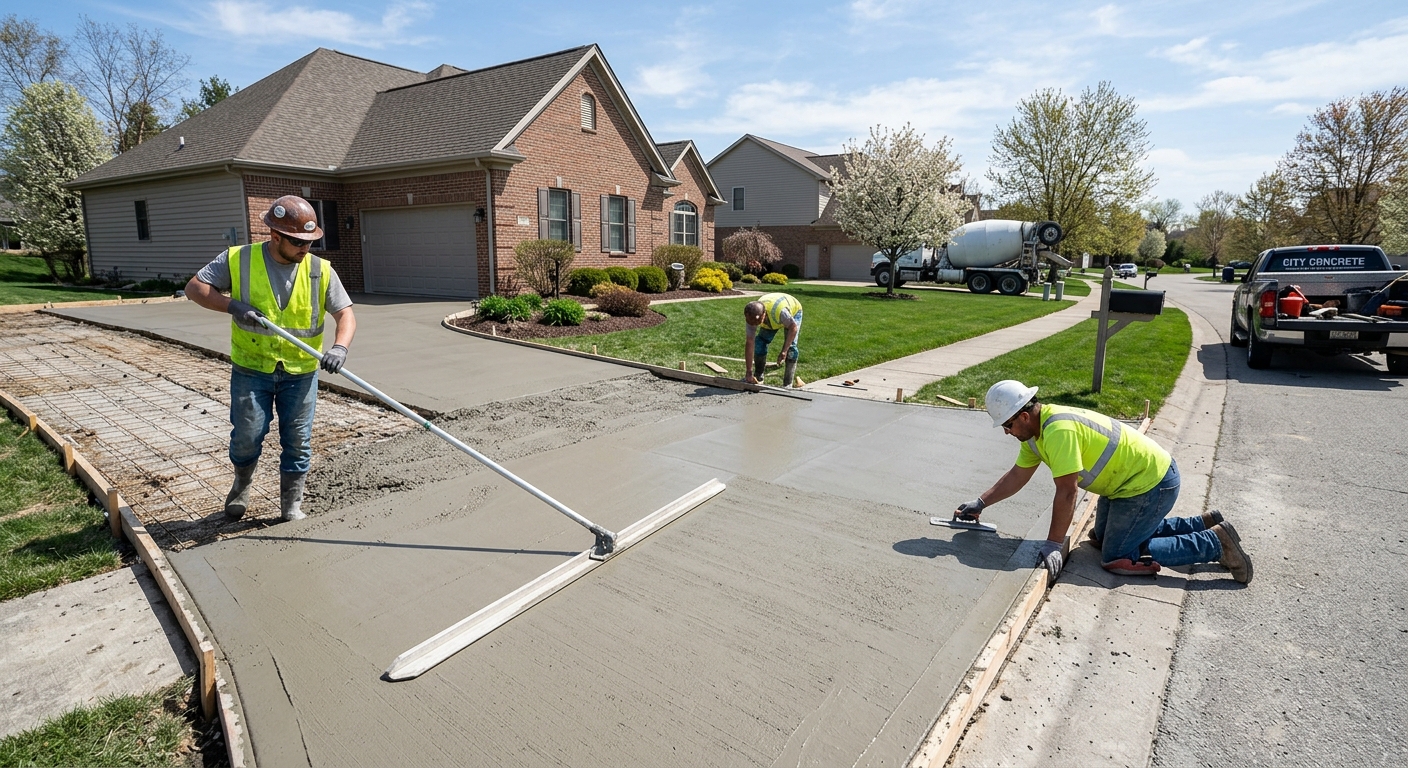
Concrete work options and costs in Brentwood Park
Brentwood Park is a Lower Mainland community where homeowners commonly upgrade entryways, patios, and driveways on single-detached lots. In the area, the profile shows a population of 10,500 (Statistics Canada, 2021 Census), and that steady owner-occupant demand is why local concrete crews are most booked during spring and early summer. You’ll also see many mid-life homes—often around the same era—as neighbours expand garages, rework walkways, and replace aging asphalt. That matters because slab and foundation work needs to be detailed to handle the shallow coastal frost depth and the region’s frequent wetting and drying.
Lower Mainland–Southwest pricing is shaped by mild winters, but it’s not “easy concrete.” Our frost depth is typically assumed around 450 mm / 18", so footings and thickened edges still need to sit below that to reduce freeze–thaw movement. Saturated soils and heavy coastal rainfall drive base-prep requirements (drainage and compacted granular), and exterior work generally uses air-entrained concrete plus control joints to manage cracking and scaling. In practice, scheduling and curing costs can rise when cool nights or prolonged rain follow a pour—contractors may use curing blankets, sealers, and longer cure windows to protect the finish, especially for driveways on busier streets in areas like the Montebello / Royal Oak-style residential lanes near Brentwood Road and the nearby commercial corridors, where access and timing constraints are common.
Below is a practical cost comparison for the most common concrete options in Brentwood Park, then we’ll break down the variables that swing quotes.
| Application |
Typical Size |
Key Spec |
Finish Option |
Price Range |
| Concrete driveway (standard broom finish) |
400–600 sq. ft. |
Air-entrained, control joints, compacted granular base |
Broom finish |
$18,000 – $28,000 |
| Exposed aggregate driveway |
400–600 sq. ft. |
Air-entrained, proper mix + surface exposure curing plan |
Exposed aggregate |
$22,000 – $34,000 |
| Stamped concrete driveway or patio |
300–500 sq. ft. |
Air-entrained, integral colour, release + seal coat plan |
Stamp pattern + sealer |
$22,000 – $36,000 |
| Plain concrete patio or walkway |
200–400 sq. ft. |
Air-entrained exterior mix, joints, drainage slope |
Plain finish |
$16,000 – $26,000 |
| Garage floor (interior slab) |
400–600 sq. ft. |
Vapour barrier as needed, reinforced slab, interior curing |
Steel trowel / broom alternatives |
$20,000 – $32,000 |
| Foundation footings (structural, below frost) |
Per typical house footing package |
Excavate to design depth, reinforcing, below-frost placement |
Structural concrete |
$200,000 – $350,000 |
Prices are estimates only and vary by project scope, site access and material selection.
What affects the price of concrete work in Brentwood Park
In Brentwood Park, two contractors can quote the “same” concrete job and still be 30–50% apart. The biggest reason isn’t the cement—it’s how each crew handles frost depth detailing, base preparation, reinforcement, and curing logistics in the Lower Mainland–Southwest climate. Even with mild winters, our freeze–thaw cycles and coastal rainfall mean exterior slabs need proper drainage and air-entrained concrete, plus a joint plan that limits random cracking and surface scaling.
Concrete in colder BC regions can be costlier because footings must extend below the design frost depth to prevent frost heave, and the region’s moisture conditions can require additional subgrade work. In coastal areas, frost depth is shallower (often around 0.5–1.2 m), but that doesn’t eliminate the need for below-frost placement—contractors still excavate to spec and build a consistent, compacted granular base. Air-entrainment (commonly designed for exterior exposure) is essential for exterior durability. If pours happen during cool nights or high humidity, crews may need cold-weather precautions—insulation blankets or controlled curing—to protect strength gain. De-icing salt use later can also accelerate spalling if the concrete mix and surface protection weren’t specified correctly, so sealing and workmanship both matter.
In practice, a broom-finished driveway might land in the $18–$28 per sq. ft. band, while a stamped or decorative solution typically adds labour and material for moulds/colour and sealing, pushing it into the $22–$36 per sq. ft. range. A common Brentwood Park example: replacing a driveway over poor drainage or saturated topsoil can add excavation and granular import, which raises the quote even if the final square footage looks similar. Another example is foundation work—prices can rise sharply when deeper or longer excavation is needed to reach below-frost conditions and to accommodate reinforcing placement safely.
| Price Factor |
Why It Matters |
Cost Impact |
| Frost line depth |
Determines footing depth and form height |
Higher excavation increases labour and disposal; impacts both schedule and material use |
| Site preparation |
Excavation, grading, compacted granular base |
Subgrade issues (soft/saturated soil) can add granular import and compaction time |
| Reinforcement |
Rebar or wire mesh requirement |
Rebar cages, supports, and placement labour can materially increase cost on slabs/footings |
| Mix design |
Air-entrainment and compressive strength spec |
Exterior performance mix and specified strength can cost more than basic interior mixes |
| Finish type |
Broom vs. stamped vs. exposed aggregate |
Stamped/exposed require extra labour for stamping, exposure steps, and consistent sealing |
| Pour size and concrete truck access to site |
Coverage rate and placement method |
Restricted access may require additional crew time, smaller loads, or pumping |
| Cold-weather curing precautions |
Heating and blankets |
Insulation blankets, heaters, and longer cure windows add labour and consumables |
| Control joint pattern and sealing cost |
Crack control and surface protection against salt and moisture |
More joint layout time and sealing products can add cost but reduce premature scaling/spalling |
Permits & regulations in British Columbia
In British Columbia, structural concrete work typically needs a building permit and often engineered drawings before construction starts. That includes foundation footings, foundation walls, grade beams, and other structural elements tied to the building’s load path and frost protection. By contrast, concrete flatwork—like driveways, patios, and walkways—often does not require a permit on its own, unless it changes lot grading, impacts impervious surface coverage limits, or affects drainage patterns that tie into municipal requirements or right-of-way concerns. Because each lot and municipality’s by-laws can differ, confirm with the local authority before breaking ground.
For your Brentwood Park project, verify the contractor is properly insured and can legally perform the work. Step-by-step: (1) check their documentation for a certificate of liability insurance showing current coverage and adequate limits for concrete work; request the COI and verify the job site is named or covered. (2) confirm WCB/WCB coverage (workers’ compensation) for payroll workers; ask for their clearance or coverage confirmation letter. (3) confirm their licensing status as applicable for the scope—structural concrete and excavation-related components may require trades and contractor registration depending on how the work is bundled. (4) ask for references on similar-scale Brentwood Park projects (driveway widths, slopes, and frost-depth detailing) so you can see how they handle wet-season curing and jointing.
Getting concrete right in Brentwood Park's freeze-thaw climate
The most common concrete failures in Brentwood Park are tied to water and temperature: freeze–thaw damage and surface scaling, followed by spalling if the concrete isn’t specified to resist moisture ingress. To spec the job correctly, focus on five things. First, base preparation: compacted granular sub-base to the correct depth and a consistent drainage slope, so water can’t pond under the slab. Second, mix design: for exterior flatwork, specify air-entrained concrete (often targeting about 5–7% air content for exterior exposure) and a minimum 32 MPa compressive strength unless engineering requires more. Third, control joints: the spacing and timing matter—joints should be cut or tooled to limit random cracking. Fourth, curing: plan for a minimum 7-day cure, and treat cool nights and high humidity seriously—use curing blankets or seal-curing plans when conditions are unfavourable. Fifth, sealing: apply a penetrating sealer about 28 days post-pour to repel de-icing salts and reduce water uptake.
When you’re comparing quotes, ask technical questions about air-entrainment and joint layout—poor air content is a major reason exterior slabs fail early in freeze–thaw climates. For example, a stamped patio might add cost versus a broom-finish patio, but that premium is justified when the contractor also proves they’ve matched the mix and properly cured the surface so the decorative finish doesn’t degrade. If a quote “saves” money by reducing base thickness, skipping reinforcement where needed, or cutting corners on curing/sealing, that’s where the long-term expense comes from—repairs rarely cost less than doing it right the first time.
| Spec |
Why It Matters in Brentwood Park |
What to Ask For |
Impact if Skipped |
| Compacted granular base (depth?) |
Prevents water pooling and frost movement under exterior slabs |
Granular type, target thickness below slab, and compaction method |
Early cracking, pumping, and uneven settlement during wet/cold cycles |
| Air-entrained concrete mix (target air %?) |
Improves resistance to freeze–thaw scaling and spalling |
Documented air target (typically 5–7% for exterior flatwork) and mix design sheet |
Surface deterioration and spalling within a few seasons of de-icing and freeze–thaw |
| Compressive strength (MPa rating) |
Ensures adequate durability and strength gain for exterior exposure |
Minimum 32 MPa (or higher if engineered), and curing temperature expectations |
Reduced performance and higher risk of surface damage |
| Control joints (spacing per ACI guidelines) |
Controls where cracks occur under thermal movement |
Planned joint layout, saw-cut/tooling timing, and joint depth/width |
Random cracking and moisture pathways that weaken the slab edge |
| Minimum 7-day curing period |
Reduces cracking and improves long-term durability in cool, humid conditions |
How curing is managed during rain/cold (blankets, insulated protection) |
Lower surface strength and increased permeability leading to scaling |
| Penetrating sealer (when applied after cure) |
Repels salt and water during Vancouver-area winters |
Confirm product type and application timing (about 28 days post-pour) |
Faster water absorption and more pronounced surface wear |
How to choose a concrete work contractor in Brentwood Park
Choosing the right contractor in Brentwood Park comes down to proof: insurance, proper documentation, a detailed scope, and a plan for curing in the Lower Mainland–Southwest climate. Start by verifying British Columbia insurance items. Ask for a certificate of liability insurance and check that coverage is active and appropriate for concrete work (and that subcontractors are listed or covered). For workers’ protection, confirm WCB/WCB coverage—request the most current clearance/coverage confirmation letter, not just a statement. Then, if the job includes structural components, confirm the contractor and relevant trades are properly registered for the scope they’re doing.
Next, request 2–3 itemised written quotes, ideally with a breakdown of labour and materials (excavation/base, forms, reinforcement, concrete supply, finish, saw cutting/joints, sealing, and disposal). Avoid quotes that only list a total “per square foot” without explaining inclusions—concrete pricing is easy to misunderstand when prep work differs. Read the scope carefully: is permit pulling included (when required), is disposal/haul-away included, who provides traffic control and barrier protection, and are there allowances for changes if subgrade is saturated?
For warranty, look for a clear workmanship warranty length and whether it covers cracking, spalling, and joint performance. Ask for the product/manufacturer warranty details and whether it’s transferable. Payment should be staged—never more than about 10–15% upfront; hold back until finish quality checks and completion. Finally, get a written start date and completion timeline that accounts for weather and cure times.
- Get quotes in writing with line-by-line scope (not lump sum only).
- Confirm air-entrainment and minimum strength (e.g., 32 MPa) for exterior flatwork.
- Ask what depth the compaction granular base will be and how it’s compacted.
- Request a joint layout plan (spacing and when joints are cut/toolled).
- Ask how they protect pours from cool nights and wet weather (blankets/curing plan).
- Verify liability insurance COI is current and job-site covered.
- Confirm WCB/WCB clearance/coverage for their workers.
- Check that disposal and site clean-up are included.
- Confirm whether sealing is included and the timing (typically after curing).
- Make sure concrete truck access and placement method are explained (forms/pumping if needed).
- Ask about reinforcement specifics (wire mesh vs. rebar, and how chairs/ties are used).
- Require a written start date, completion estimate, and weather contingency plan.
Concrete red flags I see in Brentwood Park include: (1) skipping or minimizing base prep due to “soft soil,” (2) not discussing air-entrainment or refusing to provide mix details, (3) scheduling a pour right before rain without a documented curing plan, (4) vague wording like “finish as required” without specifying joints/sealer, and (5) requesting large upfront payments (well above 10–15%) with no staged milestones.
Frequently asked questions — concrete work in Brentwood Park
Stamped vs broom-finish concrete — cost difference?
In Brentwood Park, stamped concrete generally costs more than a broom-finish because it adds labour for colour integration, moulds/texture application, and careful timing to get clean edges. As a ballpark, broom-finish driveway work often falls in the $18–$28 per sq. ft. band, while stamped concrete driveways/patios typically land in the $22–$36 per sq. ft. range (depending on size, base condition, and access). The climate plays into this too: stamped surfaces show imperfections faster if base prep and curing aren’t consistent through cool, damp periods common in the Lower Mainland–Southwest. When comparing quotes, don’t just look at the per-square-foot price—confirm both options use air-entrained exterior mixes, proper control joints, and sealing after cure.
When is the best time to pour concrete in Brentwood Park?
The “best” time is typically late spring through early summer when days are warmer and night temperatures don’t drop too far, because curing and early strength gain are more predictable. In Brentwood Park and the wider Lower Mainland–Southwest region, rain can still interrupt work, so contractors should plan around the weather forecast and avoid starting pours when heavy rainfall is expected in the first 24–48 hours. That said, we still pour successfully in shoulder months by using curing blankets and protective measures for cool, damp conditions, as long as the mix and curing plan are documented. If a contractor can’t explain how they’ll protect the slab/foundation and manage curing during wet or cool stretches, that’s a sign the schedule may create durability risks later.
How long does concrete take to cure?
Concrete curing has two timelines: initial cure and readiness for different uses. For most exterior flatwork in British Columbia, you should plan on at least a 7-day curing period where the concrete is protected and kept in suitable conditions, especially if cool nights or high humidity follow the pour. Even after that, concrete continues to gain strength, so sealing is typically done about 28 days post-pour with a penetrating sealer to help repel water and de-icing salts. Some contractors may allow light foot traffic sooner, but driving/parking loads and full use should match the contractor’s documented curing and strength plan. Ask for their specific curing approach for your pour date in Brentwood Park.
Do I need a permit for concrete work in British Columbia?
Often, patios, walkways, and driveways do not require a permit in British Columbia unless they affect lot grading, drainage, impervious surface limits, or the municipal right-of-way requirements. However, structural concrete—like foundation footings, foundation walls, and grade beams—typically requires a building permit and usually engineered drawings reviewed by the municipality. For a Brentwood Park homeowner, the practical step is to confirm with your local authority before you start, especially if you’re raising grades, changing drainage patterns, or modifying how water flows off your property. Also verify the contractor can provide proper documentation and is insured before they excavate or place structural concrete.
Concrete vs pavers for a patio in Brentwood Park?
For patios in Brentwood Park, both concrete and pavers can look great, but they behave differently. Concrete is usually more cost-effective up front when you keep the design simple, and durable exterior concrete with air-entrainment and joints can handle freeze–thaw cycles better when properly detailed. Pavers offer flexibility and easier spot repair, but they still require excellent base prep and drainage; if water sits below pavers, you can get shifting or settling. Pricing depends heavily on layout complexity, excavation depth, and base conditions. In the $16–$26 per sq. ft. band, plain concrete patios often compete well with basic paver installations. If you want decorative surface style and are budget-conscious, broom or lightly textured concrete with a good sealer can be a strong value versus fully stamped work.
How long does a concrete driveway last?
A well-built concrete driveway in Brentwood Park commonly lasts 20–30 years or longer, but that lifespan depends on how it’s constructed for our wet winters and freeze–thaw conditions. The main durability drivers are: correct below-frost detailing for edges/footings where thickened sections apply, a compacted granular base that prevents water pooling, air-entrained exterior mix, proper control joint spacing, and curing protection during cool/wet periods. De-icing salts can accelerate surface wear if the slab isn’t sealed, so sealing (often about 28 days after pour) is a smart step where salts are used. When budgeting, it’s worth comparing options in the $18–$28 per sq. ft. range for broom-finish versus higher-cost finishes, but don’t pick the cheapest scope if the contractor can’t show the mix and joint plan.