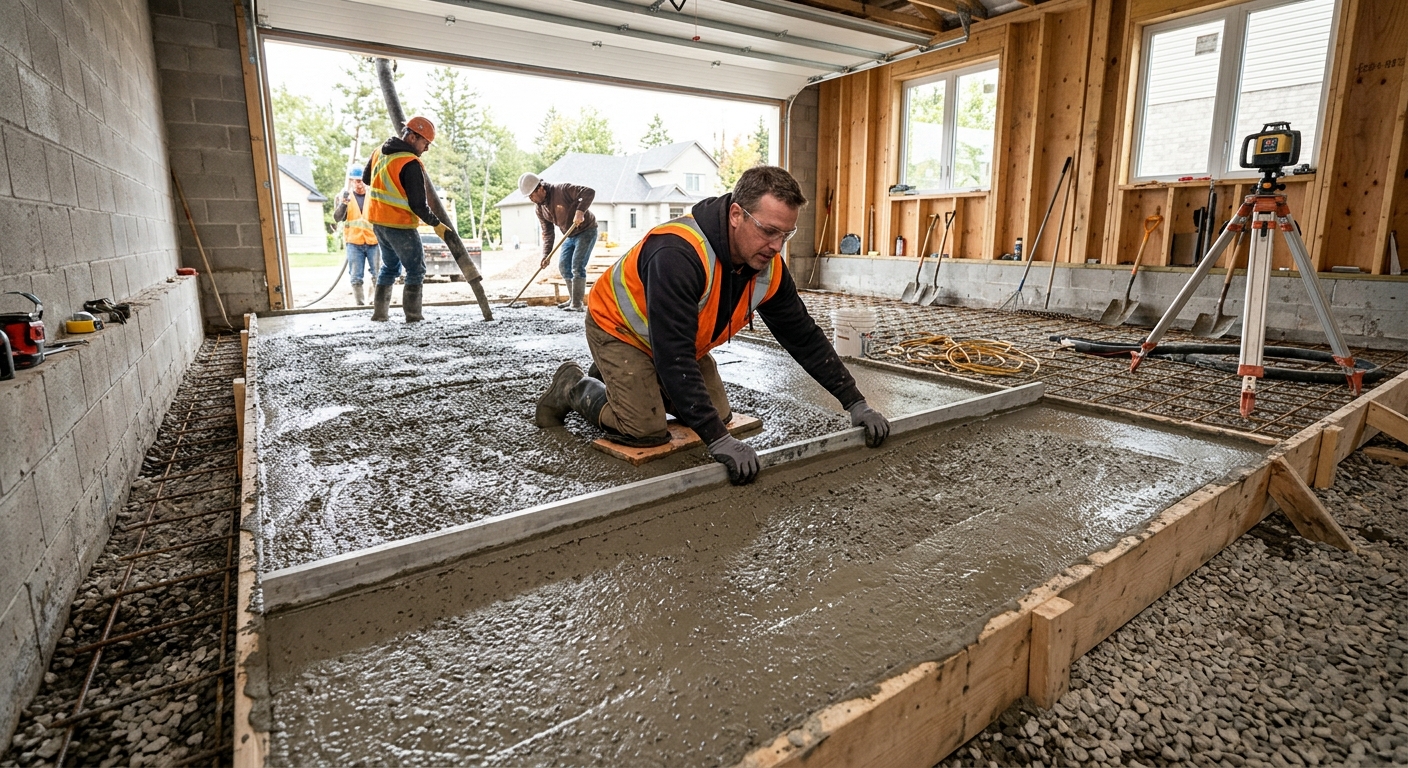
Concrete work options and costs in Port Hardy
Port Hardy homeowners typically start with one of three jobs: a new concrete driveway, a patio/walkway, or foundation concrete tied to an addition. In Port Hardy, single-detached houses make up 56.4% of dwellings, which is why most flatwork demand centres on driveways, patios and walkways for everyday use and accessibility. With 1,210 homeowner households (67.4% of all households) and a housing stock where 71.3% of homes were built before 1981, it’s common to see older driveways resurfaced, replaced, or extended as families upgrade entrances and garages.
On Vancouver Island and the Coast, pricing is shaped by a relatively shallow design frost depth paired with frequent wetting and freeze–thaw cycles. That combination means exterior slabs still need air-entrained mixes, well-draining granular base, and a control-joint plan to reduce scaling and random cracking. Costs are also influenced by short windows for proper curing after heavy rain or cold snaps—contractors often build in weather contingencies and may upgrade the mix (and protection) to keep the job meeting durability expectations.
In Port Hardy, the trade is especially in demand around the Harbour Road corridor and the more established neighbourhood pockets closer to downtown, where access is tight and driveways are often narrow. If a contractor can’t get a pump or forms in cleanly, labour and forming time rise quickly.
To compare options apples-to-apples, use the table below as a practical baseline for typical scopes and finishes, then confirm specs in your written quote.
| Application |
Typical Size |
Key Spec |
Finish Option |
Price Range |
| Concrete driveway (standard broom finish) |
400 sq. ft. |
Exterior air-entrained mix + control joints |
Broom finish |
$16,000–$25,000 |
| Exposed aggregate driveway |
400 sq. ft. |
Air-entrained mix + surface retarder/aggregate wash |
Exposed aggregate |
$19,000–$29,000 |
| Stamped concrete driveway or patio |
300 sq. ft. |
Air-entrained mix + integral colouring |
Stamped pattern |
$15,000–$26,000 |
| Plain concrete patio or walkway |
200 sq. ft. |
Exterior air-entrained mix + broom or light trowel |
Broom/straight-edge finish |
$2,800–$4,400 |
| Garage floor (interior slab) |
480 sq. ft. |
Vapour barrier + reinforcement as specified |
Plain trowel or lightly broomed |
$19,000–$34,000 |
| Foundation footings (structural, below frost) |
Varies (e.g., 4–8 ft. wide walls, total linear metres) |
Designed depth below frost + proper granular base |
Structural concrete |
$10,000–$20,000 |
Prices are estimates only and vary by project scope, site access and material selection.
What affects the price of concrete work in Port Hardy
In Port Hardy and across Vancouver Island and the Coast, it’s normal to see quote swings of 30–50% for “the same” concrete job. The difference usually comes down to frost requirements, freeze–thaw durability specs, and how much prep and protection the contractor includes. Because many homes in the area are older (71.3% built before 1981), there are also more cases where you’re working around existing slabs, poor drainage, or compacted backfill that needs correction before new concrete can perform.
Frost line depth and freeze–thaw cycles dictate every exterior spec: footings must sit below the design frost depth to prevent frost heave, and exterior slabs require air-entrained concrete to survive repeated wetting and freezing. In this coastal BC climate band, frost depth is commonly assumed around 0.5–1.2 m for design purposes, so the footing depth and form height are less extreme than interior provinces—but the freeze–thaw frequency is still what drives durability costs. Cold-weather curing precautions also matter: when temperatures drop after a rain event, contractors may need insulation blankets and, in some cases, temporary heating to keep strength gain on track.
De-icing salts (even when used sparingly) accelerate surface spalling risk on unprotected, improperly air-entrained exterior concrete, so sealing often becomes part of the lifecycle plan. Practically, a driveway replacement might land near the local “concrete driveway / slab” backbone of $16–$25 per square foot, but stairs, removal and hauling, and upgraded mix spec can push projects toward the higher end. Meanwhile, plain patios/walkways may start closer to the $14–$22 band, but if your base is soft and needs thicker granular replacement, the price follows the excavation.
Two quick Port Hardy examples: (1) a narrow Harbour Road access lot may increase labour for forming and concrete placements; (2) a site with poor drainage might require more granular base and a drainage layer, raising the prep portion more than the finish choice. Even stamped work won’t justify its added cost unless the base and jointing are already correct.
| Price Factor |
Why It Matters |
Cost Impact |
| Frost line depth — determines footing depth and form height |
Helps prevent frost heave and foundation movement |
Can add major excavation and concrete volume for footings |
| Site preparation — excavation, grading, compacted granular base |
Correct subgrade compaction reduces settlement and cracking |
Rises with soft soils, over-excavation, and hauled-in aggregate |
| Reinforcement — rebar or wire mesh requirement |
Supports load capacity and controls cracking (as designed) |
Cost increases with steel quantity, tying, and added labour |
| Mix design — air-entrainment and compressive strength spec |
Exterior durability relies on freeze–thaw resistance |
Usually modest per cubic metre, but required for proper exterior performance |
| Finish type — broom vs. stamped vs. exposed aggregate |
Surface aesthetics and placement complexity |
Stamped/exposed are more labour-intensive and require more skilled finishing |
| Pour size and concrete truck access to site |
Access affects forming time, labour, and whether a pump is needed |
Narrow lots and tight turns can increase costs quickly |
| Cold-weather curing precautions — heating and blankets |
Strength gain and surface protection in cool periods |
Adds labour and materials; sometimes necessary to meet spec |
| Control joint pattern and sealing cost |
Controls where cracks can form and protects surfaces from moisture and salts |
Sealing adds a measurable line item, but reduces long-term damage |
Permits & regulations in British Columbia
In British Columbia, structural concrete work typically requires a building permit, especially when it involves elements that support the structure or impact load paths. That usually includes footings, foundation walls, and grade beams for basements, additions, or structural repairs. Many of these projects also trigger engineered drawings, which municipalities may review as part of permit approvals.
Concrete flatwork (driveways, patios, and walkways) often does not require a permit, but there are important exceptions. If the work changes lot grading, affects drainage away from the foundation, increases impervious surface coverage beyond local expectations, or touches the municipal right-of-way/sidewalk area, a permit or approval may be required. In Port Hardy, always confirm before breaking ground—especially if you’re altering slopes for accessibility or redirecting surface water.
Before you sign with a contractor, verify they carry liability insurance and WSIB/WCB coverage (the specific coverage term depends on contractor status). Ask for up-to-date proof of insurance and, for the job site, a clearance letter or equivalent documentation where applicable.
Step-by-step for Port Hardy homeowners:
1) Ask for the contractor’s legal business name and certificate documents.
2) Check licensing status using the relevant provincial contractor licensing registry (online).
3) Review the certificate of insurance: ensure it covers the work, includes adequate liability limits, and lists your project/site address correctly.
4) Confirm WSIB/WCB coverage status is current and applicable to the crew that will pour.
5) Request references from similar-scale concrete jobs in the Vancouver Island and Coast region.
Getting concrete right in Port Hardy's freeze-thaw climate
Concrete fails in Port Hardy when water gets trapped near the surface and freezes, expanding against weak, poorly prepared base or inadequate mix design. The result is commonly scaling and spalling—often worsened by de-icing salt use and by random cracking that lets more moisture into the slab. To spec the job correctly, focus on five things that tie directly to Vancouver Island and Coast durability: base, mix, joints, curing, and sealing.
(1) Base preparation: excavate to the right depth and install a compacted granular sub-base with good drainage. If the subgrade is soft or saturated, the slab can settle and crack, even if the finish looks good at pour day. (2) Mix design: exterior flatwork should use air-entrained concrete (commonly 5–7% air content target for freeze–thaw durability) and meet a minimum compressive strength such as 32 MPa as specified for exterior work. (3) Control joints: place joints to limit random cracking and keep shrinkage cracking predictable. (4) Curing: plan for a minimum 7-day curing period under proper conditions; cool, damp spells slow strength gain and can increase early-age surface damage. (5) Sealing: apply a penetrating sealer after the cure (commonly around 28 days post-pour) to repel moisture and reduce salt-driven deterioration.
When you’re comparing quotes, ask for these specs by name. A contractor who only talks about the finish but not the air content and base thickness is the one to worry about. For example, upgrading from a plain broom driveway to stamped concrete might add meaningful cost, but it’s only “worth it” if the foundation prep and air-entrained mix are already properly budgeted. If a low quote cuts granular replacement or uses an interior mix approach, you risk premature spalling—turning a modest savings into expensive replacement.
| Spec |
Why It Matters in Port Hardy |
What to Ask For |
Impact if Skipped |
| Compacted granular base (depth?) |
Supports load and reduces moisture pooling under freeze–thaw conditions |
Granular base depth and compaction method matched to your soil |
Settlement cracks and loss of slab support |
| Air-entrained concrete mix (target air %?) |
Prevents freeze–thaw damage and helps resist surface scaling/spalling |
Target exterior air content (typically 5–7% for freeze–thaw flatwork) |
Scaling and spalling in wet BC winters |
| Compressive strength (MPa rating) |
Affects long-term durability and resistance to wear |
Minimum compressive strength (commonly 32 MPa for exterior flatwork) |
Higher risk of premature wear and cracking |
| Control joints (spacing per ACI guidelines) |
Limits where cracks can form as the slab shrinks/expands |
Proposed joint spacing, saw-cut timing, and joint sealing plan |
Random cracking and more water intrusion |
| Minimum 7-day curing period |
Strength gain is slower in cool, wet Port Hardy weather |
How curing protection will be handled during rain/cold snaps |
Surface weakness and early-age damage |
| Penetrating sealer (when applied after cure) |
Reduces moisture and salt penetration that contributes to spalling |
When sealer will be applied after cure (commonly around 28 days) |
Faster deterioration of the top surface |
How to choose a concrete work contractor in Port Hardy
Choosing the right concrete contractor in Port Hardy is mostly about verifying coverage, matching the spec—not just comparing numbers. Start by confirming British Columbia licensing status (ask for the contractor’s legal name and registration details), then verify liability insurance and WSIB/WCB coverage for the workers who will be on your site. You should see a current certificate of insurance (with coverage amounts that fit the scope) and documentation that the crew is covered for workplace injury.
Next, get 2–3 itemised written quotes. Look for a breakdown that separates labour and materials (and ideally shows excavation/base prep, reinforcement, concrete supply, forming, finishing, and disposal/haul-away). Avoid quotes that only list a single lump sum with “concrete included” wording—those often hide exclusions like removal of existing slab, saw-cutting, granular replacement, drainage upgrades, or permit responsibility.
Review the scope carefully: What’s included for concrete disposal? Is trucking/placement access addressed? Is a pump included or excluded? If sealing is recommended for exterior flatwork, is it included after cure, and who applies it?
Warranty matters too. Ask for the workmanship warranty length, what it covers (cracks that occur within a defined context, spalling related to mix/base specs, workmanship-related settlement issues), and whether any product/manufacturer warranty is transferable. Finally, plan the payment schedule: never agree to more than 10–15% upfront, and hold back until the work is complete and cleanup is done.
Get a written timeline with a start date and completion estimate—on Vancouver Island, weather can shift pour-day sequencing, but your contractor should be clear about curing protection and contingency handling.
- Confirm British Columbia licensing using the contractor’s legal business name.
- Request proof of liability insurance and ensure it matches the project site.
- Verify WSIB/WCB coverage for the actual crew members assigned to your job.
- Ask for at least two references on similar-scale driveways or patios in the region.
- Get itemised quotes (excavation/base prep, reinforcement, concrete supply, finishing, disposal).
- Require clarity on exclusions: removal, disposal, drainage corrections, and any grading changes.
- Ask what air-entrained mix and compressive strength will be used for exterior work.
- Confirm control joint pattern and whether joints will be saw-cut and sealed (if applicable).
- Ask how they handle curing in cool/wet weather (blankets/heating if needed).
- Confirm whether sealing is included and the timing (after cure, not immediately after finishing).
- Keep payment to 10–15% upfront max; hold a portion until completion and cleanup.
- Get start and completion dates in writing, including weather contingency language.
Concrete red flags in Port Hardy: vague mix wording (“standard concrete” with no air content), quotes that don’t mention base prep depth/compaction, no plan for control joints, promises of “instant curing” or no curing protection in cool weather, and contractors asking for large upfront payments without a detailed scope and schedule.
Frequently asked questions — concrete work in Port Hardy
What is air-entrained concrete and why does it matter here?
Air-entrained concrete is made with tiny, evenly distributed air bubbles that help the mix handle freeze–thaw stress. In Port Hardy and across Vancouver Island and the Coast, even though winters are milder than inland BC, wetting followed by cold snaps can still damage surfaces. That’s why exterior flatwork (driveways, walkways, patios) should use an air-entrained mix with a freeze–thaw durability target—commonly in the 5–7% air range—rather than a standard “interior” mix. If air-entrainment is missing or low, you’re more likely to see scaling and spalling over a few winters, especially if de-icing salts are used. When comparing quotes, ask for the mix spec and confirm it’s designed for exterior exposure in British Columbia’s freeze–thaw conditions. A driveway typically falls in the $16–$25 band here, and the right mix is part of what you’re paying for.
How do I prepare the base for a concrete slab?
Base preparation is where good concrete starts. For a Port Hardy slab, the contractor should excavate to stable, well-draining material and then install a compacted granular sub-base to the depth required for your site conditions. The goal is a uniformly supported base that won’t pump water up into the slab during freeze–thaw cycles. Ask how they’ll deal with soft or saturated subgrade: will they over-excavate, add granular replacement, and compact in lifts? You should also hear about drainage—surface water management away from foundations matters in older neighbourhoods where 71.3% of homes were built before 1981. Proper compaction and drainage are often more important than whether you choose a broom finish or stamped finish. If you’re building a walkway or patio, base prep is still essential even though it’s commonly cheaper than driveways. A plain patio or walkway often lands near the $14–$22 band, but poor base prep can add costs later through cracking and uneven settlement.
How do I compare concrete quotes?
Comparing quotes in Port Hardy is less about the final number and more about whether the specs match. Ask for itemised pricing so you can see labour and materials separately: excavation and granular base prep, reinforcement (if required), concrete supply, forming, finishing, and disposal/haul-away. Confirm whether the quote includes air-entrained concrete for exterior work and the minimum compressive strength they’re using (commonly 32 MPa for exterior flatwork). Check control joint details and whether sealing is included after curing—especially if you’ll use de-icing salts. Also compare “access” assumptions: narrow lots or limited truck access can raise forming and labour time. If one quote uses a broom finish but another includes stamping, those aren’t the same scope—stamped concrete typically sits higher in the $22–$35 band for decorative work. A driveway around the $16–$25 band may still come in lower or higher depending on base remediation and mix upgrades.
Can concrete be poured in cold weather in Port Hardy?
Concrete can be poured in cold weather in Port Hardy, but it has to be protected and scheduled correctly. Cool, wet conditions slow strength gain, and early-age surface damage is a real risk during rain/cold snaps. A proper contractor will monitor temperatures, plan pour timing, and use curing protection such as insulating blankets and/or temporary heating when needed so the concrete reaches adequate strength safely. The key is not to rely on “it feels warm enough” on the morning of the pour; the curing period matters too—cold-weather precautions are part of meeting durability expectations in British Columbia’s freeze–thaw cycle. Expect some weather contingency in good quotes because contractors may need extra labour and materials for protection. If a quote doesn’t mention curing protection at all and you’re pouring near shoulder season, ask directly how they’ll manage curing. In practice, that might be why two driveway quotes differ by 30–50% even when the finish option looks similar.
How do I maintain concrete in Port Hardy's freeze-thaw climate?
Maintenance in Port Hardy is about keeping water and salts out and addressing small issues before they grow. Start with sealing: a penetrating sealer applied after the concrete has fully cured (often around 28 days post-pour) can reduce moisture and salt penetration, which helps slow scaling and spalling. Use a proper de-icer sparingly—especially avoid heavy salt loads right against the slab edge, where damage starts first. Keep surface debris and leaf buildup cleared so water doesn’t sit in corners or at joint lines. If you notice small cracks, check whether joints are sealed as originally designed and keep drainage working (downspouts and surface water should not flow onto the new slab). For older driveways in a community with many pre-1981 homes, drainage problems are common, so maintenance also includes ensuring the surrounding grading still sheds water away from the concrete.
What causes concrete to spall in Port Hardy winters?
Spalling in Port Hardy is usually driven by moisture movement plus freeze–thaw stress. Water penetrates the surface through hairline cracks or unsealed joints; when temperatures drop, water expands inside the concrete, breaking off the outer surface. Inadequate air-entrainment is a major contributor because the mix can’t tolerate the freeze–thaw cycling the way it should. Another common cause is poor base prep and drainage—if the slab is sitting on weak, saturated subgrade, it can move slightly and create pathways for water. Fast freeze events after heavy rain increase risk, which is why Vancouver Island and Coast concrete work needs a well-planned pour and curing protection. If de-icing salts are used, they can intensify damage—making sealing and joint maintenance more important. When you compare options, don’t expect a “cheap” finish to fix a durability problem; even a broom-finished driveway in the $16–$25 band will fail early if the air-entrained mix and control joint plan aren’t built correctly for British Columbia’s climate.