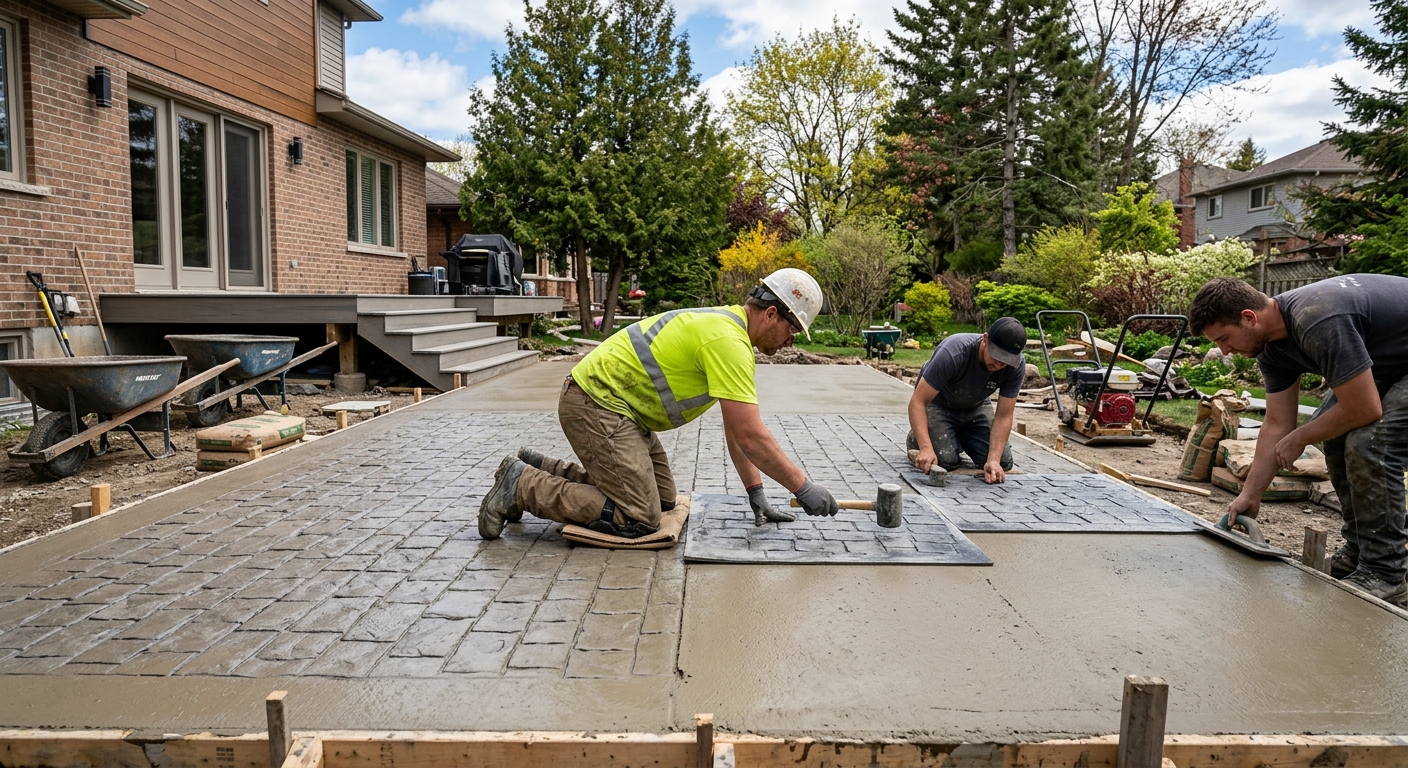
Concrete work options and costs in Pemberton
Pemberton homeowners usually start with the same question: what will a concrete driveway, patio, walkway or foundation cost in today’s Lower Mainland–Southwest market. Concrete flatwork is in especially steady demand here because much of the local housing stock is owner-occupied (64.9% of households are homeowners, Statistics Canada, 2021 Census), and a meaningful share of dwellings are single-detached homes (16.6% of dwellings). That mix tends to mean more driveways, sidewalks and backyard patios needing durable, winter-ready surfaces.
Lower Mainland–Southwest pricing is shaped by our mild winters plus a shallow but real frost line and frequent wet periods. Even when temperatures aren’t consistently freezing like in northern BC, freeze–thaw cycles and saturated soils can still stress slabs and foundations. That means contractors plan footings below the design frost depth (commonly around 450 mm / 18" as a practical assumption), build a properly compacted granular base for exterior slabs, and specify air-entrained concrete with controlled joints to manage cracking and scaling. Prolonged rain, cool nights, and high humidity also affect scheduling and curing; longer curing times and extra curing protection can be needed to reach design strength and surface durability.
In Pemberton, demand is often strongest around town-centre streets and the Wedge/Fraser Valley Highway corridor, where property access and drainage conditions influence prep scope and material use. Below is a practical comparison of common options you’ll see in local quotes, before we break down what drives price up or down.
| Application |
Typical Size |
Key Spec |
Finish Option |
Price Range |
| Concrete driveway (standard broom finish) |
400–600 sq. ft. |
Air-entrained exterior mix, compacted granular base, control joints |
Broom finish |
$7,200 – $16,800 |
| Exposed aggregate driveway |
400–600 sq. ft. |
Air-entrained exterior mix, base prep for drainage, jointing for shrinkage |
Exposed aggregate (stone wash) |
$9,200 – $19,800 |
| Stamped concrete driveway or patio |
300–500 sq. ft. |
Air-entrained mix, integral colour (where specified), proper curing protection |
Stamped pattern + release agent |
$9,600 – $24,500 |
| Plain concrete patio or walkway |
200–350 sq. ft. |
Compacted base, control joints, edge forms for clean lines |
Broom or light trowel finish |
$3,200 – $9,100 |
| Garage floor (interior slab) |
400–600 sq. ft. |
Vapour retarder (where required), reinforcement per plan, proper curing |
Broom finish or smooth trowel (lightly textured) |
$7,000 – $18,000 |
| Foundation footings (structural, below frost) |
Varies by plan |
Excavate to design depth below frost, structural concrete, rebar as required |
Unfinished structural concrete |
$9,000 – $28,000 |
Prices are estimates only and vary by project scope, site access and material selection.
What affects the price of concrete work in Pemberton
In Pemberton and across the Lower Mainland–Southwest, it’s common to see quotes for the “same” concrete job differ by 30–50%. The reason isn’t the concrete alone—it’s the hidden scope that protects the concrete over time. In this region, our shallow frost depth still drives footing design, and freeze–thaw cycles plus heavy rainfall make drainage and base prep non-negotiable. Contractors also price in labour availability around the pour season, curing protection needs during cool or wet stretches, and the realities of truck access on local lots.
Specifically, frost depth and freeze–thaw cycles dictate every key concrete spec. Footings must extend below the design frost depth (coastal BC is typically about 0.5–1.2 m, while colder regions require deeper excavation and more cold-weather precautions). For exterior flatwork, air-entrained concrete is essential to reduce damage from freeze–thaw scaling and spalling risk. When conditions are colder or damp, contractors may need insulated blankets, curing blankets, or heated enclosures to protect the slab and reach design strength safely—those steps add material and labour cost.
Two examples that often move cost up or down in Pemberton: (1) Sloped driveways near wet ground may require more excavation and subdrain work to keep water away from the base, which can push a driveway toward the higher end of pricing (for example, concrete driveways align with local bands of about $18–$28 per sq. ft.). (2) For patios and walkways, a straightforward level site with good truck access can keep costs nearer the lower band (about $16–$26 per sq. ft.), especially when finish selection stays plain (broom) instead of stamped. If your home was built before 1981 (10.7% of dwellings, Statistics Canada, 2021 Census), you may also find older drainage patterns and settlement areas that require additional base correction before the new slab will last—often adding excavation and reinforcement work measured in dollars, not just “small tweaks.”
| Price Factor |
Why It Matters |
Cost Impact |
| Frost line depth |
Determines how deep footings and thickened edges must go |
Higher excavation and formwork when deeper |
| Site preparation |
Excavation, grading, drainage and compacted granular base quality |
More base/subdrain work raises labour and disposal |
| Reinforcement |
Rebar or wire mesh reduces cracking in the right locations |
Material + tying/labour can add noticeable cost |
| Mix design |
Air-entrainment and compressive strength requirements for freeze–thaw durability |
Special mix and QC steps add to material cost |
| Finish type |
Broom vs stamped vs exposed aggregate affects labour and consumables |
Stamped/exposed typically costs more |
| Pour size and concrete truck access to site |
Smaller pours may need more batching trips; limited access adds handling |
Extra time and equipment for placement |
| Cold-weather curing precautions |
Protects strength gain and surface durability in cool nights |
Blankets/heating increase labour and material |
| Control joint pattern and sealing cost |
Controls shrinkage cracking and protects against surface wear |
Cutting and later sealing add line-item cost |
Permits & regulations in British Columbia
In British Columbia, structural concrete work usually requires a building permit. That typically includes footings, foundation walls, grade beams, and any other concrete elements that carry structural loads or form part of the foundation system. In many cases, engineered drawings must be provided and reviewed as part of the permitting process. For concrete flatwork—patios, walkways and driveways—permits are often not required unless the project affects lot grading, changes drainage in a way that impacts adjacent properties, triggers impervious surface coverage limits, or involves work within a municipal right-of-way. Because rules can vary by the details of your site and scope, it’s smart to confirm directly with the local authority before breaking ground.
Before signing a contract in Pemberton, ask for proof that the contractor is properly insured and able to work on BC construction sites. Step by step: (1) check whether they hold the appropriate BC business/contractor registration through the online registry used for contractor verification (the exact listing depends on the business type); (2) request a current certificate of liability insurance showing adequate coverage for the work; (3) ask for confirmation of WSIB/WCB coverage for their workers (and verify it matches the company name on the quote). (4) Ask for references on similar projects—particularly exterior slabs where drainage and freeze–thaw durability specs matter. If the contractor can’t provide these documents promptly, that’s a sign to slow down.
Getting concrete right in Pemberton's freeze-thaw climate
Concrete can fail in Pemberton when the job doesn’t match our real conditions: wet soils, frequent freeze–thaw cycles, and seasonal temperature swings that stress slab edges and surfaces. Most failures you’ll see start with base prep done too shallow or too loosely compacted, then move to mix design where air-entrainment is missing or inadequate. The result is scaling and spalling during cold seasons, especially where driveways take de-icing salts and repeated wetting.
To spec the job correctly for the Lower Mainland–Southwest, start with base preparation: a properly compacted granular sub-base to the right depth for your soil and frost considerations, plus drainage attention so water doesn’t sit under the slab. Next is mix design: for exterior flatwork, request air-entrainment typically in the 5–7% range and at least a 32 MPa minimum compressive strength so the concrete can resist freeze–thaw stress. Control joints matter too—correct spacing helps keep shrinkage cracking controlled instead of random. Curing is equally critical: plan for a minimum 7-day curing period under suitable protection, and in cool, damp windows, use curing blankets or other protection so strength gain isn’t compromised. Finally, sealing should be considered: apply a penetrating sealer about 28 days after the pour to help repel salt and water from the surface.
Ask contractors about air-entrained mix verification and joint layout, not just colour and finish. For example, upgrading from a broom-finish driveway to stamped concrete can add cost, but it’s worth it when the project includes stronger base prep and correct jointing. If the quote difference is driven mostly by surface decoration (not base and mix), and the drainage plan is weak, the cheaper plain broom approach often performs better in the long run—even if it looks simpler today.
| Spec |
Why It Matters in Pemberton |
What to Ask For |
Impact if Skipped |
| Compacted granular base (depth?) |
Prevents pumping and protects against frost-related movement |
Granular depth and compaction method tied to your soil |
Settlement, cracking and edge heaving over time |
| Air-entrained concrete mix (target air %?) |
Resists freeze–thaw scaling in exterior exposure |
Air content targets (often 5–7% for exterior flatwork) |
Spalling, scaling and surface deterioration |
| Compressive strength (MPa rating) |
Ensures durability and strength gain before heavy use |
Minimum 32 MPa (or higher if engineered) |
Soft surface, higher crack risk and poor wear resistance |
| Control joints (spacing per ACI guidelines) |
Limits random shrinkage cracking and controls crack width |
Joint layout drawings or spacing range for your slab size |
Uncontrolled cracking and moisture ingress |
| Minimum 7-day curing period |
Strength gain needs stable protection in cool, wet stretches |
What curing protection is used when nights are cool |
Reduced strength and surface damage |
| Penetrating sealer (when applied after cure) |
Helps repel water and de-icing salt during winter |
Plan to apply about 28 days post-pour (once cured) |
Faster wear, staining and salt-related spalling risk |
How to choose a concrete work contractor in Pemberton
Choosing the right concrete contractor in Pemberton comes down to verifying proof of capability and protecting yourself with clear documentation. Start with BC insurance and coverage. Ask for their certificate of liability insurance and confirm the coverage matches the contractor name on your contract. Then request confirmation of WSIB/WCB coverage for their workers. If they use subcontractors, require the same documents from them as well. For licensing and registration verification, look them up in the relevant BC contractor/business registry used for public verification (and cross-check the exact legal name on the quote and insurance).
Next, get 2–3 itemised written quotes. You want a breakdown that shows labour and materials, not just a single lump sum. Ask what’s included: excavation and disposal, granular base supply and compaction, rebar or mesh, forms, curing protection, saw-cut control joints, and whether sealing is included (or scheduled after cure). Confirm whether permits are included if needed—structural foundation work typically triggers permitting requirements. Make sure the scope notes who is responsible for protection of existing landscaping and how site drainage will be handled during the pour.
Warranty matters, but clarify what’s covered. Ask for the workmanship warranty length, any product/manufacturer warranty on decorative sealers/finishes, and whether warranties are transferable if you sell the home. For payment schedule, never pay more than 10–15% upfront, and hold back a portion until the job is complete and cleaned. Finally, get the start date and completion estimate in writing, including what weather-related delays are allowed for in a freeze–thaw and coastal-wet climate.
- Ask for proof of liability insurance and verify dates are current.
- Confirm WSIB/WCB coverage for workers and check subcontractor coverage too.
- Check the contractor’s BC registration/legal name matches the quote.
- Get itemised quotes: excavation, base, reinforcement, concrete supply, finishing, curing, sealing.
- Verify control joint layout and whether joints match slab dimensions.
- Ask about air-entrained mix and minimum compressive strength (MPa).
- Confirm granular base depth and compaction requirements.
- Ask how drainage is handled on your lot (especially for sloped or wet sites).
- Clarify curing protection methods for cool nights and rain exposure.
- Confirm saw-cut timing and whether sealing is planned after curing (commonly around 28 days).
- Review warranty terms for workmanship and any decorative finish/sealer coverage.
- Use a payment schedule with limited upfront payment and a holdback until completion.
Concrete red flags in Pemberton include contractors who won’t discuss air-entrainment, ignore drainage and base prep, propose a pour without a joint plan, pressure you to pay large deposits early, or provide only a single lump sum without a breakdown of excavation/disposal and reinforcement.
Frequently asked questions — concrete work in Pemberton
How much does concrete work cost in Pemberton?
In Pemberton, costs depend heavily on the finish, site prep, and how much drainage and frost protection work is needed. For example, concrete driveways typically land in a local band of about $18–$28 per sq. ft., which often translates into a wide total range once excavation, base, reinforcement, and access are included. Plain patios and walkways commonly fall around $16–$26 per sq. ft. Stamped concrete adds labour and materials for formwork and finishing, so it’s usually higher than broom-finish. If your driveway or patio requires extra grading or subdrain work due to saturated soils and local drainage patterns, that can move your project toward the top of the band. The best way to price accurately is an itemised quote that separates base prep, reinforcement, concrete mix, finishing, and sealing.
How deep must footings be for Pemberton's frost line?
Footing depth is set to go below the design frost depth so the foundation doesn’t lift during freeze–thaw cycles. In the Lower Mainland–Southwest, local practice often assumes a practical frost depth around 450 mm / 18", but structural footings and thickened edges must still be placed below that design level based on your engineered drawings and soil conditions. While coastal BC is generally shallower than interior and northern regions, Pemberton still experiences freeze–thaw and wet soil conditions, so we don’t “guess” footing depth. Ask your contractor whether they are building to the engineer’s spec and whether they included excavation to the required depth and properly formed, reinforced structural concrete. Getting the permit and engineered detail right early prevents costly changes later.
Why does concrete crack in Pemberton and how is it prevented?
Concrete cracks are normal to a degree because concrete shrinks as it cures, and it expands and contracts with temperature changes. In Pemberton, the bigger problem is when cracks become uncontrolled and let water into the slab edge—then freeze–thaw can worsen the damage. Prevention comes from correct base prep (compacted granular and good drainage), a properly designed air-entrained mix for exterior durability, and a disciplined control joint pattern sized to your slab. Joints should be planned so shrinkage cracks happen at the intended locations rather than randomly. For exterior flatwork, sealing after the appropriate cure period helps limit moisture and salt penetration. If you’re comparing quotes, make sure both proposals include the same joint spacing approach and concrete mix specs, not just the final colour or texture.
Stamped vs broom-finish concrete — cost difference?
Stamped concrete usually costs more than broom-finish because of the extra steps: stronger surface finishing workflow, pattern work, release agents, and more careful timing around curing and tooling. In Pemberton, that added labour is why stamped driveways and patios often sit higher than basic finishes within the regional price bands. As a reference point, concrete driveways generally price around $18–$28 per sq. ft. (depending on prep and finish), while stamped options often fall at the upper end of driveway/patio totals because they require more finishing time and consumables. If your broom-finish quote is dramatically lower than a stamped quote, confirm both include equal base depth/compaction, reinforcement, and air-entrained mix. If the stamped option is priced higher but skips proper joints or curing protection, it may cost you twice later through premature scaling or spalling.
When is the best time to pour concrete in Pemberton?
The “best” time is when temperatures support curing and you can manage rain exposure—because cool nights and prolonged wet periods affect strength gain and surface quality in British Columbia’s coastal-wet conditions. In Pemberton, contractors typically schedule to avoid extended heavy rain immediately after the pour and to ensure protection if temperatures drop. You’ll often see improved outcomes in stretches with milder days and fewer interruptions, but experienced crews can pour in shoulder seasons if they plan cold-weather curing protection (curing blankets/insulation where required) and keep surfaces protected until finishing and curing are complete. Ask your contractor how they manage curing when rain or high humidity is forecast, and whether they plan additional time for strength development before removing forms or allowing heavier use.
How long does concrete take to cure?
Curing is not just “wait a couple days.” For most exterior flatwork and slabs, you should expect a minimum 7-day curing period under proper conditions before treating the concrete as reasonably strong for normal use. Full design strength continues to develop beyond that—typically over several weeks depending on temperature and mix. In Pemberton’s climate, cool nights and high humidity can slow early strength gain, so crews often use curing blankets or other protection to maintain suitable conditions. Sealing is usually planned after the concrete has properly cured—commonly around 28 days post-pour—so the surface is ready to accept the sealer and can better repel water and de-icing salts. If a contractor is promising a fast turnaround for use right after placement, ask how they’ve protected curing and what your specific slab mix/conditions are.