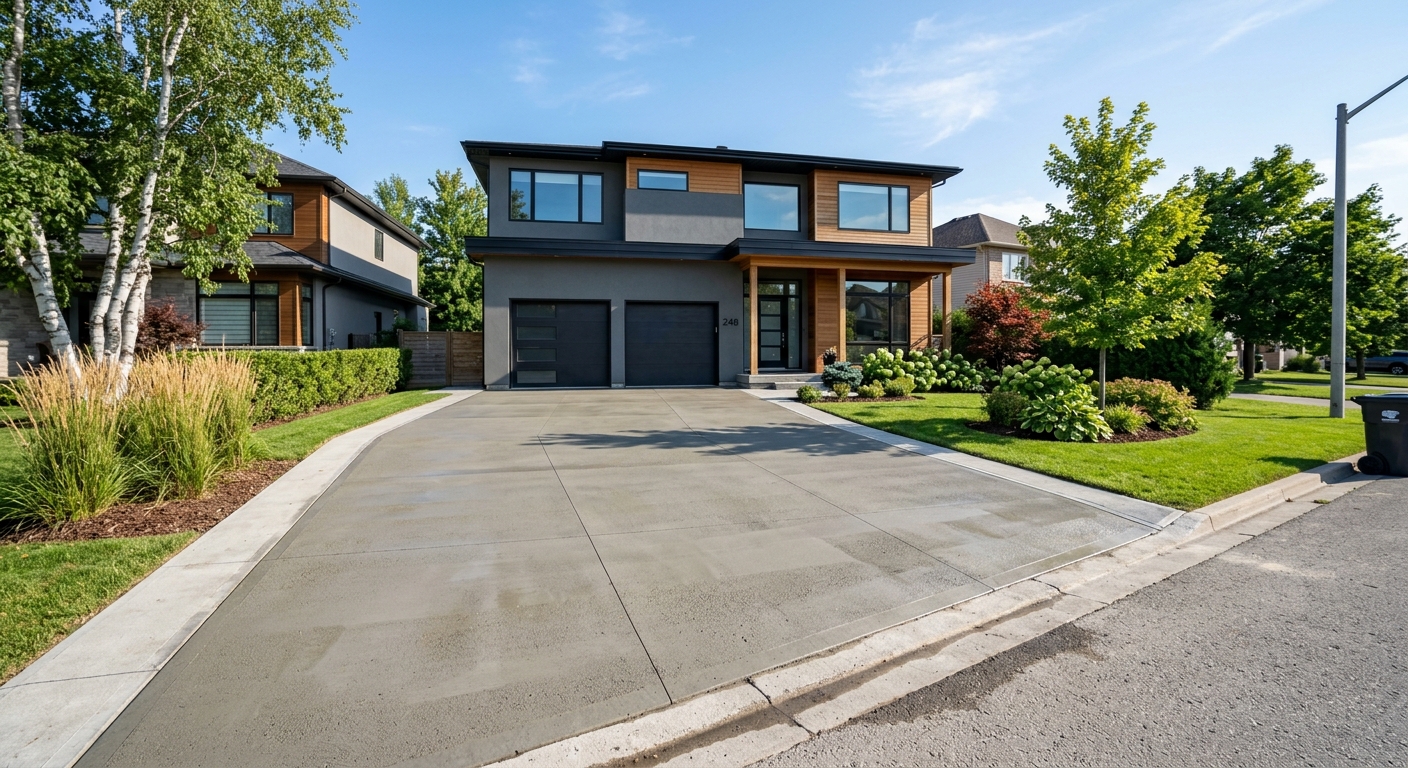
Concrete work options and costs in Hammond
In Hammond, British Columbia, concrete flatwork and foundations are a big part of how driveways, patios, and basement support get built for the long haul. With a population of 12,709 (Statistics Canada, 2021 Census), the market is active but still small enough that scheduling and crew availability can swing month to month, especially around the wetter spring shoulder season. Most homes here are built as single-detached households, which is typical for the Lower Mainland–Southwest, and it’s exactly what drives demand for curb-and-stone driveways, walkways, and backyard patios that can tolerate coastal-wet conditions and frequent freeze–thaw cycles.
In the Lower Mainland–Southwest, pricing is shaped less by deep, aggressive frost than by how we protect concrete from cycles of saturation and temperature swings. Local practice typically assumes a frost depth around 450 mm / 18", so footings, piers, and thickened edges are set below that to reduce frost heave risk. On top of that, contractors must plan for prolonged rain, cool nights, and high humidity—meaning tighter curing controls (blankets, longer cure times, and sometimes sealers) to achieve durable surface performance. That’s why quotes can differ even when the drawings look the same: base prep quality, mix design (including air-entrainment), and how well joints and sealing are handled all affect both cracking and scaling.
If you’re comparing options for the Hammond area—say around the East Hammond / waterfront-side neighbourhoods where drainage and access are often more critical—use the ranges below as a realistic starting point before you price your specific size and finish.
| Application |
Typical Size |
Key Spec |
Finish Option |
Price Range |
| Concrete driveway (standard broom finish) |
400 sq. ft. (approx. 20' x 20') |
Air-entrained exterior mix, compacted granular base, control joints |
Broom finish, saw-cut joints |
$18,000–$28,000 |
| Exposed aggregate driveway |
400 sq. ft. (approx. 20' x 20') |
Air-entrained exterior mix, base prep and curing control |
Exposed aggregate (retarder wash / broom assist) |
$24,000–$34,000 |
| Stamped concrete driveway or patio |
250 sq. ft. (approx. 25' x 10') |
Air-entrained exterior mix, integral colour or hardener, reinforcement as required |
Stamp + colour release (or integral colour) |
$22,000–$36,000 |
| Plain concrete patio or walkway |
180 sq. ft. (approx. 12' x 15') |
Air-entrained exterior mix, compacted base, joints at changes |
Broom or light trowel finish |
$10,000–$18,000 |
| Garage floor (interior slab) |
400 sq. ft. (approx. 20' x 20') |
Vapour barrier where required, compacted base, rebar/wire mesh as specified |
Power trowel or broom finish |
$16,000–$26,000 |
| Foundation footings (structural, below frost) |
Typical single-detached footing run: 120–180 linear ft. |
Excavation, forms, reinforcement, pour below design frost |
Cast-in-place reinforced concrete |
$24,000–$52,000 |
Prices are estimates only and vary by project scope, site access and material selection.
What affects the price of concrete work in Hammond
In the Lower Mainland–Southwest, two quotes for the same “size” concrete job can easily be 30–50% apart because the real drivers aren’t just square footage—they’re excavation difficulty, base prep quality, the mix design spec, and how the contractor manages curing in a coastal-wet climate. Labour rates and equipment availability in the Vancouver–Surrey–Abbotsford corridor also push pricing up when rain disrupts schedules and crews. Move farther north or to harsher freeze conditions and you’ll often see higher costs from deeper excavations and shorter pour seasons; in Hammond, we don’t need extreme frost depth like in colder provinces, but we still must design for freeze–thaw cycles that can undermine durability.
Frost and temperature cycling dictate the spec. Footings and thickened edges must extend below the design frost depth (local practice often references about 450 mm / 18"), and exterior slabs should use air-entrained concrete to handle freeze–thaw scaling. When winter conditions roll in, contractors may need cold-weather curing precautions—curing blankets and, in some cases, temporary heat—which adds cost. Salt also becomes a factor: de-icing chemicals can accelerate surface wear, so sealing is often recommended for driveways and patios that get treated in winter.
In Hammond, a few practical examples explain pricing swings. A driveway poured on poor drainage soil might need more granular base and regrading before we can even think about colour or stamp—this can move a standard driveway closer to the higher end of the $18–$28 per sq. ft. driveway range. Conversely, a straightforward patio on firm, already-prepped grade with good truck access can land near the lower $16–$26 per sq. ft. band for patios/walkways.
| Price Factor |
Why It Matters |
Cost Impact |
| Frost line depth |
Determines footing depth and form height |
Higher excavation and more rebar/steel chairs; can materially increase foundation and thickened-edge costs |
| Site preparation |
Excavation, grading, compacted granular base |
Loose subgrade, poor drainage, or hauling off excess soil raises base-cost and disposal charges |
| Reinforcement |
Rebar or wire mesh requirement |
Concrete with inadequate reinforcement is a failure risk; required reinforcement adds labour and material |
| Mix design |
Air-entrainment and compressive strength spec |
Exterior durability specs (air entrainment) can add cost versus basic mixes, but reduce spalling risk |
| Finish type |
Broom vs. stamped vs. exposed aggregate |
Stamped and exposed finishes require more labour time, materials, and finishing skill |
| Pour size and concrete truck access to site |
Placement efficiency and labour planning |
Small access constraints can increase labour time and may require pumping or additional crew |
| Cold-weather curing precautions |
Heating and blankets |
Added equipment and monitoring during cool snaps; often needed to meet strength and durability targets |
| Control joint pattern and sealing cost |
Controls cracking locations and protects against moisture/de-icing exposure |
Proper saw-cut timing and sealing materials/installs add line-items, but help prevent premature scaling |
Permits & regulations in British Columbia
In British Columbia, structural concrete work typically requires a building permit—especially for footings, foundation walls, and grade beams. Municipal review often involves engineered drawings to ensure the design meets structural and foundation requirements for the site. For concrete flatwork such as driveways, patios, and walkways, permits are often not required by default, but they can become necessary when the work affects lot grading, stormwater drainage, impervious surface coverage, or the municipal right-of-way (for example, work tied into curb or boulevard drainage).
Before breaking ground in Hammond, confirm the exact permit trigger with the local authority—especially if you’re changing slopes toward a foundation drain or altering downspout routing. Also verify the contractor carries the proper protection: liability insurance plus WCB/WSIB coverage (as applicable for the contractor’s business operations). Ask for references on similar-scope jobs (driveways with air-entrained mixes, and any subgrade drainage upgrades).
To verify a contractor step-by-step in BC: (1) check the contractor’s business details through the online registry they provide (or their public listing), (2) request and review a Certificate of Insurance showing current liability coverage, (3) request proof of worker coverage (WCB/WSIB documentation), (4) ask for permits/engineer sign-offs if structural concrete is involved, and (5) confirm the start date aligns with any inspection points required by the permit process.
Getting concrete right in Hammond's freeze-thaw climate
Concrete fails in Hammond when the system isn’t built to handle wetting, saturation, and freeze–thaw cycles. The most common problem I see is spalling and scaling from inadequate air-entrainment, or from base prep that traps water and allows freeze action under the slab. To spec the job correctly in the Lower Mainland–Southwest, start with base preparation: excavate to a stable subgrade and place a compacted granular sub-base to the right thickness for local soils and drainage conditions. Then lock in the mix design: for exterior flatwork, specify air-entrained concrete (targeted around 5–7% air) and a minimum 32 MPa compressive strength for durability.
Next, control cracking deliberately. Include a rational control joint plan (saw-cut or formed timing per the contractor’s method) so shrinkage cracks occur where you want them. Curing is where many schedules cut corners: even in mild BC weather, you need at least 7 days of proper curing conditions—especially when cool nights and high humidity slow strength gain. Finally, sealing matters in a salt-and-rain environment: apply a penetrating sealer after the concrete has cured (often around 28 days) to repel de-icing salts and reduce moisture uptake.
Ask these questions to avoid spalling: “What air content are you targeting and how do you verify it on site?” and “How will you protect the slab during cool or rainy weather?” A typical example: if a stamped patio is quoted at the high end of the $22–$36 per sq. ft. decorative range, it’s often justified by better base prep and tighter control joints—not just the stamp. If a “cheap” broom finish driveway also skips air-entrainment or proper joints, you may save on day one but pay later for patching and early scaling.
| Spec |
Why It Matters in Hammond |
What to Ask For |
Impact if Skipped |
| Compacted granular base (depth?) |
Prevents water pooling and reduces frost influence under the slab |
Confirm base thickness, granular type, and compaction testing method |
Settlement, pumping, and early cracking; higher freeze-thaw damage risk |
| Air-entrained concrete mix (target air %?) |
Air voids provide freeze–thaw resistance in a wet, coastal climate |
Target 5–7% air for exterior flatwork and how it’s verified |
Spalling and scaling from freeze–thaw; costly resurfacing |
| Compressive strength (MPa rating) |
Ensures durability and surface integrity under traffic and moisture |
Minimum 32 MPa (or project-specified rating) at design age |
Surface wear, softening, and reduced long-term performance |
| Control joints (spacing per ACI guidelines) |
Controls where cracking occurs and limits random cracking |
Joint spacing plan and when joints will be cut/formed |
Random cracks, water intrusion, and faster freeze-thaw deterioration |
| Minimum 7-day curing period |
Cooling and humidity can slow strength gain without protection |
How curing will be protected during cool nights or rain |
Low strength, surface weakness, and increased scaling risk |
| Penetrating sealer (when applied after cure) |
Reduces moisture and salt penetration from de-icing and rain |
Schedule for application after cure (commonly around 28 days) |
Accelerated surface deterioration and higher maintenance costs |
How to choose a concrete work contractor in Hammond
Choosing the right contractor in Hammond, British Columbia is mostly about verifying protection, then confirming the spec. Start with BC licensing/business details (if applicable to the contractor’s work), then ask for proof of liability insurance and proof of worker coverage (WCB/WSIB documentation as applicable). Don’t accept “we’re covered” verbally—request the certificate and confirm it’s current. For a quick check: your certificate should show the coverage limits, policy effective dates, and the business name matching the quote.
Next, get 2–3 itemised written quotes. You want labour and materials broken out, not just a single lump sum. Make sure the quote clearly lists excavation, disposal, forms, reinforcement, concrete mix spec (including air entrainment), base thickness, curing method, joint cut plan, and whether sealing is included. Ask what’s excluded: for example, old slab removal, off-site disposal, temporary protection in rain, concrete grinding/patching, and any required inspections.
Warranty should be in writing. Ask for the length of workmanship coverage and whether the manufacturer warranty (for admixtures/sealers, if applicable) transfers with ownership. For payment, never pay more than 10–15% upfront; hold back a portion until the work is complete and cleaned up. Finally, get a start date and completion estimate in writing, and confirm how they handle scheduling when the weather window closes—coastal rain and cool nights directly affect curing in the Lower Mainland–Southwest.
- Ask whether the concrete mix is air-entrained for exterior exposure.
- Request base prep details: thickness, granular type, and compaction method.
- Confirm reinforcement requirements (mesh/rebar) and where it’s placed in the slab.
- Get a joint plan: spacing, tooling/cutting method, and timing.
- Ask how curing will be protected in cool or rainy periods.
- Confirm whether sealing is included and when it will be applied after curing.
- Verify insurance with a current Certificate of Insurance before work begins.
- Request WCB/WSIB proof (as applicable) and confirm it matches the contracting business.
- Ensure the quote includes site protection (covers, barriers) and cleanup.
- Confirm disposal/haul-away is included (or specify who handles it).
- Make sure access constraints (narrow driveway, street access) are priced in.
- Get a written start date, crew schedule, and completion target.
Concrete contractor red flags I see in Hammond: vague “concrete quality” descriptions with no mention of air entrainment, quotes that exclude base prep and drainage even when the grade is suspect, no proof of liability insurance/WCB coverage, pressure to take large deposits (over 10–15%), and workmanship promises that aren’t written with clear timelines and joint/sealing responsibilities.
Frequently asked questions — concrete work in Hammond
How long does a concrete project take in Hammond?
In Hammond and the Lower Mainland–Southwest, timing depends on weather, curing conditions, and prep complexity. For a typical residential driveway or patio, the “active” pour day is often just hours, but the overall timeline usually stretches because we must complete excavation, base compaction, forms, reinforcement, and then manage curing in cool, humid, or rainy spells. Concrete needs proper curing to reach strength; a minimum curing period is generally about 7 days before you treat it as serviceable, with full durability performance developing over weeks. If you’re doing stamped decorative work, labour and layout time can add days for stamping and touch-up. If drainage corrections or added base depth are required, expect extra time for material delivery and compaction.
What is a concrete overlay and is it suited to Hammond?
A concrete overlay is an additional thin concrete layer placed over an existing slab, usually after surface preparation (grinding, patching, and sometimes bonding agents). It can be suited to Hammond when the existing slab is structurally sound—meaning it isn’t badly heaved, undermined, or extensively cracked with movement. However, the freeze–thaw climate and wet conditions in BC make it critical to fix the underlying drainage and base issues; otherwise, moisture keeps migrating under the new layer, and cracks can “telegraph” through. For driveways that have surface scaling, overlays can improve appearance, but sealing and joint management become even more important. If your existing slab is failing due to moisture or poor support, replacement may be the better long-term value compared with overlay costs.
How do I seal concrete to protect it in Hammond?
Sealing helps protect against moisture uptake and, in winter, de-icing salt exposure. In Hammond, I recommend a penetrating sealer for exterior slabs because it reduces water absorption without forming a thick surface film that can fail if the concrete moves or cracks. Timing matters: most sealers are applied after the concrete has cured adequately—commonly around 28 days—so the slab is dry enough for proper penetration. Preparation should be thorough: clean off dust, remove any contaminants, and repair any spalled areas before sealing. Ask the contractor what product they use and whether they’ll include coverage rates and surface conditions in the plan. When sealing is included in the scope, it’s often part of why higher quotes (for example, patio finishes within the $16–$26 per sq. ft. band) look “more complete” than cheaper options that skip durability steps.
What is the difference between concrete and cement?
Concrete is the full building material you pour: a mixture of cement, water, sand, gravel (or crushed stone), and often admixtures like air-entrainment and plasticizers. Cement is just one ingredient—typically Portland cement—inside that concrete mix. In practical homeowner terms, when a contractor says they’re specifying “air-entrained concrete,” they’re talking about the concrete mix as a whole, not just the cement. For Hammond’s freeze–thaw and wet conditions, the key spec is the concrete mix design: air-entrainment target, compressive strength (commonly minimum 32 MPa for exterior performance), and proper curing and joints. Good concrete doesn’t come from “strong cement” alone; it comes from the full recipe and how it’s placed and cured in the coastal BC climate.
How much does concrete work cost in Hammond?
Costs in Hammond typically track the Lower Mainland–Southwest pricing bands, but your final number depends on prep, access, and finish. As a rule of thumb, concrete driveways often land around $18–$28 per sq. ft. for standard broom-finish work, while patios and walkways are commonly around $16–$26 per sq. ft. for basic finishes. Decorative work is higher: stamped concrete driveway or patio projects are frequently quoted in the $22–$36 per sq. ft. range depending on thickness, reinforcement, and how complex the pattern and base preparation are. If you see a quote that’s drastically lower, ask what’s missing—air-entrainment, proper granular base, reinforcement, curing controls, and sealing are often the line-items that protect your slab from scaling and early cracking in BC’s freeze–thaw cycles.
How deep must footings be for Hammond's frost line?
For Hammond, local practice commonly references a design frost depth around 450 mm / 18", and footings are generally placed below that to reduce frost heave risk. In practice, the final footing depth should be based on the project’s geotechnical and engineering requirements for your soil conditions, drainage, and building loads. If the site has saturated soils, drainage issues, or uncertainty in subgrade conditions, excavation and footing specifications may be deeper or supported with additional granular and drainage details. The key takeaway is that you should never “guess” footing depth from a single rule—your engineered drawings (when required) and soil report should drive it, and structural concrete work will generally require permits in BC.