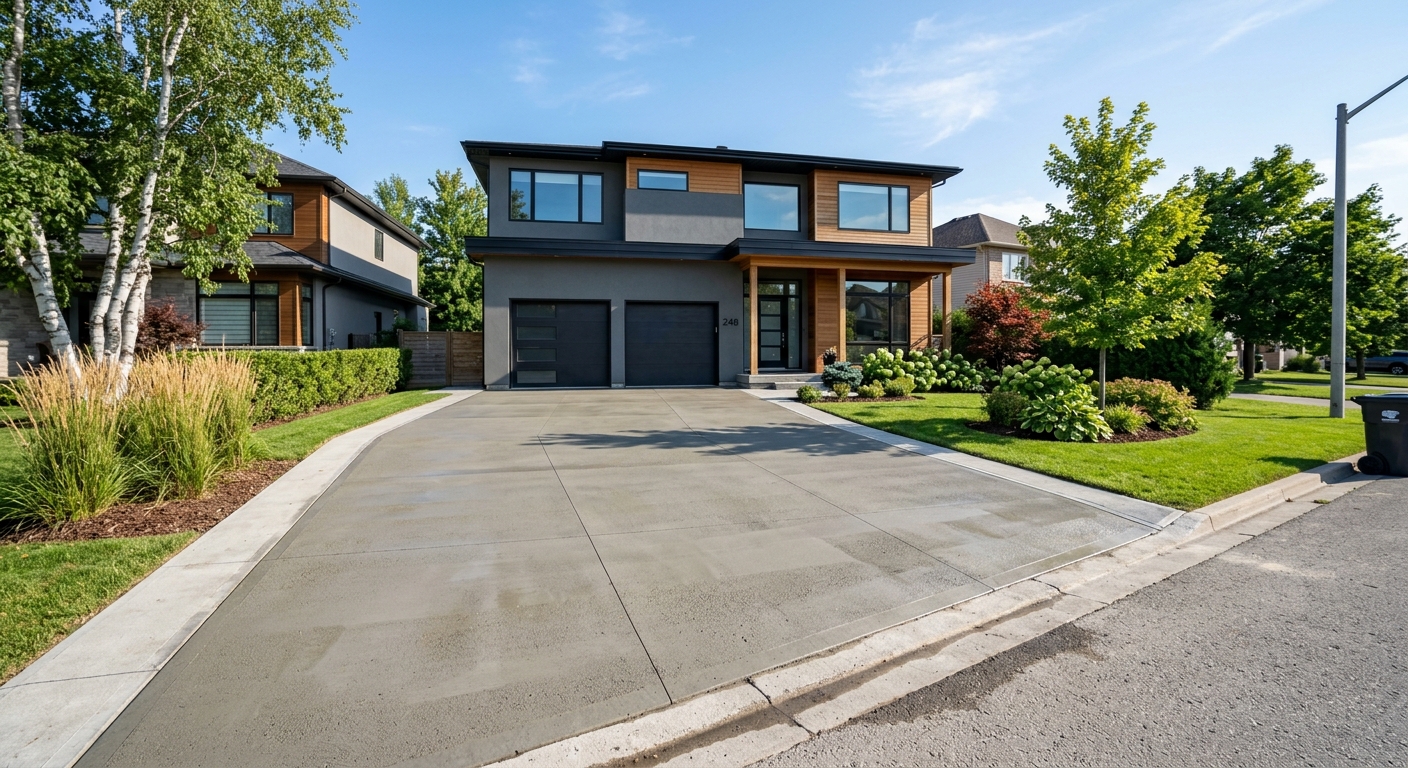
Concrete work options and costs in Metrotown
In Metrotown, concrete is one of the most reliable ways to get flatwork that handles the Lower Mainland–Southwest wet winters and frequent freeze–thaw cycles. With a population of 52,355 (Statistics Canada, 2021 Census), this area sees steady demand from homeowners and new infill projects, where driveways, patios, and entry walkways are common upgrades. The market is also shaped by the fact that single-detached homes remain a key housing style here, and that typically means frequent exterior flatwork scopes—especially in neighbourhoods around Metrotown (Burnaby) and the Edmonds–Gilmore corridor, where access lanes and front-yard landscaping are often constrained.
Concrete pricing in the Lower Mainland–Southwest is tightly tied to frost protection and drainage. Even though our frost depth is relatively shallow (commonly assumed around 450 mm / 18"), contractors still design footings and thickened edges to sit below the design frost level to reduce frost heave. That requirement affects excavation depth, forming effort, and the amount of granular base and air-entrained concrete used. Coastal rainfall also forces careful scheduling and longer curing protection (blankets/sealers) so surfaces don’t scale or dust off. As a result, two contractors can quote the same driveway differently—one might include better base prep and higher-spec mix design while another tries to fit within a tighter season window.
Below is a practical cost comparison for common concrete options so you can line up apples-to-apples specs before you book a site visit.
| Application |
Typical Size |
Key Spec |
Finish Option |
Price Range |
| Concrete driveway (standard broom finish) |
400–500 sq ft (about 18' x 22') |
6" slab on compacted granular base; control joints; air-entrained exterior mix |
Broom finish + optional sealer |
$18,000–$28,000 |
| Exposed aggregate driveway |
400–500 sq ft |
6" slab; properly cured and washed aggregate surface; air-entrained mix |
Exposed aggregate finish |
$22,000–$34,000 |
| Stamped concrete driveway or patio |
300–450 sq ft |
Thickness as designed; integral colour; air-entrained exterior mix; release agent |
Stamp pattern + texture release + sealcoat |
$22,000–$36,000 |
| Plain concrete patio or walkway |
200–350 sq ft |
4"–5" slab; compacted base; mesh/rebar as required |
Float & broom or light broom |
$16,000–$26,000 |
| Garage floor (interior slab) |
300–500 sq ft (about 20' x 25') |
4" slab; vapour considerations as needed; reinforcement as specified |
Steel trowel or broom finish (non-slip) |
$14,000–$26,000 |
| Foundation footings (structural, below frost) |
Per project; commonly 10–30 lineal ft depending on design |
Excavate below design frost depth; formwork; rebar; engineer-reviewed section |
Structural concrete (no decorative finish) |
$7,500–$14,000 |
Prices are estimates only and vary by project scope, site access and material selection.
What affects the price of concrete work in Metrotown
In Metrotown and the wider Lower Mainland–Southwest region, you can see 30–50% differences between quotes for the “same” concrete job because the real variables are below the surface: excavation depth, base drainage design, frost protection, mix design, reinforcement, and how a crew cures the concrete in cool, wet conditions. Two contractors might both advertise a “6" slab,” but one includes proper compacted granular base, a higher-spec air-entrained exterior mix, and sealer/curing protection for durability—while another tries to keep costs down by reducing preparation or relying on normal-season curing. In colder parts of BC, shorter pour seasons can increase costs further due to heating/blankets and tighter scheduling, while the Lower Mainland remains comparatively mild but still experiences wet freeze–thaw cycles that punish poorly detailed edges and unsealed surfaces.
Frost line depth dictates every exterior spec. In coastal BC, design practice often targets frost protection around 0.5–1.2 m, so footings and thickened edges must still extend below that design depth to prevent frost heave. Exterior slabs also need air-entrained concrete to handle repeated freeze–thaw and saturated soils. Then come practical cost items: de-icing salts can accelerate scaling/spalling on unsealed concrete, and that’s why sealer and correct curing planning matter.
Cost can move up or down quickly in Metrotown: a steep driveway slope or poor drainage can add granular and sub-drain work (pushing the job toward the upper end of the $18–$28 driveway band), while a simple, level patio with good access can keep you near the lower $16–$26 patio/walkway band. If you’re doing work on an older lane with existing asphalt removal, expect higher disposal and haul-away costs—older sites often have deeper disturbed soils near the curb.
| Price Factor |
Why It Matters |
Cost Impact |
| Frost line depth — determines footing depth and form height |
Footings must extend below design frost to prevent heave and cracking |
Higher excavation and forming costs; can add thousands on foundation-adjacent scopes |
| Site preparation — excavation, grading, compacted granular base |
Proper base prevents settlement and pumping under freeze–thaw and rainfall |
More granular, compaction passes, and drainage work increase price |
| Reinforcement — rebar or wire mesh requirement |
Controls cracking and improves slab durability where loads concentrate |
Material + labour; small section differences can change costs noticeably |
| Mix design — air-entrainment and compressive strength spec |
Air-entrainment protects against scaling/spalling in freeze–thaw conditions |
Better mix design costs slightly more but reduces premature failure |
| Finish type — broom vs. stamped vs. exposed aggregate |
Labour and materials change significantly with decorative finishing |
Decorative work typically pushes toward the high end of the driveway/patio bands |
| Pour size and concrete truck access to site |
Access constraints affect pump/shortfall logistics and crew time |
Limited access can add pump fees, additional labour, and longer pour logistics |
| Cold-weather curing precautions — heating and blankets |
Cool nights/high humidity slow strength gain and risk surface defects |
Heating/blankets add labour and materials; can raise costs meaningfully in shoulder season |
| Control joint pattern and sealing cost |
Joints manage cracking; sealing helps repel salts and moisture |
Skipping proper jointing/sealing often reduces cost short-term but increases repairs |
Permits & regulations in British Columbia
In British Columbia, the type of concrete work determines whether you need a permit. Structural concrete work—such as footings, foundation walls, and grade beams—typically requires a building permit and, in many cases, engineered drawings reviewed through the municipal process. For concrete flatwork like patios, walkways, and driveways, a permit is usually not required when the work is limited to surface improvements, provided it doesn’t significantly affect lot grading, stormwater drainage, or municipal right-of-way requirements. That said, changes to drainage patterns, new connections, or compliance impacts around impervious surface coverage can trigger review. Always confirm with the local authority before breaking ground.
Before you hire anyone in Metrotown, verify three things: (1) contractor liability insurance, (2) WSIB/WCB coverage, and (3) proper registration/licensing where applicable for the work being performed. Step-by-step:
- Ask for the company’s Certificate of Insurance (liability) showing your property address as the job site.
- Request proof of WCB/worker coverage (or equivalent coverage documentation) before work starts.
- Look for the contractor’s credentials/registration on the relevant provincial registry listings (and confirm the company name matches the COI).
- Get references specifically for similar-scale concrete in the Vancouver–Burnaby area (flatwork and/or foundation work, as applicable).
- Confirm whether the quote includes permit pulling and inspections if your scope is structural.
Do this up front and you’ll avoid delays, incomplete paperwork, and disputes about responsibility if something is reworked.
Getting concrete right in Metrotown's freeze-thaw climate
Metrotown concrete usually fails for predictable reasons: inadequate base preparation, poor drainage, insufficient air-entrainment, rushed curing, or control joints that don’t match the slab’s shrinkage pattern. In the Lower Mainland–Southwest, moisture is the constant—coastal rainfall saturates soils, then temperature swings can drive freeze–thaw at the edges and in joints. If the slab is under-specified, water gets in, expands when it freezes, and you see scaling, pop-outs, and eventually spalling.
To spec the job correctly, focus on five items. First, base preparation: compacted granular sub-base to the right depth for local soils and the designed frost protection strategy, not “whatever fits.” Second, mix design: for exterior flatwork, request 5–7% air content and a minimum 32 MPa compressive strength, with a mix that’s intended for freeze–thaw exposure. Third, control joints: spacing needs to limit random cracking—especially important on driveways and wider patios. Fourth, curing: plan for at least 7 days under appropriate conditions; in shoulder season, ask what cold-weather precautions will be used (blankets/sealers, and whether they’ll monitor temperatures). Fifth, sealing: apply a penetrating sealer after the cure period to help repel de-icing salts and reduce moisture absorption.
For homeowners weighing options, the price difference is often worth it. For example, moving from a plain broom-finish driveway (often near the $18–$28 band) to a decorative exposed or stamped finish can push you toward the higher end (sometimes closer to $22–$36 depending on complexity). The key is that you should only “upgrade the finish” after you’re satisfied the base, air-entrainment, and curing plan meet the freeze–thaw reality here—otherwise the decorative surface just fails faster.
| Spec |
Why It Matters in Metrotown |
What to Ask For |
Impact if Skipped |
| Compacted granular base (depth?) |
Reduces settlement and protects slab edges through wet winters and frost action |
Base depth and compaction testing method; sub-drain/positive drainage plan if needed |
Cracks, pumping, and uneven surface in a few seasons |
| Air-entrained concrete mix (target air %?) |
Air voids give water freeze–thaw room to expand without damaging paste |
Target 5–7% air content and exterior exposure spec |
Scaling/spalling risk increases significantly in Metrotown’s freeze–thaw cycle |
| Compressive strength (MPa rating) |
Design strength supports durability and reduces early wear |
Minimum 32 MPa (or higher if engineered) |
Surface defects, higher abrasion damage, and reduced long-term performance |
| Control joints (spacing per ACI guidelines) |
Directs cracking to planned lines under shrinkage and temperature changes |
Proposed joint layout and sawcut timing |
Random cracking and wider splits that trap moisture |
| Minimum 7-day curing period |
Strength gain is slower in cool, humid Lower Mainland conditions |
How curing blankets/sealing timing will be handled when nights are cool |
Lower strength and increased early surface deterioration |
| Penetrating sealer (when applied after cure) |
Helps repel moisture and de-icing salt exposure common in wet winters |
Sealer type and application timing after full cure (commonly after ~28 days for many products) |
More water absorption, faster scaling, and quicker re-wear |
How to choose a concrete work contractor in Metrotown
Choosing the right contractor is as important as the concrete mix. In British Columbia, verify licensing/registration as applicable to the type of work, then confirm insurance and coverage before the first shovel hits the ground. Start with liability insurance: request an up-to-date Certificate of Insurance and ensure the company name matches the quote and the COI. Next, check workers’ compensation coverage (WSIB/WCB or provincial equivalent documentation): ask them to provide proof before work begins. If they can’t provide clear documentation, that’s a red flag—especially on foundation work and rebar-heavy structural pours.
Then get 2–3 itemised written quotes, not lump sums. You want line items that show labour and materials, including excavation/grading, base material, reinforcement, concrete supply, finishing, curing/blankets, and sealing. Ask what’s included in the scope: disposal/hauling, sawcutting, bonding/patching to existing slabs, and whether permit pull/inspection coordination is included if your scope involves structural work. Make sure the schedule is clear: start date and completion estimate in writing.
For warranty, ask for (1) workmanship warranty length, (2) any product/manufacturer warranties for sealers or specialty finishes, and (3) whether the warranty transfers if you sell the home. Payment terms should be conservative—generally no more than 10–15% upfront, with a holdback until job completion and final cleanup.
- Confirm they have appropriate insurance (liability) and coverage for workers before work starts.
- Ask for recent references in Burnaby/Metrotown area with similar concrete types.
- Require an itemised quote: excavation/base, rebar/mesh, concrete supply, finishing, curing, and sealer if included.
- Clarify exclusions: disposal, pump fees, protection for landscaping, and traffic management.
- Confirm if permits are required for your scope and whether they handle permit coordination if needed.
- Ask for the concrete mix spec: air-entrainment, slump control, and target compressive strength.
- Ask how they handle cool nights and wet weather (blankets, curing monitoring, and rescheduling rules).
- Verify joint layout: spacing and sawcut timing.
- Confirm reinforcement plan where applicable (mesh/rebar thickness, laps/chairs, and placement depth).
- Request documentation on materials (sealer product, curing method) for decorative work.
- Set payment milestones: keep 10–15% max upfront and hold back until acceptance.
- Get a written timeline with pour day, curing expectations, and when you can use/drive on it.
Concrete red flags in Metrotown include: vague scope language (“we’ll pour a slab”), no mention of air-entrained mix for exterior exposure, cutting corners on base depth/compaction, skipping control joints or sealing, and refusing to show proof of liability coverage or workers’ coverage documentation.
Frequently asked questions — concrete work in Metrotown
When is the best time to pour concrete in Metrotown?
In Metrotown (British Columbia’s Lower Mainland–Southwest), the “best” time is when you can pour, finish, and cure without prolonged cold nights or heavy rain. Even though winters are mild compared with inland BC, freeze–thaw cycles and coastal rainfall still create surface risks and slow curing. Most contractors target late spring through early fall, but a good crew can still pour earlier/later if they plan for temperature control (blankets/heating if needed) and proper curing protection. Ask your contractor what monitoring they’ll do for temperature and moisture, and how they’ll handle schedule changes if forecasts shift. If you’re budgeting, shoulder-season work can land you at the higher end of typical bands—often closer to the $18–$28 driveway range—because curing precautions and coordination take more labour and materials.
How long does concrete take to cure?
Concrete curing happens in stages. You’ll get early set and surface hardening within hours, but strength gain continues over time. For exterior flatwork in Metrotown, plan for at least a 7-day curing period before treating the slab as fully set, especially if cool nights or high humidity are expected. Many sealers and surface protections are applied after a longer curing window (often around 28 days for many penetrating sealer programs), so the sealer isn’t trapped on a slab that hasn’t reached sufficient strength. If temperatures drop, contractors may use insulating blankets or curing blankets to reduce risk of weakened surface development. If a contractor promises “instant cure” or doesn’t discuss curing practices, ask follow-up questions—your durability depends more on curing than many people expect.
Do I need a permit for concrete work in British Columbia?
In British Columbia, it depends on what you’re building. Structural concrete such as footings, foundation walls, and grade beams typically requires a building permit and often engineered drawings reviewed through the municipal process. Concrete flatwork like patios, walkways, and driveways usually doesn’t require a permit when it doesn’t materially affect lot grading, stormwater flow, or impervious surface constraints. In Metrotown, drainage details matter because saturated soils and rainfall runoff are common triggers for edge deterioration—so changes to grading or drainage can bring permit review into the picture. The best approach is to confirm with the municipality or building department before work begins, and ask your contractor whether they include permit coordination in the quote if your scope is structural. Also verify the contractor has liability coverage and workers’ coverage documentation before starting.
Concrete vs pavers for a patio in Metrotown?
For a patio in Metrotown, concrete often wins when you want a uniform surface that tolerates seasonal moisture and freeze–thaw with fewer settlement surprises—if the base is done properly and the mix is suitable. Concrete is also easier to maintain if you include the right control joints and plan sealing after curing. Pavers can be a great choice if you like flexible patterns and want easier partial repairs, but they depend heavily on base compaction, edging, and proper drainage; otherwise, weeds and unevenness can appear over time. In cost terms, plain concrete patios commonly fall within the $16–$26 band for typical scopes, while decorative concrete can move toward $22–$36. If you’re in a high-rain run-off area near landscaping, ask both options about drainage and joint sealing—this is where durability is won.
How long does a concrete driveway last?
A well-built concrete driveway in Metrotown can last decades, but its lifespan depends on what’s underneath and how the slab is detailed for our Lower Mainland conditions. The biggest durability factors are compacted granular base depth, proper air-entrainment for exterior freeze–thaw exposure, control joints that manage shrinkage cracking, and sealing to repel de-icing salts. A driveway that’s broom-finished and properly sealed (often within the $18–$28 driveway band depending on size and access) typically holds up better than one poured with minimal base prep or no sealer plan. If decorative finishes like exposed aggregate are added, the surface may look better, but it still needs the same freeze–thaw protection underneath to survive scaling risks. If you notice spalling at edges or joint lines, it’s usually a sign moisture is entering and needs corrective sealing or joint attention.
What is air-entrained concrete and why does it matter here?
Air-entrained concrete contains a controlled amount of microscopic air bubbles. In Metrotown and the Lower Mainland–Southwest, that matters because freeze–thaw cycles and saturated soils can damage cement paste if water freezes inside. Air voids give water a place to expand, which reduces scaling, pop-outs, and spalling—common exterior failure modes when mixes aren’t designed for freeze–thaw exposure. For exterior flatwork, you can ask for a target air content (often 5–7%) and a suitable compressive strength spec like 32 MPa minimum (unless engineered otherwise). When you get quotes, look for language about air-entrainment and exterior exposure requirements rather than assuming all “standard concrete” is the same. This is one of the most important technical specs that can change a job’s long-term performance—and sometimes only moves price modestly compared with the cost of repairs.