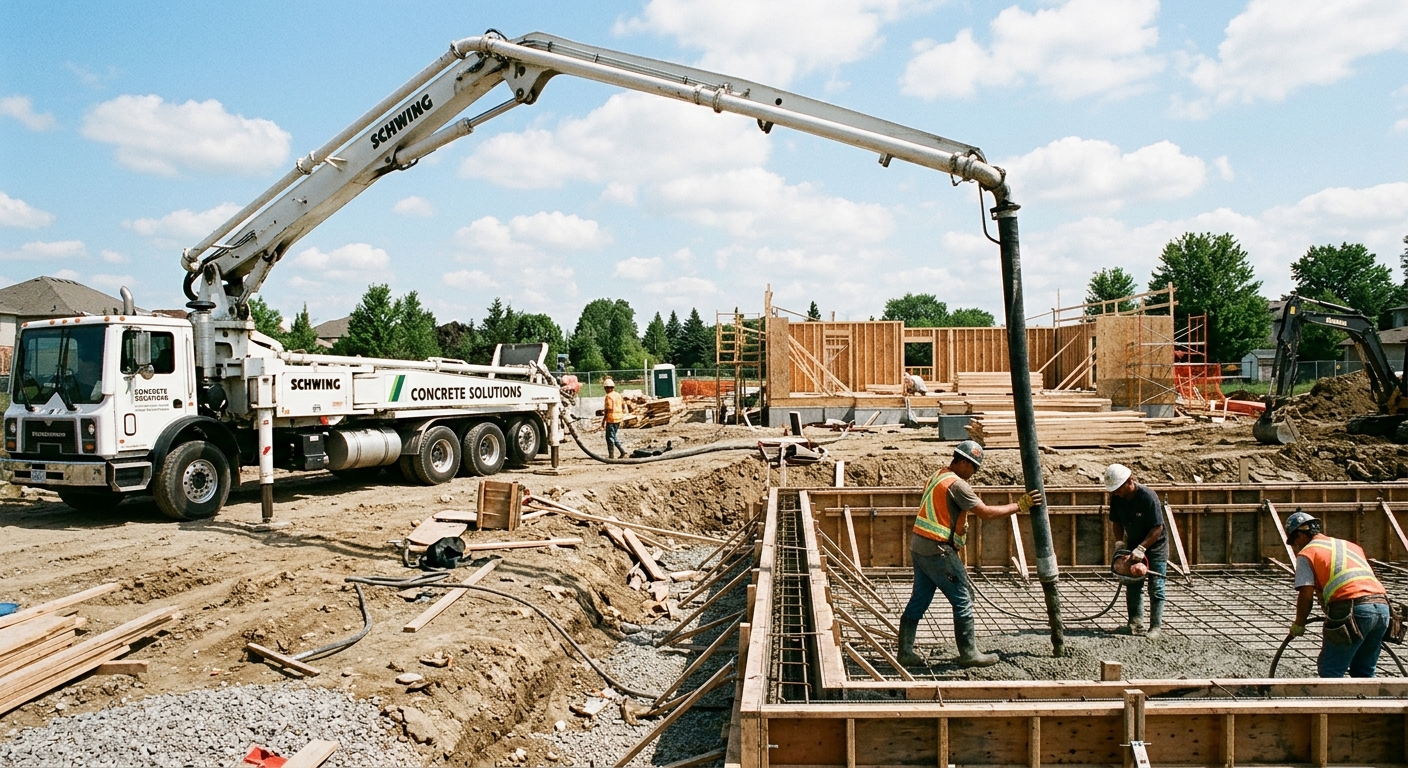
Concrete work options and costs in Comox
Comox homeowners commonly choose new concrete flatwork—driveways, patios and walkways—because it ties in well with the island’s coastal homes and the prevailing single-family neighbourhood look. With 65.8% of local dwellings being single-detached houses (Statistics Canada, 2021 Census), the demand profile here is built around concrete that performs through wet winters and repeated temperature swings. Another local driver is older housing stock: 39.6% of homes in the area were built before 1981 (Statistics Canada, 2021 Census), so many projects are replacements of aging slabs that are already spalling, settling, or failing to shed water.
On Vancouver Island and the Coast, pricing is shaped by a shallow-to-moderate frost depth combined with frequent freeze–thaw cycles. Even when the cold isn’t “interior hard,” freeze–thaw and saturated soils can still cause surface scaling, heaving, and random cracking if the base isn’t built to spec and the mix isn’t properly air-entrained. Contractor costs can also move based on weather windows: cool, rainy stretches slow curing, and teams often plan around cold snaps to avoid weak surface strength and damage.
In Comox, this trade is especially busy in areas like the Comox Valley / Courtenay–Comox corridor where infill and driveway replacements are common, particularly for homes that sit on slightly higher ground or have tighter site access. If you’re comparing options, use the table below as a baseline for typical sizes, specs and finishes—then we’ll fine-tune for your subgrade condition, drainage and finish level.
| Application |
Typical Size |
Key Spec |
Finish Option |
Price Range |
| Concrete driveway (standard broom finish) |
240–320 sq ft |
Air-entrained exterior mix, compacted granular base, control joints |
Broom finish, light sealer |
$5,000–$8,000 |
| Exposed aggregate driveway |
240–320 sq ft |
Air-entrained mix, correct timing for washing, proper curing and joints |
Exposed aggregate (light/medium stone) |
$7,000–$10,500 |
| Stamped concrete driveway or patio |
200–300 sq ft |
Air-entrained mix, integral colour, release agent system |
Stamped ashlar/stone or pattern finish |
$7,500–$12,000 |
| Plain concrete patio or walkway |
120–240 sq ft |
Air-entrained exterior mix, compacted sub-base, joints as needed |
Float/smooth or broom, optional sealer |
$2,000–$4,200 |
| Garage floor (interior slab) |
400–600 sq ft |
Interior mix, vapour considerations where applicable, joints |
Steel trowel or broom, curing compound if specified |
$5,500–$10,000 |
| Foundation footings (structural, below frost) |
Per typical footing system (house-sized) |
Engineered footing layout, below frost depth, rebar, drainage where required |
Structural concrete (no decorative finish) |
$18,000–$35,000 |
Prices are estimates only and vary by project scope, site access and material selection.
What affects the price of concrete work in Comox
In Comox, two quotes for the “same” concrete job can land 30–50% apart because Vancouver Island and the Coast have site-by-site variables that strongly impact labour time and materials: soil conditions, drainage, access constraints for forming and trucks, and how much contingency a contractor builds in for weather and curing. Add in finish selection—broom, stamped, or exposed aggregate—and you’ll see why concrete work isn’t priced like a simple commodity.
Specifically, frost line depth and freeze–thaw cycles dictate nearly every foundation and exterior flatwork detail. Contractors must set footings below the design frost depth to prevent frost heave, and exterior slabs should be built with air-entrained concrete mixes to survive repeated wetting and freezing. Where it gets tricky on this coast, curing time and protection matter: cool temperatures and saturated soils slow strength gain and raise the risk of surface damage if crews don’t plan blankets, cover, and drainage. That weather-driven reality can move costs beyond the “unit price” people expect.
Concrete options also shift the budget. A standard driveway at roughly the $16–$25 per sq ft band is often the most predictable choice; upgrading to stamped concrete can move you closer to the $22–$35 per sq ft band because of integral colour, stamping labour, and additional finishing time. Likewise, if your existing driveway is already pumping water or the sub-base is soft—common in older lots built before 1981—excavation and base replacement can add thousands before the first yard of concrete even goes down. On a typical 300 sq ft replacement, just a heavier base remediation scope can swing the total by several thousand dollars, depending on how much gets removed and hauled away.
| Price Factor |
Why It Matters |
Cost Impact |
| Frost line depth — determines footing depth and form height |
Deeper frost conditions require more excavation, forming, and concrete volume |
Often a major swing factor for foundations |
| Site preparation — excavation, grading, compacted granular base |
Bad base prep leads to settlement, cracking and drainage failures |
Can add or remove thousands based on soil condition |
| Reinforcement — rebar or wire mesh requirement |
Controls cracking and improves performance over time |
Material + placement labour increase cost |
| Mix design — air-entrainment and compressive strength spec |
Air-entrainment helps resist freeze–thaw scaling in exterior work |
Higher-spec mix typically adds per-yard cost |
| Finish type — broom vs. stamped vs. exposed aggregate |
Finish labour and finishing time vary significantly |
Stamped/exposed often adds the biggest premium |
| Pour size and concrete truck access to site |
Limited access may require smaller loads, more labour, or pumping |
Access constraints can materially increase labour |
| Cold-weather curing precautions — heating and blankets |
Protection prevents weak surfaces and damage during cool snaps |
Adds labour and materials during weather risk |
| Control joint pattern and sealing cost |
Joints manage shrinkage; sealing improves surface durability |
Small line-item but meaningful for long-term performance |
Permits & regulations in British Columbia
In British Columbia, structural concrete work typically needs a building permit. That includes footings, foundation walls, and grade beams—any work that supports the house or affects structural capacity. Depending on the project, municipalities may also expect engineered drawings to be reviewed before inspections. For concrete flatwork like patios, walkways and driveways, a permit is often not required, unless the work changes lot grading, increases impervious surface coverage beyond municipal limits, affects stormwater handling, or ties into any right-of-way considerations.
For your Comox project, confirm the exact permit triggers with the local authority before excavation starts. Also verify the contractor carries liability insurance and has required provincial coverage (WSIB/WCB) for their workers. Don’t rely on assumptions—ask for documents and check them yourself.
Step-by-step verification you can do as a homeowner: (1) request the contractor’s licence information and confirm it matches the company doing the work; (2) ask for an up-to-date certificate of insurance (liability) showing coverage active for your project dates; (3) request proof of coverage for workers (WSIB/WCB) and confirm it applies to the appropriate trade; (4) ask for references for jobs of similar scope and site conditions in the Comox / Vancouver Island area. If they can’t provide these quickly, that’s a red flag.
Getting concrete right in Comox's freeze-thaw climate
Concrete fails in Comox most often for preventable reasons: poor base prep, insufficient air-entrainment, weak curing, and sloppy joint design. The freeze–thaw cycles on Vancouver Island and the Coast can turn moisture trapped under or within a slab into expansion forces that lift, crack, or scale the surface—especially when the slab is exposed to de-icing salts and repeated wetting.
To spec the job correctly, start with base preparation. We look for a properly excavated, compacted granular sub-base to the correct depth for the soil and frost performance needs. Next is mix design: for exterior flatwork, air-entrainment is key, usually targeting about 5–7% air content, and we specify minimum 32 MPa compressive strength. Third, control joints must be placed and finished so shrinkage and temperature movement have a planned “release valve” instead of random cracking. Fourth, curing: plan for at least 7 days of curing under suitable conditions, with added protection when temperatures drop or the site stays saturated. Finally, sealing: apply a penetrating sealer after the concrete has fully cured—commonly after 28 days—so water and salts can’t easily work their way into the pores.
If you’re choosing between finishes, budget upgrades should match your goals. For example, moving from a broom-finish driveway (often within the $16–$25 per sq ft band) to stamped concrete is usually justified when you want curb appeal and pattern customization, but it isn’t necessary for “durability.” Durability mainly comes from base, mix and joints—two driveways that both meet those specs can perform similarly even if one is plain.
| Spec |
Why It Matters in Comox |
What to Ask For |
Impact if Skipped |
| Compacted granular base (depth?) |
Proper support prevents settlement and helps manage moisture movement through freeze–thaw |
Base depth and compaction test method (e.g., compact to spec thickness) |
Uneven settlement, cracking, pumping and premature failure |
| Air-entrained concrete mix (target air %?) |
Freeze–thaw resistance depends on correctly entrained air voids |
Air content target typically 5–7% for exterior flatwork |
Surface scaling/spalling after wet-cold cycles |
| Compressive strength (MPa rating) |
Strength gain and long-term performance rely on proper mix design |
Minimum 32 MPa (and confirm standard used for testing) |
Weaker surface, abrasion damage, faster deterioration |
| Control joints (spacing per ACI guidelines) |
Joints manage shrinkage/temperature movement so cracking is controlled |
Joint spacing plan and timing (saw-cut timing or formed joints) |
Random cracks, water intrusion, and freeze–thaw escalation |
| Minimum 7-day curing period |
Cool, wet conditions slow strength gain and increase risk if unprotected |
How they protect curing in cold snaps (covers/blankets) |
Surface damage, reduced durability, higher maintenance |
| Penetrating sealer (when applied after cure) |
Repels water and salts that otherwise drive scaling and spalling |
Schedule typically ~28 days post-pour, plus product type |
Higher risk of staining, spalling and seasonal surface breakdown |
How to choose a concrete work contractor in Comox
Choosing the right contractor in Comox is mostly about verification and clarity. Start by confirming British Columbia licensing (where applicable to their trade/operations), and then check insurance and coverage properly. Ask for a certificate of liability insurance and make sure it’s current for the project dates. For workers, request WSIB/WCB coverage documentation and confirm it applies to the crew assigned to your site. A reputable contractor will provide these quickly without “we’ll send it later.”
Next, get 2–3 itemised written quotes rather than one lump-sum number. You want a breakdown that shows labour, excavation/base preparation, reinforcement, concrete supply, finishing, joints, disposal/haul-off, and whether a permit (if required) is included. In Comox, site access can swing costs—so ask how they’ll handle truck placement, forming logistics and any pumping needs.
Warranty matters too: look for a clear workmanship warranty length and whether product/manufacturer warranties apply to sealers, admixtures, or specific systems. Also ask if any warranty is transferable to the next owner. Payment schedule should be conservative: don’t pay more than about 10–15% upfront, and request a holdback until the final walkthrough and completion documentation are done. Finally, insist on a start date and completion estimate in writing so you’re protected when weather delays happen.
- Ask for proof of liability insurance and WSIB/WCB coverage before signing.
- Confirm the licence/business details match the contract holder (not just a driver or foreman).
- Request 2–3 references for similar work in Comox/Vancouver Island conditions.
- Get quotes itemised for base prep, reinforcement, joints, finishing and sealing.
- Clarify what’s excluded: demo, disposal/haul-off, subgrade remediation, and dewatering.
- Ask for mix spec: air-entrainment and minimum strength, not “standard concrete.”
- Confirm curing plan for cool/rainy periods (covers/blankets, temperature protection).
- Verify joint spacing and whether joints are saw-cut or formed, including timing.
- Ensure drainage details are addressed (weeping/edge drainage where needed).
- Ask about sealers: product type and when it’s applied (commonly after curing).
- Review the payment schedule and keep a holdback until complete.
- Require a written timeline that accounts for weather contingency.
Concrete contractor red flags in Comox: they avoid discussing air-entrainment for exterior slabs, they can’t explain their control joint plan, they quote using “one price fits all” without inspecting your base/drainage, they want a large upfront payment, or they’re vague about curing protection in cold/rainy stretches.
Frequently asked questions — concrete work in Comox
How do I seal concrete to protect it in Comox?
In Comox and across Vancouver Island, sealing is most effective when it’s timed correctly and matched to the exposure. Concrete should be allowed to cure first—typically around 28 days—so the pores aren’t still actively releasing moisture. For exterior slabs, ask your contractor for a penetrating sealer (not just a film-forming coating), because it helps repel water and reduces how easily salts and moisture can work their way into the surface. This matters with our wet winters and freeze–thaw cycles, which can lead to scaling if water gets inside. Sealing also helps keep the surface looking uniform if you’re doing a decorative driveway.
What is the difference between concrete and cement?
In everyday language, people say “cement,” but the product we place as a driveway or slab is concrete. Cement is only one ingredient—typically Portland cement—that binds the rest of the materials together. Concrete is cement plus aggregates (sand and gravel), water, and often admixtures such as air-entrainment for durability in freeze–thaw climates like British Columbia’s coastal regions. That’s why the spec matters: exterior flatwork should generally use an air-entrained mix targeted for durability, not just “whatever is standard.” When you get quotes, ask what air content and strength rating they plan to use so you’re comparing apples to apples.
How much does concrete work cost in Comox?
Concrete costs in Comox vary mainly by finish, base preparation and access. For quick comparison, exterior driveways and slabs often land in the regional $16–$25 per sq ft band for broom-finish concrete, while patios and walkways commonly run about $14–$22 per sq ft depending on thickness, reinforcement and prep. Decorative work increases price: stamped concrete frequently trends toward the $22–$35 per sq ft range because of integral colour, stamping labour and additional finishing time. If your job needs extra subgrade remediation or haul-off (common on older lots), that can move the total up even if the finish choice stays simple.
How deep must footings be for Comox's frost line?
For Comox, footings must be designed to sit below the local frost exposure for the building’s engineered requirements. Coastal BC typically has a shallower design frost depth than interior regions, but the exact value used for your lot depends on local assumptions and the engineered foundation plan. That’s why I recommend treating frost depth as an engineering/spec issue rather than a homeowner “rule of thumb.” The key is that the contractor/engineer should show the footing depth in the foundation design so it’s below frost and supported on properly prepared granular base. If footings aren’t set below frost, freeze–thaw movement can lead to heave and cracking over time.
Why does concrete crack in Comox and how is it prevented?
Concrete cracks are usually caused by movement—shrinkage, temperature changes and moisture—and in Comox that movement is amplified by wet winters and freeze–thaw cycles. Random cracking is most likely when joints aren’t planned, the base isn’t compacted correctly, or the concrete mix isn’t properly air-entrained for exterior exposure. Prevention is about specs and sequencing: use air-entrained exterior concrete, place and time control joints so cracks form where intended, and ensure proper curing and protection in cool or rainy periods. Finally, drainage details matter—if water pools near edges, it drives moisture into the slab and increases movement. A good contractor will talk you through base, joints and curing before quoting.
Stamped vs broom-finish concrete — cost difference?
Stamped concrete costs more than broom-finish because it’s not just a different texture—it’s a more involved process. Broom-finish driveways are generally priced in the $16–$25 per sq ft band, while stamped concrete typically sits closer to the $22–$35 per sq ft range due to integral colour, release agents, stamping labour and additional finishing steps. That said, the durability fundamentals don’t change: you still need correct base prep, air-entrained mix, proper control joints and curing in Vancouver Island’s wet, freeze–thaw conditions. If your main goal is long service life and easy maintenance, broom-finish can be the better value. If you want curb appeal and pattern customization, stamping is where you’ll justify the premium.