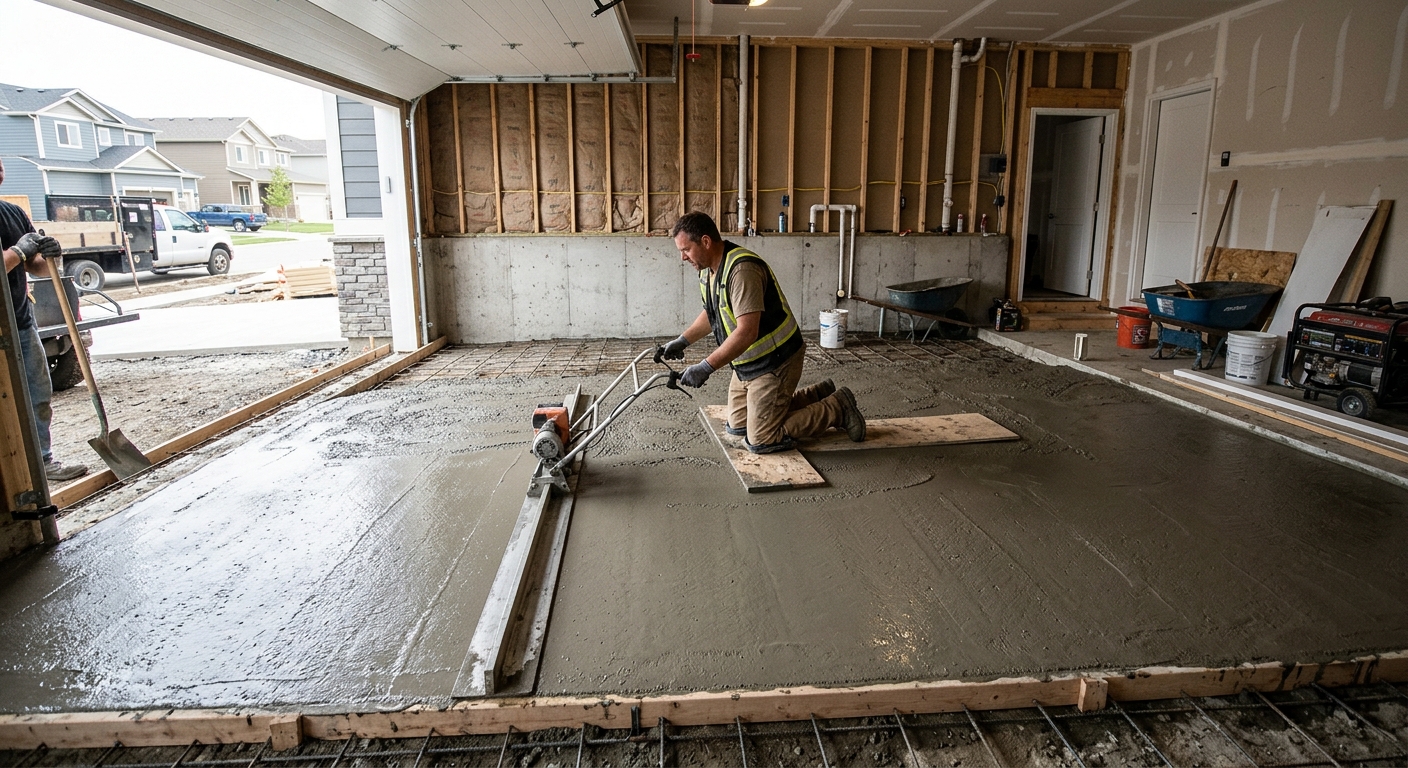
Concrete work options and costs in Burnaby
Burnaby homeowners typically choose between several concrete options depending on how much traffic the area gets, how smooth they want the surface, and how well they’re protecting it from our Lower Mainland–Southwest weather. In Burnaby, single-detached houses make up 18.9% of dwellings, and that matters because driveways, front patios, and walkways are the most common concrete flatwork upgrades for this housing type. With 61,185 homeowner households (60.5% of households own) and a large share of older homes built before 1981 (35.5%), many properties are due for re-laying or improving drainage and slab surfaces.
Pricing here is shaped by a shallow-but-real frost depth and frequent freeze–thaw cycles. Even though winters are generally mild, saturated soils and coastal rainfall can undermine weak base preparation, which is why contractors emphasize compacted granular base, good subgrade drainage, and air-entrained concrete for exterior work. Labour availability and scheduling also affect cost: when rain or high humidity slows curing, crews plan around longer curing windows and may add curing blankets or surface protection to hit design strength.
In busy areas such as Metrotown and the Cameron/Brentwood corridor, concrete flatwork demand is especially steady—so it’s common to see faster scheduling for straightforward broom-finish driveways, while stamped and decorative jobs can take longer due to formwork, colour control, and finishing time.
Below are practical starting ranges to compare common concrete applications in Burnaby before you request an itemised quote.
| Application |
Typical Size |
Key Spec |
Finish Option |
Price Range |
| Concrete driveway (standard broom finish) |
400–600 sq. ft. |
4"–5" slab, air-entrained mix, compacted base, control joints |
Broom finish, optional perimeter forms |
$18,000–$28,000 |
| Exposed aggregate driveway |
400–600 sq. ft. |
4"–5" slab, air-entrained mix, good curing for surface durability |
Exposed finish with sealer-ready surface |
$22,000–$34,000 |
| Stamped concrete driveway or patio |
300–500 sq. ft. |
4"–5" slab, air-entrained mix, colour hardeners, release agent |
Stone/brick stamp pattern, integral colour |
$26,000–$42,000 |
| Plain concrete patio or walkway |
150–300 sq. ft. |
4" slab typical, compacted granular base, control joints |
Float + light broom or broom finish |
$8,000–$18,000 |
| Garage floor (interior slab) |
400–600 sq. ft. |
4" slab, vapour considerations if needed, compacted base |
Standard trowel/finish, optional broom edges |
$16,000–$26,000 |
| Foundation footings (structural, below frost) |
Varies by house plan |
Footings placed below design frost depth; rebar per engineer |
Reinforced structural concrete |
$200,000–$350,000 |
Prices are estimates only and vary by project scope, site access and material selection.
What affects the price of concrete work in Burnaby
For the same “driveway replacement” scope, quotes can swing by 30–50% across the Lower Mainland–Southwest and other parts of BC because concrete pricing here is driven by how deep and how carefully crews must build the system—not just by the visible slab. In practice, contractors price for excavation, base preparation, drainage, reinforcement details, mix design, finishing time, and the real-world curing delays caused by coastal rainfall and high humidity.
Frost line depth and freeze–thaw cycles dictate specs for every exterior item. In colder regions, footings must extend below the design frost depth to prevent frost heave; local practice commonly assumes a frost depth around 450 mm / 18" for design planning, so exterior footings and thickened edges are placed below that to reduce movement risk. Exterior slabs also need air-entrained concrete to survive repeated wetting, freezing, and scaling. When it’s colder or damp longer than expected, cold-weather curing precautions (blankets, insulation, temperature control) add labour and material cost. Finally, with de-icing salts in winter, sealing becomes important—unsealed surfaces are more likely to show early scaling and spalling.
Two examples explain why cost can rise or fall in Burnaby. First, if your driveway subgrade is soft or waterlogged (common near downspouts and older drainage systems), you may need additional granular excavation and re-compaction before any 4"–5" slab goes in—this can push a job toward the higher end of the typical concrete driveway band of $18–$28 per square foot. Second, a stamped driveway isn’t just “extra finishing”; it often requires thicker protection planning and more labour per square foot, so it typically prices closer to the $22–$36 band for stamped and decorative work when the pattern, colour system, and sealing are included.
Home age matters too: if your property has sections built before 1981, there’s a higher chance the base was never built to current drainage expectations, which can add several thousand dollars to proper base rebuilding and re-sloping.
| Price Factor |
Why It Matters |
Cost Impact |
| Frost line depth — determines footing depth and form height |
Footings and thickened edges must be below design frost to prevent heave |
Can increase excavation and forming time by 10–30% |
| Site preparation — excavation, grading, compacted granular base |
Weak or wet subgrade leads to settlement and cracking |
Often the biggest swing factor on older Burnaby properties |
| Reinforcement — rebar or wire mesh requirement |
Reinforcement controls cracking and helps slabs carry loads |
+$1,000–$5,000 depending on thickness and design |
| Mix design — air-entrainment and compressive strength spec |
Air-entrainment improves freeze–thaw durability in coastal wet cycles |
Minor material uplift, but protects against early surface failure |
| Finish type — broom vs. stamped vs. exposed aggregate |
Decorative finishes require more labour and tighter control |
Stamped/exposed often adds 25–60% over broom finish |
| Pour size and concrete truck access to site |
Limited access may require pumping or multiple deliveries |
Can add charges for pumping, traffic control, and extra time |
| Cold-weather curing precautions — heating and blankets |
Cool nights and damp air slow strength gain |
Can add 5–15% depending on weather window |
| Control joint pattern and sealing cost |
Joints limit random cracking; sealing helps resist salts and water |
Small per-square-foot cost, but prevents costly repairs |
Permits & regulations in British Columbia
In British Columbia, structural concrete work such as footings, foundation walls, and grade beams typically requires a building permit and often engineered drawings reviewed by the municipality. For example, when concrete supports the building’s load path or affects foundation stability, you should assume permits are required. Concrete flatwork—driveways, patios, and walkways—usually does not need a permit unless it triggers grading changes, impacts lot drainage, affects impervious surface coverage limits, or relates to the municipal right-of-way.
To verify this in Burnaby, ask your contractor up front: “Does any part of this job require a permit, or do you need engineered drawings?” A solid contractor will tell you clearly whether they plan to pull a permit, who supplies the drawings, and what will be inspected.
Next, confirm contractor credentials. Step-by-step, you can do this:
- Check the contractor’s licensing/registration information using the appropriate BC online registry for contractors before signing anything.
- Request a current Certificate of Insurance (liability) showing coverage amounts and effective dates.
- Ask for proof of coverage for workers (WSBC/WCB coverage) so you’re not exposed if someone is injured on your property.
- Verify the insured party name matches the company you’re hiring.
- Ask for references from similar concrete scope (driveways, slab replacements, or footing work) and confirm the work was completed to schedule.
Finally, insist on a written scope that states whether permit pull and inspections are included—so there are no surprises after the excavation starts.
Getting concrete right in Burnaby's freeze-thaw climate
Concrete failures in Burnaby are rarely about “bad concrete” alone—they’re usually about the system: base, drainage, mix, joints, curing, and protection. In our Lower Mainland–Southwest climate, the combination of coastal rainfall, frequent freeze–thaw cycles, and de-icing salt exposure can drive spalling (surface scaling and flaking) when air content isn’t correct or when curing is rushed. If the slab sits on poor granular base or a wet subgrade, it can also pump fines and open up cracks, letting water into the structure.
To spec the job correctly, start with base prep. Use compacted granular sub-base to the right depth for the soil and frost considerations—especially on older lots where drainage may have changed over decades. Then address mix design: for exterior flatwork, request air-entrained concrete with a target air content typically around 5–7% for good freeze–thaw resistance and a minimum 32 MPa compressive strength. Add control joints with a spacing plan that limits random cracking and makes the cracks predictable and repairable. Curing is critical: plan for at least 7 days of proper curing under suitable conditions, and in cooler, damp weather use curing blankets or other cold-weather precautions so the slab reaches design strength. After curing, apply a penetrating sealer about 28 days post-pour to repel water and de-icing salts.
Ask these questions to avoid the most common issue—spalling from inadequate air-entrainment. For example, if you’re comparing options, a broom-finish driveway may land in the $18–$28 per square foot range, while stamped work is often higher (commonly $22–$36 per square foot). The extra cost is usually justified only if the base, mix spec, joints, and curing are the same quality standard—not just because of the decorative stamp.
| Spec |
Why It Matters in Burnaby |
What to Ask For |
Impact if Skipped |
| Compacted granular base (depth?) |
Proper thickness and compaction reduce settlement and water retention during coastal rain |
Minimum granular depth and compaction method; confirm drainage plan |
Cracking, pumping fines, and premature slab failure |
| Air-entrained concrete mix (target air %?) |
Freeze–thaw durability depends on entrained air; Burnaby’s wet winters intensify risk |
Target air content of about 5–7% for exterior flatwork |
Spalling/scaling within a few winters |
| Compressive strength (MPa rating) |
Strength gain must reach design requirements for load and abrasion resistance |
Minimum 32 MPa specified for the slab |
Surface wear, cracking, and reduced durability |
| Control joints (spacing per ACI guidelines) |
Joints manage shrinkage cracks so they don’t become uncontrolled pathways for water |
Joint spacing plan and timing of saw-cut/formed joints |
Random cracking and more expensive repairs |
| Minimum 7-day curing period |
Cool nights and high humidity slow strength development in the Lower Mainland |
Confirmation of curing method; temperature/conditions plan |
Low strength, dusting, and early scaling |
| Penetrating sealer (when applied after cure) |
Sealer helps repel salt and water penetration during winter cycles |
Penetrating sealer after cure (commonly about 28 days post-pour) |
Faster water/ion ingress, more spalling risk |
How to choose a concrete work contractor in Burnaby
Choosing a concrete contractor in Burnaby is less about who’s cheapest that day and more about who specs and manages the details that prevent freeze–thaw damage. Start by verifying British Columbia licensing/registration for the specific work they advertise, then confirm liability insurance and workers’ coverage. In practical terms: ask for a current Certificate of Insurance and proof of WSBC/WCB coverage, and ensure the insured name matches the company on your contract. If they can’t provide documents promptly, that’s a red flag.
Next, get 2–3 itemised written quotes. Not lump-sum only—ask them to break out labour and materials by line items (excavation/grading, granular base, reinforcement, concrete supply, pumping/transport, formwork, finishing, joints, sealer, and disposal). Make sure the quote clearly states whether a permit is required and whether permit pull, inspections, and protection of nearby surfaces are included.
Warranty also matters. Ask for a workmanship warranty length (and what it covers—cracks from shrinkage, settlement due to base issues, surface scaling due to curing, etc.). Confirm product/manufacturer warranty if a system is used (like sealers or admixtures) and whether it’s transferable to you.
For payment, avoid paying more than 10–15% upfront. Use a reasonable holdback until completion and final cleanup. Finally, get a start date and completion estimate in writing, including what happens if rain delays curing. In Burnaby, timing is real cost because crews may need curing blankets, additional supervision, or rescheduling when coastal rain hits.
- Provide written scope: slab thickness, base build-up, and reinforcement requirements
- Confirm air-entrainment and minimum compressive strength in the quote
- Ask about drainage treatment and how water is directed away
- Clarify joint pattern, saw-cut timing, and whether joints are sealed
- Confirm curing plan (blankets/sealer schedule if cold or rainy)
- Include disposal/loading fees (soil/old slab haul-away)
- State truck access plan and whether pumping is required
- Get a clear allowance for removal of existing concrete (and any regrading)
- Verify insurance certificate and WSBC/WCB proof are current
- Confirm warranty terms in writing before you sign
- Request references for similar Burnaby projects (older homes included)
- Use a payment schedule with a holdback until final inspection/cleanup
Concrete contractor red flags in Burnaby: they won’t commit to air-entrainment or a curing plan, they provide only a vague “per square foot” price without base/drainage details, they ask for large upfront payments (above 10–15%), they can’t produce insurance/WSBC/WCB documents, or they dismiss control joints and sealing as optional after the fact.
Frequently asked questions — concrete work in Burnaby
Can concrete be poured in cold weather in Burnaby?
Yes, concrete can be poured in cold weather in Burnaby, but it must be done with a proper cold-weather plan. In the Lower Mainland–Southwest, temperatures can dip during nights while days stay damp and humid from coastal rainfall, which slows strength gain and increases finishing challenges. A competent crew will manage mix temperature, protect the slab with curing blankets/insulation, and extend curing as needed to reach design strength. If the ground is frozen or saturated beyond workable limits, excavation and base prep may need to pause or be reworked because a weak base will still fail even with “good” concrete. Ask your contractor how they handle curing temperatures, and whether air-entrainment is included for exterior flatwork. For reference, exterior driveways commonly land in the $18–$28 per square foot band when base, mix spec, and curing are properly managed.
How do I maintain concrete in Burnaby's freeze-thaw climate?
To maintain concrete in Burnaby’s freeze–thaw conditions, focus on water control and surface protection. Start with drainage: keep downspouts and grading directing runoff away from the slab so water doesn’t pond. Use a penetrating sealer after the proper cure window (often about 28 days post-pour) to help repel moisture and reduce salt-related surface damage. During winter, use de-icing products carefully—overuse and harsh salts can accelerate scaling. For minor hairline cracks, don’t ignore them: cleaning and targeted crack repair helps keep water out of the subgrade and reduces freeze–thaw stress. Regularly inspect joints and re-seal where needed, because joints are meant to be the “controlled” crack points. If your home is older (many are built before 1981), maintenance matters even more because the drainage and base were often built to older expectations.
What causes concrete to spall in Burnaby winters?
Spalling in Burnaby typically comes from water getting into the concrete and then expanding as it freezes, plus chemical attack from de-icing salts. The most common preventable cause is inadequate air-entrainment: without the correct air void system, freeze–thaw cycling breaks down the surface paste faster than it should. Base and drainage issues also contribute—if the slab sits on a wet or poorly compacted granular base, the concrete can see movement and microcracking, which opens pathways for water. Curing problems can add to this: if curing is rushed or the slab doesn’t reach adequate early strength, the surface can be more vulnerable. That’s why reputable contractors specify air-entrained exterior mix and a minimum 7-day curing plan. If spalling shows up early, ask whether the job used correct air content and whether a penetrating sealer was applied after cure.
What is rebar and when is it required in British Columbia?
Rebar is reinforcing steel bars placed inside concrete to help control cracking and carry tensile stresses that plain concrete alone can’t handle. In British Columbia, whether rebar is required depends on the structural design: for structural elements like footings and foundation walls, reinforcement is typically required by the engineering drawings and the building code provisions for load and durability. For concrete flatwork like driveways, some designs use wire mesh or engineered reinforcement depending on thickness, soil conditions, and expected loads (like vehicle weight and shrinkage control). In older Burnaby homes (many built before 1981), reinforcement choices can also reflect how the existing slab performed and what’s being corrected during replacement. If your project involves any structural concrete (footings/foundation walls), you should expect a permit and engineered design that calls out reinforcement placement. Ask your contractor to reference the engineered drawing requirements for the specific element.
How long does a concrete project take in Burnaby?
Typical timelines in Burnaby depend on weather, site access, and whether you’re doing flatwork or structural concrete. For driveway or patio flatwork, the excavation and forms are often completed in 1–3 days, with concrete placement on a single pour day. Finishing and curing protection can extend the “ready to use” timeline. Even when the surface is walkable sooner, you should plan on full strength and best durability after proper curing—often at least 7 days before heavy use, and additional protection/handling considerations depending on conditions. Rain can also change scheduling because coastal humidity can slow finishing and strength gain, so crews may use blankets and adjust start dates. Stamped work adds time because of colour work, pattern setting, and careful finishing. If you’re comparing quotes, don’t just compare price—ask for a written schedule and curing plan to understand why one crew may be able to start sooner than another.
What is a concrete overlay and is it suited to Burnaby?
A concrete overlay is a new layer of concrete placed over an existing slab (after preparation), usually to improve appearance and extend service life without fully removing everything. In Burnaby, overlays can be suitable when the existing concrete is still structurally sound—meaning it’s not heavily heaved, extensively cracked through the slab, or failing with widespread spalling that indicates deeper moisture and base issues. Overlays still need excellent surface preparation, proper bonding, and correct mix/control so freeze–thaw cycles don’t create new debonding or reflect old cracks. If water is getting under or through the slab due to drainage or base problems, an overlay may hide symptoms temporarily but can fail sooner. For homeowners, it can be a cost-effective option when repairs are localized, but if the base is compromised (common on older lots built before 1981), full slab replacement is often the more durable solution. As a price reference, decorative new work like stamped concrete often runs in the $22–$36 band; overlays can be competitive, but only if the existing substrate is truly ready for bonding.