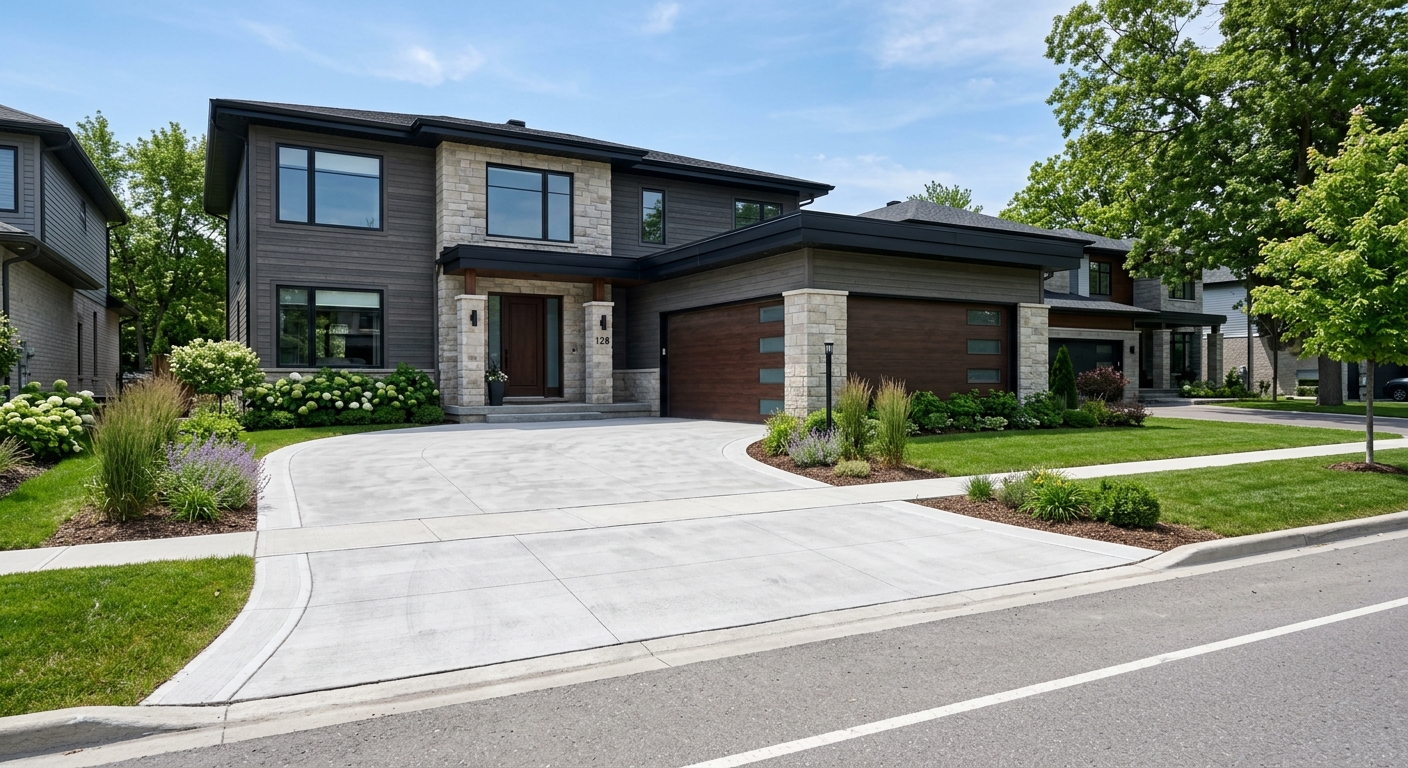
Concrete work options and costs in Crescent Beach
Crescent Beach is a small coastal community where homeowners count on concrete for durable driveways, patios, walkways and foundation support year after year. With a population of about 1,200 (Statistics Canada, 2021 Census), demand is steady but not huge—so scheduling can tighten in spring and early summer when the Lower Mainland–Southwest is busiest. Most concrete flatwork demand is tied to single-family housing typical of coastal neighbourhoods like Crescent Beach proper and the shoreline-adjacent blocks, where people want curb appeal without constant repairs.
In the Lower Mainland–Southwest, pricing is shaped less by extreme freeze and more by frequent freeze–thaw cycles, saturated soils, and coastal rainfall. Even with a shallow frost depth (often designed around ~450 mm / 18"), we still place footings and thickened edges below that line to reduce frost heave risk. That means excavation, engineered base prep and air-entrained mixes stay central to every exterior slab job. We also plan curing around cool nights and high humidity, which can add labour time (and sometimes curing blankets and sealers) when rain interrupts placement.
Because these factors affect both material and labour, two homes with the same square footage can still land in different price tiers—especially when comparing plain broom finishes to stamped or exposed aggregate work. To help you compare apples-to-apples, here are typical Crescent Beach price bands by application, then you can move to the factors that push quotes higher or lower.
| Application |
Typical Size |
Key Spec |
Finish Option |
Price Range |
| Concrete driveway (standard broom finish) |
320–520 sq. ft. |
Compacted granular base; air-entrained exterior mix; control joints |
Stamped not included; broom float |
$8,000–$14,000 |
| Exposed aggregate driveway |
320–520 sq. ft. |
Proper base + curing plan to avoid surface scaling |
Exposed aggregate top finish (stone exposure) |
$10,000–$18,000 |
| Stamped concrete driveway or patio |
250–450 sq. ft. |
Air-entrained exterior mix; dense finishing workflow |
Stamp mats + release + colour hardener/sealers |
$9,000–$16,000 |
| Plain concrete patio or walkway |
140–320 sq. ft. |
Compacted granular base; slope for drainage |
Broom or light trowel; simple edging |
$2,800–$8,000 |
| Garage floor (interior slab) |
420–620 sq. ft. |
Vapour control where needed; proper thickness; mesh/rebar as required |
Smoother finish; sawcut joints |
$7,000–$13,500 |
| Foundation footings (structural, below frost) |
Per footing/area (varies by design) |
Excavate to frost-protected depth; reinforced concrete; engineered details |
Structural concrete (not a decorative finish) |
$6,500–$14,000 |
Prices are estimates only and vary by project scope, site access and material selection.
What affects the price of concrete work in Crescent Beach
In Crescent Beach and across the Lower Mainland–Southwest, quotes for what looks like the “same” concrete job can swing by 30–50% because the real costs sit underneath the finish: excavation depth, drainage work, base compaction, reinforcement, concrete mix design and curing time. Compared with other parts of British Columbia, contractors in colder or wetter areas often have higher excavation and cold-weather heating/blanket costs. Even within the Lower Mainland, coastal rainfall can disrupt pour scheduling and extend curing windows, which increases labour and equipment time.
Frost and freeze–thaw cycles dictate much of the specification. Here, codes and typical practice assume a frost depth around 450 mm / 18", so footings and thickened edges are placed below that to avoid frost heave. Exterior slabs and driveways should use air-entrained concrete to handle repeated wetting and freezing; when air content or curing is off, you can get surface scaling and spalling later. Colder regions also face shorter pour seasons and more frequent need for curing precautions (heating, blankets), which is one reason prices trend higher farther from the milder Lower Mainland pocket.
In Crescent Beach, two examples that commonly raise cost are (1) saturated subgrade that needs extra granular base and better drainage, and (2) extra thickness or reinforcement where soil conditions or slopes demand it. Conversely, costs can drop when access is easy, haul distances are short, and demolition/disposal scope is minimal. For context, a standard driveway may land near the region’s $18–$28 per sq. ft. backbone, while stamped & decorative work typically runs higher—often in the $22–$36 per sq. ft. range—because of colour systems, stamping labour and extra finishing steps.
| Price Factor |
Why It Matters |
Cost Impact |
| Frost line depth — determines footing depth and form height |
Footings must sit below design frost to reduce frost heave and settlement risk |
Higher excavation and more concrete/height of forms |
| Site preparation — excavation, grading, compacted granular base |
Saturated coastal soils need proper granular base and drainage for stability |
Often one of the biggest swing factors in the quote |
| Reinforcement — rebar or wire mesh requirement |
Controls cracking and improves slab/foundation performance under loads |
Adds labour, tying support, and material costs |
| Mix design — air-entrainment and compressive strength spec |
Exterior air-entrainment improves freeze–thaw durability and scaling resistance |
Higher-spec mix and batching requirements |
| Finish type — broom vs. stamped vs. exposed aggregate |
Decorative finishes require more workflow time and specialty steps |
Stamped/exposed can add significant labour |
| Pour size and concrete truck access to site |
Access affects pumping/placing methods and crew efficiency |
Hard access can increase labour hours and equipment |
| Cold-weather curing precautions — heating and blankets |
Cool, wet conditions can slow strength gain and increase surface defects |
Blankets/heaters add labour and materials |
| Control joint pattern and sealing cost |
Jointing reduces random cracking; sealing improves water/road-salt resistance |
More layout time and added materials for sealer |
Permits & regulations in British Columbia
In British Columbia, the permit picture depends on what you’re building, not just that it’s “concrete.” Structural concrete work—such as foundation walls, grade beams, retaining elements and the footing system that supports the structure—typically requires a building permit and often engineered drawings that the municipality reviews. Concrete flatwork (like driveways, patios, walkways and exterior steps) usually does not require a permit unless it affects lot grading, drainage, impervious surface coverage limits, or the municipal right-of-way (for example, where you’re altering curb/sidewalk tie-ins or changing drainage to the street).
Before breaking ground in Crescent Beach, confirm requirements with the local authority because shoreline drainage and grading can be sensitive. Also verify the contractor is properly insured and covered for workplace safety: ask for proof of liability insurance and WCB/WSIB coverage as applicable to their trade and payroll structure (the exact paperwork should be provided on request).
Step-by-step, here’s how a homeowner verifies credentials in BC:
- Licence/credentials: check the contractor’s licensing/registration status using the relevant BC public registry resources (or ask for their licence number and verification page).
- Liability insurance: request a current certificate of insurance (COI) showing general liability limits and that the policy is active for your contract period.
- Clearance/coverage: request proof of coverage for their workers (WCB/WSIB documentation), not just “we have insurance.”
- References: ask for 2–3 photos and addresses of similar-scale work (exterior slabs in coastal conditions are ideal).
- Written scope: ensure the permit responsibility is clear—if permits are required, confirm who pulls them and what’s included.
Getting concrete right in Crescent Beach's freeze-thaw climate
Crescent Beach’s biggest concrete threat isn’t “deep winter freezing” so much as repeated freeze–thaw cycles combined with coastal-wet conditions. When water gets into the concrete and around the base, then freezes, it expands and can drive scaling and spalling at the surface. The fix is a specification that starts with base preparation and continues through mix design, joints and curing—so water has fewer ways to penetrate and the concrete has enough durability to handle the cycle.
Here’s how to spec the job correctly for the Lower Mainland–Southwest: (1) base preparation using compacted granular sub-base to the right depth for your soil and site conditions; aim for a stable, well-drained foundation to reduce pumping and settlement. (2) mix design with air-entrainment—typically targeting about 5–7% air content for exterior flatwork—and a minimum 32 MPa compressive strength so the slab reaches durability expectations. (3) control joints placed to manage where cracking will occur rather than letting it happen randomly. (4) curing with enough protection time; in practice we plan for at least 7 days of proper curing conditions, and in cool/cetain rainy windows that may mean blankets and more careful timing. (5) sealing with a penetrating sealer after the concrete fully cures (commonly around 28 days) to repel de-icing salts and reduce water ingress.
To avoid the most common failure—spalling from inadequate air-entrainment—ask your contractor to explicitly confirm the mix spec. A practical example: if a stamped patio quote comes in noticeably lower than another contractor’s price, it can be unjustified if the cheaper option cuts corners on base depth, air content, or curing. In Crescent Beach, that difference often shows up later as surface scaling, and repairs rarely make economic sense compared to doing the proper $22–$36 per sq. ft. type work with a durable spec.
| Spec |
Why It Matters in Crescent Beach |
What to Ask For |
Impact if Skipped |
| Compacted granular base (depth?) |
Stable support reduces settlement and limits water movement that accelerates freeze–thaw damage |
Confirm granular type, thickness and compacted depth based on site soil and loading |
Cracking, uneven surface, and faster deterioration |
| Air-entrained concrete mix (target air %?) |
Air pores help the concrete resist freeze–thaw scaling and spalling in wet coastal winters |
Confirm target air content (about 5–7% for exterior flatwork) and exterior durability requirements |
Scaling/spalling and early surface failure |
| Compressive strength (MPa rating) |
Strength gain is tied to durability and performance, especially during cool curing periods |
Confirm minimum 32 MPa (or higher if engineered) and expected curing conditions |
Reduced durability and higher risk of cracking under stress |
| Control joints (spacing per ACI guidelines) |
Proper joint layout controls where cracks form during drying and temperature swings |
Ask for the joint spacing plan and sawcut timing |
Random cracking and uncontrolled appearance issues |
| Minimum 7-day curing period |
Cold nights and high humidity can slow strength development if curing is rushed |
Confirm curing method and minimum curing duration before heavy use |
Lower strength and surface defects in wet cycles |
| Penetrating sealer (when applied after cure) |
Helps repel water and de-icing salts that contribute to freeze–thaw surface scaling |
Ask for sealer type and timing (commonly after full cure, around 28 days) |
More water ingress and accelerated spalling risk |
How to choose a concrete work contractor in Crescent Beach
Choosing the right contractor in Crescent Beach means verifying credentials that protect you if something goes wrong and making sure the quote reflects the right spec for our coastal freeze–thaw climate. In British Columbia, confirm the contractor’s licensing/registration status first (ask for the licence number and where it can be verified). Next, request a current certificate of liability insurance and confirm the coverage limits are appropriate for concrete flatwork and any excavation/demolition involved.
Then check coverage for their workers: ask for WCB/WSIB clearance or proof of coverage that matches their payroll and trade activity. Don’t accept vague assurances—ask to see the actual documents and dates.
For pricing, get 2–3 itemised written quotes that break out labour, excavation/site prep, materials, reinforcement, finishing, and any pump/haul equipment. Avoid a “one number” lump sum unless it clearly includes everything you expect (including disposal of concrete, prep for drainage, and site restoration). Review whether a permit pull is included where required for structural concrete; flatwork may not need a permit unless grading or impervious surface limits are affected.
Warranty matters: ask for the workmanship warranty length in writing, whether it covers surface scaling or cracking due to defective workmanship, and whether any product/manufacturer warranty is included and transferable. For payment, never pay more than 10–15% upfront, and hold back a portion until the work is complete and clean (including final sealing only when the concrete has reached the proper cure window). Get a start date and completion estimate in writing—weather and curing timing are real cost drivers here, so clarity prevents surprises.
- Ask who is responsible for permits (structural vs flatwork scope).
- Request COI for liability insurance and confirm coverage is active.
- Provide proof of WCB/WSIB clearance/coverage for workers.
- Insist on itemised quotes (base prep, reinforcement, mix, finish, curing, sealing).
- Confirm exterior mix is air-entrained and specify expected air content and strength.
- Require joint plan: spacing and sawcut timing.
- Ask how drainage will be handled and whether saturated soils are treated with extra granular/base.
- Clarify disposal: is old concrete removal and hauling included?
- Verify access: will they pump, and what are the truck/wheelbarrow limits?
- Get curing/blanket plan for cool nights and rainy windows.
- Confirm warranty terms in plain language and what is excluded.
- Agree on payment schedule and holdback before work starts.
Red flags in Crescent Beach: quotes that avoid discussing air-entrainment and curing; “too-good-to-be-true” decorative pricing with no material/colour system details; vague scope language like “concrete as needed” without base depth or joint spacing; skipping drainage/base prep and blaming natural cracking later; and contractors asking for large upfront payments or refusing to provide proof of insurance and worker coverage.
Frequently asked questions — concrete work in Crescent Beach
What is a concrete overlay and is it suited to Crescent Beach?
Concrete overlays are thin (or resurfacing) cementitious layers applied over existing concrete to restore appearance without full removal. In Crescent Beach, overlays can be suited for driveways or patios that are structurally sound—meaning the original slab isn’t badly heaving, pumping, or suffering major settlement. Overlays mainly improve surface wear and minor pitting; they do not “fix” a failing base. Because our coastal-wet freeze–thaw cycle can emphasize bond problems, the key is surface prep: grinding/shot blasting, crack treatment, and proper moisture management. If you’re seeing scaling already, a full-depth replacement or engineered base correction is often the better long-term option. As a price reference point, many homeowners end up comparing overlay costs to a plain patio/ walkway priced around the local $16–$26 per sq. ft. backbone, and the “cheaper now” option can lose value if the bond fails after a few seasonal wet/freezing cycles.
How do I seal concrete to protect it in Crescent Beach?
Sealing helps reduce water and de-icing salt penetration, which is important in British Columbia’s coastal freeze–thaw conditions. For most exterior flatwork, use a penetrating sealer rather than a high-gloss film coating—penetrating types absorb and repel water at the surface, helping slow scaling and spalling. Timing is critical: apply the sealer after proper curing, commonly around 28 days post-pour, and only when the slab is dry enough for the sealer to absorb correctly. Before sealing, the surface should be clean and free of dust, curing compounds, and any contaminants. In Crescent Beach, if you experience winter melt use, don’t skip sealing—road salts can accelerate surface breakdown. Ask your contractor which sealer type they use, coverage rate (sq. ft. per litre), and whether they include sealing in the scope or as a separate line item.
What is the difference between concrete and cement?
In everyday talk people say “cement” when they mean the finished slab, but technically they’re different. Cement is one ingredient—usually Portland cement—mixed with water and aggregates (sand, gravel) to make concrete. Concrete is the full engineered mixture that becomes your driveway, patio or foundation after it cures. Your contractor’s quote depends heavily on concrete design details: for example, exterior concrete in Crescent Beach should be air-entrained and specified to hit a minimum compressive strength (often 32 MPa or higher). That’s part of the durability story for our freeze–thaw cycles. When you hear about “cement-based” products (like some patching mortars or overlays), those are usually cement plus additives, applied as a separate system over your existing slab.
How much does concrete work cost in Crescent Beach?
Concrete pricing in Crescent Beach generally tracks the Lower Mainland–Southwest’s backbone rates, but your final number depends on base prep, reinforcement, and finish level. For driveway/surface flatwork, typical region pricing is about $18–$28 per sq. ft. for concrete driveway/slab and $16–$26 per sq. ft. for patios and walkways. Decorative work like stamped or higher-end exposed aggregate often runs higher—commonly $22–$36 per sq. ft.—because it requires more labour steps and finishing materials. Foundation/footings pricing is usually quoted per project scope/design, often in the $200–$350 range for footing-related line items, but structural conditions and engineered details can push the total up. If you want a more accurate comparison, ask for an itemised quote that includes excavation and compacted granular base depth, air-entrained mix confirmation, reinforcement, curing plan, and whether sealing is included.
How deep must footings be for Crescent Beach's frost line?
Crescent Beach is on the coastal side of British Columbia, where frost penetration is typically shallower than in interior or northern regions. Local practice commonly designs for a frost depth around 450 mm / 18", but that does not mean footings can be placed at the surface frost depth. In order to reduce frost heave risk, exterior structural elements like footings and thickened edges are placed below the design frost depth and according to the project’s engineered foundation requirements. The exact depth can vary based on soil conditions, local drainage, and the structural design, so your safest guide is the engineered foundation drawings for your home. Also note: if drainage is poor or subgrade is saturated, contractors may need additional base preparation or changes to protect performance. If you’re doing structural concrete, treat footing depth as a design/spec item, not a “guess” number.
Why does concrete crack in Crescent Beach and how is it prevented?
Concrete cracks in Crescent Beach mainly because of shrinkage (drying), temperature movement, and moisture/soil behaviour during and after curing—not because concrete is “bad.” Our freeze–thaw cycle and coastal rainfall add stress when water enters along edges or through joints, especially if base prep and air-entrainment aren’t right. Prevention starts with a properly compacted granular base and drainage, correct exterior mix design (air-entrained for durability), and a planned control joint pattern. Control joints are the “intentional weak points” that help cracks form where they’re expected rather than randomly across the slab. Curing is equally important: rushing curing in cool, wet conditions can increase shrinkage stress and early defects. Finally, sealing after curing helps reduce water ingress from rain and de-icing salt exposure, which supports better long-term surface performance. When you ask for joint spacing, curing duration, and air-entrainment in the quote, you’re addressing the root causes rather than hoping for the best.