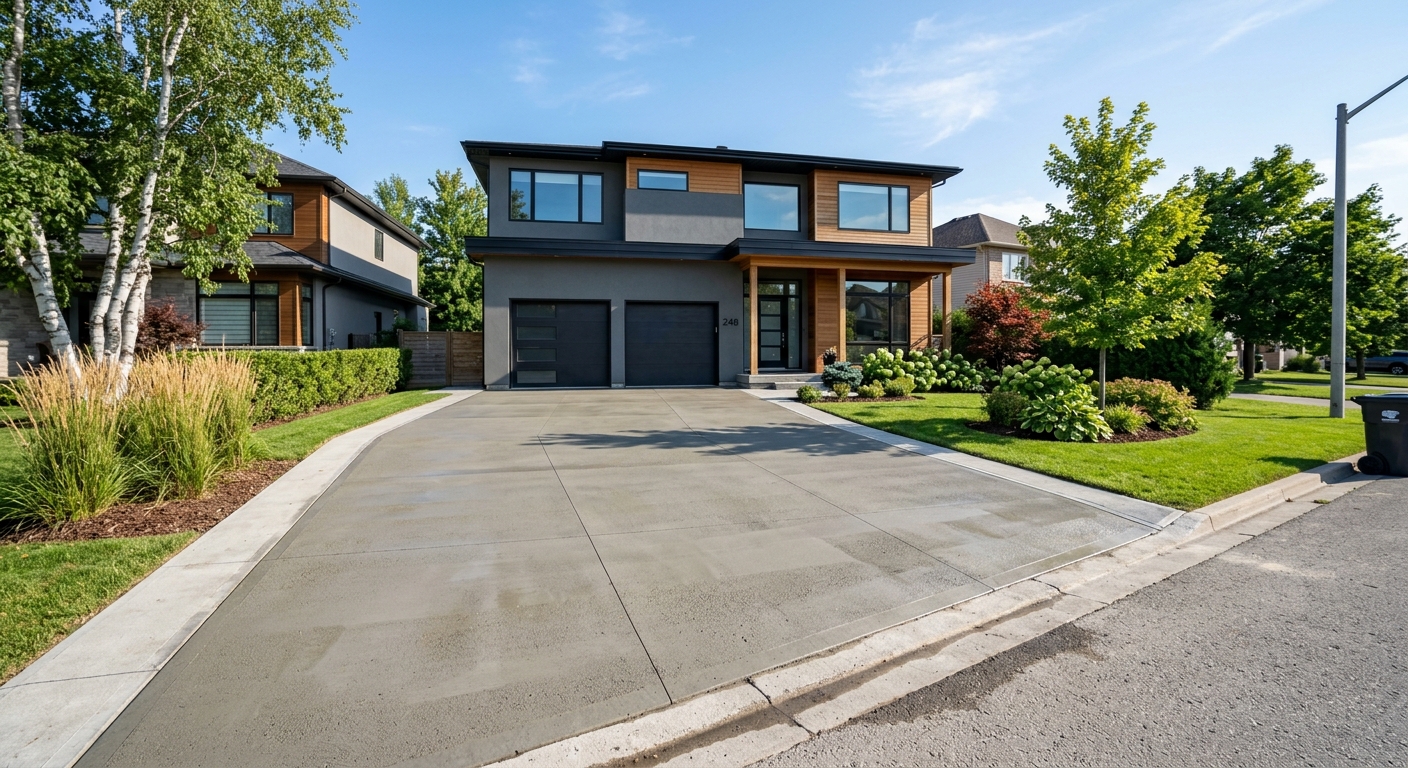
Concrete work options and costs in Chilliwack Mountain
In Chilliwack Mountain, BC, most homeowners end up choosing between driveway and patio flatwork (for daily curb appeal) and structural concrete (for foundations and footings). With a population of 2,510 (Statistics Canada, 2021 Census), the local market is smaller, so turnaround time can depend on scheduling availability from the Vancouver–Surrey–Abbotsford corridor. Concrete services are especially in demand in built-up areas such as Vedder Crossing and near the Highway 1 corridor, where homes are close to roads and driveway access matters for truck placement. If you’re planning flatwork, the typical homeowner upgrades align with the region’s moisture-and-freeze-thaw reality: even though our winter temperatures are milder than much of Canada, cold snaps plus frequent wetting still drive cracking and scaling risk if the mix, drainage, and curing aren’t right.
In the Lower Mainland–Southwest, crews typically design for an approximate frost depth around 450 mm (18")—so footings and thickened edges are placed below that to help prevent frost heave. Pricing also reflects how long we may wait for dry weather, plus the extra care needed for air-entrained mixes, joint layout, and curing blankets on cool nights. Because the area’s concrete labour pool is tied to a larger regional workforce, complex sites and difficult access can widen the gap between “basic” and “fully engineered” scopes. Use the cost ranges below as your starting point, then compare your quotes line-by-line in the next sections.
| Application |
Typical Size |
Key Spec |
Finish Option |
Price Range |
| Concrete driveway (standard broom finish) |
320–500 sq. ft. |
Reinforced slab with compacted granular base; air-entrained mix for exterior exposure |
Broom finish, control joints, sealant recommended |
$18,000–$28,000 |
| Exposed aggregate driveway |
320–500 sq. ft. |
Engineered base + air-entrained concrete; proper curing to protect surface durability |
Exposed aggregate (wash finish), standard control joints |
$22,000–$35,000 |
| Stamped concrete driveway or patio |
250–450 sq. ft. |
Reinforced slab with air-entrained mix; integral colour |
Stamp mats + release + sealed finish |
$22,000–$40,000 |
| Plain concrete patio or walkway |
180–350 sq. ft. |
Compacted granular base; air-entrained mix; joints to manage shrinkage |
Light broom or trowel finish, optional sealer |
$16,000–$26,000 |
| Garage floor (interior slab) |
300–600 sq. ft. |
Vapour barrier (as applicable), reinforcement as required, minimum finishing tolerances |
Float finish, optional densifier/sealer |
$14,000–$26,000 |
| Foundation footings (structural, below frost) |
Per linear foot / typical small foundation |
Excavation + forming + rebar; poured below design frost depth to reduce freeze-thaw movement |
Steel-reinforced concrete footings; no decorative finish |
$200–$350 |
Prices are estimates only and vary by project scope, site access and material selection.
What affects the price of concrete work in Chilliwack Mountain
In the Lower Mainland–Southwest, two contractors can quote the “same” concrete project and still be 30–50% apart, even before you add extras like drainage or stamped work. The difference usually comes down to how deeply they plan for frost protection, how much base prep they include, what structural reinforcement is specified, and whether they price the right concrete mix for durability in a wet/cool climate. Prices also vary across British Columbia because colder regions typically have deeper excavations and shorter pour seasons, which means higher excavation, forming, and cold-weather protection costs. In Chilliwack Mountain, we’re closer to the mild end of BC, but freeze–thaw cycling and saturated soils still make drainage and air-entrainment non-negotiable—so “cheap” mixes or skipped curing can turn into expensive surface repairs later.
For example, a driveway that’s priced around the regional flatwork band (about $18,000–$28,000 for a typical exterior slab) can jump if the contractor has to remove more unsuitable soil, add better granular base, or re-grade to direct water away from the slab edges. Likewise, decorative options such as stamped or exposed work often land closer to the higher band (around $22,000–$36,000 for typical driveway/patio scopes) because of integral colour, stamp labour, and extra sealing steps. Housing stock also matters: older lots with minimal drainage and older retaining features often need additional prep and rework, which costs money up front but prevents the washouts and spalling we see when water gets trapped.
| Price Factor |
Why It Matters |
Cost Impact |
| Frost line depth — determines footing depth and form height |
Footings and thickened edges must extend below the design frost depth to reduce frost heave. |
Higher excavation depth and forming time can materially increase foundation/footing costs. |
| Site preparation — excavation, grading, compacted granular base |
Weak subgrade and poor drainage undermine the slab’s long-term stability. |
More removal, hauling, and granular layers raise the labour and equipment costs. |
| Reinforcement — rebar or wire mesh requirement |
Controls cracking and helps carry loads, especially for driveways and thicker sections. |
Material and installation time adds cost; under-reinforcement reduces durability. |
| Mix design — air-entrainment and compressive strength spec |
Exterior slabs need air-entrained concrete for freeze–thaw resistance. |
Specified mix and quality control can increase material price but reduces failure risk. |
| Finish type — broom vs. stamped vs. exposed aggregate |
Decorative finishes require additional labour, colour, and sealing steps. |
Stamped/exposed typically adds significant labour and higher material selection. |
| Pour size and concrete truck access to site |
Long hauls, limited access, or multiple placements increase labour and logistics. |
Extra crew time, pump/placing charges, and schedule changes can add cost. |
| Cold-weather curing precautions — heating and blankets |
Cool nights slow strength gain; protection is needed for proper cure. |
Blankets, insulation, and temperature monitoring add line-item expense. |
| Control joint pattern and sealing cost |
Joints manage shrinkage cracks; sealing reduces water and salt ingress. |
Proper joint saw cuts and sealant add modest cost but can prevent surface spalling. |
Permits & regulations in British Columbia
In British Columbia, structural concrete work—think footings, foundation walls, and grade beams—typically requires a building permit and often engineered drawings that the local municipality reviews as part of the permit process. For concrete flatwork like driveways, patios, and walkways, permits usually aren’t required unless the work affects lot grading, drainage plans, impervious surface coverage limits, or the municipal right-of-way (for example, if you’re touching a boulevard area or changing how runoff is directed). Even when a permit isn’t typically required, it’s still smart to confirm with the local authority before breaking ground—especially in established neighbourhoods where drainage patterns and municipal interfaces can be tight.
For homeowner verification in Chilliwack Mountain, take a simple step-by-step approach: (1) ask for the contractor’s business licence information and proof of their legal right to perform the work (and confirm the correct credential for any trades involved in structural elements); (2) request a Certificate of Insurance showing commercial general liability coverage and ensure it’s active for the project dates; (3) confirm WSIB/WCB coverage for workers (or provide acceptable proof of coverage status); and (4) request references for similar foundation/footing or driveway projects with comparable site access. Where possible, check the contractor’s details through the appropriate online registries and verify the certificate “date of issue” and the project address/location match.
Getting concrete right in Chilliwack Mountain's freeze-thaw climate
Concrete commonly fails in Chilliwack Mountain when water gets into the slab or the base, then expands during freeze–thaw cycles. The most costly symptom is surface spalling, which often traces back to inadequate air-entrainment, poor curing, and joints that weren’t planned to move safely. To spec the job correctly, start with the base: use compacted granular sub-base to the right depth for local soil conditions and to support the slab so it won’t pump or settle during wet winters. Next is mix design: for exterior flatwork, insist on air-entrained concrete (commonly 5–7% air content) and a minimum 32 MPa compressive strength suitable for exterior exposure. Then lock in cracking control with properly placed control joints (not random—they need a pattern), and plan for curing: allow a minimum 7-day cure under suitable conditions, and protect the slab with curing blankets or coverings when cold nights are expected. Finally, seal after the concrete has cured—typically penetrating sealer applied 28 days post-pour—to help repel de-icing salts and reduce moisture penetration.
When homeowners compare options, the price jump is usually justified by durability details. For instance, a broom-finished driveway might target the lower band (about $18,000–$28,000), while a stamped driveway often moves higher (about $22,000–$40,000) because it includes colour, stamp labour, and extra sealing steps. If the contractor can’t explain air content, joint spacing, and curing protection in plain language, the “savings” often show up later as repairs.
| Spec |
Why It Matters in Chilliwack Mountain |
What to Ask For |
Impact if Skipped |
| Compacted granular base (depth?) |
Prevents settlement and helps manage saturation during coastal-wet seasons. |
Base thickness (often several inches to meet design), compaction method, and drainage grade details. |
Uneven settlement, voids under slab, and accelerated cracking. |
| Air-entrained concrete mix (target air %?) |
Air voids improve freeze–thaw durability in a wet/cool coastal climate. |
Specify target air content of 5–7% for exterior flatwork and confirm mix on order. |
Higher risk of scaling and spalling during freeze–thaw cycles. |
| Compressive strength (MPa rating) |
Strength gain supports long-term performance and resists surface wear. |
Minimum 32 MPa (and whether early strength requirements apply). |
Surface damage, dusting, and reduced resilience under traffic. |
| Control joints (spacing per ACI guidelines) |
Controls shrinkage cracking so cracks happen at planned locations. |
Joint spacing plan, saw-cut timing, and alignment to slab geometry. |
Random cracking and water ingress into vulnerable edges. |
| Minimum 7-day curing period |
Proper curing is critical in cool, humid conditions for strength and durability. |
Confirmation of cure method (curing blankets/sealers as needed) and curing timeline. |
Reduced strength, poor surface durability, and early deterioration. |
| Penetrating sealer (when applied after cure) |
Helps repel moisture and de-icing salt exposure from freeze–thaw seasons. |
State sealer type and timing—typically 28 days after pour. |
More water/salt penetration leading to scaling and spalling. |
How to choose a concrete work contractor in Chilliwack Mountain
Start by verifying the contractor’s standing. In British Columbia, ask for proof of current business registration/licence as applicable to the scope, plus a Certificate of Insurance (commercial general liability) that covers the project site. Next, confirm workers’ compensation coverage (WSIB/WCB) before work begins—request documentation rather than verbal assurances. If they can’t provide it quickly, treat that as a red flag. Then get 2–3 itemised written quotes that break down labour and materials, not just a single lump sum. A good quote should name: excavation and hauling/disposal, base prep and compaction, reinforcement (rebar/wire mesh), concrete mix and air-entrainment requirements, finish type (broom vs stamped/exposed), joint sawing timing, and curing/sealing inclusions.
Read exclusions carefully: is permit pulling included if it’s required for the structural portion? Is concrete truck access assumed? Is pump placement included if needed? Is sealant included (and when applied—after cure)? Warranty matters too: look for a clear workmanship warranty period and separate clarity on manufacturer/product warranties; ask whether anything is transferable if you sell your home. For payment scheduling, never agree to more than about 10–15% upfront; use a holdback until completion and walkthrough items are addressed. Finally, insist on a written timeline with a start date, pour-day conditions, and completion estimate—especially important in Chilliwack Mountain where cool nights and wet stretches can affect curing.
- Provide itemised pricing (labour, materials, equipment, disposal) rather than one number.
- Confirm the mix design includes air-entrainment for exterior exposure.
- Ask for the joint plan (spacing and saw-cut timing) in writing.
- Check whether curing blankets/heating are included for cool weather.
- Verify insurance certificates are current and match your address/job dates.
- Confirm workers’ compensation coverage documentation before work starts.
- Request rebar/wire mesh spec and thickness requirements for your slab.
- Ask how drainage and grading are handled at slab edges and slope transitions.
- Clarify whether sealers are included and the application date after pour (commonly 28 days).
- Make sure concrete truck access and any pump/placing charges are addressed.
- Get a written start/completion timeline and curing protection plan.
- Confirm warranty length, what it covers, and the claim process.
Concrete contractor red flags in Chilliwack Mountain: (1) vague specs like “standard mix” with no mention of air-entrainment; (2) refusing to put joint spacing, curing method, and sealing timing in the written scope; (3) asking for large deposits up front (beyond 10–15%) or no holdback; (4) skipping site grading/drainage explanations and focusing only on the surface finish; and (5) no proof of current insurance/coverage or reluctance to share references for similar slab/foundation work.
Frequently asked questions — concrete work in Chilliwack Mountain
How deep must footings be for Chilliwack Mountain's frost line?
In Chilliwack Mountain (Lower Mainland–Southwest, British Columbia), contractors typically design footing depth to be below the local design frost depth to reduce the risk of frost heave. In practice, local codes and common engineering assumptions often reference an approximate frost depth around 450 mm (18"), but the actual required footing embedment can vary with soil conditions, drainage, and structural loads—so your engineered foundation drawings should be the final authority for your specific site. If your contractor is guessing without confirming the design requirements, that’s a concern. For homeowners budgeting, footing scopes often price separately from flatwork; foundation/footings commonly fall in the regional band of about $200–$350 per linear foot depending on excavation, reinforcement, and forming complexity.
Why does concrete crack in Chilliwack Mountain and how is it prevented?
Concrete cracks in Chilliwack Mountain mainly due to shrinkage, temperature movement, and how the slab responds to moisture changes in the base. The freeze–thaw cycle adds a second layer of risk by increasing wetting and saturation at slab edges if drainage is poor. Cracking becomes more visible (and more damaging) when joints aren’t planned or when the concrete wasn’t made for exterior durability. Prevention is mostly about process: compacted granular base with proper grading, an air-entrained exterior mix, and a control joint pattern that guides where cracks form. Curing also matters—cool nights and high humidity slow strength gain. Finally, sealing after cure helps reduce water and salt intrusion, which improves surface durability during BC winters.
Stamped vs broom-finish concrete — cost difference?
Stamped and broom-finish concrete differ in both materials and labour. A broom-finished driveway or patio is typically priced closer to the lower flatwork bands (for example, driveway flatwork often lands around $18,000–$28,000 depending on size and site conditions). Stamped concrete requires integral colour, stamp mats/release, additional finishing steps, and careful curing/sealing to maintain the surface appearance—so it commonly moves higher, often around $22,000–$36,000 for typical driveway/patio projects in this tier. The most important takeaway in British Columbia is that the decorative finish doesn’t replace durability requirements: air-entrainment, joint layout, and curing still have to meet exterior specifications to avoid spalling.
When is the best time to pour concrete in Chilliwack Mountain?
The best time to pour concrete in Chilliwack Mountain is when you can achieve suitable placement and curing conditions—usually late spring through early fall—so you’re not battling prolonged wet periods, cold nights, and delayed strength gain. In the Lower Mainland–Southwest climate, rain and humidity can still be an issue even in “warm” months, but crews can manage it with scheduling, surface protection, and proper curing practices. If a pour is required in cooler weather, the contractor should plan for cold-weather curing precautions (such as blankets and temperature monitoring) so concrete reaches design strength. Ask your contractor to provide a written pour-day plan and curing protection approach before you book the date.
How long does concrete take to cure?
Concrete curing has two timelines: strength gain and when it’s ready for different uses. As a practical homeowner guideline in British Columbia, plan for at least a minimum 7-day cure period under proper conditions before treating the slab as fully stabilized. That aligns with how most contractors protect exterior slabs in Chilliwack Mountain, where cool nights and moisture can slow curing. For sealing, the common approach is to apply penetrating sealer after the concrete has cured sufficiently—often around 28 days post-pour—so the sealer can better penetrate and help repel water and de-icing salt. If your contractor rushes cure time or doesn’t explain curing blankets/sealers in the schedule, that’s a durability risk.
Do I need a permit for concrete work in British Columbia?
In British Columbia, concrete that’s part of the structural system—such as footings, foundation walls, and grade beams—typically requires a building permit and often engineered drawings that municipalities review. Concrete flatwork like driveways, patios, and walkways usually does not require a permit unless it affects lot grading, drainage, impervious surface coverage rules, or municipal right-of-way/boulevard interfaces. For Chilliwack Mountain homeowners, the best step is to confirm requirements with the local authority before breaking ground and to ask your contractor whether permits are included in the scope when structural work is involved. Also verify contractor insurance and workers’ compensation coverage documentation before work starts.