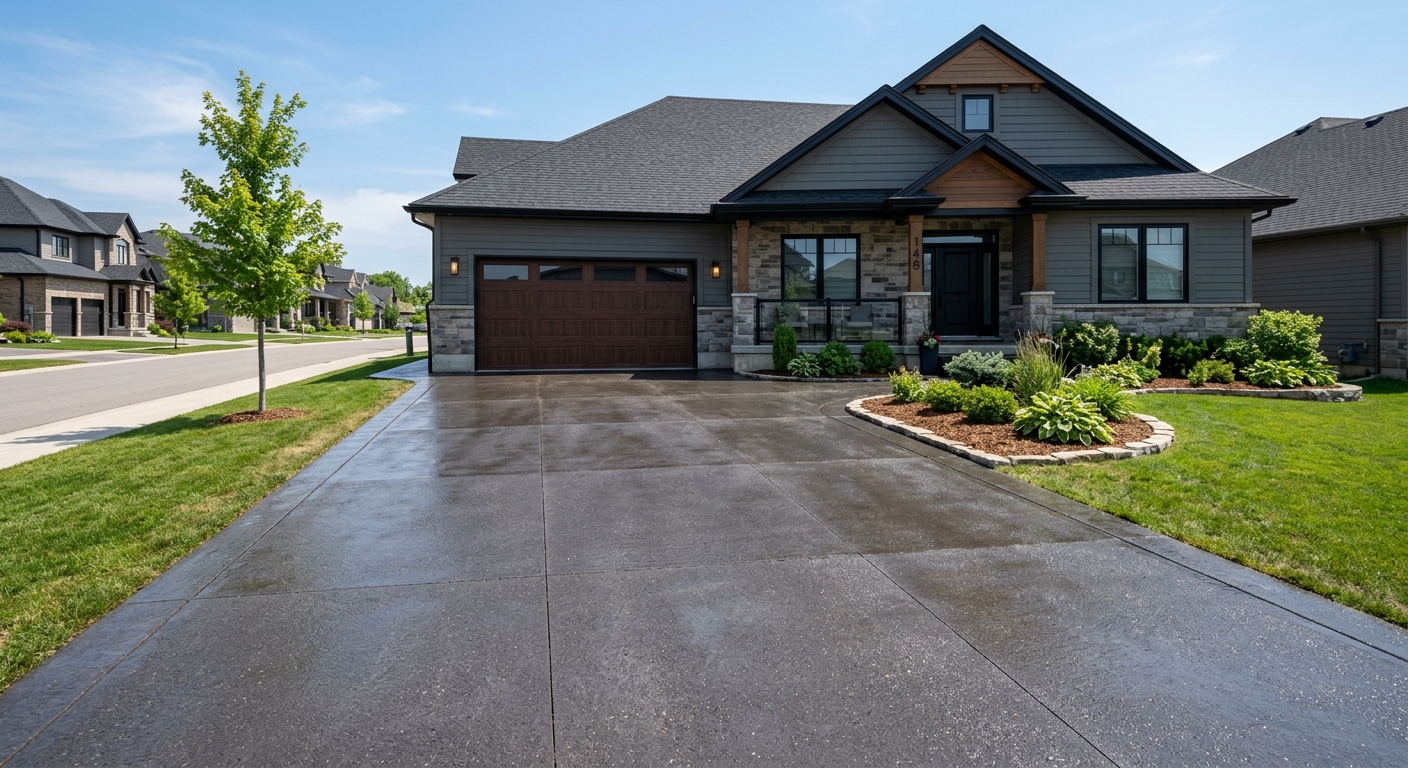
Concrete work options and costs in Dundarave
Dundarave homeowners typically choose concrete for driveways, patios and foundation work because it’s durable on the Lower Mainland–Southwest coast, where soils can stay saturated and freeze–thaw cycles still occur. With a population of 5,350 (Statistics Canada, 2021 Census), Dundarave is a smaller, steady market—so scheduling is often driven by contractor availability around busy summer driveway seasons in nearby Vancouver–Surrey. Just as important, the local housing stock tends to skew toward single-detached styles that use a lot of exterior flatwork, and those projects are where you’ll feel the biggest climate-driven cost differences: air-entrained mixes, properly drained granular base prep, and longer curing practices during cool, humid stretches.
In the Lower Mainland–Southwest region, practice commonly assumes a frost depth around 450 mm / 18", so footings, piers and thickened edges are placed below that to reduce frost heave risk. Mild winters don’t eliminate freeze–thaw damage; they shift it. Coastal rainfall and saturated subgrade mean more attention to drainage layers and compaction, and that’s why two “same-size” driveways can land far apart—especially when one design includes reinforcement and engineered base prep while another doesn’t. If you’re in the demand pocket around Dundarave Village, concrete flatwork tends to turn over faster because of ongoing renovations and infill-style upgrades.
Below are realistic Dundarave price bands you can use to compare bids, then we’ll break down the exact factors that move the cost up or down.
| Application |
Typical Size |
Key Spec |
Finish Option |
Price Range |
| Concrete driveway (standard broom finish) |
400–600 sq ft |
4"–5" slab, compacted granular base, mesh or rebar as required |
Broom finish |
$7,200–$13,800 |
| Exposed aggregate driveway |
400–600 sq ft |
4"–5" slab, air-entrained mix, proper curing to reduce scaling |
Exposed aggregate |
$9,000–$16,500 |
| Stamped concrete driveway or patio |
250–500 sq ft |
4" slab, reinforcement where needed, control joints |
Stamp + colouring |
$7,000–$18,000 |
| Plain concrete patio or walkway |
200–400 sq ft |
4" slab, compacted base, edge forms |
Plain trowel or broom |
$3,200–$9,800 |
| Garage floor (interior slab) |
300–600 sq ft |
4" slab, vapour barrier where required, reinforcement |
Smooth / broom finish |
$6,000–$14,500 |
| Foundation footings (structural, below frost) |
Per linear foot equivalent |
Below design frost depth, reinforced concrete, excavation & forming |
Structural concrete |
$200–$350 |
Prices are estimates only and vary by project scope, site access and material selection.
What affects the price of concrete work in Dundarave
In Dundarave and across the Lower Mainland–Southwest, it’s common to see quotes for the “same” concrete project vary by 30–50% because concrete pricing isn’t just the slab—it’s the base build-up, mix design, reinforcement, scheduling, and curing logistics around rain and cool nights. Contractors also price risk differently when sites have limited truck access, steep driveways, or higher subgrade moisture—conditions that are common on the coast. Compared with more interior or northern BC regions, our frost line is usually shallower, but coastal wet conditions and freeze–thaw cycles still force the same durability thinking: air-entrained concrete, drainage attention, and control joints done correctly to manage cracking and scaling.
Frost depth and freeze–thaw cycles dictate every exterior spec. Footings extend below the design frost depth (coastal BC is commonly assumed around 0.5–1.2 m in coastal designs), and exterior slabs still need air-entrained concrete to survive repeated saturation and temperature swings. When the weather turns cool, cold-weather curing precautions—blankets, extended curing practices, and sometimes mix temperature management—add labour and equipment. De-icing salt exposure in driveways also accelerates surface spalling if the mix and sealing aren’t right, so sealing becomes part of the long-term cost story. In concrete bids, this shows up as differences between a broom-finished driveway in the $18–$28/sq ft tier and stamped work that often lands higher (and may include extra colouring, texture skins, and more labour time).
Two Dundarave examples that commonly raise cost: (1) a saturated, poorly drained front yard that requires deeper granular base and improved drainage, and (2) tight access near Dundarave Village where pump or smaller pour logistics increase truck waiting and placement time. On the other hand, costs can drop when a site already has stable grade, good drainage, and straightforward access—particularly for plain patio work in the $16–$26/sq ft band. If you’re working near older homes with long-settle issues, expect additional subgrade prep and proof-rolling—often costing real dollars before concrete is even poured.
| Price Factor |
Why It Matters |
Cost Impact |
| Frost line depth |
Determines footing depth and form height |
More excavation and deeper forming increases foundation/footing labour and equipment time |
| Site preparation |
Excavation, grading, compacted granular base |
Wet subgrade and hauling spoil pileups can add significant cost |
| Reinforcement |
Rebar or wire mesh requirement |
Rebar adds material and tie-in time; omission can shorten service life |
| Mix design |
Air-entrainment and compressive strength spec |
Air-entrained durability mix may cost more but reduces scaling/spalling risk |
| Finish type |
Broom vs. stamped vs. exposed aggregate |
Stamped/exposed work adds crew time, colouring materials, and finishing stages |
| Pour size and concrete truck access to site |
Placement efficiency and waiting time |
Tight access can require more labour for short-haul placement or pump logistics |
| Cold-weather curing precautions |
Heating and blankets |
Equipment and labour to protect strength gain, especially with cool nights |
| Control joint pattern and sealing cost |
Crack control and protection from de-icing salts |
Proper joint layout plus penetrating sealer at/after cure increases long-term durability |
Permits & regulations in British Columbia
In British Columbia, structural concrete work—such as footings, foundation walls, and grade beams—normally requires a building permit, and engineered drawings are often reviewed by the municipality. Concrete flatwork (driveways, patios, walkways) typically does not require a permit unless your work affects lot grading, drainage, impervious surface coverage limits, or the municipal right-of-way (for example, any work near a curb/sidewalk area may trigger additional approvals). Because requirements can vary by site conditions, confirm with the local authority before you break ground.
When you hire a concrete contractor in Dundarave, also verify basic protection: the contractor should carry liability insurance and have appropriate WCB coverage (or the equivalent coverage arrangement used for construction trades in BC). Ask for references on similar-scale projects—especially exterior flatwork that’s been poured in coastal-wet conditions and finished with proper jointing and curing.
Step-by-step homeowner checks:
- Licence/eligibility: confirm they’re authorized to perform the work in BC using the contractor registration/registry information they provide (or the relevant online registry entry).
- Certificate of Insurance: request a current COI showing general liability, policy dates, and job-site coverage.
- WCB coverage: ask for proof of clearance/status documentation that matches the job period.
- Engineered/permit involvement: if it’s structural concrete, ask who pulls the permit and which drawings are being used.
- References: request 2–3 photos and addresses of finished projects with drainage and freeze–thaw detailing similar to your site.
Getting concrete right in Dundarave's freeze-thaw climate
Concrete fails in Dundarave’s coastal-wet freeze–thaw environment most often due to weak or unprotected surfaces, poor drainage, or missing durability specifications. To get it right, spec five things in the right order: (1) base preparation, (2) mix design, (3) control joints, (4) curing, and (5) sealing. For base prep, we excavate and place compacted granular sub-base to the correct depth for local soil and frost considerations, then verify grade so water doesn’t sit under the slab. For exterior flatwork, use an air-entrained mix (commonly targeting 5–7% air content depending on the mix design and exposure) and a minimum 32 MPa compressive strength so the concrete can resist scaling when the ground repeatedly saturates and cools. Control joints are required to manage where cracking happens—spaced to limit random cracking across wide areas. Curing matters even more than homeowners expect: give the concrete at least 7 days under proper conditions, and when cool, rainy weather rolls through, use curing blankets or equivalent protection so strength gain isn’t compromised. Finally, apply a penetrating sealer after the concrete has cured (often around the 28-day mark) to repel de-icing salts and moisture.
The technical questions to ask are simple but critical. “What air-entrainment system are you using?” and “What’s your control joint layout for this slab size?” help prevent spalling caused by inadequate air-entrainment. As a cost example, a plain broom-finished driveway may land in the $18–$28/sq ft tier, while stamped work is higher; the extra dollars can be justified when the contractor also includes the same durability base, correct mix, and proper curing—otherwise you pay more for a finish that still fails.
| Spec |
Why It Matters in Dundarave |
What to Ask For |
Impact if Skipped |
| Compacted granular base (depth?) |
In Dundarave, saturated subgrade and shallow frost behavior increase movement under slabs |
State granular thickness and compaction method; confirm drainage grade |
Settlement, cracking, and premature edge failure |
| Air-entrained concrete mix (target air %?) |
Freeze–thaw cycles plus coastal moisture require durability against scaling |
Target air content (commonly 5–7% for exterior flatwork) and mix design sheet |
Surface scaling/spalling and reduced service life |
| Compressive strength (MPa rating) |
Ensures strength gain under cool, humid conditions |
Minimum 32 MPa and protection plan if nights are cold |
Soft surface, abrasion failure, and durability problems |
| Control joints (spacing per ACI guidelines) |
Manages shrinkage and temperature cracking in exterior slabs |
Joint layout drawn on your plan, including saw-cut timing |
Random cracking that can open pathways for moisture |
| Minimum 7-day curing period |
Cool nights and rain can slow strength development |
How they protect curing (blankets/sealers vs. weather strategy) |
Lower strength and higher long-term cracking risk |
| Penetrating sealer (when applied after cure) |
Coastal wetting and de-icing salts demand moisture resistance |
Type of penetrating sealer and application timing after cure |
Faster moisture ingress, staining, and scaling near edges |
How to choose a concrete work contractor in Dundarave
Choosing the right concrete contractor in Dundarave starts with proof, not promises. In British Columbia, confirm the contractor can legally perform the work and carries liability insurance suitable for the job site. Ask for their current certificate of insurance and verify the policy is active for your start date to completion. For worker protection, verify WCB/WCB-equivalent coverage and request proof of clearance/status for the period the crew will be on your property. You can also ask for references on projects with similar site access and exterior exposure so you’re not comparing an indoor garage slab to coastal driveway conditions.
Next, get 2–3 itemised written quotes, not just a lump sum. You want line items that separate labour and materials: excavation and haul, forming, base granular and compaction, reinforcement, concrete supply, finishing, jointing, curing protection, and sealing (if included). Carefully read exclusions: is disposal included? Are permit pull and inspections included if structural concrete is involved? Are you paying for saw-cutting and sealing as add-ons? A good quote makes these boundaries clear.
Warranty should cover workmanship for a defined period (for example, cracking due to workmanship faults) and describe product/manufacturer coverage separately. Ask if any warranty is transferable to future owners, which matters for resale. Payment schedule matters too: never pay more than 10–15% upfront; hold back a meaningful portion until the finish, jointing, and cleanup are complete.
- Ask for their concrete mix spec: air-entrainment and minimum compressive strength
- Confirm excavation and base prep details in writing
- Verify reinforcement plan (mesh/rebar) and spacing for your slab type
- Request a joint layout and saw-cut timing plan
- Check whether curing blankets and weather protection are included
- Confirm whether sealing is included and the application timing
- Ensure quotes list disposal/haul and any saw-cutting or patching
- Verify site access plan (truck approach, parking, delivery times)
- Ask about traffic management and driveway access during cure
- Get start date and completion estimate in writing
- Check references within the last 12–24 months
- Confirm cleanup standards and debris hauling responsibility
Concrete red flags I see in Dundarave: vague “we’ll use good concrete” wording, no mention of air-entrainment, missing joint layout, start dates that shift without weather plans, and quotes that exclude sealing while assuming you’ll “just maintain it later.”
Frequently asked questions — concrete work in Dundarave
Stamped vs broom-finish concrete — cost difference?
In Dundarave, stamped concrete usually costs more than a broom-finished driveway or patio because it adds extra crew labour (multiple finishing steps), stamp mats/texture tooling, and often colouring materials. If you’re comparing finishes in the Lower Mainland–Southwest, broom-finished concrete flatwork commonly aligns with the $18–$28/sq ft tier, while stamped & decorative concrete commonly lands higher—often roughly in the $22–$36/sq ft tier depending on complexity and area. The real “cost difference” isn’t just the pattern: ask whether both options include the same base preparation, reinforcement (if required), air-entrained mix, control joints, and curing protection. If a contractor cuts corners on durability to keep stamped pricing low, you’re paying extra for a surface that can still scale or spall in our coastal wet + freeze–thaw conditions.
When is the best time to pour concrete in Dundarave?
The best time to pour in Dundarave is generally late spring through summer when rainfall is more manageable and daytime temperatures support predictable curing. That said, experienced contractors can pour in shoulder seasons if they plan for cool nights—typically using curing blankets or other weather protection so strength gain stays on track. In practice for the Lower Mainland–Southwest, scheduling often aims to avoid long rain events right after placement and to protect the slab during early strength development. If you’re aiming for exterior flatwork, ask for their weather monitoring plan (how they respond if a cold snap or heavy rain hits) and whether they include curing protection in the quote. That’s where bids can diverge and why “same slab size” prices might differ.
How long does concrete take to cure?
Concrete curing has two timeframes homeowners should know: initial protection/handling and reaching design durability. Typically, concrete needs at least 7 days of curing under proper conditions before you treat it as sufficiently set for many normal uses, but full strength and long-term performance continue beyond that. For exterior durability against moisture and de-icing salt, sealing is commonly scheduled after the concrete has cured (often around 28 days) so the sealer can do its job. In Dundarave’s coastal climate—where humidity and cool nights can slow surface drying—contractors may extend curing protection using blankets and temperature control. The key is not just the calendar; it’s whether the contractor maintains adequate curing conditions for your pour temperature and weather that day.
Do I need a permit for concrete work in British Columbia?
In British Columbia, concrete work that’s structural—like footings, foundation walls, and grade beams—typically requires a building permit and often engineered drawings reviewed by the municipality. For concrete flatwork such as patios, walkways, and driveways, permits often aren’t required unless your project affects lot grading, drainage, impervious surface limits, or involves work near municipal right-of-way areas. Because Dundarave sites can have drainage and slope considerations that change the answer, don’t rely on assumptions: ask the contractor whether your specific scope triggers a permit and confirm with the local authority before excavation. A reliable contractor should clearly state in the quote whether permit pulling and inspections are included (when needed) rather than leaving you to figure it out after the fact.
Concrete vs pavers for a patio in Dundarave?
Both concrete and pavers can work well in Dundarave, but the choice usually comes down to durability strategy and maintenance expectations. Concrete patios are generally a strong value if you get the base prep and joints right: a compacted granular base, proper drainage, air-entrained mix for exterior exposure, and correct control joints help manage cracking under our coastal wetting and freeze–thaw cycles. Pavers can be forgiving for localized repairs, but they still require proper base thickness and setting materials—otherwise you can get settlement or weed growth. In pricing terms, plain concrete patios and walkways commonly align with the $16–$26/sq ft tier, while more decorative options like stamped concrete usually increase costs. If you want, tell me your patio size and whether it’s sloped toward the house—then you can compare options using the same drainage assumptions.
How long does a concrete driveway last?
A well-built concrete driveway in the Lower Mainland–Southwest can last decades, but “how long” depends heavily on durability details: correct base preparation, proper air-entrained mix, a good joint layout, and protective curing. In Dundarave, surface scaling and edge deterioration can happen sooner if salt exposure is heavy and the concrete wasn’t air-entrained or sealed. A basic broom-finished driveway built to spec often performs best when sealed at the proper time and maintained with mindful de-icing practices. The cost tier matters, too: in our market, many driveways land in the $18–$28/sq ft band, and decorative stamped or exposed aggregate work typically costs more (often $22–$36/sq ft) because of extra finishing steps. Paying for durability spec upfront is usually the difference between “good-looking for a few years” and long-term performance.