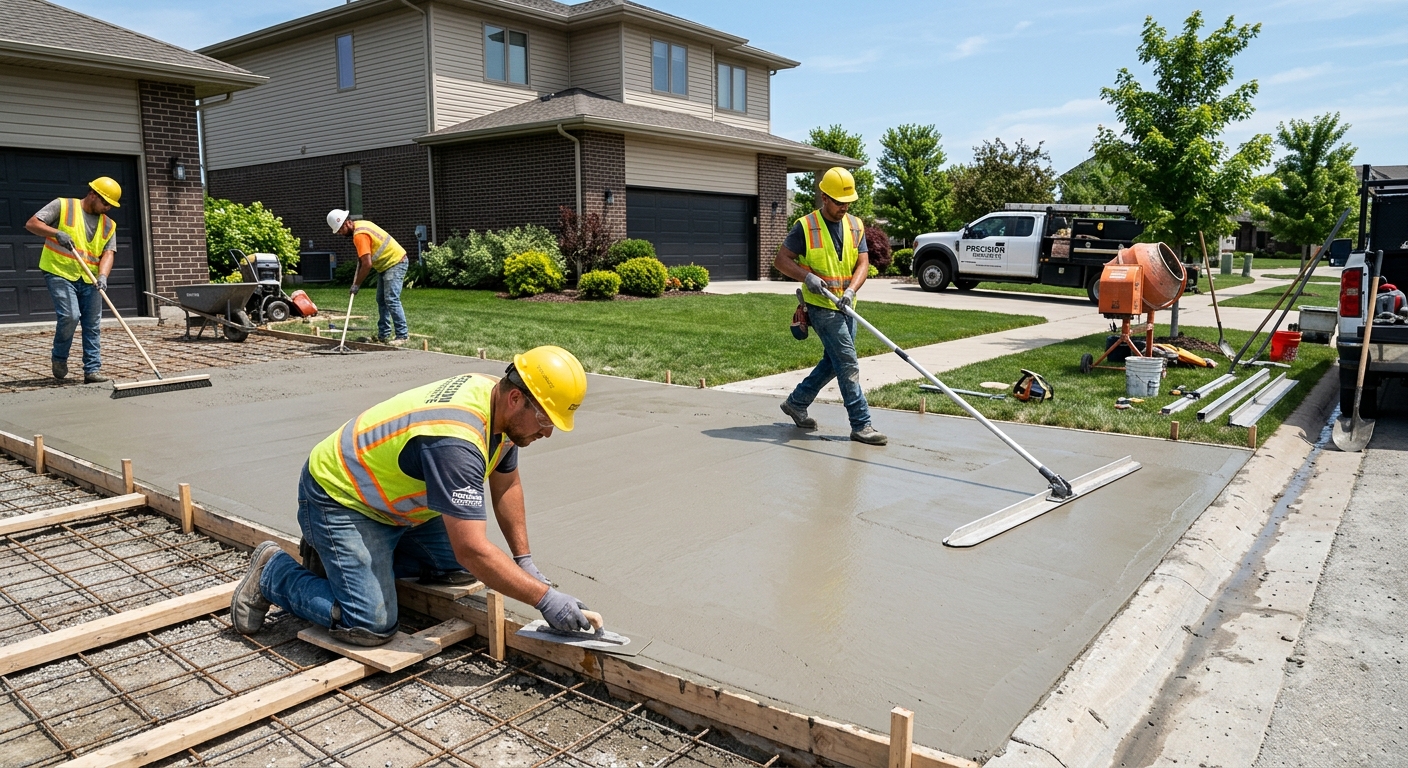
Concrete work options and costs in Kelvin
Concrete contractors in Kelvin see the same range of flatwork requests as the rest of the Lower Mainland–Southwest, but pricing here is shaped by our coastal-wet weather, cool nights, and a shallow frost depth that still demands careful footing placement and drainage. Kelvin is a small community with a 2021 population of 1,890 (Statistics Canada, 2021 Census), so contractor scheduling can swing quickly when rain systems roll in—especially for driveways and patios that need proper base prep and controlled curing. Most demand is tied to the local housing stock, where single-detached homes are a common target for new driveways, garage slabs, and exterior walkways. The climate also means freeze–thaw cycling and saturated soils are real design drivers, so we plan thicker bases, air-entrained mixes, and joint layouts to manage cracking and scaling. In practice, that’s why two homeowners can get quotes that differ significantly even when the visible finish looks similar.
In Kelowna? Not here—Kelvin is where crews often feel the effect of limited paving and concrete availability around nearby job hubs, and that availability affects labour rates and the timeline you can realistically hold. Neighbourhood-level demand is especially high around the core residential areas where families are upgrading asphalt for safer, lower-maintenance concrete driveways and entry patios. Below is a quick comparison of typical sizes and specs you’ll see in Kelvin quotes, so you can sanity-check what’s reasonable before you call for an itemized estimate.
| Application |
Typical Size |
Key Spec |
Finish Option |
Price Range |
| Concrete driveway (standard broom finish) |
480–600 sq. ft. |
Reinforcement as required + compacted granular base |
Broom finish, control joints, sealer optional |
$18,000–$28,000 |
| Exposed aggregate driveway |
480–600 sq. ft. |
Similar base + higher-tolerance mix finishing |
Exposed aggregate (slip-resistant texture) |
$22,000–$34,000 |
| Stamped concrete driveway or patio |
300–500 sq. ft. |
Reinforced slab + integral colour (where selected) |
Stamped patterns + release agent + sealer |
$22,000–$36,000 |
| Plain concrete patio or walkway |
200–350 sq. ft. |
Air-entrained exterior mix + proper drainage grade |
Float/trowel with broom or light broom texture |
$3,200–$8,500 |
| Garage floor (interior slab) |
400–600 sq. ft. |
Vapour barrier as needed + reinforcement |
Standard smooth/steel-trowel finish |
$10,000–$18,000 |
| Foundation footings (structural, below frost) |
Per linear foot scope (commonly 40–80 ft.) |
Footings placed below design frost depth + engineered rebar |
Standard formed concrete, construction joints as required |
$8,000–$28,000 |
Prices are estimates only and vary by project scope, site access and material selection.
What affects the price of concrete work in Kelvin
In the Lower Mainland–Southwest, it’s common to see quotes for the “same” concrete surface come in 30–50% apart once you account for excavation depth, base build-up, reinforcement, mix design, finish complexity, and curing controls. The main reason is our climate: even with a shallow frost depth, Kelvin still sits in a zone where freeze–thaw cycles and saturated soils can punish under-built slabs and poorly drained bases. In our region, typical practice assumes a frost depth around 450 mm / 18"—and the contractor has to place exterior footings and thickened edges below frost to prevent frost heave. That pushes forming height, excavation volume, and hauling costs higher than you might expect from “mild winters.”
Concrete mix spec is another big driver. Exterior slabs require air-entrained concrete so the freeze–thaw cycling doesn’t scale and spall the surface. When crews pour in cool, damp stretches, they may need curing blankets, sealers later, and longer schedule control—extra labour that shows up even if the finish looks unchanged. Colder regions often need heated curing and deeper excavations; in coastal BC we may not dig as deep as some interior provinces, but we still pay for base quality and rain-day planning. De-icing salts later on are tough on unsealed or under-specified concrete, which is why sealing can be a meaningful value add.
Two practical examples that frequently change the quote in Kelvin: (1) replacing a compacted granular base “thin spot” with the correct depth can add cost but prevents soft subgrade and future settlement—often worth it when you’re near finish grades; (2) upgrading from a plain broom driveway to exposed aggregate or stamped surface jumps finish time and material costs—often moving from around the $18–$28 driveway range into the $22–$36 stamped band. A driveway adjacent to older soils or a higher water-table lot can also add drainage work, which is often the difference between “looks fine now” and “fails after the first tough season.” For context, with Kelvin’s small population (Statistics Canada, 2021 Census), contractor availability can tighten, and that can also widen quote ranges when multiple jobs are stacking for the same favourable weather window.
| Price Factor |
Why It Matters |
Cost Impact |
| Frost line depth |
Determines footing depth and how far below 18" you need to build for frost protection |
Higher excavation/forming = more labour and concrete volume |
| Site preparation |
Excavation, grading, removal of unsuitable material, and compacted granular base |
Changes both truck/haul costs and compaction time |
| Reinforcement |
Rebar/wire mesh placement supports slab and reduces cracking risk |
Material + labour for tying/positioning |
| Mix design |
Air-entrainment and strength spec for exterior freeze–thaw durability |
Higher-spec mix and quality control |
| Finish type |
Broom vs stamped vs exposed aggregate drives finishing time and product selection |
Stamped/exposed typically higher labour + sealers |
| Pour size and concrete truck access to site |
Access limits pump vs chute time and affects crew planning |
Restricted access can require extra crew time or equipment |
| Cold-weather curing precautions |
Blankets/heating protect early-age strength under cool, damp conditions |
Can add rental/consumables and schedule labour |
| Control joint pattern and sealing cost |
Joints control where cracking occurs; sealing helps repel de-icing salts |
More layout time + later sealing work |
Permits & regulations in British Columbia
In British Columbia, most structural concrete work requires municipal review and a building permit—especially when the concrete is part of a load-bearing system. Typically, footings, foundation walls, grade beams, and other structural foundation elements require a permit and often engineered drawings. Concrete flatwork like patios, walkways, and driveways usually does not require a permit on its own unless it affects lot grading, ties into drainage requirements, increases impervious surface beyond local limits, or impacts municipal right-of-way conditions. In Kelvin, always confirm with the local authority before you break ground; “no permit needed” is project-specific.
Before work starts, verify three basics: (1) the contractor carries liability insurance, (2) the contractor has the required provincial coverage (commonly WCB for workers), and (3) the contractor is properly licensed for the scope they’re performing. Here’s a simple homeowner step-by-step: first, ask for a certificate of insurance (COI) and confirm it lists the project address as applicable and has liability coverage limits that match the risk of excavation and slab work. Second, ask for proof of WCB coverage (or the clearance letter if they’re exempt in certain cases) and check the details. Third, use the province’s online registry tools or the contractor’s credentials page to confirm the licence is active and matches their concrete/placement scope. Finally, request references on similar-size jobs in the Lower Mainland–Southwest timeframe so you can confirm they understand our freeze–thaw and curing requirements—not just the finish look.
Getting concrete right in Kelvin's freeze-thaw climate
Concrete fails in Kelvin most often for predictable reasons: water gets in, freeze–thaw cycles expand it, and the surface begins to scale or spall—especially when the slab is thin, the base is poorly prepared, or the mix isn’t properly air-entrained. In the Lower Mainland–Southwest, we spec exterior flatwork with a focus on three layers: base, mix, and detailing. (1) Base preparation: we use compacted granular sub-base to the correct depth for the soil and frost conditions, plus attention to drainage so the slab isn’t sitting on saturated material. (2) Mix design: for exterior slabs, air-entrainment is key (often 5–7% air content depending on mix/air target) and the concrete should meet a minimum 32 MPa compressive strength requirement so it can reach reliable performance. (3) Control joints: joints must be cut/formed so cracking happens in planned locations rather than randomly. (4) Curing: you need at least 7 days of proper curing conditions; when nights are cool and humidity is high, crews plan around it to avoid early-age weakness. (5) Sealing: a penetrating sealer applied after the full cure period helps repel de-icing salts and reduces moisture movement into the surface.
To avoid the classic spalling problem, ask directly about air-entrainment and joint spacing—those two topics prevent most durability complaints in British Columbia. Pricing-wise, the difference between a plain patio and a stamped or decorative finish is often justified by labour time and materials: for a 300–400 sq. ft. job, you might sit closer to the $16–$26 patio band for plain work, while stamped concrete typically moves you toward the $22–$36 decorative band. The added cost is not “just the pattern”—it’s also extra finishing steps, curing attention for release/sealer systems, and a more precise joint plan.
| Spec |
Why It Matters in Kelvin |
What to Ask For |
Impact if Skipped |
| Compacted granular base (depth?) |
Helps prevent settlement and keeps moisture from lingering under the slab |
“What base depth are you using for my soil and frost conditions?” |
Cracks, uneven surface, premature breakdown |
| Air-entrained concrete mix (target air %?) |
Protects against freeze–thaw scaling in exterior slabs |
“What is your air content target and how do you verify it?” |
Spalling, scaling and surface loss over the first seasons |
| Compressive strength (MPa rating) |
Ensures early-age and long-term durability for traffic loads |
“Confirm the minimum 32 MPa spec—what mix will you order?” |
Higher chance of surface wear and structural concerns |
| Control joints (spacing per ACI guidelines) |
Limits random cracking paths and manages shrinkage/temperature movement |
“What joint spacing will you use and where exactly will joints land?” |
Random cracks that can collect water and worsen freeze–thaw damage |
| Minimum 7-day curing period |
Cool nights and humidity can slow strength gain without curing controls |
“How long will curing be protected, and what conditions are required?” |
Reduced strength, increased scaling and weak surface |
| Penetrating sealer (when applied after cure) |
Repels de-icing salts and helps reduce moisture migration |
“When exactly will you apply sealer after cure, and what product?” |
More salt damage, higher risk of surface deterioration |
How to choose a concrete work contractor in Kelvin
Choosing the right concrete contractor in British Columbia starts with verification, not charisma. First, confirm licensing and insurance. Ask for a certificate of liability insurance—then look for coverage that matches excavation and concrete placement risk (and confirm the certificate is current). Next, verify workers’ coverage through WCB/WCB-related proof (or a clearance letter if applicable). Finally, confirm the contractor’s licence is active and matches the scope you’re hiring for; don’t assume “concrete” means the same thing as “forming and structural work.” In Kelvin’s freeze–thaw climate, you also want a crew that routinely specifies air-entrainment, jointing, and curing controls—not just standard flatwork.
Then, demand 2–3 itemised written quotes that break out labour and materials (base prep, excavation, reinforcement, formwork, concrete supply, finishing labour, disposal, and sealing—if included). Avoid lump-sum quotes that don’t explain what’s excluded. Ask whether a permit is included where it’s required (structural foundation work typically needs one) and whether disposal is part of the price. Review the warranty: look for a clear workmanship warranty period, what it covers, and whether product/manufacturer warranties are separate and transferable. For payment, a fair schedule is typically no more than 10–15% upfront, with holdback until completion and surface acceptance. Get a start date and completion estimate in writing so you can plan around rain-heavy windows and curing time.
- Ask for proof of liability insurance and confirm it’s current.
- Request WCB/WCB clearance proof for workers assigned to your job.
- Verify the contractor’s licence is active in British Columbia and matches the work scope.
- Get itemised quotes (labour vs materials vs disposal) rather than one lump number.
- Confirm reinforcement plan (rebar/wire mesh) and placement method.
- Ask how they achieve the air-entrainment target for exterior slabs.
- Review joint layout: spacing, locations, and how/when joints will be cut.
- Ask about curing method and minimum 7-day protection.
- Confirm whether a sealer is included, and if not, ask for a separate line item.
- Check whether they include base preparation depth and soil/drianage details.
- Clarify truck access, pumping/chute plan, and how they manage close-quarters sites.
- Confirm warranty terms in writing and what “workmanship” actually covers.
Red flags I watch for in Kelvin: quotes that don’t discuss air-entrainment for exterior work, missing joint specifications (or joint spacing that’s “whatever”), no plan for curing/blankets during cool damp stretches, deposits larger than 15% without clear milestones, and contractors who won’t provide COIs/coverage proof or references on similar-size Lower Mainland–Southwest flatwork.
Frequently asked questions — concrete work in Kelvin
When is the best time to pour concrete in Kelvin?
The best time to pour concrete in Kelvin is when you have a dry window with mild-to-cool temperatures but not freezing conditions—because curing and early strength matter most in our Lower Mainland–Southwest freeze–thaw cycles. In practice, we plan pours around rain forecasts, cool nights, and high humidity so we can protect the slab during the critical early-age period. If temperatures drop, a contractor should plan cold-weather curing precautions such as blankets and schedule adjustments so the concrete reaches design strength. For exterior flatwork, don’t assume “summer only”: if the weather is stable, a late spring or early fall pour can work well with proper curing. If you’re comparing quotes, ask what weather contingency is included because that impacts labour and may explain why one bid is near the $18–$28 driveway range while another is higher.
How long does concrete take to cure?
Concrete typically reaches sufficient handling strength within the first 24–48 hours, but curing is a process, not a single day. For Kelvin projects, the practical minimum you should expect is at least 7 days of curing under proper conditions, especially for exterior slabs exposed to moisture and temperature swings. Full performance develops over longer periods; design strength is normally achieved over 28 days depending on mix, temperature, and curing conditions. In British Columbia’s coastal-wet climate, cool nights and high humidity can slow surface drying—so crews often use curing blankets or proper protection to maintain temperature and moisture. If de-icing salts are a concern in your driveway season, plan for sealing after the cure period rather than immediately after finishing.
Do I need a permit for concrete work in British Columbia?
In British Columbia, whether you need a permit depends on the concrete scope. Structural concrete such as footings, foundation walls, and grade beams typically needs a building permit and often engineered drawings reviewed through the municipal process. Concrete flatwork like driveways, patios, and walkways usually does not require a permit by itself, unless it changes lot grading, affects drainage requirements, increases impervious surface limits, or impacts the municipal right-of-way. For Kelvin homeowners, the safest approach is to ask the contractor to confirm permit responsibility in writing before excavation. You can also contact the local authority for a quick clarification. A reputable contractor should be able to tell you whether the work is permit-triggering and include that in the quote scope.
Concrete vs pavers for a patio in Kelvin?
Concrete and pavers both work for patios in Kelvin, but the “right” choice depends on how you want moisture and cracking managed. Concrete offers a uniform surface with integrated grading, and when it’s properly specified with air-entrainment, joint control, and correct base prep, it performs well through freeze–thaw cycling. Pavers can be flexible and easier to spot-repair if a unit settles, but they still require excellent base compaction and drainage detailing—otherwise you’ll see weed growth or unevenness over time. Price-wise, plain concrete patios often land in the $16–$26 band for many Lower Mainland scenarios, while decorated options like stamped finishes typically move higher into the $22–$36 range. If you want a low-maintenance finish and consistent level surface, a properly built plain or stamped concrete patio is usually the cleaner long-term bet in our climate.
How long does a concrete driveway last?
A well-built concrete driveway in Kelvin commonly lasts decades, but longevity is driven by the details: base preparation, drainage, air-entrained exterior concrete, joint spacing, curing, and—critically—surface protection if you use de-icing salts. In the Lower Mainland–Southwest climate, moisture movement and freeze–thaw cycling can be harder on unsealed or under-specified slabs, leading to scaling or spalling sooner than homeowners expect. If the driveway is properly spec’d (including air-entrainment and joint layout) and maintained with a penetrating sealer after the cure period, it typically holds up very well under normal vehicle traffic. If you’re choosing between options, the cost jump from a standard broom driveway toward exposed aggregate or stamped textures often reflects additional finishing and durability steps—why two quotes can land in different parts of the driveway bands like $18–$28 versus higher decorated pricing.
What is air-entrained concrete and why does it matter here?
Air-entrained concrete is mixed with a controlled amount of tiny air bubbles. Those bubbles give water a place to expand when temperatures drop and freeze, reducing internal damage to the concrete paste. In Kelvin and across British Columbia’s coastal-wet conditions, freeze–thaw cycling and saturated soils are key reasons exterior slabs can scale or spall when the mix isn’t designed for it. For exterior flatwork, a common target is roughly 5–7% air content depending on the mix design and specified tolerance, paired with a minimum 32 MPa compressive strength spec and proper curing. When air-entrainment is omitted or not controlled, homeowners often see surface deterioration in the first tough seasons, especially where de-icing salt accelerates surface wear. In quotes, ask how the contractor will ensure and verify air entrainment, not just that “we use good concrete.”