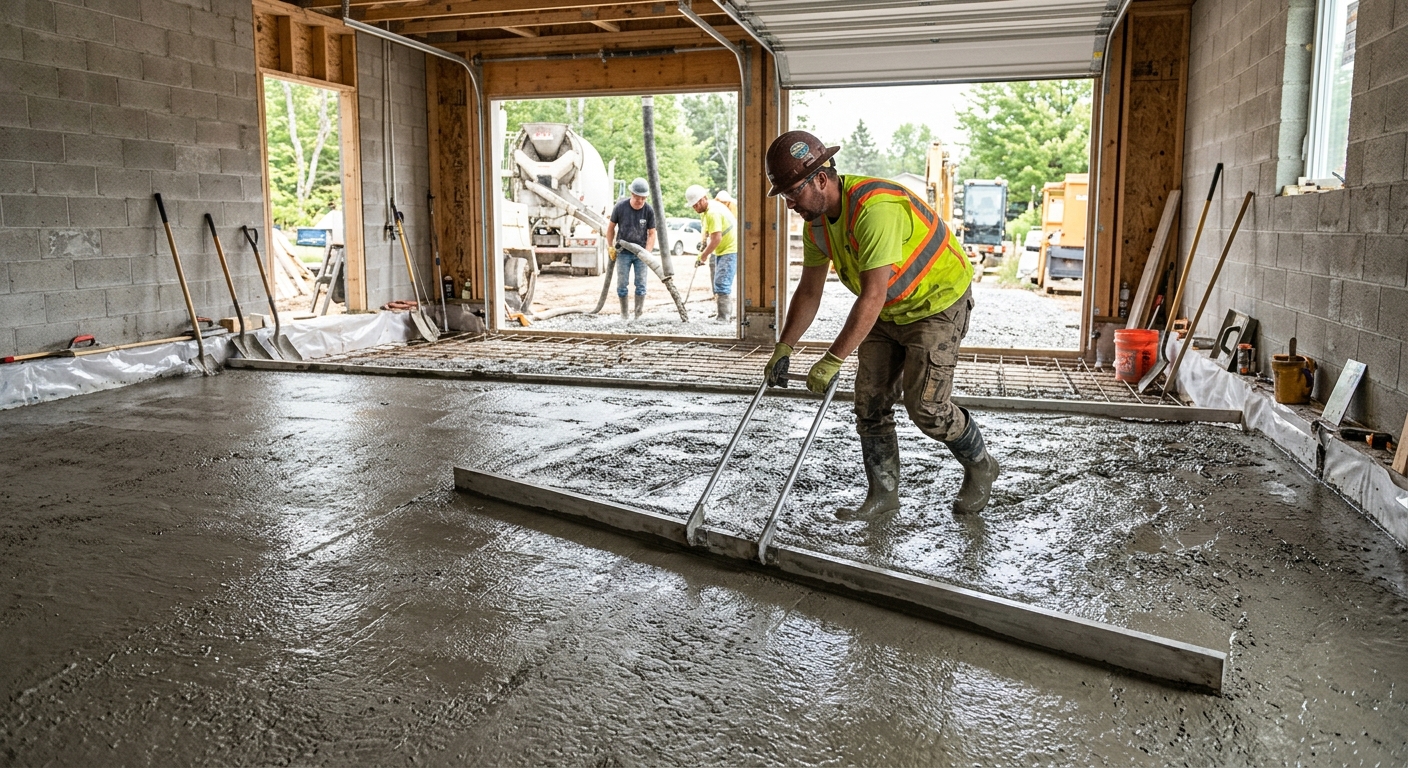
Concrete work options and costs in Aloha Estates
In Aloha Estates, concrete work is a practical choice for homeowners who want flatwork that handles our coastal-wet weather and frequent freeze–thaw cycles. This area’s housing stock is dominated by single-detached homes, and with a 2021 population of 3,098 (Statistics Canada, 2021 Census), you’ll see steady demand for driveways, patios, and foundation-related repairs from year to year. In the Lower Mainland–Southwest, costs are shaped less by extreme winter temperatures and more by shallow-but-critical frost protection (typical design practice assumes about 450 mm / 18") and by how we manage rain, cool nights, and curing humidity so concrete reaches strength and resists scaling. That climate also affects scheduling: pours often get planned around forecasted wet stretches, and contractors may use curing blankets and sealers more often than in drier regions.
Concrete contractors in the Vancouver–Surrey–Abbotsford corridor are generally available, but the most in-demand work—especially replacements in older neighbourhood pockets and the side-yard access-heavy jobs near the local commercial areas—can book up quickly during drier spring windows. If you’re weighing standard options, the price spread usually comes down to base prep quality, mix design (air-entrainment), and the labour intensity of finishes.
Below is a practical comparison of common driveway, patio, slab, and foundation options so you can line up your quote with the right specs before you ask for measurements and engineering where needed.
| Application |
Typical Size |
Key Spec |
Finish Option |
Price Range |
| Concrete driveway (standard broom finish) |
400–600 sq ft |
Reinforced slab with air-entrained mix; control joints |
Broom finish, sealcoat (optional) |
$7,200 – $12,500 |
| Exposed aggregate driveway |
400–600 sq ft |
Air-entrained mix; proper retarder timing; seal required |
Exposed stone aggregate finish |
$9,000 – $15,800 |
| Stamped concrete driveway or patio |
300–550 sq ft |
Air-entrained mix; rebar/wire per slab thickness; joints |
Stamped pattern with release + sealer |
$10,000 – $18,900 |
| Plain concrete patio or walkway |
200–450 sq ft |
Compacted granular base; air-entrained exterior mix |
Float/steel trowel + light broom texture |
$3,400 – $10,500 |
| Garage floor (interior slab) |
300–520 sq ft |
Vapour considerations; thicker slab at edges; reinforcement |
Broom finish or light trowel |
$6,200 – $14,500 |
| Foundation footings (structural, below frost) |
Per linear foot / wall segment |
Excavate to below design frost depth; engineered sizing |
Structural concrete only |
$200 – $350 |
Prices are estimates only and vary by project scope, site access and material selection.
What affects the price of concrete work in Aloha Estates
In Aloha Estates and the wider Lower Mainland–Southwest, it’s common to see quotes for the “same-looking” concrete job come in 30–50% apart. The difference isn’t usually the concrete itself—it’s the engineering assumptions, the base preparation, the mix specification, and how the contractor handles moisture and curing in a coastal-wet climate. Contractors also schedule around labour availability and rain windows, which can change the equipment and crew time required to stay on spec.
Two major technical drivers are frost protection and freeze–thaw durability. Even though our frost depth is typically much shallower than inland BC, industry practice still assumes about 450 mm / 18" design frost for exterior support, so footings, piers, and thickened edges must be placed below that to avoid frost heave. All exterior slabs should use air-entrained concrete to survive freeze–thaw cycling and reduce scaling. Colder regions require deeper excavations and more cold-weather precautions; here, we still see cool nights and high humidity, and that can extend curing time or require curing blankets/controlled curing.
Local site conditions can swing costs too. For example: (1) a driveway replacement on a saturated, clay-heavy lot may require more excavation and better granular drainage before you ever pour—often raising base costs; (2) adding rebar/wire to manage expected loads or shrinkage can shift your reinforcement line item; and (3) finish choice—like moving from a basic broom driveway to stamped or exposed aggregate—typically increases labour and material, which is why you’ll often see stamped work running in the $22 – $36 per sq ft band in our market, while standard driveway flatwork sits closer to $18 – $28 per sq ft depending on thickness and base.
Finally, if your home is older (common around many parts of Aloha Estates), you may also be dealing with legacy drainage patterns that cause earlier surface deterioration—so the “fix” may include grading and weeping/edge drainage, not just replacing concrete. That’s where the quote gap often shows up in real dollars.
| Price Factor |
Why It Matters |
Cost Impact |
| Frost line depth — determines footing depth and form height |
Footings must sit below design frost to prevent heave and settlement |
Higher excavation and formwork; can raise structural cost noticeably |
| Site preparation — excavation, grading, compacted granular base |
Good base reduces pumping, settlement, and premature cracking |
Driveway and patio base work often drives “hidden” quote differences |
| Reinforcement — rebar or wire mesh requirement |
Controls cracking and supports loads when done per spec and placement |
Adds material and labour; low placement quality can be more costly later |
| Mix design — air-entrainment and compressive strength spec |
Air-entrainment protects against freeze–thaw scaling and spalling |
Small material cost increase, but avoids expensive rework |
| Finish type — broom vs. stamped vs. exposed aggregate |
More labour/time, tight timing, and extra sealing/coatings |
Stamped/exposed typically costs more than broom finished flatwork |
| Pour size and concrete truck access to site |
Access affects pump vs. chute work and crew time |
Pump truck, longer carry, and waiting time can increase totals |
| Cold-weather curing precautions — heating and blankets |
Cold slows strength gain; curing protects durability and surface quality |
Blankets/insulation and monitoring add labour and equipment costs |
| Control joint pattern and sealing cost |
Joints control where cracks happen; sealing improves water resistance |
Sealing is an add-on, but skipped sealing often costs more in repairs |
Permits & regulations in British Columbia
In British Columbia, structural concrete work typically needs a building permit, and many projects require engineered drawings reviewed by the municipality. Structural items usually include concrete that supports the structure—footings, foundation walls, grade beams, and other load-bearing foundation components. For these scopes, a permit is commonly required because changes affect structural safety, drainage assumptions, and load paths.
Concrete flatwork like patios, walkways, and driveways typically does not require a permit by default. However, permits may be required if the work alters lot grading, changes drainage patterns, impacts impervious surface limits, or affects municipal right-of-way conditions (for example, near the curb/sidewalk area). In Aloha Estates, always confirm with the local authority before you break ground, particularly if you’re lowering/raising grades, adding catch basins, or tying in to an existing drainage system.
Contractor verification is just as important as permits. Step one: confirm the contractor carries liability insurance—request a certificate of insurance and ensure it includes the right job address and coverage limits. Step two: verify the contractor has the required workers’ compensation coverage (commonly WSBC/WCB coverage) so you’re not left exposed if someone is injured on site. Step three: confirm competency and track record by asking for references on similar driveway/patio and foundation scopes. If engineered drawings are part of your project, ensure the contractor is coordinating correctly with the engineer’s requirements. You should also ask for written confirmation of who is pulling permits (if required) and what’s included.
Finally, make sure you get everything in writing—scope, material specs, curing approach, and a clear start/finish timeline—so you can hold the contractor to the same standard that the permit process expects.
Getting concrete right in Aloha Estates's freeze-thaw climate
Concrete failures in Aloha Estates usually come from water getting into the slab system and then freezing—this is where freeze–thaw cycling, saturated soils, and coastal rainfall combine to cause surface scaling (and sometimes spalling). The right fix starts before concrete ever arrives: base prep. For exterior flatwork, you need a compacted granular sub-base to the correct depth for local subgrade and drainage conditions, plus proper grading so water doesn’t pond. Poor base prep may look fine for the first winter, then cracks and edge deterioration show up in the following seasons.
Next is mix design. Exterior slabs should be made with air-entrained concrete (commonly in the 5–7% air range for freeze–thaw exposure) and a minimum compressive strength spec (a practical baseline is 32 MPa for many flatwork applications). If air-entrainment is wrong—or not verified—freeze–thaw damage escalates quickly. Control joints also matter: they limit random cracking by giving concrete a planned place to crack as it shrinks.
Curing is the other make-or-break step in our Lower Mainland–Southwest conditions. Even with mild winters, cold nights and high humidity can slow strength gain, so plan for at least 7 days of proper curing under the right temperature/humidity conditions. In colder stretches, contractors may need curing blankets or insulated protection. After cure, sealers help repel de-icing salt and moisture—typically with a penetrating sealer applied after the recommended cure period (often around 28 days).
If you’re comparing options, the extra cost is sometimes justified: switching from plain broom to stamped concrete costs more, but skipping sealing or using an under-specified mix isn’t worth saving. For example, if a stamped driveway comes in around $22 – $36 per sq ft versus a broom driveway closer to $18 – $28 per sq ft, that price gap can be reasonable when the contractor still maintains proper air-entrainment, base prep, joints, and curing—those are what keep both finishes performing through wet winters.
| Spec |
Why It Matters in Aloha Estates |
What to Ask For |
Impact if Skipped |
| Compacted granular base (depth?) |
A stable, drained base prevents settlement and edge breakdown under freeze–thaw |
Base depth and granular type; compaction method/test (per site conditions) |
Pumping, rocking, early cracking, and increased water intrusion |
| Air-entrained concrete mix (target air %?) |
Air voids help manage freeze–thaw pressure and reduce scaling/spalling |
Air content target (typically 5–7% for exterior flatwork) |
Accelerated surface deterioration and costly replacement |
| Compressive strength (MPa rating) |
Adequate strength ensures durability and reduces surface wear |
Minimum 32 MPa (or engineered higher spec if required) |
Weak surfaces, increased cracking risk, reduced long-term performance |
| Control joints (spacing per ACI guidelines) |
Joints manage shrinkage cracking so cracks don’t become random and wide |
Joint spacing plan and saw-cut timing |
Random cracking patterns and more water paths into the slab |
| Minimum 7-day curing period |
Curing under proper conditions is essential in cool, wet Lower Mainland weather |
How curing will be maintained; temperature protection if nights are cool |
Reduced strength gain, surface scaling, and higher failure likelihood |
| Penetrating sealer (when applied after cure) |
Water and de-icing salt resistance helps protect surfaces in our wet winters |
Penetrating sealer plan; application timing after cure (often ~28 days) |
Faster staining, scaling, and spalling around traffic and edges |
How to choose a concrete work contractor in Aloha Estates
Choosing the right contractor in British Columbia starts with verification, not sales pressure. First, licensing/registration: ask how the contractor is set up for the work they’re doing and request proof of registration/eligibility where applicable. Next is liability insurance—ask for a certificate of insurance showing coverage that matches your project and address. Finally, confirm workers’ compensation coverage (WSBC/WCB). You should be able to view clearance information or a letter/certificate upon request. If a contractor won’t provide documents quickly, that’s a red flag.
For pricing, you want 2–3 itemised written quotes, not a single lump sum that hides trade-offs. Ask for a breakdown that shows excavation/site prep, granular base, reinforcement (rebar/wire), concrete supply/mix spec (including air-entrainment), finish labour, joints, disposal, and sealing (if included). In Aloha Estates, also confirm whether permits are included where required and who pays for any required engineering sign-offs for structural scopes.
Warranty matters too: ask for the workmanship warranty length and whether product/manufacturer warranties apply. Clarify whether the warranty is transferable to future owners. Then agree on a payment schedule—never more than 10–15% upfront for typical residential concrete work, and hold back a portion until the job is complete, cleaned, and any punch-list items are addressed. Get the timeline in writing with a start date and estimated completion window, and confirm how the crew will protect the pour if rain or cool nights arrive.
- Request proof of liability insurance (certificate of insurance) and confirm it matches your address.
- Verify WSBC/WCB coverage (ask for clearance/coverage confirmation in writing).
- Get 2–3 itemised quotes with labour + materials breakdown (no “mystery” line items).
- Confirm concrete mix spec includes air-entrainment for exterior freeze–thaw exposure.
- Ask who handles compaction testing (or how compaction will be documented).
- Confirm reinforcement type and placement (rebar chairs/spacers, not mesh on dirt).
- Ask for the control joint plan: spacing and timing (before/after finishing).
- Clarify curing method (blankets, seal curing, temperature protection if needed).
- Know whether sealers are included and when penetrating sealer will be applied.
- Ask what’s excluded: demolition, haul-away/disposal, regrading, drainage corrections.
- Ensure a written start date and weather-protection plan for scheduling changes.
- Use a payment schedule with small upfront deposit (10–15%) and holdback at end.
Concrete red flags I watch for in Aloha Estates: (1) they won’t discuss air-entrained mix or control joints, (2) reinforcement “optional” or placed on the ground with no spacers, (3) promises of “no cracking” instead of proper jointing and curing, (4) no written curing plan for cool/wet forecast days, and (5) asking for large upfront payments before base prep, rebar placement, and forms are complete.
Frequently asked questions — concrete work in Aloha Estates
What is the difference between concrete and cement?
In British Columbia, people often use the terms “cement” and “concrete” interchangeably, but they’re not the same. Cement is the powder component (typically Portland cement) that reacts with water to form the binding material. Concrete is the full engineered mix: cement + water + sand + gravel/stone (and often air-entrainment for exterior slabs). That air-entrainment step is important in Aloha Estates because our freeze–thaw cycles and wet coastal weather can damage surfaces if the mix isn’t designed properly. When you request a quote, ask whether your exterior driveway or patio mix is air-entrained and what compressive strength is specified—those details relate to the concrete, not just the cement.
How much does concrete work cost in Aloha Estates?
Concrete pricing in Aloha Estates usually tracks the Lower Mainland–Southwest cost drivers: base preparation, excavation depth, reinforcement, mix design, and the finish system. For a driveway slab, many homeowners budget around $18 – $28 per sq ft for standard concrete and about $22 – $36 per sq ft for stamped or decorative work, depending on thickness and site conditions. Smaller patios and walkways can come in lower per project total because there’s less demolition and less base area. Structural concrete like foundation footings is commonly quoted per linear foot, often landing in the $200 – $350 range depending on engineered requirements, excavation, and access. If your lot has saturated soil or requires extra drainage/granular work, expect a higher portion of the quote to be in base prep rather than in finish labour.
How deep must footings be for Aloha Estates's frost line?
For Aloha Estates, local concrete practice typically assumes a design frost depth around 450 mm / 18". That means exterior structural supports and foundation footings should extend below that frost line to reduce the risk of frost heave. Exact footing depth can still change based on the engineered foundation design, soil conditions, and the specific foundation system. Don’t try to “guess” footing depth from the frost line alone—your contractor should confirm the engineered drawings for structural concrete scopes. In practice, when we excavate for footings, we also account for drainage and base materials so the area stays stable through wet winters and freeze–thaw cycles common in the Lower Mainland–Southwest.
Why does concrete crack in Aloha Estates and how is it prevented?
Concrete cracking is normal; the goal is to control when and where it happens. In Aloha Estates, the main causes are shrinkage during curing, temperature movement, and water infiltration that becomes freeze–thaw pressure. Prevention starts with proper base preparation so the slab doesn’t settle unevenly, then correct air-entrainment so freeze–thaw doesn’t accelerate surface deterioration. Control joints are also key: they create planned crack locations at the right spacing and timing. Finally, curing matters—insufficient curing can lead to weaker surfaces and early cracking. If de-icing salt is used and the slab isn’t properly sealed after curing, the surface can scale faster, and that can make any cracks more noticeable over time. A good contractor will discuss joints, curing protection, and sealing as part of the plan, not as optional add-ons.
Stamped vs broom-finish concrete — cost difference?
Stamped concrete costs more than broom-finished concrete mainly because it adds labour intensity and materials: moulds/forms, release agents, tighter finishing timing, and typically sealing to protect the decorative surface. In the Lower Mainland–Southwest, you’ll often see stamped & decorative concrete in the $22 – $36 per sq ft band, while standard broom-finish driveways commonly fall around $18 – $28 per sq ft depending on thickness and base prep. That price gap is justified when the contractor still follows the core durability specs—air-entrained mix for freeze–thaw, proper reinforcement/placement, control joints, and correct curing in cool, wet conditions. If someone tries to cut corners on those items to save money, decorative surfaces may look fine initially but can deteriorate faster in our coastal climate.
When is the best time to pour concrete in Aloha Estates?
The best time to pour in Aloha Estates is when you can manage rain risk and keep curing conditions within the spec. In practice, many homeowners schedule spring and early summer pours because temperatures are more reliable and crews can maintain consistent curing. That said, Lower Mainland–Southwest concrete projects happen year-round; what matters is the plan for cool weather and wet forecasts. Contractors should use curing blankets or other temperature protection if nights are cold, and they should monitor curing to ensure the mix reaches strength safely. If you’re pouring around heavy rain windows, the contractor should explain how they’ll protect the work and how long they’ll extend curing. For exterior durability, skipping proper curing is one of the fastest ways to end up with scaling and cracking that you’ll notice after the next freeze–thaw stretch.