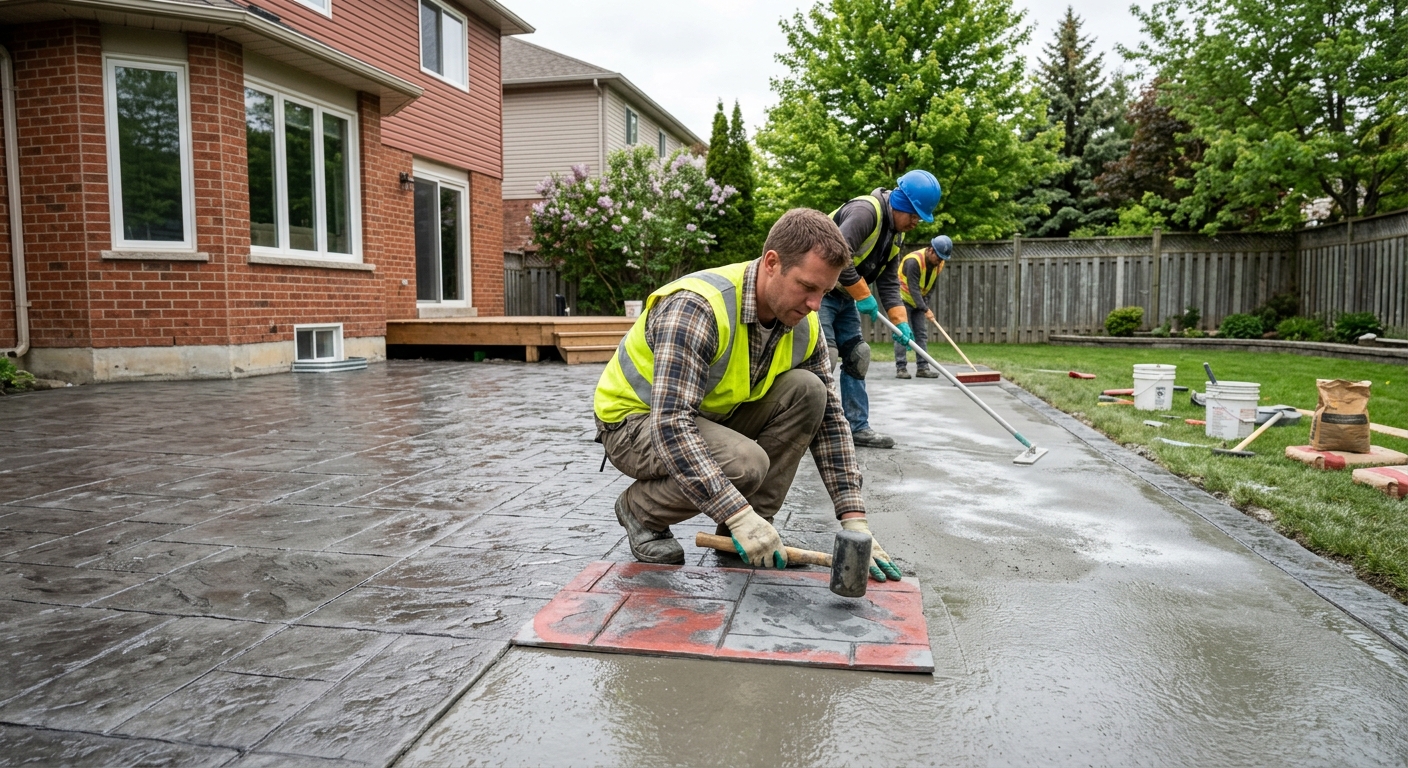
Concrete work options and costs in Olympic Village
In Olympic Village, British Columbia, homeowners typically compare several concrete options—because the same driveway width can land in very different price brackets depending on sub-base prep, mix design, and how long we need to nurse the concrete through Vancouver-area rain and cool nights. Olympic Village is also part of a dense Lower Mainland–Southwest housing market; while the province-wide mix varies, the neighbourhood’s sidewalks, condos, and older single-family streets create steady demand for flatwork that can handle frequent moisture and freeze–thaw cycles. With a local population of 9,423 (Statistics Canada, 2021 Census), contractors plan around a continuous stream of small-to-mid residential pours, and that affects availability and scheduling.
In the Lower Mainland–Southwest, pricing is shaped by a shallow but meaningful frost depth—local practice commonly targets footings and thickened edges around 450 mm / 18" or deeper—plus drainage and air-entrained concrete for exterior slabs. Coastal-wet conditions can prolong curing and increase labour time for protection measures (curing blankets, sealers timed after cure). You’ll often see crews busiest around the more active streets and frontage areas near False Creek and the parks/trail connections—those are the spots where access constraints and tight elevations require more careful forming and base prep.
Below is a realistic cost comparison for typical residential concrete work, using local pricing bands and the specs most projects need in Olympic Village. Use this table as a baseline, then your contractor can tighten the numbers after a site visit.
| Application |
Typical Size |
Key Spec |
Finish Option |
Price Range |
| Concrete driveway (standard broom finish) |
300–400 sq. ft. |
Frost-protected base, air-entrained mix for exterior exposure |
Broom finish + control joints |
$7,200–$11,200 |
| Exposed aggregate driveway |
300–400 sq. ft. |
Proper curing and surface retarder control |
Exposed aggregate (wash finish) |
$8,800–$13,800 |
| Stamped concrete driveway or patio |
200–350 sq. ft. |
Air-entrained exterior mix + reinforcement as needed |
Stamped pattern + release + sealer |
$4,400–$12,600 |
| Plain concrete patio or walkway |
150–300 sq. ft. |
Compacted granular base and drainage attention |
Float/steel trowel then light broom or stamp-free finish |
$2,900–$6,900 |
| Garage floor (interior slab) |
400–600 sq. ft. |
Vapour control (as applicable), properly spaced joints |
Plain trowel finish |
$8,000–$15,000 |
| Foundation footings (structural, below frost) |
Per project |
Excavate below frost depth and structural rebar per engineer |
Typically formed footings/walls (not decorative) |
$10,500–$24,500 |
Prices are estimates only and vary by project scope, site access and material selection.
What affects the price of concrete work in Olympic Village
In the Lower Mainland–Southwest, it’s common to see quotes for the “same” concrete project swing by 30–50% once contractors price the details: how deep the base needs to be, whether reinforcement is required, and how the job is protected during cool, damp weather. Even in British Columbia, the region-specific reality matters—mild winters don’t eliminate freeze–thaw, and saturated coastal soils can turn what looks like a straightforward slab into a drainage-and-compaction job.
For Olympic Village, the frost line depth and freeze–thaw cycles drive the entire spec. Footings and thickened edges must extend below the design frost depth (local practice commonly assumes about 450 mm / 18"), and exterior slabs should be air-entrained to resist scaling and surface deterioration. When the weather turns cold enough to slow set and early strength gain, cold-weather curing precautions (insulating blankets, occasionally heating) add labour and materials. De-icing salt also accelerates spalling, so sealers and proper joint layout become part of “doing it right,” not an upsell.
Here are a few real-world examples of cost movement in Olympic Village: (1) A 320 sq. ft. broom-finished driveway may land in the $18–$28 per sq. ft. band, but adding exposed aggregate can push it toward the top end due to surface wash/finish labour—often justifiable if you want a non-slip, durable surface. (2) A stamped driveway or patio may feel like it should cost “just more,” but stamp materials, integral colour, and extra set-up time commonly keep it closer to $22–$36 per sq. ft. (3) If your lot has poor drainage or a high water table, excavation and base drainage can quickly move costs upward because crews must stabilize subgrade before concrete arrives.
| Price Factor |
Why It Matters |
Cost Impact |
| Frost line depth |
Determines footing depth and form height to prevent frost heave |
Higher excavation and concrete volume for deeper frost protection |
| Site preparation |
Excavation, grading, compacted granular base, and drainage control |
Can add significant labour where soils are saturated or uneven |
| Reinforcement |
Rebar or wire mesh depends on slab thickness, soil support, and loading |
Material and placement labour; prevents cracking and increases longevity |
| Mix design |
Air-entrainment and compressive strength spec for exterior freeze–thaw durability |
Different concrete mix pricing plus batching time |
| Finish type |
Broom vs. stamped vs. exposed aggregate changes labour intensity and tooling |
Stamped/exposed finishes typically cost more per sq. ft. |
| Pour size and concrete truck access to site |
Access affects pump time, placement speed, and crew coordination |
Tight streets/limited drive width can add truck or pump charges |
| Cold-weather curing precautions |
Heating/blankets protect early strength and reduce surface damage |
Extra materials and labour, especially in shoulder seasons |
| Control joint pattern and sealing cost |
Joint layout controls cracking; sealing protects against moisture and salts |
Often a modest cost that prevents expensive rework |
Permits & regulations in British Columbia
In British Columbia, structural concrete work generally requires a building permit, and municipalities often expect engineered drawings (especially for foundations and load-bearing elements). Work that typically DO require a permit includes: foundation footings, foundation walls, grade beams, retaining wall components, and any structural slab that’s part of the building system (for example, engineered garage/house slabs). Concrete is still “concrete,” but once it carries structural loads, it’s treated as part of the building envelope and safety requirements.
Concrete flatwork—patios, walkways, and most driveways—typically does NOT require a permit unless it affects lot grading, drainage, or municipal limits around impervious surface coverage, or if it ties into a larger drainage/right-of-way issue. Even when a permit isn’t usually required, it’s smart to confirm with the local authority before breaking ground, particularly in older Olympic Village lots where drainage patterns and services can be tight.
Step-by-step, here’s how a homeowner can verify a contractor in BC: (1) ask for their business licence number (or confirmation they’re in good standing), (2) request a Certificate of Insurance showing liability coverage (and ensure the coverage dates are current), and (3) confirm WSIB/WCB coverage for their workers (the documentation should clearly indicate coverage status). Then look for references or photos of similar concrete work—driveways and patios in coastal-wet conditions—so you can judge how they handle air-entrained mixes, joints, and curing.
Getting concrete right in Olympic Village's freeze-thaw climate
Concrete failures in Olympic Village usually trace back to three preventable issues: weak sub-base support, the wrong mix for exterior exposure, and poor curing/finishing when the weather stays cool and damp. In the Lower Mainland–Southwest, freeze–thaw cycles and saturated soils still challenge durability even if winters are milder than interior BC. That’s why the specs that matter most are: (1) base preparation—compacted granular sub-base to the right depth for local soil and frost protection, (2) mix design—air-entrained concrete (commonly 5–7% air content for exterior flatwork) and minimum 32 MPa compressive strength, (3) control joints—placed early and spaced correctly to limit random cracking, (4) curing—minimum 7 days under proper conditions, and (5) sealing—penetrating sealer applied after cure to repel de-icing salts and reduce moisture ingress.
If you’re choosing between a basic broom driveway and something more decorative, the “extra cost” should be tied to workmanship and durability, not just appearance. For example, a broom-finished driveway may land around $18–$28 per sq. ft., while stamped or specialty finishes often climb closer to the $22–$36 per sq. ft. band. In practice, that premium is justified when the contractor also confirms air-entrainment, joint layout, and curing protection—because those are the factors that stop spalling and surface scaling over the years.
When you interview contractors, ask directly about air-entrainment and joint spacing. Spalling from inadequate air entrainment is one of the most common exterior failures we see when shortcuts are taken—especially on driveways and steps exposed to splashback and winter salts.
| Spec |
Why It Matters in Olympic Village |
What to Ask For |
Impact if Skipped |
| Compacted granular base (depth?) |
Provides stable support and supports frost-protected thickness in Olympic Village’s wet soils |
Confirm the designed excavation depth and compacted granular lift thickness |
Settlement, cracking, and “lippage” as water and frost cycles move the slab |
| Air-entrained concrete mix (target air %?) |
Protects against freeze–thaw scaling and helps exterior durability in coastal-wet conditions |
Request air content target (typically 5–7%) and mix spec for exterior exposure |
Surface scaling/spalling and faster surface deterioration |
| Compressive strength (MPa rating) |
Ensures the concrete reaches design performance for load and durability |
Minimum 32 MPa spec (or higher if engineering requires) |
Reduced strength gain, increased wear and cracking risk |
| Control joints (spacing per ACI guidelines) |
Controls where cracks form to avoid random cracks across walkways and driveways |
Ask for joint spacing plan and timing (cutting/finishing sequence) |
Random cracking, water infiltration, and earlier joint failure |
| Minimum 7-day curing period |
Cold nights and high humidity can slow strength and surface readiness |
Confirm curing method and that work won’t compromise curing |
Surface weakness, increased scaling risk, and durability shortfalls |
| Penetrating sealer (when applied after cure) |
Repels moisture and reduces damage from salts and repeated wetting |
Penetrating sealer after cure (commonly around 28 days post-pour) |
Higher moisture uptake, faster wear and staining |
How to choose a concrete work contractor in Olympic Village
Start by verifying that your concrete contractor is properly set up for British Columbia projects: request proof of liability insurance (a current Certificate of Insurance), and confirm WSIB/WCB coverage for their workers so you’re not exposed if someone is injured on site. If they can’t provide paperwork promptly, that’s a major warning sign. Also ask for local references—driveways, patios, and exterior steps in the Lower Mainland–Southwest—because managing wet curing conditions and proper mix design is the real test here.
Next, get 2–3 itemised written quotes. You want a breakdown that separates labour and materials (and includes line items like excavation/base prep, reinforcement, concrete supply, finishing, joints, and sealing if requested). Avoid quotes that are purely lump sum with vague language like “standard prep.” Carefully read exclusions: is disposal included? Is permit pulling included if required for structural work? Are pump charges or cut-and-grind included if the access is tight?
Warranty matters too. Ask for a clear workmanship warranty length (and what it covers), whether there’s a manufacturer warranty for any special products used, and whether the warranty is transferable if you sell the home. For payment schedule, never pay more than 10–15% upfront; hold back a portion until the job is complete and protected curing steps are done. Finally, get a start date and completion estimate in writing, including what happens if rain delays finishing or curing.
- Provide proof of liability insurance with current effective dates
- Provide WSIB/WCB coverage documentation for their workers
- List similar recent Olympic Village or Lower Mainland–Southwest projects
- Use itemised quotes (labour + materials + accessories like rebar, sealers, disposal)
- State whether a building permit is included when structural concrete is involved
- Confirm excavation depth and compacted granular base specification
- Confirm air-entrained mix for all exterior concrete and the target air content
- Confirm joint spacing plan and timing of cutting/finishing
- Ask how they protect concrete during cool nights and wet weather curing
- Ask whether they include curing method (blankets, curing compound if applicable)
- Confirm sealing plan and “after cure” date (commonly around 28 days)
- Keep payments aligned to milestones; avoid large upfront deposits
Concrete red flags in Olympic Village include: quotes that don’t mention air-entrainment or joints, promises to “pour no matter the weather” without curing protection, vague “standard thickness” specs with no base depth detail, no documentation for insurance/coverage, and warranties that exclude cracking/joint-related issues or won’t cover workmanship clearly.
Frequently asked questions — concrete work in Olympic Village
What is rebar and when is it required in British Columbia?
Rebar is steel reinforcement used inside concrete to help resist tension forces and control cracking—especially in slabs-on-grade, driveways with heavier loads, and structural elements. In British Columbia, whether rebar is required depends on the design and the engineer/architect’s specifications. For structural concrete like foundation footings and foundation walls (which require permits and engineered drawings), reinforcement is typically specified by an engineer for strength and durability. For exterior flatwork in Olympic Village (driveways, patios, and walkways), contractors may recommend rebar or welded wire mesh based on slab thickness, soil support, and expected loading. A good quote should clearly state if reinforcement is included and why, rather than assuming “standard” always works. Given our freeze–thaw and coastal moisture, reinforcement plus the correct base prep and air-entrained mix is what helps concrete last.
How long does a concrete project take in Olympic Village?
Typical timelines in Olympic Village depend on scope and weather. A driveway or patio is often poured quickly, but the overall schedule includes excavation/base prep, inspections where required, forming, delivery coordination, finishing, and then curing protection. Even when rain is light, the Lower Mainland–Southwest climate means crews may need curing blankets or controlled finishing to manage cool nights and high humidity. As a rule of thumb, plan for several days for a small flatwork job (prep to pour), then add curing time before heavy use. Concrete strength gain continues over weeks, but many projects are treated as “usable for light traffic” after sufficient curing and weather conditions. Most importantly, sealing is commonly applied after cure—often around 28 days—especially if you expect de-icing salts in winter. If your quote mentions a simple schedule without curing protection, that’s a warning sign for exterior work.
What is a concrete overlay and is it suited to Olympic Village?
A concrete overlay is a thin concrete layer placed over an existing slab (often after preparation like grinding and patching) to renew appearance or correct minor surface issues. In Olympic Village and throughout the Lower Mainland–Southwest, overlays can be suited to select driveways when the underlying slab is structurally sound and properly prepared for bonding. The biggest risk is trapping moisture from beneath—especially in saturated coastal soils—so contractors must assess drainage, cracks, and slab condition first. Overlays are usually less expensive than complete replacement, but they only “win” when the existing concrete isn’t moving or significantly deteriorated. If your slab has widespread scaling from poor air-entrainment or deep structural cracks, replacement is usually the better long-term value. A contractor should explain their prep method and bonding steps, not just the thickness. If the quote doesn’t address freeze–thaw durability and joint sealing strategy, be cautious.
How do I seal concrete to protect it in Olympic Village?
In Olympic Village, sealing helps protect against moisture penetration and helps reduce damage from de-icing salts that can accelerate spalling. For exterior concrete, the usual approach is: allow the concrete to cure fully first, then apply a penetrating sealer that repels water rather than forming a thick surface film. Many contractors target sealer application around 28 days post-pour (exact timing depends on mix design, temperature, and curing conditions). Before sealing, the surface should be clean and dry—especially after cool, damp weather—so the sealer can penetrate consistently. Ask what product they use, whether it’s rated for freeze–thaw exposure, and whether they recommend resealing intervals. If you’re choosing between options, sealing is often a small line item compared with the overall cost of driveway work (for example, a broom driveway may be in the $18–$28 per sq. ft. band), but it can prevent early surface wear and staining.
What is the difference between concrete and cement?
Concrete is the final construction material you see and use—it’s a mixture of cement, water, aggregates (sand and gravel), and often admixtures (like air-entrainment for exterior durability). Cement is just one component of concrete. In practical terms for Olympic Village homeowners, what matters is the concrete specification: for exterior flatwork, you want an air-entrained mix to handle freeze–thaw cycles and coastal moisture. You also want a minimum compressive strength rating (commonly at least 32 MPa) and the right curing and joint plan. When contractors talk about “cement,” they may be referring to the base binder inside the concrete. A clear quote should specify the concrete mix design and performance, not just the general term. If you’re comparing bids for driveways and patios, pay attention to whether the quote explicitly includes air-entrainment and correct finish/joint/curing steps, because that’s what actually affects durability and the likelihood of scaling or spalling.
How much does concrete work cost in Olympic Village?
Concrete costs in Olympic Village usually align with Lower Mainland–Southwest pricing bands, but your exact total depends on base prep, reinforcement, finish type, and access. For example, a concrete driveway (standard broom finish) commonly lands in the $18–$28 per sq. ft. range, while stamped & decorative concrete typically sits higher, around $22–$36 per sq. ft. Plain patios and walkways often fall closer to $16–$26 per sq. ft. Structural foundation work has a different structure entirely; footings are usually priced as a project item and, in practice, many residential scopes land in the $200–$350 range as a per-unit allowance within quotes, but the total can vary widely based on excavation and engineering.
Your quote should explain what’s included: excavation depth, compacted granular base, whether the concrete is air-entrained, joint layout, curing protection, and sealing (if applicable). If you want a fair comparison, ask for itemised labour/materials rather than a single lump sum.