Concrete work options and costs in Kimberley
Concrete work in Kimberley is a popular way to upgrade curb appeal, add durability, and make winter maintenance easier. Kimberley’s housing stock is mostly single-detached (76.6% of dwellings), which is exactly the kind of market that drives steady demand for driveways, patios, and walkways. With 2,810 homeowner households (78.2% of households own), homeowners typically plan upgrades alongside repairs and renovations—so you’ll often see concrete flatwork quoted with foundation work, drainage improvements, or landscape grading.
In the Kootenays, costs are shaped less by “brand” and more by climate and sequencing. Cold continental winters and frequent freeze–thaw cycles mean exterior slabs and driveways need air-entrained mixes, properly graded base, and a control-joint plan that limits random cracking. Frost depth also pushes footing bottoms well below grade, and that adds excavation, forms, and labour—especially in areas where soil removal is significant and drainage has to be corrected. Because the pour season is shorter than in milder parts of BC, contractors may schedule heating, insulated blankets, and longer curing protection to avoid scaling or weak surface strength.
Locally, this trade is especially busy around the town’s more established residential areas near the downtown core, where driveways and walkways are often replaced to address old slab deterioration and drainage issues. If you’re comparing options, the best next step is to look at realistic price bands for each concrete application.
| Application |
Typical Size |
Key Spec |
Finish Option |
Price Range |
| Concrete driveway (standard broom finish) |
400 sq. ft. |
Exterior slab with air-entrained mix, compacted base, control joints |
Broom finish |
$7,200–$11,200 |
| Exposed aggregate driveway |
400 sq. ft. |
Air-entrained mix, proper curing to support clean exposure |
Exposed aggregate (water-spray or retarder method) |
$8,800–$13,200 |
| Stamped concrete driveway or patio |
250 sq. ft. |
Air-entrained mix, release agent timing, sealed finish schedule |
Stamps + color hardener |
$6,250–$10,000 |
| Plain concrete patio or walkway |
200 sq. ft. |
Exterior slab with drainage-graded base and joints |
Smooth/steel-trowel or broom |
$2,800–$4,800 |
| Garage floor (interior slab) |
480 sq. ft. |
Moisture-aware sub-base, perimeter reinforcement as required |
Float + light broom texture |
$7,200–$12,000 |
| Foundation footings (structural, below frost) |
Varies by home |
Excavation below frost depth, rebar, formwork, engineered sizing |
Reinforced concrete footings |
$70–$120 |
Prices are estimates only and vary by project scope, site access and material selection.
What affects the price of concrete work in Kimberley
In Kimberley and across the Kootenays, quotes for the “same” concrete job can swing by 30–50% depending on how the contractor protects the slab from frost and freeze–thaw movement, plus how much site work is required. That kind of spread isn’t just labour—material spec (air-entrainment and strength), base excavation and compaction, and whether the crew can pour and cure safely inside a short cold-weather schedule all change the final cost. In British Columbia’s colder micro-climates, you’ll also see tighter coordination around trucking, temperature control, and curing blankets, especially when winter weather compresses the pour calendar.
Two technical requirements drive a lot of the variability: (1) frost line depth and (2) freeze–thaw cycles. Footings must extend below the design frost depth to prevent frost heave; in colder inland regions, that commonly means deeper excavation and more formwork. For every exterior slab, contractors typically spec air-entrained concrete so the freeze–thaw cycle doesn’t turn into scaling, pop-outs, or early surface deterioration. Cold weather also matters: shorter pour season means more winter protection (insulation, heated enclosures, and longer curing), which adds unit cost. Finally, if you use de-icing salt, surface spalling risk increases—so sealing is often recommended on driveways and steps, adding a separate line item.
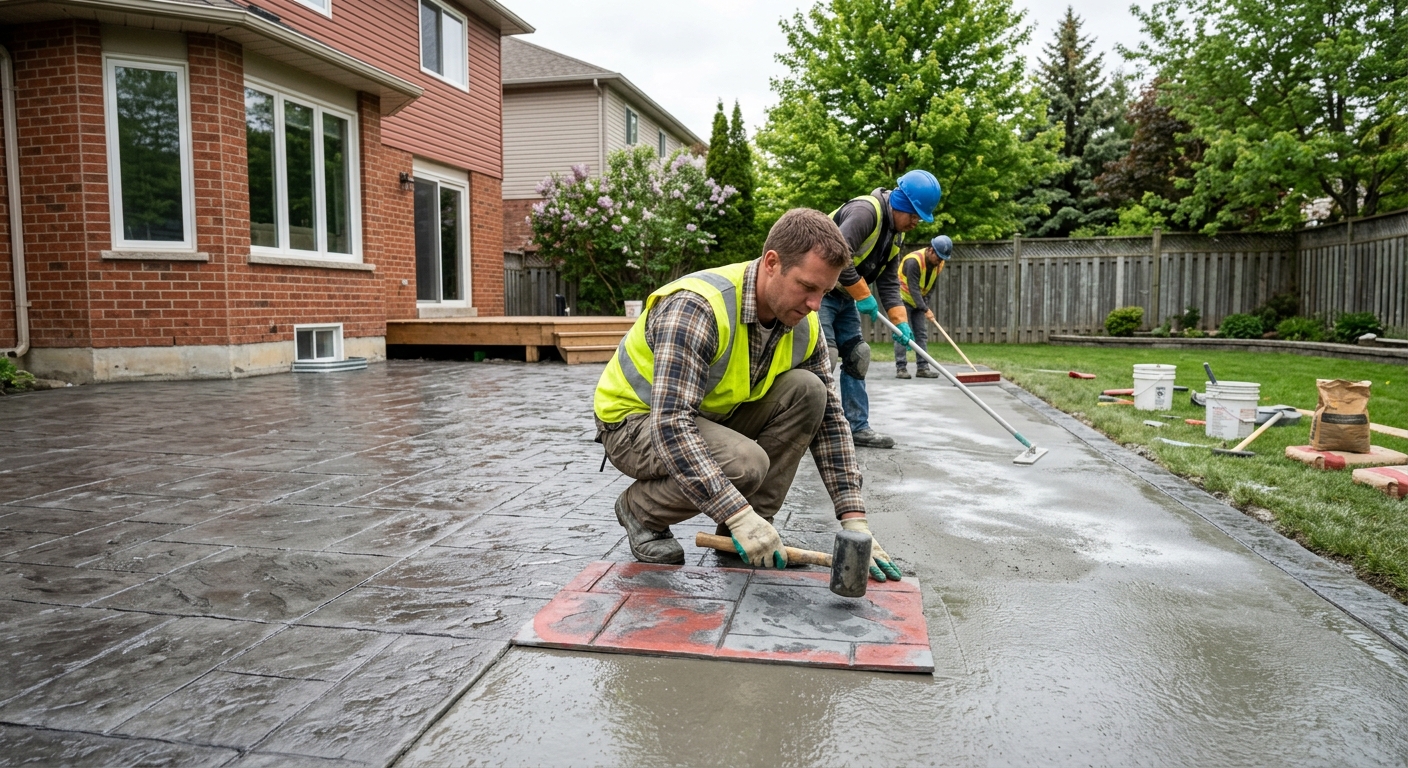
Examples from Kimberley: replacing an older driveway often costs more when the base has failed and must be rebuilt with compacted granular material; conversely, a straightforward patio on stable, well-draining soil can land near the lower band (like patio/walkway pricing around $14–$24 per sq. ft.). Stamped work costs more because of colour hardeners, stamp timing, and finishing labour—often in the $25–$40 per sq. ft. range—yet it can be justified when homeowners want a durable look that survives our winter salt and melt cycles.
| Price Factor |
Why It Matters |
Cost Impact |
| Frost line depth |
Determines footing depth, form height, and excavation volume |
Higher depth increases labour, trucking, and rebar/formwork |
| Site preparation |
Excavation, grading, and compacted granular base control settlement |
Poor drainage or soft subgrade can add significant base rebuild |
| Reinforcement |
Rebar or wire mesh supports slabs and helps control crack width |
Material + placement labour; sometimes more is required near openings |
| Mix design |
Air-entrainment and strength spec help slabs survive freeze–thaw and loading |
Better spec costs more per yard, but reduces early failures |
| Finish type |
Broom vs. stamped vs. exposed aggregate changes labour and materials |
Stamped/exposed work adds steps (release agents, curing, tools) |
| Pour size and concrete truck access to site |
Access affects pumping, labour time, and waste management |
Hard access can trigger extra labour and pump costs |
| Cold-weather curing precautions |
Heating and blankets protect early strength development |
Shorter pour season increases scheduling and protective measures |
| Control joint pattern and sealing cost |
Joint spacing manages random cracking; sealing helps repel salt and water |
More joints/joint detailing and sealer add line-item costs |
Permits & regulations in British Columbia
In British Columbia, structural concrete work typically requires permitting. If you’re doing foundation concrete such as footings, foundation walls, grade beams, or other structural elements, you’ll usually need a building permit, and engineered drawings are often reviewed through the municipal process. For concrete flatwork—like patios, walkways, and driveways—permits are commonly not required unless the project affects lot grading, impervious surface coverage limits, or ties into municipal right-of-way requirements (for example, drainage impacts near a boulevard).
Before breaking ground in Kimberley, start by confirming your scope with the local authority: ask whether your driveway size, slope changes, or drainage alterations trigger any permit or inspection requirements. Also verify the contractor is properly insured: request proof of liability coverage and coverage for workers through the applicable workplace insurance (commonly WSIB/WCB coverage depending on their classification). Ask for references on similar-scale jobs—ideally exterior slabs poured in cold conditions.
To verify a contractor in BC, do this step-by-step: (1) search the contractor’s business details and licensing/registration on the appropriate public registry listings; (2) request a current certificate of insurance and ensure the coverage is active for the project period; (3) ask whether they have clearance/confirmation for workplace coverage and request documentation; (4) confirm their address and contact, then check references that match your scope (driveway/flatwork vs. foundation). Good contractors won’t treat this as “too much”—they treat it as standard due diligence.
Getting concrete right in Kimberley's freeze-thaw climate
Concrete failures in Kimberley usually come down to water and timing. Water enters through micro-cracks and weak surfaces; then freeze–thaw cycles expand ice and widen movement. If the base isn’t compacted to the correct depth, if the mix isn’t air-entrained, or if curing happens too cold, you’ll see surface scaling, pop-outs, and cracks that don’t only look bad—they also accelerate further water intrusion. The right spec is what protects your driveway or patio through years of winter ploughing and de-icing.
To spec the job correctly in Kimberley’s conditions, focus on five things. First, base preparation: ensure a properly compacted granular sub-base at the right depth for local soil and frost exposure, with attention to drainage. Second, mix design: exterior flatwork should be air-entrained with an air content typically around 5–7% and a minimum compressive strength around 32 MPa. Third, control joints: spacing should be planned to limit random cracking—especially important for wide driveways and slabs that freeze unevenly. Fourth, curing: aim for a minimum 7-day curing period under proper conditions; cold weather often requires insulation, curing blankets, or heated enclosures to reach strength safely. Fifth, sealing: apply a penetrating sealer after the concrete has fully cured (commonly around 28 days post-pour) to repel de-icing salts.
Here’s a practical dollar example: upgrading from a basic “cheap” mix to a properly air-entrained exterior spec and adding winter curing protection can add a noticeable amount upfront, but it’s often cheaper than rebuilding a driveway early. Homeowners who skip air-entrainment in freeze–thaw climates frequently face premature surface scaling—an outcome you definitely don’t want on a $18–$28 per sq. ft. driveway when you’re paying for labour twice.
| Spec |
Why It Matters in Kimberley |
What to Ask For |
Impact if Skipped |
| Compacted granular base (depth?) |
Controls settlement and supports frost exposure resistance |
Base depth for your site conditions + compaction testing approach |
Uneven support leads to cracking, pumping, and premature failure |
| Air-entrained concrete mix (target air %?) |
Air pockets reduce freeze–thaw damage in exterior slabs |
Target air content (commonly 5–7% for exterior flatwork) on the ticket/spec |
Spalling, scaling, and pop-outs from inadequate freeze resistance |
| Compressive strength (MPa rating) |
Early and long-term strength supports loading and durability |
Minimum 32 MPa (or higher if engineered for your design) |
Surface weakness, increased cracking, and reduced lifespan |
| Control joints (spacing per ACI guidelines) |
Limits random cracking caused by shrinkage and temperature movement |
Joint layout plan and spacing that matches slab dimensions |
Random cracks and wider damage paths for water intrusion |
| Minimum 7-day curing period |
Cold conditions can slow strength gain and increase defects |
Curing plan for cold weather (blankets/heating as needed) for at least 7 days |
Weak surface, higher risk of scaling and early cracking |
| Penetrating sealer (when applied after cure) |
Helps repel salts and water penetration during winter |
Sealer application schedule after cure (commonly 28 days post-pour) |
Faster salt/water deterioration and shorter service life |
How to choose a concrete work contractor in Kimberley
Choosing the right concrete contractor in Kimberley is mostly about verification and clarity—because in our freeze–thaw climate, small gaps in base prep, mix spec, and curing protection become expensive later. Start with British Columbia compliance: confirm the contractor’s licensing/registration status through the relevant public registry listings, then request proof of liability insurance showing coverage amounts and active dates. Next, ask for evidence they have workers covered through workplace insurance (WSIB/WCB coverage depending on their classification). If they can’t provide current documents quickly, that’s a sign to slow down.
Get 2–3 itemised written quotes. You want a breakdown that separates labour and materials (concrete supply, base materials, reinforcement, forms, finish work, and—if applicable—pumping or demolition). Avoid “lump sum only” pricing unless the scope is extremely clear. Read the exclusions carefully: is permit pulling included (if needed), is disposal of existing concrete included, and are winter curing measures included if temperatures require them? Warranty terms matter too: ask for a workmanship warranty length, whether product/manufacturer warranties apply to specific materials, and if anything is transferable if you sell the home.
Payment schedule should protect you: never pay more than 10–15% upfront. Hold back a portion until the work is complete and cleaned up, and confirm the timeline in writing, including a start date and completion estimate. With concrete, “close enough” dates often turn into cold-weather pours without adequate curing protection.
- Verify contractor licensing/registration status in British Columbia before scheduling.
- Request a certificate of liability insurance with active dates and project coverage.
- Confirm workplace insurance/coverage documentation (WSIB/WCB as applicable) for the crew.
- Ask for 2–3 references from similar exterior jobs poured in cold conditions.
- Get an itemised quote (labour + materials), not a single lump sum.
- Confirm site prep scope: excavation depth, granular base materials, and compaction expectations.
- Ask for mix ticket details: air-entrainment and minimum compressive strength spec.
- Confirm reinforcement scope: rebar/wire mesh placement and thickness coverage.
- Review finish plan: broom vs stamped vs exposed aggregate, plus curing and sealing steps.
- Ask about cold-weather procedures: blankets/heating, and who supplies them.
- Confirm control joint layout and sealing schedule for salt exposure.
- Use a payment schedule with 10–15% max upfront and holdback until completion.
Red flags in Kimberley include: quoting “standard” concrete without specifying air-entrainment for exterior slabs, skipping a winter curing plan even when temps are near freezing, vague joint spacing/layout, refusing to provide insurance documentation, and offering overly low prices that don’t include base rebuild, disposal, or sealing when de-icing salts are involved.
Frequently asked questions — concrete work in Kimberley
How do I seal concrete to protect it in Kimberley?
In Kimberley, sealing is a practical defence against de-icing salts and meltwater. The key is timing: for most exterior slabs, wait until the concrete has cured properly—commonly about 28 days post-pour—before applying a penetrating sealer. Ask your contractor to use a product suited for freeze–thaw climates and ensure the surface is clean and dry (no contaminants, dust, or standing moisture). Sealing doesn’t stop freezing, but it reduces water uptake through the surface and micro-cracks, which helps limit salt-driven deterioration. If you’re comparing driveway options, remember that a driveway in the $18–$28 per sq. ft. range is still vulnerable without correct mix spec and protection.
What is the difference between concrete and cement?
Cement is one ingredient within concrete. Concrete is the finished construction material made by combining cement with water, aggregates (sand and gravel/crushed stone), and often admixtures. For Kimberley’s exterior work, contractors specify things like air-entrainment (to help manage freeze–thaw cycles) and a minimum compressive strength (often around 32 MPa for flatwork). If a quote only talks about “cement” but doesn’t mention air-entrainment, strength, and curing, you should ask for the actual concrete mix specification and confirmation of how they’ll protect the slab in cold weather. In practice, what matters to you is the concrete performance spec—not the ingredient name.
How much does concrete work cost in Kimberley?
Costs in Kimberley depend heavily on site prep, access, and how the contractor handles winter curing and freeze–thaw durability. For flatwork, the regional pricing bands typically put concrete patio/walkways around $14–$24 per sq. ft., while driveways often land around $18–$28 per sq. ft. Stamped and decorative concrete tends to be higher, commonly $25–$40 per sq. ft., because of additional labour steps and materials. Foundation footings are quoted differently (by structural scope), and the local pricing band is commonly $70–$120 per unit where applicable. Always request itemised quotes so you can see what’s included for excavation, compaction, reinforcement, and—if needed—blankets/heating for cold pours.
How deep must footings be for Kimberley's frost line?
Footing depth is determined by the design frost depth and your soil conditions, and in cold Kootenay climates footings must be set below frost to prevent frost heave. The exact required depth is set by engineering/design for the house and local conditions—there isn’t a single “one number” for every lot. What you can do as a homeowner is ask your contractor (or builder) to reference the approved foundation design and explain how the footing bottom is located relative to the design frost depth on your plan. If you’re comparing quotes for foundation footings, watch for scope details: excavation volume, form height, and reinforcement are where contractors either properly comply—or cut corners that lead to movement and cracking later.
Why does concrete crack in Kimberley and how is it prevented?
Concrete cracks are common in Kimberley because of shrinkage, temperature swings, and—most importantly—freeze–thaw movement when water gets into the slab. Cracking becomes a bigger problem when control joints aren’t planned or when the mix doesn’t have the right air-entrainment for exterior durability. Prevention starts with the basics: correct granular base preparation and compaction, air-entrained exterior concrete, and a control joint pattern sized for your slab dimensions to limit random cracking. Curing also matters: in cold weather, a minimum 7-day curing approach with protection (blankets/heating) helps the concrete reach strength properly. Sealing after full cure further reduces water and salt intrusion through surface pores and micro-cracks.
Stamped vs broom-finish concrete — cost difference?
Stamped concrete costs more than a broom-finish because it involves extra steps: stamp mats, release agents, colour work (often colour hardener), and more careful timing and finishing. In Kimberley, broom-finish driveways typically fit the $18–$28 per sq. ft. band for standard exterior slab work, while stamped driveways or patios commonly land in the $25–$40 per sq. ft. range. That premium can be worth it when you want decorative appearance plus good durability—as long as the contractor still specs the essentials (air-entrained mix, proper base, control joints, and curing). If someone quotes stamped work without discussing those freeze–thaw durability items, it’s a mismatch for our climate.