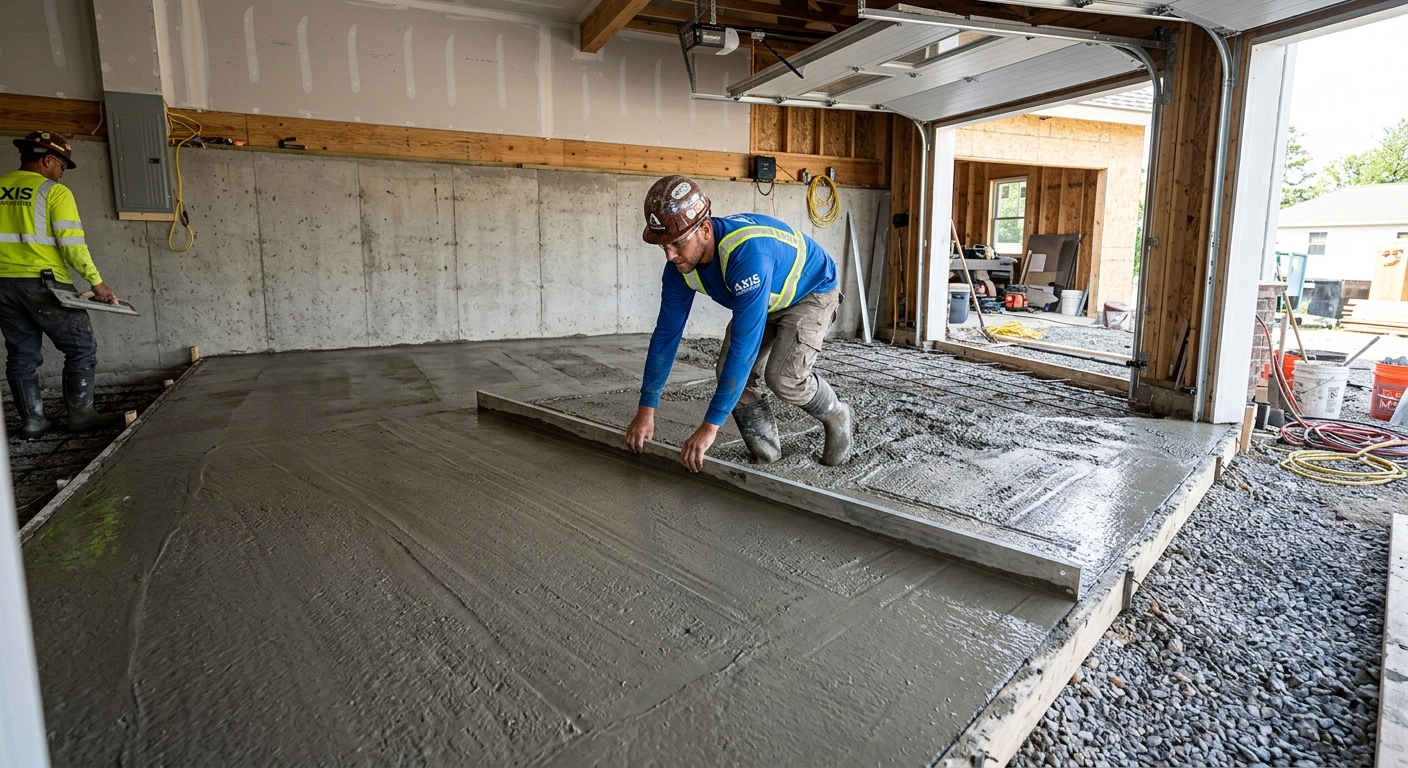
Concrete work options and costs in Woodwards
Concrete work in Woodwards is one of those trades where “same-looking” projects can land in very different price brackets. In a community of 8,055 people (Statistics Canada, 2021 Census), wood-frame single-detached homes and growing infill demand make concrete flatwork—driveways, patios, walkways, and garage slabs—especially active. A large share of households here lean toward ground-oriented living, which means exterior concrete is a high-visibility upgrade and a frequent maintenance item (Statistics Canada, 2021 Census).
In the Lower Mainland–Southwest, mild winters and a shallow frost line still create cost pressure because crews must design around freeze–thaw cycles, saturated soils, and heavy coastal rainfall. Typical practice assumes frost depth around 450 mm / 18", so footings, piers, and thickened edges are placed below that to avoid frost heave. That influences excavation depth, base prep, and how we build formwork—costs that are usually not optional. Scheduling also matters: prolonged rain, cool nights, and high humidity can extend curing and require blankets or sealers to protect new concrete. Labour availability in the Vancouver–Surrey–Abbotsford corridor is strong, but stormy weeks can tighten scheduling and increase mobilization costs.
In Woodwards proper, concrete work is especially in demand around the more intensively built residential pockets—where driveways and patio renewals commonly happen alongside landscaping updates and foundation touch-ups. If you’re comparing options, the best way to start is by matching your finish and structural needs to the specs in the table below.
| Application |
Typical Size |
Key Spec |
Finish Option |
Price Range |
| Concrete driveway (standard broom finish) |
300–400 sq ft (28–37 m²) |
4" slab, compacted granular base, air-entrained mix, control joints |
Broom finished + curing compound |
$18,000–$28,000 |
| Exposed aggregate driveway |
300–400 sq ft (28–37 m²) |
Proper base prep + air-entrained mix; broom or wash-out aggregate method |
Exposed aggregate (two-step wash) |
$22,000–$32,000 |
| Stamped concrete driveway or patio |
200–350 sq ft (19–33 m²) |
Engineered base, air-entrained mix, release agent and stamping control |
Stamped pattern (brick/stone/wood-look) |
$22,000–$36,000 |
| Plain concrete patio or walkway |
150–250 sq ft (14–23 m²) |
Slab thickness per use, compacted base, control joints where needed |
Broom or light trowel finish |
$16,000–$26,000 |
| Garage floor (interior slab) |
300–450 sq ft (28–42 m²) |
4" slab, wire mesh or rebar as required, vapor considerations if applicable |
Trowel/broom hybrid + cure |
$24,000–$40,000 |
| Foundation footings (structural, below frost) |
Varies; common 8–12 m linear |
Below-design frost depth (~450 mm / 18" practice), excavation + rebar/cage |
Structural concrete only |
$200,000–$350,000 |
Prices are estimates only and vary by project scope, site access and material selection.
What affects the price of concrete work in Woodwards
Even when two contractors quote “the same” concrete job in the Lower Mainland–Southwest, prices can differ by 30–50% because the real work is in the unseen items: excavation depth, base prep quality, mix design, reinforcement, curing control, and whether the crew can protect concrete from coastal rain and cool nights. On top of that, contractor availability and mobilization costs can swing during the busy spring-to-fall window—especially when decks, retaining walls, and foundation-related repairs overlap.
Here’s the core reason specs shift in British Columbia: frost protection and durability. Frost depth around 450 mm / 18" influences every footing and thickened edge detail—we place footings below the design frost to prevent frost heave. For exterior slabs, air-entrained mixes are essential to survive freeze–thaw cycles; that’s not just “better concrete,” it’s how you avoid scaling and spalling. In colder regions farther from the Lower Mainland you’d typically pay more due to deeper excavations and shorter pour seasons, but in Woodwards the coastal-wet timing adds its own cost: curing blankets, sealers, and longer cure windows are often required when the forecast turns damp. De-icing salts (especially around driveways) accelerate surface damage if the concrete isn’t sealed at the right stage.
Concrete costs also rise with practical site factors. A driveway replacement on a tight lot with limited truck access can add excavation and short-load logistics, while rebar addition for a thicker slab or damaged subgrade raises labour and materials. Conversely, a simple patio with good existing drainage and straightforward access can come in closer to the $16–$26 per-sq-ft range for flatwork options, while decorative stamped work will typically push toward the $22–$36 band because of additional finishing time and materials.
| Price Factor |
Why It Matters |
Cost Impact |
| Frost line depth |
Determines footing depth and form height |
Higher excavation and deeper labour can add significant dollars on structural work |
| Site preparation |
Excavation, grading, compacted granular base |
Poor subgrade means extra base and compaction effort to stabilize the slab |
| Reinforcement |
Rebar or wire mesh requirement |
Material and placement time increases for thicker/loaded slabs and structural elements |
| Mix design |
Air-entrainment and compressive strength spec |
Exterior durability specs can increase material cost but reduce failure risk |
| Finish type |
Broom vs. stamped vs. exposed aggregate |
Decorative finishes add labour steps, tooling, and workflow sensitivity |
| Pour size and concrete truck access to site |
Sequencing and pumping/hosing needs |
Tight access may require smaller loads, additional labour, or pumping |
| Cold-weather curing precautions |
Heating and blankets |
When nights are cool, crews must protect placement and achieve strength on schedule |
| Control joint pattern and sealing cost |
Limits random cracking and repels de-icing salts |
Skipping proper jointing or sealing can lead to premature surface damage |
Permits & regulations in British Columbia
In British Columbia, structural concrete work generally requires municipal oversight. Work such as concrete footings, foundation walls, and grade beams typically falls under the building permit process, and many projects also require engineered drawings reviewed by the municipality. By contrast, concrete flatwork—driveways, patios, and walkways—often does not require a permit unless it changes lot grading, affects stormwater management, or triggers impervious surface coverage limits or municipal right-of-way considerations. Even when a permit isn’t required, you still want a clear plan for drainage and surface runoff so you don’t create water problems for the foundation or neighbours.
A practical, step-by-step verification process for a homeowner in Woodwards is straightforward. First, ask the contractor for their business registration and confirm they are properly licensed/registered to perform the work in BC (their website and business profile typically show registration details). Second, request a current certificate of liability insurance naming you as an additional insured where applicable. Third, confirm WSIB/WCB coverage (or their applicable provincial coverage documentation) before the first day on site.
Finally, ask for clearance letters or current account status documentation and references from similar-scale jobs in the Lower Mainland–Southwest. If the contractor can’t provide proof quickly, or their drawings don’t match the scope, treat it as a red flag and move on.
Getting concrete right in Woodwards's freeze-thaw climate
In Woodwards, concrete problems usually start with one of five issues: weak or poorly compacted base preparation, inadequate air-entrainment, missing or poorly spaced control joints, curing that doesn’t reach early strength, or no surface protection after placement. Freeze–thaw cycles and coastal rainfall keep subgrades saturated longer, so the concrete has to be durable from day one. The goal is to keep water out of voids, allow for movement where cracking is expected, and ensure the slab reaches design strength under realistic temperature and moisture conditions.
To spec the job correctly, start with base prep: use compacted granular sub-base to the design depth for local soil and to support the slab without settlement. Next, mix design: specify air-entrainment for exterior flatwork (commonly 5–7% air content) and a minimum 32 MPa compressive strength. Third, control joints: plan joint spacing so cracking occurs in predictable locations instead of random shrinkage cracks. Fourth, curing: plan for at least 7 days of curing under proper conditions—especially important when cold nights or damp weather show up during the pour season. Fifth, sealing: apply a penetrating sealer after cure (commonly around 28 days post-pour) to repel de-icing salts and reduce scaling potential.
Those details can seem like “extra,” but they’re what prevent expensive failures. For example, a broom-finish driveway might be priced in the $18–$28 band; choosing the right air-entrained mix and base thickness is usually a small fraction of total cost, yet it protects a large-ticket surface from premature spalling. On the other hand, paying for decorative stamped work (often $22–$36) without sealing and proper joints can still lead to early wear.
| Spec |
Why It Matters in Woodwards |
What to Ask For |
Impact if Skipped |
| Compacted granular base (depth?) |
Stability under freeze–thaw and wet subgrade |
Granular type and target thickness to meet load and frost protection needs |
Settlement, cracking, and uneven slab surface |
| Air-entrained concrete mix (target air %?) |
Resists freeze–thaw scaling in exterior exposure |
Confirm air content target (typically 5–7% for exterior flatwork) |
Spalling and surface scaling, especially after salt exposure |
| Compressive strength (MPa rating) |
Ensures durable performance and strength gain |
Minimum 32 MPa specified for the intended exposure |
Reduced durability, surface wear, and early damage |
| Control joints (spacing per ACI guidelines) |
Controls where shrinkage cracks occur |
Joint layout plan and cut timing so joints form before random cracking |
Random cracking and difficult-to-repair cosmetic defects |
| Minimum 7-day curing period |
Critical in cool nights and high humidity |
How curing will be protected during the first week (blankets/plan) |
Slower strength gain and higher risk of surface defects |
| Penetrating sealer (when applied after cure) |
Repels de-icing salt and water in wet winters |
Sealer schedule around 28 days post-pour and product type |
More scaling, staining, and shorter surface life |
How to choose a concrete work contractor in Woodwards
Choosing the right contractor in Woodwards comes down to proof, not promises. For British Columbia work, start by verifying their credentials: ask for their BC business registration/contractor details and confirm they carry current liability insurance. Request a certificate of insurance before work begins, and ensure it’s valid for the project period. Next, confirm WSIB/WCB coverage and provide the applicable clearance letter or proof of coverage. If a contractor can’t supply insurance and coverage documentation quickly, it usually means you’re taking on the risk.
Then, get 2–3 itemised written quotes—not just a lump sum. You want separate line items for labour and materials (concrete, rebar/wire mesh, granular base, formwork, finishing, joints, sealing, and disposal). Read the scope for exclusions: is permit pulling included (when required for structural work), is debris hauling included, and what happens if weather delays the pour? A good contractor will also note how they’ll handle cool nights and wet conditions (curing blankets, curing plan, and timing).
For warranty, ask for workmanship warranty length and whether product/manufacturer warranties apply to any coatings, sealers, or admixtures. Ask if the warranty is transferable if you sell your home. Keep payment safe: never pay more than 10–15% upfront, and use a holdback until the job is complete and inspected. Finally, insist on a written start date and completion estimate that aligns with the weather and curing requirements.
- Ask for a current certificate of liability insurance and verify policy dates.
- Confirm WSIB/WCB coverage with proof/clearance documentation.
- Request 2–3 itemised quotes showing labour vs. materials.
- Make sure the quote lists base prep thickness, granular type, and compacted depth.
- Confirm the mix design is air-entrained for exterior work.
- Verify reinforcement requirements (rebar/wire mesh) match slab thickness and use.
- Ask for control joint pattern and when joints will be cut.
- Clarify curing plan during wet/cool weather (blankets/curing compound).
- Confirm sealing scope: product type and “applied after cure” timing.
- Ask what’s included in site access: pumping, hoses, and concrete truck logistics.
- Check disposal/removal: old concrete hauling and cleanup included?
- Get a written timeline with weather contingencies and re-scheduling rules.
In Woodwards, the biggest red flags are: quotes that ignore base thickness and frost/durability details, no mention of air-entrainment for exterior flatwork, vague cure/seal timelines, contractors who demand large upfront payments, and workmanship that isn’t backed by a clear written warranty.
Frequently asked questions — concrete work in Woodwards
Stamped vs broom-finish concrete — cost difference?
In Woodwards and across the Lower Mainland–Southwest, stamped concrete costs more than a broom-finish because it adds labour-intensive steps (stamps, release agents, pattern timing, and more controlled finishing). A broom-finish driveway typically sits in the $18–$28 band, depending on slab size and access. Stamped concrete driveways or patios often fall closer to the $22–$36 band because of extra finishing time and sometimes higher material allowances. Both options should use air-entrained concrete for exterior freeze–thaw exposure and should include a control joint plan. If you’re comparing quotes, ensure both include the same base prep depth, reinforcement decisions, curing protection, and whether sealing is included—those factors matter more than the appearance.
When is the best time to pour concrete in Woodwards?
The best time in Woodwards is typically late spring through early fall when temperatures are consistently workable and rain events are manageable. In the Lower Mainland–Southwest, mild winters help, but cool nights and prolonged coastal rain can still slow strength gain and complicate finishing. Contractors often watch overnight forecasts and plan for curing blankets when needed so concrete can reach early strength safely. If a pour is scheduled during a damp stretch, the crew should have a written curing plan (protection and curing time) and be ready to manage surface finishing sensitivity. For structural work like footings and foundation walls, the schedule is often tied to inspections—so confirm lead times and permit timing before booking the pour date.
How long does concrete take to cure?
Concrete “cures” in phases. In practice, you should plan for a minimum 7-day curing period where the contractor protects the slab so it can develop strength under Woodwards’ cool, humid conditions. Surface finish and early handling often happen much sooner, but durability comes from reaching adequate strength with proper moisture and temperature control. In addition, if you’re using a penetrating sealer for exterior durability, most sealers are applied after the concrete has cured—commonly around 28 days post-pour—so the surface is ready to accept the treatment and repel moisture and de-icing salt. If you live near areas with heavy rainfall and you expect salt use in winter, curing and sealing timing can be the difference between a driveway that looks good for years versus one that scales or spalls early.
Do I need a permit for concrete work in British Columbia?
In British Columbia, it depends on the type of concrete work. Structural items—such as footings, foundation walls, and grade beams—typically require a building permit and often engineered drawings reviewed through the municipal process. Concrete flatwork like driveways, patios, and walkways often doesn’t require a permit unless it affects lot grading, drainage, impervious surface rules, or the municipal right-of-way. Even when no permit is required, proper drainage and frost/durability specs are still essential in Woodwards’ climate. The best approach is to ask the contractor what their scope requires and confirm directly with the local authority before breaking ground. Also verify the contractor provides proof of liability insurance and WCB/WSIB coverage.
Concrete vs pavers for a patio in Woodwards?
Concrete and pavers can both work well in Woodwards, but they behave differently with freeze–thaw and heavy rain. Concrete patios are usually installed on a compacted granular base with a control joint plan, and when done with air-entrained mix and proper curing, they handle weather cycles well. Pavers can be easier to repair when a single unit fails, but they depend heavily on base compaction, joint sand selection, and drainage—weaknesses can lead to shifting or weed growth. Cost-wise, plain concrete patios often align with the $16–$26 band, while decorative upgrades (like stamping) push higher. For the “best fit,” compare your priorities: long-term monolithic look and low maintenance favour concrete; flexible repairs and a traditional look can favour pavers—provided the base and drainage are engineered correctly.
How long does a concrete driveway last?
With good base prep, air-entrained exterior concrete, control joints, proper curing, and sealing where appropriate, a concrete driveway in Woodwards can last for decades. Typical lifespan expectations vary with usage, drainage, and winter maintenance habits. Heavy vehicle loads, poor runoff control, and neglecting sealing can shorten service life—especially in a freeze–thaw environment where moisture cycles through the slab. Salting increases the risk of surface scaling if the concrete isn’t protected. A well-installed broom-finish driveway priced in the $18–$28 band can perform very well, but the “hidden” items—granular base compaction, correct air content, joint spacing, and cure/seal timing—are what typically determine whether you get 15 years vs 30+ years. Ask your contractor how they plan to handle joints and sealing in your quote.