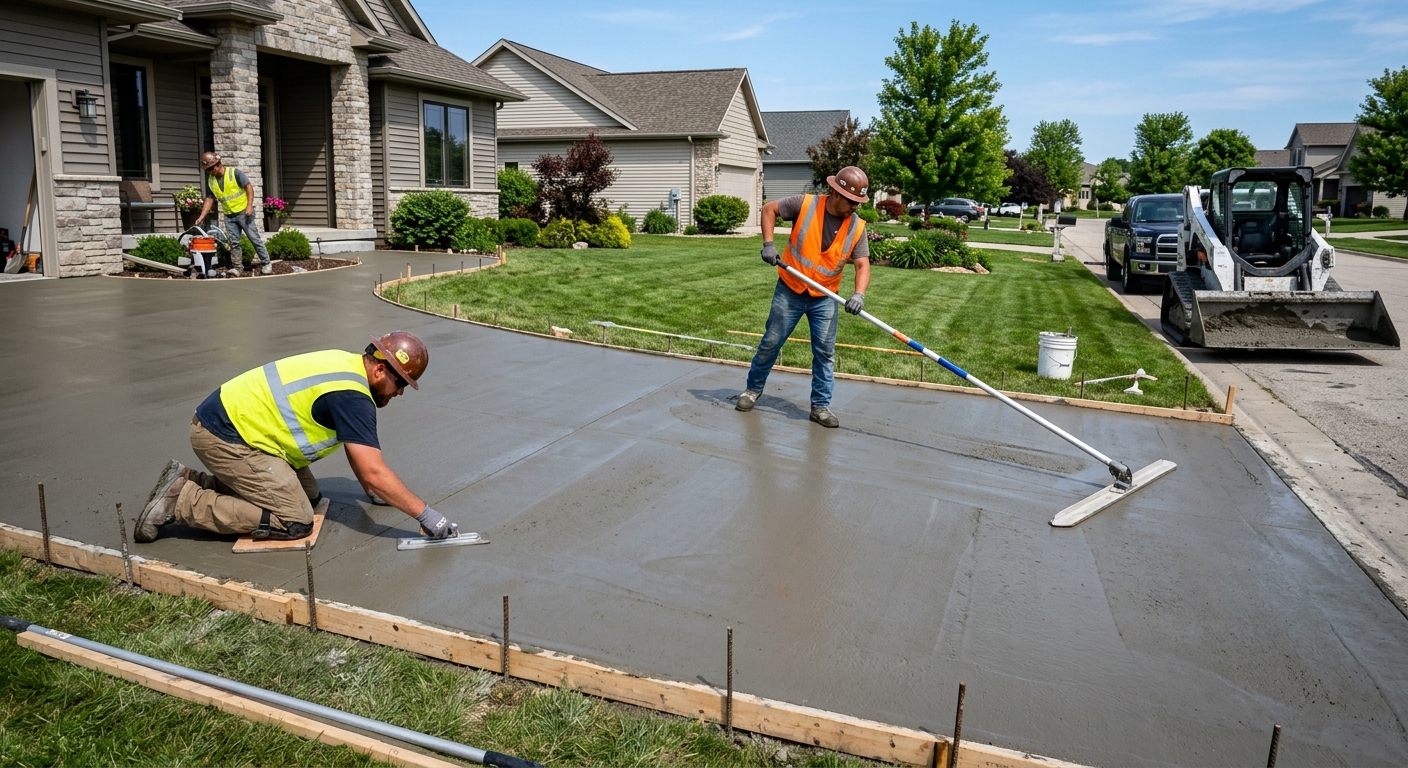
Concrete work options and costs in Westwood Plateau
In Westwood Plateau, concrete flatwork is a major upgrade for homeowners—especially as many families invest in driveway and patio improvements after moving into established neighbourhoods. With a 2021 population of 19,776 in the broader area (Statistics Canada, 2021 Census), there’s enough consistent demand to support experienced crews, but pricing still fluctuates based on schedule, site conditions, and how each contractor handles the Lower Mainland–Southwest freeze-thaw climate. At the same time, Westwood Plateau’s mix of single-family homes drives frequent work on driveways, walkways, and back patio slabs—exactly the type of concrete that needs the right base, air-entrained mix, and joints to keep cracking under control.
In the Lower Mainland–Southwest, mild winters and a shallow frost line still matter because saturated soils and frequent freeze–thaw cycles can damage slabs and foundation edges if specs aren’t followed. Local practice commonly assumes a design frost depth around 450 mm / 18", so footings, piers, and thickened edges are typically placed below that to reduce frost heave risk. Coastal-wet conditions also mean scheduling around prolonged rain, cool nights, and high humidity—often requiring curing blankets, sealers, and longer cure timelines for durable driveways and patios.
If you’re comparing options, the best way is to look at apples-to-apples specs. Below are common Westwood Plateau project types and realistic price bands, including finishing differences like broom, exposed aggregate, and stamping.
| Application |
Typical Size |
Key Spec |
Finish Option |
Price Range |
| Concrete driveway (standard broom finish) |
400–600 sq. ft. |
Air-entrained exterior mix, compacted granular base, control joints |
Broom finish, light edging |
$18,000–$28,000 |
| Exposed aggregate driveway |
400–600 sq. ft. |
Air-entrained exterior mix, proper cure, wash/expose process |
Exposed aggregate, slip-resistant texture |
$22,000–$34,000 |
| Stamped concrete driveway or patio |
300–550 sq. ft. |
Air-entrained mix, stamping mats, colour hardener where selected |
Stamped pattern with sealer |
$22,000–$36,000 |
| Plain concrete patio or walkway |
200–400 sq. ft. |
Reinforcement as required, air-entrained mix, joints |
Float/trowel or broom-sawn finish |
$16,000–$26,000 |
| Garage floor (interior slab) |
400–600 sq. ft. |
Vapour control considerations, reinforcement per design, floor flatness |
Broom finish or smooth trowel (as specified) |
$14,000–$26,000 |
| Foundation footings (structural, below frost) |
Per linear foot allowance (project-dependent) |
Excavation below design frost, thickness per engineering, rebar placement |
Structural concrete (not a decorative finish) |
$200–$350 |
Prices are estimates only and vary by project scope, site access and material selection.
What affects the price of concrete work in Westwood Plateau
In Westwood Plateau and across the Lower Mainland–Southwest, two homeowners can receive quotes that differ by 30–50% for the “same” concrete project because the pricing is driven by hidden scope: base thickness, drainage detailing, reinforcement needs, mix requirements, and how long it takes to cure and protect the slab in damp weather. That same spread is why British Columbia pricing can diverge from interior or northern regions—contractors factor in frost strategy, shorter pour seasons, and the real cost of keeping concrete at proper conditions long enough to reach design performance.
For exterior work in this region, the local frost-depth assumption (commonly about 450 mm / 18") still dictates where footings and thickened edges sit. Where soils stay saturated and you get freeze–thaw cycles, air-entrainment becomes non-negotiable for exterior slabs, and control-joint detailing needs to be planned—not “added later.” Colder regions farther inland or in higher elevations typically face deeper excavation or more time and heating/insulation precautions, which increases excavation, forming, and curing costs. In Westwood Plateau, scheduling is also affected by rain and high humidity, so crews may protect pours with curing blankets or plan longer protection windows, especially for driveways and patios.
Concrete choices also shift costs. If you’re staying with a standard broom driveway, you’re usually closer to the driveway band (about $18–$28). Move to exposed aggregate or stamping, and the labour, finishing time, and decorative materials can push the project toward the stamped/decorative range (about $22–$36). For example, upgrading a 450 sq. ft. patio from plain to stamped can be justified when you want a consistent, durable look with proper sealing—otherwise, plain finishes often deliver the same structural longevity at a lower price.
| Price Factor |
Why It Matters |
Cost Impact |
| Frost line depth — determines footing depth and form height |
Footings must be placed below the design frost depth to limit frost heave. |
Higher excavation and forming increases structural concrete cost. |
| Site preparation — excavation, grading, compacted granular base |
Weak subgrade leads to settlement and cracking; drainage reduces saturation. |
More hauling, regrading, and granular increases labour and material use. |
| Reinforcement — rebar or wire mesh requirement |
Controls cracking and improves slab performance where spans or loads warrant it. |
Material and labour for tying/placing can add significant cost. |
| Mix design — air-entrainment and compressive strength spec |
Exterior freeze–thaw exposure requires air-entrained concrete durability. |
Specified mix can be more expensive than basic mixes. |
| Finish type — broom vs. stamped vs. exposed aggregate |
Decorative finishes require additional materials and more skilled finishing. |
Stamped and exposed aggregate typically cost more per sq. ft. |
| Pour size and concrete truck access to site |
Small access limits may require pumps or additional equipment/time. |
Longer pours and handling often raise labour costs. |
| Cold-weather curing precautions — heating and blankets |
Cool nights/high humidity can slow strength gain and increase risk of surface issues. |
Blankets, heaters, and extra protection add direct costs. |
| Control joint pattern and sealing cost |
Joints manage shrinkage cracking; sealing helps repel de-icing salts. |
Proper joint layout and sealing materials extend the project scope. |
Permits & regulations in British Columbia
In British Columbia, structural concrete work generally requires municipal oversight because it relates directly to the building’s stability. That means tasks like foundation walls, grade beams, and structural footings typically require a building permit and often engineered drawings reviewed as part of the permit process. Concrete flatwork—driveways, patios, and walkways—usually does not require a permit unless it affects lot grading, stormwater or impervious surface coverage rules, or impacts municipal right-of-way conditions. If your plan changes how water drains toward a neighbour or changes elevations significantly, it’s smart to verify requirements before breaking ground.
For your Westwood Plateau project, here’s a practical way to verify your contractor in a way that protects you: (1) Ask the contractor for their liability insurance certificate (COI) and confirm it’s current; (2) Ask about WSBC/WCB coverage for their workers and whether they carry coverage in the province; (3) Confirm the business registration details and credentials they use when bidding; and (4) Request references from similar slab or footing jobs, ideally in the Lower Mainland–Southwest climate (air-entrainment, jointing, and drainage details show up in photos).
Step-by-step, you can then cross-check: use online registries for contractor credentials where available, look at the COI expiry date and named insured, and request a clearance/verification letter where the insurer or coverage provider provides it. If they can’t produce paperwork promptly, that’s often a sign to keep looking.
Getting concrete right in Westwood Plateau's freeze-thaw climate
Concrete fails in Westwood Plateau mostly when the slab isn’t built to resist moisture movement and freeze–thaw action. The two biggest culprits homeowners can’t see early are inadequate base preparation and poor mix design. In the Lower Mainland–Southwest, soils can stay saturated, and even with a shallow frost-depth profile (often around 450 mm / 18"), freeze–thaw cycles can still damage edges, joints, and any areas exposed to de-icing salts. If the concrete isn’t air-entrained, water expands during freezing and can cause surface scaling and spalling.
To spec the job correctly, start with base preparation: the contractor should excavate to a designed depth and place a properly graded, compacted granular sub-base with attention to subgrade drainage. Next is mix design: for exterior flatwork, ask for air-entrainment targeted around 5–7% air content and minimum 32 MPa compressive strength (as specified in the mix design). Control joints matter too—spacing must be planned to limit random cracking. Then curing: minimum 7 days is a common baseline, but in cool wet conditions they should protect the pour with appropriate coverings or blankets to keep the slab gaining strength safely. Finally, sealing: a penetrating sealer should be applied after cure (often around 28 days) to help repel salts and reduce moisture intrusion.
Asking for these details is how you avoid expensive “redo” work. For instance, a driveway might land near $18–$28 for a broom-finish scope, but paying for correct air-entrainment and proper curing is what protects that investment. If you skip those specs to save a bit, spalling repairs quickly become costlier than the initial difference between standard and decorative options.
| Spec |
Why It Matters in Westwood Plateau |
What to Ask For |
Impact if Skipped |
| Compacted granular base (depth?) |
Stable base reduces settlement and controls water migration under the slab. |
Base depth to suit soil conditions and frost strategy; engineered grading plan. |
Cracking, uneven settlement, and faster deterioration of the surface. |
| Air-entrained concrete mix (target air %?) |
Freeze–thaw durability depends on entrained air to manage expansion pressure. |
Target air content around 5–7% for exterior flatwork (confirm in mix design). |
Scaling and spalling risk rises sharply in winter. |
| Compressive strength (MPa rating) |
Strength gain supports long-term surface durability and load performance. |
Minimum 32 MPa (or higher if required by engineer/spec). |
Surface wear, reduced durability, and potential early failures. |
| Control joints (spacing per ACI guidelines) |
Joints guide shrinkage cracking to predictable locations. |
Proposed joint layout and spacing appropriate for the slab dimensions. |
Random cracking that can become a water path. |
| Minimum 7-day curing period |
Cold nights and high humidity can slow curing—protection reduces risk. |
How they protect the slab if temperatures are cool or rain is expected. |
Weaker early-age concrete and higher chance of surface defects. |
| Penetrating sealer (when applied after cure) |
Salt exposure and moisture reduce surface longevity without protection. |
Sealer application at about 28 days after pour (when cure is complete). |
More water absorption and accelerated scaling/spalling. |
How to choose a concrete work contractor in Westwood Plateau
Choosing the right contractor in Westwood Plateau starts with verifying credentials and coverage. In British Columbia, confirm they carry current liability insurance and workers’ coverage (WSBC/WCB) for their crews. Practically, you do this by requesting: (1) a certificate of insurance showing the effective dates and named insured; (2) proof of coverage or a clearance/verification document where applicable; and (3) their business details for contact and invoicing clarity. If a contractor won’t provide documentation quickly, that’s a risk you shouldn’t take.
Next, get 2–3 itemised written quotes—not one lump sum. Ask for a breakdown that includes excavation/grading, granular base, reinforcement (if any), concrete mix type, finishing labour, jointing, curing protection, and sealing (if included). Review what’s excluded: disposal/hauling, sawcut depth, reinforcement placement, permit responsibilities (if any), and whether they include traffic control and protection for your property.
Warranty should be clear and in writing. Ask for the workmanship warranty length, what it covers (surface cracking, joint issues, scaling), and whether product/manufacturer warranties are included and transferable. For payment, never pay more than 10–15% upfront; use a holdback until substantial completion and inspection/cleanup are finished. Finally, insist on a timeline with a start date, weather contingency plan (rain/cool nights), and a completion estimate.
- Ask who will place the concrete and who does finishing/jointing on your job.
- Confirm air-entrainment and mix design target in writing for exterior work.
- Get joint layout and sealing plan stated in the scope.
- Clarify reinforcement type (mesh vs rebar) and thickness/spacing if required.
- Verify granular base depth and compaction method.
- Confirm truck access method: direct chute placement vs pump vs small-load handling.
- Ensure rain/heating/blanket protection is included for cool wet periods.
- Ask whether demolition and hauling are included or priced separately.
- Confirm sawcut timing for control joints and whether it’s coordinated with curing.
- Request cleanup and waste disposal details before signing.
- Check references for similar slab work in the Lower Mainland–Southwest climate.
- Use a written payment schedule tied to milestones and inspections.
Concrete red flags in Westwood Plateau include: quotes that avoid specifying air-entrainment or joint spacing, vague curing commitments (“we’ll cure it” with no method), unusually low pricing versus typical driveway bands ($18–$28) without explanation, no proof of insurance/coverage, and payment demands that exceed 10–15% upfront with no holdback.
Frequently asked questions — concrete work in Westwood Plateau
How do I compare concrete quotes?
To compare concrete quotes in Westwood Plateau, start by making sure you’re comparing the same specifications, not just the same square footage. Ask each contractor to itemise excavation/grading, granular base depth, reinforcement approach, and the concrete mix design—especially air-entrainment for exterior slabs. Confirm the finish type (broom vs stamped vs exposed aggregate), joint layout, curing protection in cool wet weather, and whether penetrating sealer is included and when it will be applied. It’s also reasonable to compare the practical finish outcome: ask for photos of similar work and note how their joints look after winter. If one quote lands far below typical driveway pricing (often about $18–$28 in this tier) but can’t explain what’s missing, treat it as a scope gap rather than a bargain. (Statistics Canada, 2021 Census)
Can concrete be poured in cold weather in Westwood Plateau?
Yes, concrete can be poured in cold weather in British Columbia, but it must be protected so it can gain strength safely. In Westwood Plateau, cool nights and damp conditions can slow curing, even when freezing temperatures aren’t constant. A competent contractor will include cold-weather curing precautions such as curing blankets, insulation, and temperature management (as required by the mix and site conditions), and they should coordinate pour timing to avoid rain contamination and excessive heat loss. You should also ask how they’ll protect the slab during the first 7 days and what steps they take if temperatures dip overnight. If a contractor plans to proceed without a clear cold-weather plan, that’s a risk—weak early-age concrete can reduce long-term durability and can increase surface issues under freeze–thaw cycles.
How do I maintain concrete in Westwood Plateau's freeze-thaw climate?
Maintenance in Westwood Plateau is mostly about moisture and salt management. After your pour and full cure, plan on penetrating sealer (typically applied after about 28 days) to help repel de-icing salts and reduce moisture absorption. Use de-icing products thoughtfully—aggressive salts can accelerate surface wear and spalling on exterior slabs if the concrete surface is repeatedly wetted and frozen. Keep drainage working: make sure downspouts and grading direct water away from the driveway edges and patio borders. If you notice small cracks, don’t ignore them—monitor them and address joint deterioration early. In spring and after heavy rains, look for joint gaps that allow water intrusion; controlling water movement is how you extend the life of slabs through repeated freeze–thaw cycles.
What causes concrete to spall in Westwood Plateau winters?
Spalling in Westwood Plateau winters is usually caused by moisture getting into the concrete and then expanding during freezing. The most common reason is inadequate air-entrainment: without the correct amount of entrained air, freeze–thaw cycles generate internal pressure that breaks down the surface. Poor or incomplete curing can also contribute by leaving the slab more vulnerable at early age. Another factor is water pathways created by cracked slabs or improperly designed control joints—if joints aren’t spaced and sealed correctly, water and salt can repeatedly soak and freeze in the same locations. Finally, saturated base conditions and poor drainage can keep the slab damp longer. When you review quotes, insist on air-entrainment and proper jointing; these details directly protect your exterior concrete.
What is rebar and when is it required in British Columbia?
Rebar (reinforcing steel) is used to control cracking and add tensile capacity to concrete members where design requires it. In British Columbia, whether you need rebar depends on the structure type and the engineered design. For example, foundation footings, grade beams, and many structural foundation components are typically reinforced per engineering documents. For exterior flatwork like driveways and patios, reinforcement may be recommended based on slab thickness, soil support, and loading—some designs use wire mesh or rebar grids, while others rely more on thickness and base prep. In Westwood Plateau projects, reinforcement decisions also tie back to frost exposure and drainage: a well-prepared base and air-entrained mix reduce stress, but reinforcement still helps manage shrinkage and temperature-related cracking. Ask your contractor to specify reinforcement type, placement, and whether an engineer’s detail is required for your scope.
How long does a concrete project take in Westwood Plateau?
Project duration in Westwood Plateau depends on curing conditions, site preparation complexity, and finish type. Typically, demolition and base work can take 1–3 days for many residential slabs, followed by one pour day. Decorative work (stamped or exposed aggregate) may add additional finishing time and labour, and scheduling can stretch if prolonged rain or cool nights affect curing and protection. Even after the surface looks “ready,” you should plan around strength gain: the common baseline is minimum 7 days of curing under proper conditions for many slabs. Sealing is usually scheduled after full cure—often around 28 days—so you may have an additional window for the final protective step. If you’re comparing options within typical driveway bands (like $18–$28 for a standard broom driveway), remember that decorative finishes can add time as well as cost, mainly due to process and protection requirements.