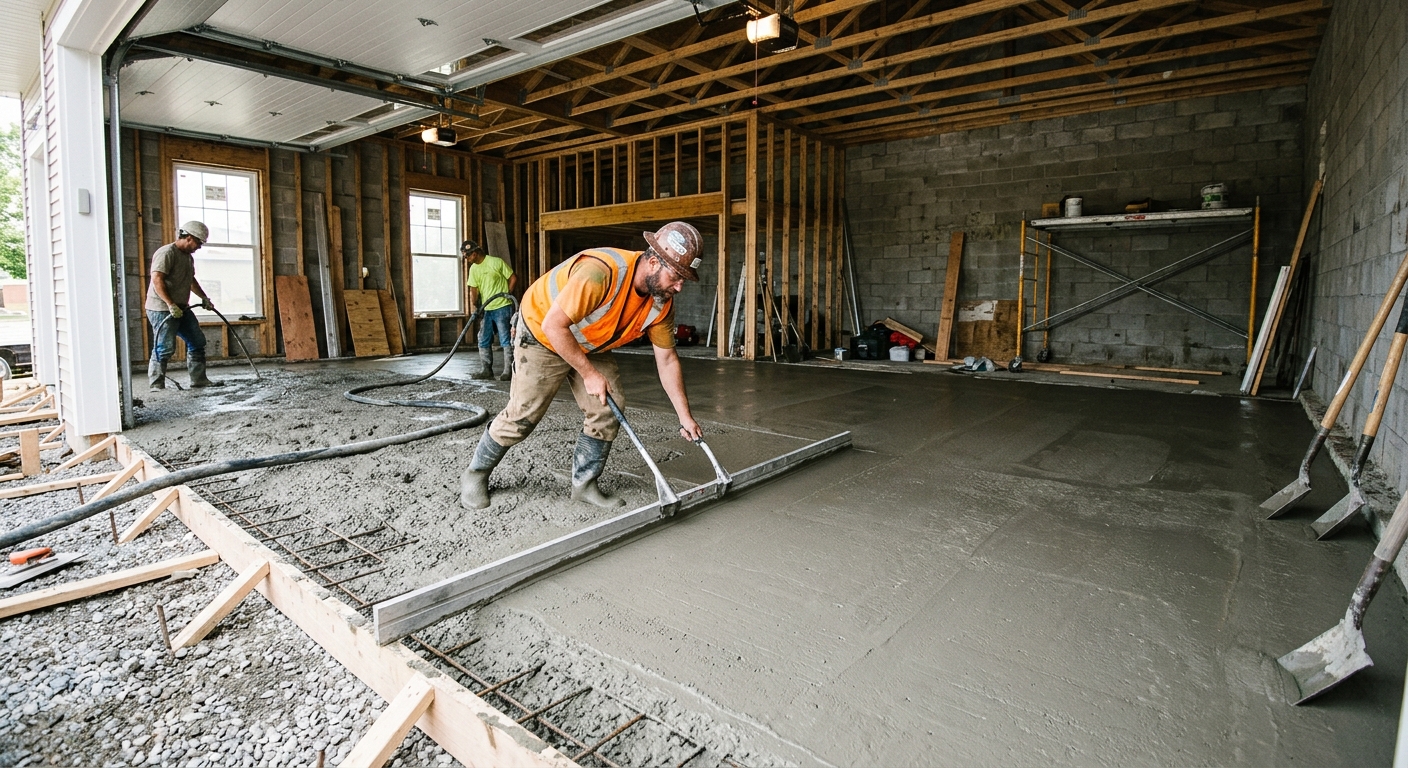
Concrete work options and costs in Strawberry Hill
In Strawberry Hill, concrete flatwork is a big part of everyday property upgrades—especially for the tens of thousands of homes in the area. Strawberry Hill’s housing stock is dominated by single-detached neighbourhoods, and the Lower Mainland is a place where driveways, patios and walkways get used year-round. With a population of about 41,000 people (Statistics Canada, 2021 Census), you can feel the steady demand for trades that know how to handle wet winters, cool nights and long damp stretches that affect curing. That demand is particularly noticeable around the local core of Surrey’s established residential streets near Whalley/Surrey Central access routes, where homeowners often rework old asphalt and failing pavers with new, properly drained concrete.
In the Lower Mainland–Southwest, the shallow frost depth (commonly planned around 450 mm / 18") still matters because freeze–thaw cycles and saturated soils can attack unprotected edges and weak subgrades. Contractors price accordingly: expect engineered base preparation with compacted granular, attention to drainage, air-entrained mixes for exterior work, and scheduling that avoids prolonged rain while still meeting cure-time targets. Those choices affect both labour and material rates, so comparing quotes is all about matching specs—not just looking at totals.
Below is a practical snapshot of common options and typical pricing so you can decide what level of finish and structure you’re really paying for.
| Application |
Typical Size |
Key Spec |
Finish Option |
Price Range |
| Concrete driveway (standard broom finish) |
12 ft x 20 ft (240 sq. ft.) |
Reinforcement + air-entrained mix for exterior |
Broom finish, basic control joints |
$18,000–$28,000 |
| Exposed aggregate driveway |
12 ft x 20 ft (240 sq. ft.) |
Drainage-focused base + air-entrained mix |
Exposed aggregate (surface retarder) |
$22,000–$33,000 |
| Stamped concrete driveway or patio |
10 ft x 20 ft (200 sq. ft.) |
Air-entrained mix + properly spaced joints |
Stamp pattern + colour hardener/antiquing |
$22,000–$36,000 |
| Plain concrete patio or walkway |
10 ft x 12 ft (120 sq. ft.) |
Compacted granular base + drainage allowance |
Float/smooth or light broom |
$16,000–$26,000 |
| Garage floor (interior slab) |
20 ft x 22 ft (440 sq. ft.) |
Vapour control (if required) + fibre or mesh |
Smooth trowel or broom finish |
$18,000–$30,000 |
| Foundation footings (structural, below frost) |
Varies by home |
Excavate + form + rebar; placed below design frost |
Structural concrete (no decorative finish) |
$200–$350 |
Prices are estimates only and vary by project scope, site access and material selection.
What affects the price of concrete work in Strawberry Hill
In the Lower Mainland–Southwest, quotes for what looks like the same concrete job can vary by 30–50% because “concrete” isn’t one product—it’s a system. In Strawberry Hill and across British Columbia, the real price drivers are excavation depth, base preparation, frost protection details, mix design and the labour required to place and cure in a climate that can swing between damp, cool and wet. When crews face saturated subgrade or constrained site access, they spend more time on drainage correction, forming and protective measures, and that changes labour and disposal costs.
Frost line depth and freeze–thaw cycles dictate specs in this region. Footings must extend below the design frost depth to prevent frost heave, and our local practice typically plans around about 450 mm / 18". Exterior slabs also require air-entrained concrete so the freeze–thaw cycle doesn’t scale and spall the surface. Colder regions often need deeper excavations and shorter pour seasons (which increases heating/blanketing and scheduling cost), while here we’re still dealing with persistent moisture: you pay for better base prep, attention to drainage, and curing aids (blankets/sealers/longer cure windows) to reach durability goals. De-icing salts in winter can accelerate surface damage if sealing isn’t planned—so contractors who include proper sealing are often more expensive upfront but reduce call-backs.
For a driveway, the biggest “why” is usually base and reinforcement: replacing just the top 2–3" over poor drainage often costs less at first, but it typically performs worse. Meanwhile, stamped concrete may cost closer to $22,000–$36,000 because it needs additional materials and labour for stamping/colouring compared to a standard broom finish that may land nearer $18,000–$28,000. Age also matters: older Strawberry Hill lots often have older drainage patterns, so you may need more grading and granular replacement, which pushes the total upward.
| Price Factor |
Why It Matters |
Cost Impact |
| Frost line depth — determines footing depth and form height |
Footings must be below design frost to avoid heave and cracking |
Higher excavation + forming time |
| Site preparation — excavation, grading, compacted granular base |
Weak subgrade and poor drainage lead to settlement and early failure |
Can add significant labour and disposal |
| Reinforcement — rebar or wire mesh requirement |
Controls cracking and improves slab durability under loads |
Material + placement labour |
| Mix design — air-entrainment and compressive strength spec |
Air-entrainment helps concrete survive freeze–thaw exposure |
Often increases material cost but boosts longevity |
| Finish type — broom vs. stamped vs. exposed aggregate |
Surface prep, colour, and finishing time differ by system |
Higher finish labour and special materials |
| Pour size and concrete truck access to site |
Access affects pump/boom use and crew efficiency |
Extra equipment or slower placement |
| Cold-weather curing precautions — heating and blankets |
Protects early-age strength gain when it’s cool and damp |
Additional thermal labour and supplies |
| Control joint pattern and sealing cost |
Joints manage cracking; sealing helps resist salt scaling |
Materials + extra day(s) for proper application timing |
Permits & regulations in British Columbia
In British Columbia, structural concrete work typically requires a building permit. That includes footings, foundation walls, grade beams and other foundation elements that support the building load. For many homes, the municipality expects engineered drawings for structural concrete, and those drawings guide how the concrete is placed and reinforced. Concrete flatwork—like patios, walkways and driveways—usually does not require a permit on its own, unless it affects lot grading, changes stormwater flow, impacts impervious surface coverage rules, or touches municipal right-of-way conditions (for example, if you’re altering drainage along the frontage). Because rules can vary by proposal and scope, confirm with the local authority before breaking ground, especially if your driveway ties into curb drainage or changes the site’s slope.
Before you sign a contract in Strawberry Hill, verify the contractor’s coverage and compliance step-by-step:
- Licence/registration: check the contractor’s business information through the relevant provincial contractor registry search (or the company’s registration references provided in writing).
- Liability insurance: request a current Certificate of Insurance showing the limits, that you’re not listed as an excluded party, and that the policy is active during construction dates.
- WCB coverage: confirm coverage and request proof/clearance documentation where applicable; don’t accept “we’re covered” without documentation.
- References: ask for 2–3 recent projects of similar scale (exterior flatwork and, if applicable, foundation work), ideally in the Lower Mainland–Southwest climate.
If a contractor can’t produce insurance/coverage documents or gives vague answers about permits for foundation elements, that’s a red flag.
Getting concrete right in Strawberry Hill's freeze-thaw climate
Concrete fails in Strawberry Hill mostly due to moisture management and freeze–thaw stress. The biggest preventable problem is spalling from inadequate air-entrainment. When the surface repeatedly freezes while water is trapped inside or at the base, the concrete expands and deteriorates—first the top paste, then deeper scaling and cracking. The cure is to spec the job as a system: base preparation, correct mix, correct jointing, protected curing and then sealing where appropriate.
(1) Base preparation: plan for a compacted granular sub-base at the right depth for local soils and frost considerations. In practice, that means proper excavation, grading, and compaction—not “pour on top of existing gravel.” Ensure drainage is addressed so water doesn’t sit against slab edges.
(2) Mix design: for exterior flatwork, use air-entrained concrete (commonly targeted around 5–7% air for exterior exposure) and specify minimum 32 MPa compressive strength so the concrete reaches the strength and durability needed for weather cycling.
(3) Control joints: place joints to limit random cracking into manageable lines. Seal and maintain them.
(4) Curing: plan for a minimum 7-day curing period under proper conditions; in cool, damp weather, crews should protect the surface to keep temperature and moisture conditions in the safe range for early-age strength.
(5) Sealing: apply a penetrating sealer after cure (typically around 28 days post-pour) to help repel de-icing salts and reduce surface water absorption.
Concrete option pricing should match the spec: for example, upgrading from a basic broom finish driveway to a stamped system may move you from roughly $18,000–$28,000 into the $22,000–$36,000 range, but the cost is justified only if the base, air-entrainment, joints and curing are still built to the same durability standard.
| Spec |
Why It Matters in Strawberry Hill |
What to Ask For |
Impact if Skipped |
| Compacted granular base (depth?) |
Stable base reduces settlement and water pooling that accelerates freeze–thaw damage |
Minimum granular thickness based on soil and design; compaction test method |
Uneven settlement, pumping, cracking |
| Air-entrained concrete mix (target air %?) |
Air bubbles provide freeze–thaw resistance for exterior exposure |
Confirm air content target (commonly 5–7% exterior) and mix design |
Scaling and spalling, rough surface failure |
| Compressive strength (MPa rating) |
Strength gain supports durability and resists weathering and surface wear |
Minimum 32 MPa rating (and confirm design timing) |
Premature wear and cracking under loads |
| Control joints (spacing per ACI guidelines) |
Joints manage shrinkage and temperature movement so cracking stays controlled |
Joint spacing plan tied to slab dimensions and finish type |
Random cracking and difficult-to-repair damage |
| Minimum 7-day curing period |
Early-age curing matters when cool nights and high humidity slow strength gain |
Protection plan for curing (wind/rain/cool temperatures) |
Reduced strength and surface degradation |
| Penetrating sealer (when applied after cure) |
Sealer reduces water and salt intrusion, lowering spalling risk |
Apply after cure (commonly around 28 days) with documented product |
Faster salt scaling and water absorption |
How to choose a concrete work contractor in Strawberry Hill
Choosing the right contractor in Strawberry Hill starts with verifying credentials and protecting yourself with documentation. In British Columbia, you want a contractor who can show current liability insurance and appropriate workers’ compensation coverage. To check each item, don’t rely on verbal promises:
- Licence/registration: confirm their business identity and current registration status through the provincial registry search or documentation they provide.
- Liability insurance: request a Certificate of Insurance with active dates covering the project period and adequate limits.
- Workers’ compensation: request clearance/coverage proof (where applicable) so you’re not exposed if someone is injured on your property.
- References: ask for recent photos and addresses of similar exterior work done in the Lower Mainland–Southwest climate.
Next, get 2–3 itemised written quotes. Look for a breakdown that separates labour, concrete supply, excavation/base prep, reinforcement, finishing, and surface protection. A quote that’s only a lump sum often hides missing scope like disposal, drainage adjustments, or concrete joint sealing plans.
Read exclusions line-by-line: Are permits included (if required), is sawcutting included, and is hauling/disposal included? Confirm warranty details: workmanship coverage length, product/manufacturer warranty details, and whether the warranty is transferable if you sell the home. For payment, a safe approach is to keep deposits low—never more than 10–15% upfront—and use a holdback until the job is fully completed and cleaned. Finally, get a written start date and an end date estimate, including how rain days are handled in schedules.
- Ask if they use air-entrained mix for all exterior concrete.
- Confirm reinforcement type (mesh vs rebar) and where it’s placed (supports/spacers).
- Require a base prep plan with granular depth and compaction expectations.
- Check that they include control joint layout and finishing details.
- Ask about curing methods and whether blankets/sealers are planned for cool, wet weeks.
- Request a detailed line item for sealing (or state clearly if it’s excluded).
- Clarify concrete truck access and whether pumping/boom use is included.
- Confirm disposal/hauling of excavated materials is part of the scope.
- Ensure drainage is addressed (swales, edge drains, or base slope).
- Get a written warranty statement and what it covers (materials vs labour).
- Verify payment schedule and keep a holdback until final inspection.
- Ask for a site visit and measurement verification before final pricing.
If a contractor in Strawberry Hill dismisses air-entrainment, won’t discuss joint spacing, pressures you for a large upfront payment, can’t show insurance/coverage documents, or provides only a vague lump-sum quote with no base prep and curing plan—walk away.
Frequently asked questions — concrete work in Strawberry Hill
How long does a concrete driveway last?
In Strawberry Hill and across the Lower Mainland–Southwest, a properly built concrete driveway commonly lasts 20 to 30 years, and sometimes longer when it’s detailed for moisture and freeze–thaw exposure. The climate factor is the key: exterior slabs should be air-entrained, placed over a well-compacted granular base, and finished with a joint plan that controls cracking. Sealing after cure matters too, especially because de-icing salts can contribute to scaling if the surface is left unprotected. If you’re comparing finishes, remember that a standard broom driveway priced around $18,000–$28,000 can still fail early if the base drains poorly or the mix isn’t designed for freeze–thaw durability. Good contractors in British Columbia build for the long run—base first, air-entrainment, then curing and sealing.
What is air-entrained concrete and why does it matter here?
Air-entrained concrete is mixed with tiny, evenly distributed air bubbles that give the water inside concrete a place to expand when it freezes. In Strawberry Hill’s coastal-wet climate, exterior slabs stay exposed to moisture and then cool down enough for freeze–thaw cycles to stress the surface. Without air-entrainment, the paste can crack and pop off over time—commonly seen as scaling and spalling at edges and low spots. That’s why reputable BC crews specify air-entrained concrete for driveways, patios and walkways, and why you should ask for the mix design and confirmation of exterior air content. When a contractor prices higher for durable exterior work, it’s often because they’re specifying the right mix, not because the concrete “looks nicer.”
How do I prepare the base for a concrete slab?
Concrete base preparation is the part homeowners can’t easily “see” after the pour, so you need to verify it in the proposal. In Strawberry Hill, you typically want excavation to the correct depth, removal of unsuitable material, and installation of a compacted granular sub-base with proper grading for drainage. The crew should then compact in lifts and confirm that the base is firm and uniform—not soft, muddy, or full of water. If your site has poor drainage or older backfill, expect extra granular replacement and grading to prevent settlement. Ask the contractor what granular thickness they’re allowing for, whether they’re addressing drainage at the slab edges, and how they’ll protect the base from getting soaked before the pour. A stronger base is often one reason a job near $22,000–$36,000 for stamped concrete performs better than a lowball broom finish.
How do I compare concrete quotes?
To compare concrete quotes in British Columbia fairly, you need to match scope and specs—not just the total price. Request itemised breakdowns for excavation/base prep, reinforcement, concrete supply, finishing, sawcutting/control joints, and surface protection (sealer). Confirm whether air-entrainment and minimum compressive strength are specified for exterior flatwork. For the finishing, compare like-for-like: broom finish versus exposed aggregate versus stamped includes different labour, curing needs and materials. Also check exclusions: disposal/hauling, permit work (if structural concrete needs it), and drainage corrections can swing pricing significantly. A quote that lands in the driveway range (often around $18,000–$28,000 for standard work) is only truly comparable if the base, mix design and curing are equivalent. If one quote is much cheaper, ask what durability-critical detail is missing.
Can concrete be poured in cold weather in Strawberry Hill?
Yes, concrete can be poured in cold weather in Strawberry Hill, but the process has to be managed correctly. The main risk isn’t just “cold”—it’s cool, damp conditions that slow early-age strength gain, and that can leave concrete vulnerable if it’s exposed to freezing too soon. Good contractors in the Lower Mainland–Southwest use cold-weather precautions such as insulating blankets and, when needed, controlled heating to keep the concrete within safe temperature ranges until it gains strength. Ask what temperature range triggers their protection steps and how long curing protection is planned. Also confirm their minimum 7-day curing plan and whether they’ll adjust scheduling around prolonged rain. If you’re quoted a bargain price during shoulder season, ask whether they’re cutting corners on curing and protection—those savings can show up as scaling or early cracking.
How do I maintain concrete in Strawberry Hill's freeze-thaw climate?
Maintenance in Strawberry Hill focuses on keeping water and salts off the surface and preventing joint problems. Start with sealing: for exterior flatwork, a penetrating sealer applied after cure (commonly around 28 days post-pour) helps repel de-icing salts and reduces water absorption. Then, watch control joints and edges—keep them clean so water can’t track underneath. During winter, use de-icing methods carefully; overusing salt can accelerate surface wear even on air-entrained concrete. For driveways and patios, remove debris and avoid letting organic matter sit in low spots. If you notice early scaling or hairline cracks, address them sooner rather than later, because moisture can enter and worsen freeze–thaw damage. Proper construction at the start—base prep, air-entrainment, curing and sealing—often does more to extend service life than heavy ongoing repairs.