Concrete work options and costs in East Clayton
In East Clayton, concrete projects are everywhere—driveways, patios, sidewalks, and the foundations that keep homes dry through Lower Mainland–Southwest’s coastal rain and periodic freeze–thaw. This neighbourhood is largely residential; in the East Clayton area, a high share of households live in single-detached homes, and the region’s population sits around 15,000 residents (Statistics Canada, 2021 Census). That housing mix is why concrete flatwork trades are busy year-round, especially around the Fraser Highway corridor and the newer build pockets where drainage and base prep are critical.
Costs in the Lower Mainland–Southwest typically reflect a “shallow but not shallow enough” frost line. Local practice commonly assumes a frost depth around 450 mm / 18", so footings, piers and thickened edges are placed below that depth to reduce frost heave risk. Even when winters feel mild, frequent freeze–thaw cycles and saturated soils push contractors to use air-entrained mixes, careful subgrade drainage, and control joints—then to plan curing around cool nights and rain. That’s also why you may see scheduling and material differences between companies: crews with the right cold-weather curing habits (blankets, sealers, extended cure timing) generally price higher but often deliver more durable surfaces.
Below are realistic, homeowner-facing price ranges for common concrete jobs in East Clayton. Use the table as a baseline, then match the specs to your site conditions (access, drainage, and finishes) before comparing quotes.
| Application |
Typical Size |
Key Spec |
Finish Option |
Price Range |
| Concrete driveway (standard broom finish) |
400–600 sq. ft. |
Air-entrained exterior mix; compacted granular base; control joints |
Broom finish |
$18,000–$28,000 |
| Exposed aggregate driveway |
400–600 sq. ft. |
Air-entrained exterior mix; properly cured and finished; slip-resistant texture |
Exposed aggregate |
$22,000–$32,000 |
| Stamped concrete driveway or patio |
300–500 sq. ft. |
Reinforced as required; air-entrained exterior mix; color + seal |
Stamp + color seal |
$22,000–$36,000 |
| Plain concrete patio or walkway |
200–400 sq. ft. |
Air-entrained exterior mix; compacted base; joints to control cracking |
Float and broom/plain finish |
$16,000–$26,000 |
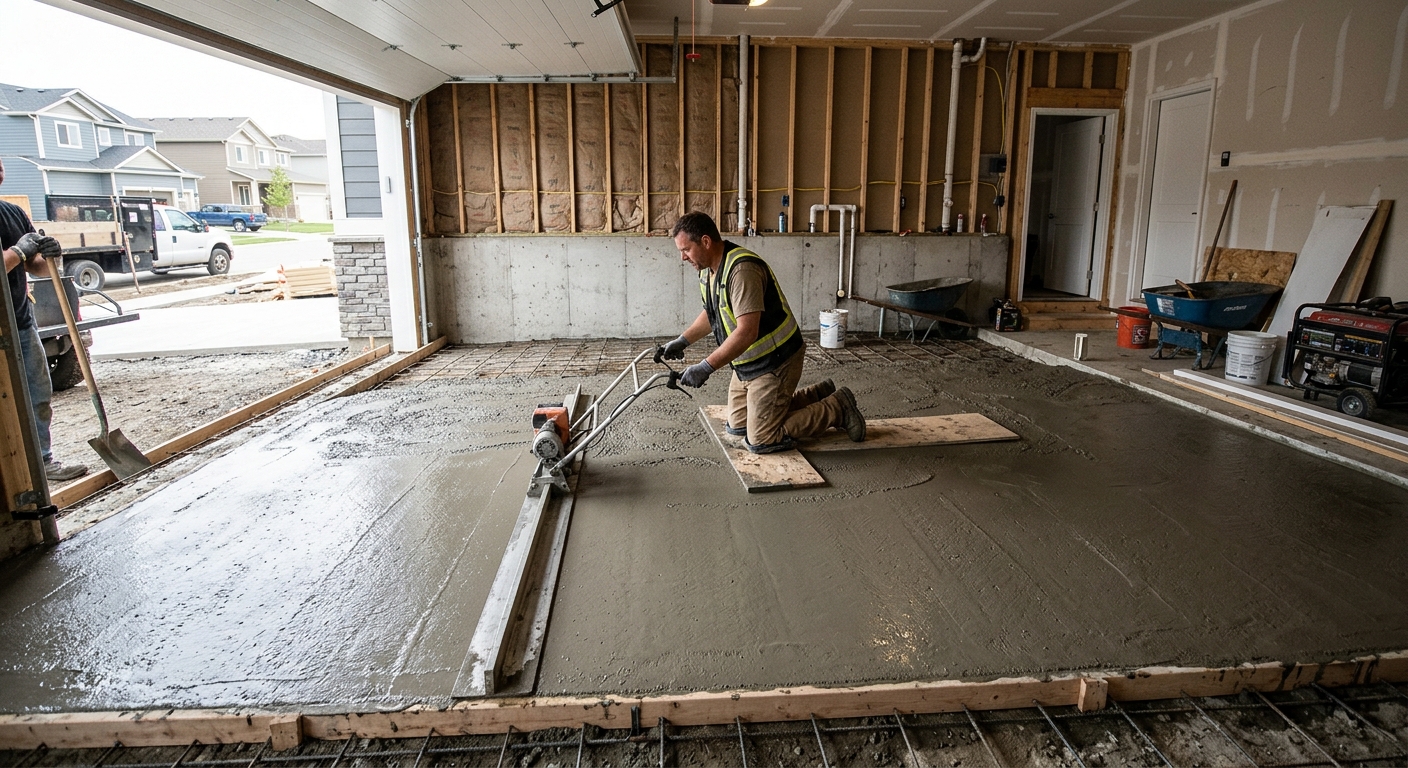
| Garage floor (interior slab) |
300–600 sq. ft. |
Vapour barrier; minimum thickness per design; mesh/reinforcement as needed |
Powder/steel trowel finish |
$12,000–$22,000 |
| Foundation footings (structural, below frost) |
Per footing system / typical 1–2 storey home |
Excavate below design frost depth; structural rebar; concrete below frost line |
Reinforced structural concrete |
$200,000–$350,000 |
Prices are estimates only and vary by project scope, site access and material selection.
What affects the price of concrete work in East Clayton
In East Clayton and across the Lower Mainland–Southwest, it’s common to see quotes for the “same” concrete job land 30–50% apart. The gap usually isn’t profit—it’s the hidden cost drivers: excavation depth, base design, reinforcement requirements, mix specifications (especially air-entrainment), and how contractors handle curing in cool, wet conditions.
Frost line depth and freeze–thaw cycles dictate many specs in British Columbia. Even with a shallower frost line than much of Canada, local practice still targets a frost depth around 450 mm / 18", and footings must extend below the design frost depth to prevent frost heave. All exterior slabs typically require air-entrained concrete mixes so the surface can resist scaling and freeze–thaw deterioration. Colder regions can increase costs due to shorter pour seasons and the need for heating/insulating blankets, but in the Lower Mainland–Southwest the winter challenge is often more about prolonged dampness, cool nights, and scheduling around rain—leading to added labour time for protection and longer curing.
Two simple examples in East Clayton: (1) if your site needs deeper, wider excavation to reach stable soil or add proper granular drainage, you’ll pay more for forming and hauling; (2) if your driveway or patio is near a downspout line or sits in a low spot, proper subgrade drainage and base thickness can cost more upfront, but it reduces premature cracking and trip hazards. You’ll also notice finish pricing: standard broom driveway work tends to sit around $18,000–$28,000, while stamped options commonly move into $22,000–$36,000 because of labour intensity, pattern control, and sealing.
| Price Factor |
Why It Matters |
Cost Impact |
| Frost line depth — determines footing depth and form height |
Footings and thickened edges must sit below design frost depth to avoid heave. |
More excavation and concrete volume; higher forming labour |
| Site preparation — excavation, grading, compacted granular base |
Weak subgrade and poor drainage lead to settlement and early cracking. |
Can add significant truck/haul and base material costs |
| Reinforcement — rebar or wire mesh requirement |
Controls crack width and improves structural performance where required. |
Material + labour for tying/positioning; may increase slab thickness |
| Mix design — air-entrainment and compressive strength spec |
Exterior freeze–thaw durability depends on air entrainment and minimum strength. |
Higher material cost; more careful batching/spec compliance |
| Finish type — broom vs. stamped vs. exposed aggregate |
Finishes require different labour, tools, and sealing timelines. |
Stamped/exposed typically costs more than broom-finished concrete |
| Pour size and concrete truck access to site |
Small restricted sites can require more staging time and pumps/short lifts. |
Access can add labour and equipment charges |
| Cold-weather curing precautions — heating and blankets |
Protects against early freezing and ensures design strength gain. |
Additional labour and materials for thermal protection |
| Control joint pattern and sealing cost |
Joints limit random cracking; sealing improves resistance to salts and water ingress. |
Extra saw-cut/plan time and sealer/product cost |
Permits & regulations in British Columbia
In British Columbia, the permitting approach depends on whether you’re changing structure and site drainage, versus adding flatwork. Structural concrete work—such as footings, foundation walls, and grade beams—generally requires a building permit and, in many cases, engineered drawings that the municipality reviews. For concrete flatwork (patios, walkways, and many driveways), a permit is often not required unless the work affects lot grading, connections to drainage, impervious surface coverage limits, or the municipal right-of-way.
Before you schedule excavation in East Clayton, confirm with the local authority. Also ensure your contractor carries proper liability insurance and has the appropriate WCB coverage. For concrete crews, this matters because freeze–thaw and wet-weather scheduling can increase site hazards (slips, heavy deliveries, and longer workdays).
Step-by-step for a homeowner: (1) Ask for the contractor’s business details and proof of insurance; (2) Verify the licence/registration for the firm and/or lead worker using the BC online registry channels (start with the contractor’s own licence number and name); (3) Request a current certificate of insurance showing liability limits suitable for construction work; (4) Ask for evidence of WCB coverage; and (5) Get references for similar-scale East Clayton jobs and confirm they handled any required engineered foundation work.
Getting concrete right in East Clayton's freeze-thaw climate
In East Clayton, concrete most often fails when water gets into the slab and the freeze–thaw cycle turns that water into expansion forces. That shows up as surface scaling, spalling around edges and joints, and widening cracks. The cure is specification discipline: build a solid base, use the right mix for the exterior environment, control cracking with joints, and protect curing long enough for the concrete to reach strength. Because Lower Mainland–Southwest weather can swing quickly—cool nights, coastal humidity, and driving rain—contractors need a plan for curing continuity, not just a “pour and go” approach.
To spec the job correctly: start with base preparation using compacted granular at the correct depth for local soil and frost protection, then order air-entrained concrete (commonly 5–7% air content for exterior flatwork) and a minimum 32 MPa compressive strength when designed/required. Add control joints at spacing that limits random cracking, and schedule saw-cutting and joint sealing so joints don’t become the water entry point. Curing should be at least 7 days under proper conditions, with extra protection (curing blankets or other measures) in cold or damp stretches. Finally, apply a penetrating sealer after cure—typically around 28 days post-pour—so de-icing salts and rainfall don’t quickly degrade the surface.
Ask specifically about spalling prevention. If a contractor suggests a non–air-entrained mix on an exterior driveway, that’s a major red flag in British Columbia’s coastal-wet freeze–thaw conditions. A dollar example: a broom-finished driveway may fall near $18,000–$28,000, while a stamped driveway at $22,000–$36,000 includes extra labour and sealing—worth it for appearance, but it’s only durable if the underlying mix and joints are specified correctly.
| Spec |
Why It Matters in East Clayton |
What to Ask For |
Impact if Skipped |
| Compacted granular base (depth?) |
Stable, drained support reduces settlement and helps manage frost effects. |
Confirm base depth, granular type, and compaction requirements for your soil |
Cracking, uneven slab, early edge failure |
| Air-entrained concrete mix (target air %?) |
Freeze–thaw durability depends on microscopic air voids to relieve internal pressure. |
Target 5–7% air for exterior flatwork (per mix design) |
Higher risk of scaling and spalling in winter |
| Compressive strength (MPa rating) |
Strength gain supports durability and reduces surface breakdown. |
Minimum 32 MPa (or project-required spec) |
Surface wear, reduced long-term performance |
| Control joints (spacing per ACI guidelines) |
Joints control where cracking happens when concrete shrinks/expands. |
Joint spacing and timing plan (saw-cut schedule) |
Random cracking and water intrusion |
| Minimum 7-day curing period |
Cold, wet weather can slow strength gain if curing protection isn’t used. |
How curing will be maintained for at least 7 days |
Lower strength and higher scaling/spalling risk |
| Penetrating sealer (when applied after cure) |
Repels water and helps resist salt exposure and staining. |
Application about 28 days after pour (once fully cured) |
Faster water/salt penetration and surface deterioration |
How to choose a concrete work contractor in East Clayton
When you hire concrete contractors in East Clayton, verify credentials before you compare prices. In British Columbia, ask for proof of the business licence/registration (use the number the contractor provides to verify it on the appropriate BC registry channels), and request a current certificate of insurance showing liability coverage that matches construction activities. Then confirm WCB/WCB coverage—don’t accept verbal assurances. For contractor selection, ask for references for similar jobs (driveways and exterior slabs) in the Surrey–Abbotsford corridor so you’re matching local soil, drainage practices, and curing scheduling.
Next, get 2–3 itemised written quotes. You want a breakdown that separates labour and materials—especially excavation/base prep, reinforcement (mesh/rebar), concrete supply, finishing, joint cutting, and sealing. Avoid “lump sum” quotes that don’t say what’s included for disposal, protection of landscaping, saw-cutting, and curing measures in cool, rainy stretches.
Warranty matters: request a workmanship warranty length in writing and clarify product/manufacturer warranty coverage, plus whether it transfers if you sell the home. Payment scheduling should be conservative—never pay more than 10–15% upfront; use a holdback until key milestones are complete (base ready, pour completed, cure/sealing completed). Finally, get a start date and completion estimate in writing so wet-weather delays don’t turn into cost overruns.
- Ask for a site visit and written base/prep plan (not just “we’ll pour”)
- Confirm air-entrained mix and exterior freeze–thaw suitability
- Request joint spacing and a saw-cut schedule
- Ensure reinforcement approach is specified (mesh/rebar where needed)
- Ask who controls curing (blankets, sealers, and minimum cure timing)
- Check whether excavation includes removal/disposal of unsuitable material
- Verify truck access and how they handle restricted lanes
- Confirm sealing type and when it’s applied (after cure)
- Get concrete delivery and slump/quality checks described in the quote
- Make sure drawings/scope specify thickness and edge details
- Use an itemised quote with labour + materials line items
- Confirm warranty terms and what’s excluded (e.g., salt use, drainage issues)
Concrete red flags in East Clayton: contractors who won’t discuss air-entrainment for exterior slabs, quotes that omit joint spacing and sealing, refusing to show proof of liability insurance or WCB coverage, minimizing base prep (or skipping granular compaction), and pushing full payment upfront without milestones or a written warranty.
Frequently asked questions — concrete work in East Clayton
Can concrete be poured in cold weather in East Clayton?
Yes, concrete can be poured in cold weather in East Clayton, but only with the right cold-weather curing precautions. In the Lower Mainland–Southwest, you can still get periods of cool nights and damp conditions that slow strength gain. A competent contractor will protect the slab during and after the pour using methods like curing blankets, insulation, and temperature management so the concrete reaches its target strength and doesn’t freeze early. If a contractor is vague about curing (for example, “we’ll just pour and it’ll be fine”), that’s a warning sign. For exterior flatwork, you also need air-entrainment so freeze–thaw durability doesn’t suffer later—especially when rain and temperature swings are common.
How do I maintain concrete in East Clayton's freeze-thaw climate?
Maintenance in British Columbia comes down to keeping water and salts from attacking the surface. Start with basic drainage: don’t let downspouts dump directly onto a driveway edge; ensure grading sheds water away from the slab. Plan to have a penetrating sealer applied after the concrete has fully cured—often around 28 days—so the surface repels moisture and reduces salt penetration. In winter, limit de-icing salt where possible and use it carefully; excess salt can accelerate surface deterioration. If you notice small cracks at joints, keeping those joints properly sealed helps prevent water entry. When maintained this way, exterior slabs that were built to spec (air-entrained mix, correct base, control joints) typically last longer and look better.
What causes concrete to spall in East Clayton winters?
Spalling is usually a freeze–thaw and moisture problem. Water enters the slab—often through poorly protected joints or weak surfaces—then expands when temperatures drop, breaking off outer concrete. The most common technical cause is inadequate air-entrainment for exterior exposure; without the proper air void system, freeze–thaw forces damage the surface. Another factor is inadequate base preparation or poor drainage, which allows water to remain under or at the edges. Improper curing in cool, wet periods can also reduce durability. In East Clayton, where coastal rainfall and temperature swings happen in close succession, slabs that weren’t built with air-entrained concrete and a sealing plan are more likely to show scaling and spalling sooner.
What is rebar and when is it required in British Columbia?
Rebar (reinforcing steel) is used to help control cracking and improve the performance of structural concrete. In British Columbia, whether rebar is required depends on the engineered design, slab thickness, soil conditions, and loading (for example, a garage floor or a foundation system). For structural elements like footings and foundation walls, rebar is typically specified by design documents and is tied to code requirements and engineering. For exterior flatwork such as patios and walkways, some projects need mesh or rebar while others can rely on properly designed base prep and thickness—still, the spec should be stated in the quote. If a contractor gives you no thickness and no reinforcement plan, ask directly; you should be able to see how the design is meeting durability and load needs.
How long does a concrete project take in East Clayton?
Timelines vary by size, access, and weather, but most concrete flatwork in East Clayton involves distinct steps: excavation and base compaction (often 1–3 days), forming (often 1 day), the pour day (typically 1 day), and curing/protection afterward. Finishes like stamped concrete add time for placement, stamping, and careful handling. While the slab may be “walkable” sooner, contractors should still plan curing—minimum 7 days under proper conditions is a common benchmark—before you apply heavy use. For projects that require sealing, allow time after cure for sealer installation, often around 28 days. If your quote is priced near $16,000–$26,000 for a patio, expect a faster schedule than something that includes structural work; foundation-related scope is more involved and usually stretches longer due to inspections and engineered steps.
What is a concrete overlay and is it suited to East Clayton?
A concrete overlay is typically a new cementitious layer placed over an existing concrete slab to improve appearance or restore function. It can be suited to East Clayton when the existing base is still structurally sound and the surface preparation is done correctly (grinding/scarifying, proper bonding system, and drainage considerations). However, overlays aren’t a fix for deep structural issues, failed drainage, or widespread cracking that points to settlement or frost-related movement. In British Columbia’s freeze–thaw climate, a poorly prepared substrate can lead to early delamination. If your driveway or patio has spalling and failing joints, you may be better with removal and replacement rather than overlay. Before choosing, ask for an assessment of subgrade stability, joint condition, and whether air-entrained mix and correct thickness are planned for durability.