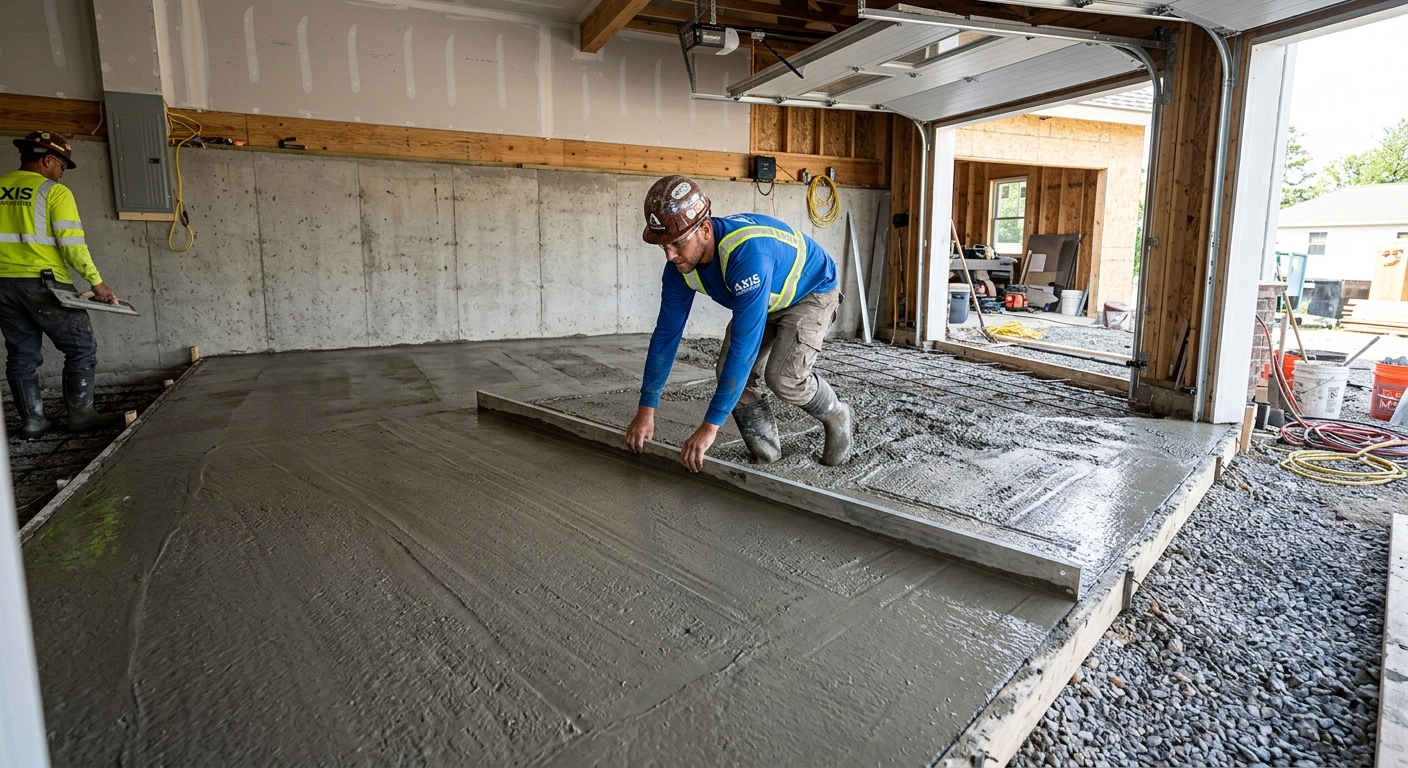
Concrete work options and costs in Shawnigan Lake
Concrete work in Shawnigan Lake tends to move with the Lower Mainland–Southwest market: even when two homes have similar lot sizes, the cost can shift based on access, soil conditions, and how much freeze–thaw protection the design needs. With a population of 3,908 (Statistics Canada, 2021 Census), our market is smaller than the core Vancouver areas, so scheduling and crew availability can matter—especially around wet weeks when curing is slower. Most concrete flatwork demand here comes from single-detached neighbourhoods where driveways, patios, and entry walks are common upgrades; that housing pattern is typical in the region (Statistics Canada, 2021 Census).
In the Lower Mainland–Southwest, winters are mild but the shallow frost depth still drives specs: practice typically assumes a frost depth around 450 mm / 18", so footings, thickened edges, and structural elements must be placed below that to reduce frost heave risk. Coastal-wet conditions also mean base drainage, air-entrained concrete, and longer curing support (blankets/sealers) are built into the job. That’s why you’ll see local estimates cluster into the same budget bands—driveways often land in the $18–$28 per square foot range, while patios/walkways commonly fall near $16–$26—then adjust for site prep, reinforcement, and finish.
If you’re in high-demand pockets like the Shawnigan Lake Village area, you’ll often see tighter access (trucks, forms, and staging) which can affect labour time. Below is a quick comparison of typical options so you can translate contractor quotes into a like-for-like scope.
| Application |
Typical Size |
Key Spec |
Finish Option |
Price Range |
| Concrete driveway (standard broom finish) |
400–600 sq. ft. |
Air-entrained mix, compacted granular base, control joints |
Broom finish |
$7,200–$14,500 |
| Exposed aggregate driveway |
400–600 sq. ft. |
Air-entrained mix, proper curing window, drainage-friendly base |
Exposed aggregate |
$10,000–$18,500 |
| Stamped concrete driveway or patio |
300–600 sq. ft. |
Air-entrained mix, stamping set, sealer plan |
Stamped (pattern + colour) |
$9,000–$22,000 |
| Plain concrete patio or walkway |
200–400 sq. ft. |
Air-entrained mix, compacted base, joints as needed |
Float + light broom |
$3,200–$9,000 |
| Garage floor (interior slab) |
300–500 sq. ft. |
Vapour barrier (if spec’d), reinforcement, proper slab thickness |
Plain trowel/finish |
$7,500–$16,500 |
| Foundation footings (structural, below frost) |
Varies by house |
Below design frost, engineered details, reinforcement |
Structural concrete |
$6,500–$18,000 |
Prices are estimates only and vary by project scope, site access and material selection.
What affects the price of concrete work in Shawnigan Lake
In the Lower Mainland–Southwest and across British Columbia, two quotes for the “same” concrete job can differ by 30–50% because the scope is rarely identical: base prep depth, drainage work, reinforcement, mix design, and finishing time are the big swing factors. A driveway that’s priced like a simple slab may quietly exclude haul, excavation to firm subgrade, or the granular base thickness needed for our wet coastal soils. In other parts of BC with deeper frost and colder schedules, contractors also add cold-weather precautions—heating, insulating blankets, and longer curing—so labour and materials shift too.
Here in Shawnigan Lake, footings and thickened edges must be set below the design frost depth (practice often references ~450 mm / 18"), and freeze–thaw cycles make exterior slabs sensitive to scaling and spalling. That’s why air-entrained concrete is typically non-negotiable for driveways, patios, and walkways. When crews pour in cooler, damp stretches, they often need curing blankets and protective measures; that’s additional labour and equipment rental. Also, once you start using de-icing salts, a good sealer plan becomes part of protecting the surface—again, not always included in cheaper bids.
To see how this plays out in dollars: upgrading from plain broom-finish to stamped concrete often moves a driveway or patio into the $22–$36 per square foot neighbourhood, but the higher cost can be justified if the quote also includes a proper base, air-entrained mix, and a real sealer schedule. On the flip side, a basic patio might only need to land around $16–$26 per square foot—if the contractor doesn’t overbuild the foundation-level base or add unnecessary reinforcement.
| Price Factor |
Why It Matters |
Cost Impact |
| Frost line depth — determines footing depth and form height |
Footings must extend below the design frost to prevent frost heave |
Higher excavation and forming time |
| Site preparation — excavation, grading, compacted granular base |
Wet/coastal soils require the right base depth and drainage strategy |
Often the biggest variable cost |
| Reinforcement — rebar or wire mesh requirement |
Controls cracking in driveways/slabs based on thickness and design |
Labour + steel/material price increase |
| Mix design — air-entrainment and compressive strength spec |
Air-entrainment helps durability through freeze–thaw cycling |
Material premium; usually essential outdoors |
| Finish type — broom vs. stamped vs. exposed aggregate |
More finishing steps and curing/sealer coordination |
Stamped/exposed typically cost more |
| Pour size and concrete truck access to site |
Limited access can add labour for wheelbarrows/laser set-up |
Extra crew time and potential equipment charges |
| Cold-weather curing precautions — heating and blankets |
Protects early strength gain in cool, damp conditions |
Heating/blanket rental + additional monitoring |
| Control joint pattern and sealing cost |
Joints reduce random cracking; sealing helps against de-icing salts |
Small line item that prevents costly call-backs |
Permits & regulations in British Columbia
In British Columbia, concrete work falls into two broad buckets: structural concrete typically requires a building permit, while most exterior flatwork is usually exempt unless it changes drainage, grading, or site coverage limits. For Shawnigan Lake homeowners, that means you should expect a permit for foundation walls, grade beams, footings, and other structural elements—especially when the drawings are engineered and tied to the foundation system for a new build or major structural alteration. You generally do not need a permit for typical patios, driveways, and walkways, provided the work stays within normal lot grading and does not impact municipal requirements for impervious surface coverage or right-of-way conditions.
Before work starts, your best approach is step-by-step:
- Ask the contractor what permits (if any) are required for your specific scope and whether they will handle the permit submission.
- Verify the contractor carries liability insurance (request a current certificate of insurance).
- Confirm coverage for workplace injury protection as applicable (contractors should be set up for their workforce; your contractor should provide proof/clearance documentation or the information needed to verify it).
- Request references from similar-scale jobs in the Shawnigan Lake area (driveways, patios, or foundation-related concrete).
- Confirm start date, pour schedule, and weather plan in writing—BC rain and cool nights can affect curing requirements.
To verify in practice, look for a public licence/registration listing where your contractor is registered, then match it to their certificate of insurance and any coverage/clearance letter they provide. If they can’t supply current documents or references, treat that as a red flag before you sign.
Getting concrete right in Shawnigan Lake's freeze-thaw climate
Concrete failures in Shawnigan Lake are usually linked to three things: water management, the right concrete mix, and curing. Even with mild winters, Lower Mainland–Southwest freeze–thaw cycles and saturated soils can drive scaling and spalling if the mix isn’t properly air-entrained or if the base is poorly prepared. The fix starts at the ground level: build a compacted granular sub-base to the correct depth for local soil and to support the slab without settlement. Next, specify a mix with air-entrainment and a minimum compressive strength so the concrete reaches design durability before it sees repeated wetting/cooling.
For exterior flatwork, control joints matter just as much as the finish. Joints should be planned to limit random cracking—especially on driveways and patios where temperature swings expand and contract the slab. Curing is another common gap: in damp, cool BC conditions, rushing curing can leave the surface weak, which increases abrasion and freeze–thaw damage. Finally, add a penetrating sealer after the concrete has properly cured (commonly 28 days) to repel de-icing salts and reduce moisture ingress.
Here’s a practical example of where cost is (or isn’t) justified. If you compare a broom-finish driveway to stamped concrete, you may see the stamped option come in higher—often aligning with the $22–$36 per square foot range for decorative work. That premium is worth it only if your quote still includes correct base prep, air-entrained concrete, control joints, and proper curing/sealing. A cheap stamped quote that cuts corners on mix or curing can cost more later through surface deterioration and early spalling.
| Spec |
Why It Matters in Shawnigan Lake |
What to Ask For |
Impact if Skipped |
| Compacted granular base (depth?) |
Supports the slab and helps drainage in wet coastal soils |
Base thickness and subgrade proof/compaction method |
Settlement, cracking, and premature surface failures |
| Air-entrained concrete mix (target air %?) |
Improves freeze–thaw durability in exterior concrete |
Minimum air content for exterior flatwork (commonly 5–7% air) |
Spalling/scaling from inadequate freeze–thaw resistance |
| Compressive strength (MPa rating) |
Ensures durability and strength gain for service conditions |
Minimum 32 MPa specified for exterior flatwork (or per engineer/design) |
Low strength leads to cracking and surface wear |
| Control joints (spacing per ACI guidelines) |
Controls crack locations under thermal movement |
Joint spacing plan and timing (saw-cut vs. formed) |
Random cracks and water pathways |
| Minimum 7-day curing period |
Cold/wet periods require reliable early strength development |
How curing will be protected (blankets, moisture curing) in BC conditions |
Weaker concrete and higher risk of scaling/spalling |
| Penetrating sealer (when applied after cure) |
Reduces moisture/salt penetration from de-icing and rainfall |
Sealer type and application date (commonly after full cure, ~28 days) |
Faster deterioration and staining |
How to choose a concrete work contractor in Shawnigan Lake
Choosing the right concrete contractor in Shawnigan Lake comes down to verification, scope clarity, and scheduling realism for our BC climate. Start by confirming the contractor can legally and financially stand behind the work: in British Columbia they should provide proof of liability insurance (certificate of insurance), and they should have the required workforce injury coverage arrangements for their operations. Ask for current documents before the quote is finalized, not after. For licensing verification, use the appropriate public registry tools for registered contractors in BC, then confirm the details match the company name on the insurance certificate and the written quote.
Next, get 2–3 itemised written quotes, ideally broken into labour and materials so you can compare base prep depth, reinforcement, concrete mix specs, finishing time (broom vs. exposed vs. stamped), and sealing/curing inclusions. Make sure the scope clearly states what’s included and excluded: is demolition included? Is disposal of concrete included? Is permit handling included where required (structural/foundation work)? What about rebar tie-in, drainage adjustments, and forms for thickened edges? A quote that’s missing these details often results in change orders that push your final cost beyond the original price band.
Finally, look at warranty and payment terms. A workmanship warranty should be in writing with a clear duration and what it covers. Payment schedules should be conservative—never more than about 10–15% upfront; hold back a portion until the job is complete and cured appropriately. Timeline matters too: request a start date, pour date target, and completion estimate in writing, along with how they’ll handle rain and cool nights typical in Shawnigan Lake.
- Ask for proof of liability insurance (current certificate) before signing.
- Confirm workforce injury coverage arrangements and request the contractor’s clearance documentation or verification method.
- Verify registration/licence status in BC using public search tools, then match company name to documents.
- Get 2–3 itemised quotes (labour + materials), not one lump number.
- Ensure base prep scope includes excavation/grading and compacted granular base depth.
- Require the concrete mix spec (air-entrainment for exterior, strength rating) in the quote.
- Confirm reinforcement plan (mesh/rebar) and slab thickness where applicable.
- Check whether control joints and sealing are included and what standard they follow.
- Ask how they handle rain/cool nights and what curing measures they’ll use.
- Confirm disposal of concrete/debris is included or priced separately.
- Review warranty length and workmanship coverage details in writing.
- Use a conservative payment schedule: small deposit, then progress payments with holdback.
Concrete red flags specific to Shawnigan Lake include: promises of “no joints” or “no need for air-entrainment,” skipping base prep depth/compaction details, vague curing plans during wet stretches, quotes that don’t mention sealing timing after cure, and contractors requesting large upfront payments without a signed scope and schedule.
Frequently asked questions — concrete work in Shawnigan Lake
Do I need a permit for concrete work in British Columbia?
In British Columbia, structural concrete typically requires a building permit. That includes footings, foundation walls, grade beams, and other load-bearing structural elements, especially when engineered drawings are involved. For most Shawnigan Lake homeowners, a permit is usually not required for typical exterior flatwork like driveways, patios, and walkways—unless your project changes lot grading/drainage, affects municipal requirements for impervious surface coverage, or touches right-of-way conditions. The safest approach is to ask the contractor what category your scope falls under and confirm with the municipality before breaking ground. Also verify the contractor’s documentation (liability insurance and coverage) so you’re protected if something goes wrong during excavation or placement.
Concrete vs pavers for a patio in Shawnigan Lake?
Concrete and pavers can both work well in Shawnigan Lake, but they respond differently to our coastal-wet weather and freeze–thaw cycling. Concrete patios are typically more straightforward to build with a uniform slab, and they can be durable when you use an air-entrained mix and proper base prep. If you want a decorative look, stamped concrete can mimic stone patterns, often landing in the higher decorative band (commonly in the $22–$36 stamped range). Pavers can offer easier localized repairs if a small section shifts, and they let you fine-tune drainage. The trade-off is that paver installation often takes longer for labour, and weeds/settlement can appear if the base is not built correctly. If you’re comparing quotes, focus less on “material name” and more on the base depth, drainage layer, joint strategy, and curing/sealing plan.
How long does a concrete driveway last?
A well-built concrete driveway in British Columbia often lasts decades, but the lifespan depends on the build quality and your maintenance habits. In Shawnigan Lake’s freeze–thaw climate, the biggest drivers are air-entrainment, good drainage beneath the slab, correct base preparation, and a control joint plan that limits random cracking. Surface sealing also matters because de-icing salts and wet rainfall can accelerate scaling without protection. In realistic homeowner terms, a standard broom-finish driveway might typically be expected to perform for 20+ years before major resurfacing is needed—if it was poured in suitable conditions with proper curing and is sealed as recommended. If you see early spalling or widespread cracking, that usually indicates inadequate mix (lack of air), rushed curing, or base/subgrade issues rather than “just bad luck.”
What is air-entrained concrete and why does it matter here?
Air-entrained concrete includes microscopic air bubbles in the mix that act like pressure relief valves when water in the concrete freezes. In Shawnigan Lake and across the Lower Mainland–Southwest, even though winters are mild, freeze–thaw cycling plus coastal rainfall can repeatedly saturate exterior slabs. Without air-entrainment, the freeze–thaw action can cause scaling and spalling—flaking at the surface that you often notice after the first couple of harsh seasons. For exterior flatwork, contractors typically target around 5–7% air content (project specs can vary), and they should specify a minimum strength (commonly 32 MPa for exterior work). When you compare quotes, ask for the mix spec in writing—not just “concrete is air entrained.” This is one of the most important protections to avoid early failure.
How do I prepare the base for a concrete slab?
Concrete base prep is where good driveways and patios are won or lost. For Shawnigan Lake, you want excavation to stable subgrade, followed by a properly graded and compacted granular base that supports the slab and allows drainage under the concrete. The contractor should confirm base depth and compaction approach based on your soil conditions and the slab thickness. In our coastal-wet environment, poor drainage or insufficient compacted granular can lead to settlement and cracking later, even if the finish looks good on day one. Ask how they’ll handle soft spots, whether they’ll proof-roll or rework questionable subgrade, and what granular layers they’re placing. If you’re budgeting, remember that base prep is often part of why a driveway can land anywhere from the typical $18–$28 per square foot band—cheaper quotes may simply be under-building the base.
How do I compare concrete quotes?
To compare concrete quotes in British Columbia, treat each estimate like a scope checklist, not just a total price. Ask for itemised labour + materials, and confirm whether the quote includes excavation, compacted granular base, reinforcement (mesh/rebar if required), concrete mix specs (air-entrainment and strength), control joints, and curing protection for cool/wet periods. Then compare finishing and protection: broom finish versus stamped or exposed aggregate changes labour and material steps, and sealing after cure is a real durability cost. For example, stamped decorative concrete often sits above standard work—commonly aligning with the $22–$36 stamped range—while plain patio/walkway work more often fits the $16–$26 band when base prep and air-entrained mix are both included. Finally, review exclusions: demolition, disposal, permit handling (when required), and truck access delays. A lower quote that omits base depth, reinforcement, or air-entrainment can cost more once you repair cracking or surface spalling.