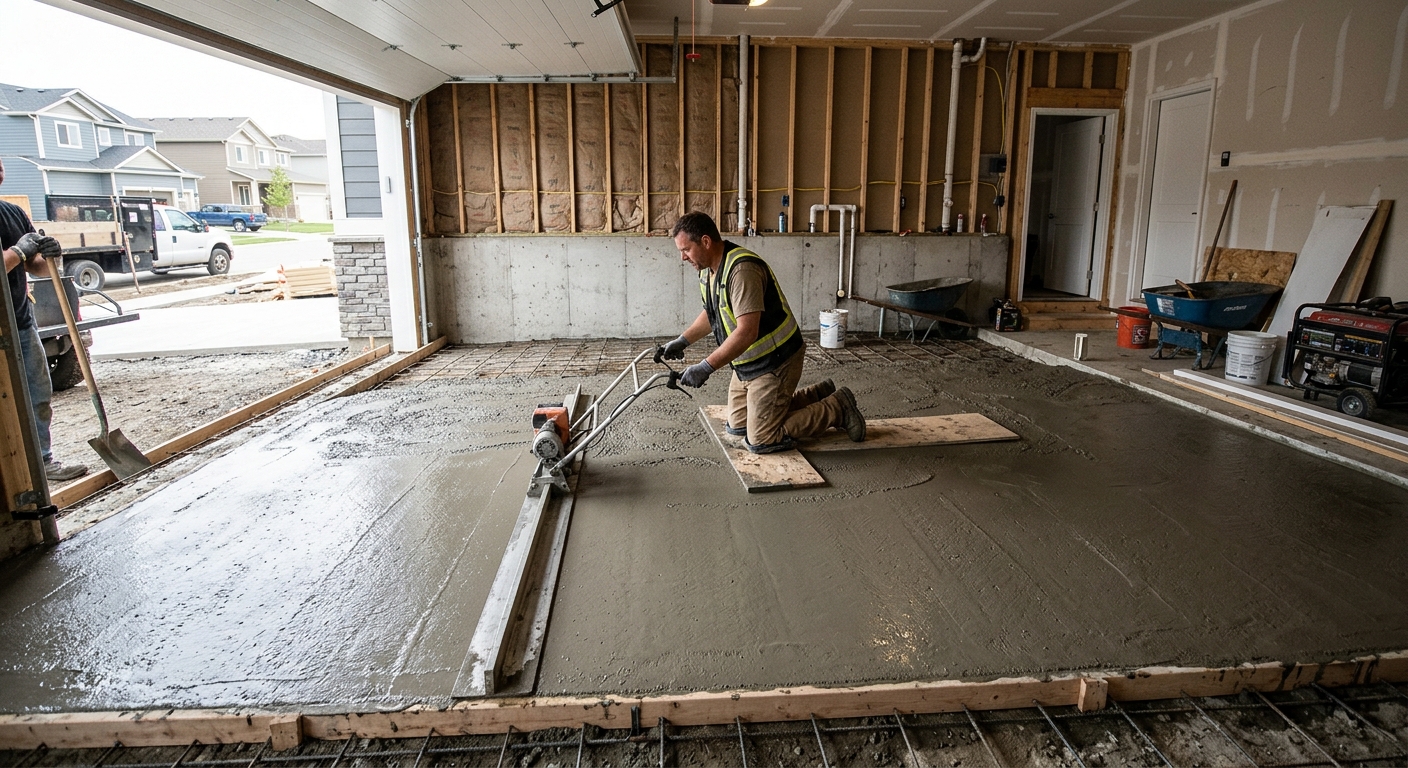
Concrete work options and costs in Lynnmour
Concrete in Lynnmour is a practical choice for homeowners who want a hardwearing surface that can handle British Columbia’s coastal-wet weather and the region’s freeze–thaw cycles. In Lynnmour, the market is largely residential, and the most common concrete flatwork requests typically come from single-family neighbourhoods—an important driver for driveway, patio and walkway demand in the Lower Mainland–Southwest. Lynnmour’s population was 2,265 in the 2021 Census (Statistics Canada, 2021 Census), which helps keep local crews busy but also means availability can tighten during spring and early fall when weather windows are best.
Although frost depth is generally shallower in coastal BC than in much of Canada, local concrete specs still assume a design frost depth around 450 mm / 18". That means footings, thickened edges and any structural elements must be placed below the frost line to reduce the risk of freeze heave and cracking. At the same time, frequent wet weather affects scheduling and curing—cool nights, high humidity and rain can slow set-up, so contractors often plan for longer curing and use protection (like blankets) when conditions aren’t ideal. Expect pricing to reflect robust base prep (compacted granular plus good drainage), air-entrained mixes, and careful jointing for exterior slabs.
In Lynnmour, demand tends to spike around the Seymour area where more residents are updating driveways and adding small patios for rear-yard living spaces. Below is a practical comparison of common options so you can line up your quote with the specs that matter.
| Application |
Typical Size |
Key Spec |
Finish Option |
Price Range |
| Concrete driveway (standard broom finish) |
400 sq. ft. |
Air-entrained mix, compacted granular base, control joints |
Broom finish + sealer |
$7,200–$11,200 |
| Exposed aggregate driveway |
400 sq. ft. |
Vibrated/controlled mix, proper curing and wash scheduling |
Exposed aggregate finish |
$9,200–$14,800 |
| Stamped concrete driveway or patio |
250 sq. ft. |
Reinforcement + air-entrained mix for exterior durability |
Stamp pattern + release + color hardener |
$6,000–$9,000 |
| Plain concrete patio or walkway |
200 sq. ft. |
Compacted base, jointing, air-entrained mix |
Float/finish + light broom texture |
$3,200–$5,200 |
| Garage floor (interior slab) |
480 sq. ft. |
Vapour barrier (if required), reinforcement, control joints |
Broom or smooth-trowel (non-slip as needed) |
$7,500–$13,000 |
| Foundation footings (structural, below frost) |
Varies by home design |
Engineered footing depth below design frost, rebar placement |
Structural concrete |
$200–$350 |
Prices are estimates only and vary by project scope, site access and material selection.
What affects the price of concrete work in Lynnmour
In the Lower Mainland–Southwest, you can see price spreads of 30–50% for the same “basic” concrete job because the quote is really about the hidden infrastructure: excavation, base compaction, reinforcement, mix design, curing protection and finishing labour. Even within British Columbia, colder regions typically require deeper excavation and more cold-weather precautions than Lynnmour, so contractors’ costs—and their bids—shift with frost depth assumptions, access constraints and seasonal timing.
Frost line depth and freeze–thaw cycles dictate every spec here. In practical terms, footings must extend below the design frost depth (commonly around 450 mm / 18" in coastal BC practice), and exterior slabs generally need air-entrained concrete so they can survive repeated wetting and thawing without scaling or spalling. When conditions are colder and pours are delayed, crews may need insulating blankets, heaters or slower scheduling to protect the concrete until it reaches safe strength—those add labour and equipment costs. Another big factor in Lynnmour is de-icing salt: salt can accelerate surface deterioration, so sealing becomes less optional for driveways and steps near entryways.
Here are a few examples of how local conditions change the number on your quote. First, if your soil is saturated or drains poorly, base prep costs rise because contractors need extra granular, better drainage and more careful grading before placing concrete. Second, switching from plain broom finish to exposed aggregate or stamped work increases material and labour—stamped & decorative concrete commonly lands around $22–$36 per sq. ft. compared with simpler driveway pricing around $18–$28 per sq. ft., so the upgrade is usually justified when you want curb appeal and can budget for a more time-intensive finish. Third, older housing stock may have tighter lot lines and more overhead obstructions, which can raise truck access and forming time.
| Price Factor |
Why It Matters |
Cost Impact |
| Frost line depth — determines footing depth and form height |
Deeper, below-frost excavation/forming prevents frost heave and structural movement |
Higher excavation and more concrete/rebar per linear foot |
| Site preparation — excavation, grading, compacted granular base |
Proper subgrade and drainage reduce settlement and reduce early cracking |
Extra labour and granular/rock hauling if conditions are soft or wet |
| Reinforcement — rebar or wire mesh requirement |
Controls shrinkage/temperature cracking and supports heavier loads |
Materials plus tying/lifting time; cost rises with thicker slabs |
| Mix design — air-entrainment and compressive strength spec |
Exterior durability depends on air-entrainment and meeting strength targets |
Higher cement/mix spec and tighter quality control |
| Finish type — broom vs. stamped vs. exposed aggregate |
Decorative finishes add stamps, release agents, washing, sealing and cure timing |
More skilled labour and longer schedules |
| Pour size and concrete truck access to site |
Small sites may require pumps/chutes or more set-up time |
Mobilization and labour increase; per-sq.-ft. cost can jump |
| Cold-weather curing precautions — heating and blankets |
Protection ensures proper strength gain even when nights cool down |
Equipment rentals and additional labour days |
| Control joint pattern and sealing cost |
Jointing reduces random cracking; sealer improves resistance to salts and staining |
Lower risk of premature failures; adds materials and application labour |
Permits & regulations in British Columbia
In British Columbia, the permit and plan-review requirement usually depends on whether the concrete work affects structure or drainage/lot servicing. Structural concrete work—typically footings, foundation walls, grade beams and engineered foundation elements—requires a building permit and often engineered drawings reviewed by the municipality. Concrete flatwork such as patios, walkways and driveways usually does not require a permit, unless it changes drainage patterns, impacts lot grading, triggers impervious surface coverage limits, or affects municipal right-of-way/sidewalk areas. The safest approach is to confirm directly with the local authority before breaking ground.
For a homeowner in Lynnmour, verifying a contractor starts with documents, not promises. First, ask for their certificate of insurance (liability) and make sure it lists you as an additional insured if appropriate for the scope. Second, confirm they carry WSIB/WCB coverage (as applicable to their work—many trades in BC will be registered through WCB systems). Third, request proof they are legally permitted to do the kind of concrete work they’re proposing (e.g., any applicable contractor registration and jobsite authority through their trade designation).
Where to look: check the provincial/national contractor registry information online for the business name, ask the contractor for a current clearance letter or coverage confirmation, and verify the insurance policy dates on the certificate of insurance. Finally, insist on references for projects similar in size and exterior exposure—coastal-wet flatwork failures often come from drainage and curing misses, not from “surface looks.”
Getting concrete right in Lynnmour's freeze-thaw climate
Concrete failures in Lynnmour are usually predictable when you understand the environment: saturated soils, cool nights, winter wetting and freeze–thaw cycles that expand and contract water inside pores. The fix is in the specification and execution. Start with (1) base preparation: the slab only performs as well as the subgrade. Contractors should excavate to the right depth for local soil conditions and frost considerations, then place compacted granular base to the planned thickness with proper grading for drainage. Next, (2) mix design: for exterior flatwork, require air-entrainment (commonly targeting 5–7% air content for exterior) so the concrete can tolerate freeze–thaw without excessive scaling. (3) Control joints: the slab should be scored and spaced to limit random cracking, because wide uncontrolled cracks create pathways for water. (4) Curing: aim for minimum 7 days under proper conditions, and use protection (curing blankets or other measures) during cool or damp periods so strength develops. Finally, (5) sealing: apply a penetrating sealer after the cure window (commonly around 28 days post-pour) to repel de-icing salts and reduce staining.
This is where comparing options becomes real. For example, a basic broom-finished driveway might fall within local driveway pricing of $18–$28 per sq. ft., while a stamped driveway may run higher (often within decorative bands around $22–$36 per sq. ft.). The extra cost is justified when the contractor also demonstrates they’ll match the base, air content and jointing to the decorative finish timeline—otherwise you’re paying for appearance while risking durability.
When you ask technical questions, focus on preventing spalling: “What air-entrainment do you target and can you show it on the mix ticket?” and “How will you manage curing if we get rain or cold nights?”
| Spec |
Why It Matters in Lynnmour |
What to Ask For |
Impact if Skipped |
| Compacted granular base (depth?) |
Reduces settlement and supports the slab during wetting and thawing |
Granular type, target compacted thickness, proof of compaction and drainage slope |
Cracking, uneven surfaces, and accelerated wear |
| Air-entrained concrete mix (target air %?) |
Helps exterior concrete survive freeze–thaw scaling in coastal-wet winters |
Mix ticket showing air content (commonly 5–7% for exterior flatwork) |
Spalling and surface pop-outs after winter |
| Compressive strength (MPa rating) |
Ensures adequate strength gain for traffic, salt exposure and impact resistance |
Minimum 32 MPa (or as specified for exposure class), delivery documentation |
Weak surface, premature deterioration and crumbling edges |
| Control joints (spacing per ACI guidelines) |
Limits random cracking and keeps water from infiltrating deep |
Joint spacing plan and cutting timing (when it’s safe to cut) |
Wider random cracks and higher maintenance risk |
| Minimum 7-day curing period |
Cold/humid conditions slow strength development in BC’s shoulder seasons |
How curing will be protected during cool nights and rain (blankets/sealer timing) |
Surface weakness and increased crack/spall risk |
| Penetrating sealer (when applied after cure) |
Repels salt and reduces water ingress that fuels freeze–thaw damage |
Sealer product type and schedule (commonly ~28 days post-pour) |
More staining, faster wear, and salt-related scaling |
How to choose a concrete work contractor in Lynnmour
Start with credentials, then move to scope clarity. In British Columbia, verify the contractor’s coverage and permissions before they pour. For licensing/registration, look up the business in the appropriate provincial registry for contractor status (use the legal business name) and confirm it matches the person/company on the quote. Next, ask for a certificate of insurance showing liability coverage with current dates. Finally, confirm WSIB/WCB coverage (depending on coverage structure for the business) and request a clearance letter or documentation that their workers are covered. Don’t rely on “we’re insured” without seeing the certificate and dates.
Get 2–3 itemised written quotes. The best quotes break costs into labour and materials (excavation/base prep, reinforcement, concrete supply, finishing, curing/protection, and disposal). Avoid quotes that only state a lump sum with no line items. Read the scope carefully for exclusions: is rebar tying included, is site cleanup included, is disposal/haul-away included, and does the price include permit pull if structural work is involved? Make sure they state whether they’re using an air-entrained exterior mix and what finish and jointing plan they’ll follow.
Warranty matters too. Ask for a workmanship warranty length and whether product/manufacturer warranties apply to sealers/finishing materials. Clarify if warranties are transferable if you sell your home. For payment, keep it conservative—never pay more than 10–15% upfront. Hold back a portion until the job is complete and any scheduled curing/sealing steps are done.
Timeline should be in writing: request a start date, pour date target (weather dependent), and an estimated completion window.
- Verify the contractor’s business name and registration details match the quote.
- Request a current certificate of insurance (liability) before scheduling.
- Confirm WSIB/WCB coverage and ask for a clearance letter if available.
- Insist on itemised pricing: base prep, rebar/mesh, concrete, finishing, curing, sealers, and disposal.
- Ask for the mix type and whether it’s air-entrained for exterior exposure.
- Confirm footing/foundation specs if any structural scope is included (below-frost depth).
- Ask how rain/cool nights will be handled during curing (blankets/heating if needed).
- Require a jointing plan: timing of scoring/cutting and spacing.
- Check whether the quote includes edging, forms, and patching of adjacent surfaces.
- Ask how they manage truck access and material placement to avoid overworking the mix.
- Confirm warranty terms in writing, including workmanship and any sealer/finish materials.
- Use a payment schedule with a holdback until final cleaning and sealing are complete.
Concrete contractor red flags in Lynnmour: vague scopes with no mix/joint/cure details; “one-size-fits-all” pricing without discussing drainage and base depth; no proof of insurance/worker coverage; refusing to provide references for exterior freeze–thaw work; and pressuring you to pay the full amount before the pour and curing steps are complete.
Frequently asked questions — concrete work in Lynnmour
Do I need a permit for concrete work in British Columbia?
In British Columbia, structural concrete work like footings, foundation walls and grade beams typically needs a building permit and often engineered drawings reviewed by the municipality. For concrete flatwork—like driveways, patios and walkways—permits are usually not required unless the project changes lot grading, drainage, impervious surface limits, or affects municipal right-of-way/sidewalk areas. Because your specific yard drainage and access conditions in Lynnmour can influence whether grading rules apply, confirm with your local authority before the pour.
Concrete vs pavers for a patio in Lynnmour?
Concrete and pavers both work well in Lynnmour’s wet-coastal climate, but they behave differently with freeze–thaw and routine maintenance. A plain concrete patio priced within the local range (often about $16–$26 per sq. ft. for patio/walkway work) can be a lower-maintenance, monolithic surface when the base is properly compacted and the slab is correctly jointed and cured. Pavers can offer easier replacement of individual sections, but the base still needs compaction and the bedding material must drain well to avoid heaving and uneven settling.
How long does a concrete driveway last?
With good base prep, air-entrained exterior concrete, correct control jointing and proper curing, a driveway in Lynnmour commonly lasts decades. The biggest drivers of shorter service life are poor drainage during rainy periods, inadequate base depth, and ignoring freeze–thaw durability requirements—leading to surface scaling or spalling. If you compare quotes, make sure the contractor specifies air-entrainment and a curing plan for cool/wet weather rather than only talking about “broom finish.” A sealed driveway after cure (often around 28 days post-pour) helps reduce salt staining and accelerates durability in winter.
What is air-entrained concrete and why does it matter here?
Air-entrained concrete is designed with tiny air bubbles that give expanding water space during freeze–thaw cycles, reducing scaling and spalling. In Lynnmour, winters can be mild, but the freeze–thaw cycles and saturated soils still stress exterior surfaces—especially on driveways and steps where de-icing salt may be used. That’s why quotes for exterior slabs should reference an air-entrained mix and provide documentation on the mix ticket. If the job is priced low and omits air-entrainment, you may see early surface deterioration even if the first season looks fine.
How do I prepare the base for a concrete slab?
Base prep is where most long-term performance is decided. In Lynnmour, the contractor should excavate to the planned depth, install and compact the correct granular base thickness, and ensure drainage slopes work so water doesn’t sit under the slab. They should also confirm the subgrade is stable and properly compacted before concrete placement. Ask for the planned base thickness, granular material type, compaction method, and how they’ll handle wet or soft soil areas. For exterior work, also ensure they plan control joints and use air-entrained concrete—base prep alone won’t prevent freeze–thaw damage if the mix isn’t right.
How do I compare concrete quotes?
Don’t compare quotes by “lowest total price” alone. For Lynnmour projects, the meaningful comparison is whether both quotes include the same specs: compacted granular base depth, reinforcement (rebar/mesh), air-entrained mix for exterior exposure, control joint spacing and timing, curing protection in cool/wet conditions, and sealing where appropriate. Ask for itemised line items for excavation/base prep, concrete supply, labour, finishing, and disposal/haul-away. If one quote is much lower, look for missing items—especially air-entrainment and curing measures. As a sanity check, driveway work often sits around $18–$28 per sq. ft. for broom-finished concrete, while decorative options like stamped work can land closer to the higher decorative bands.