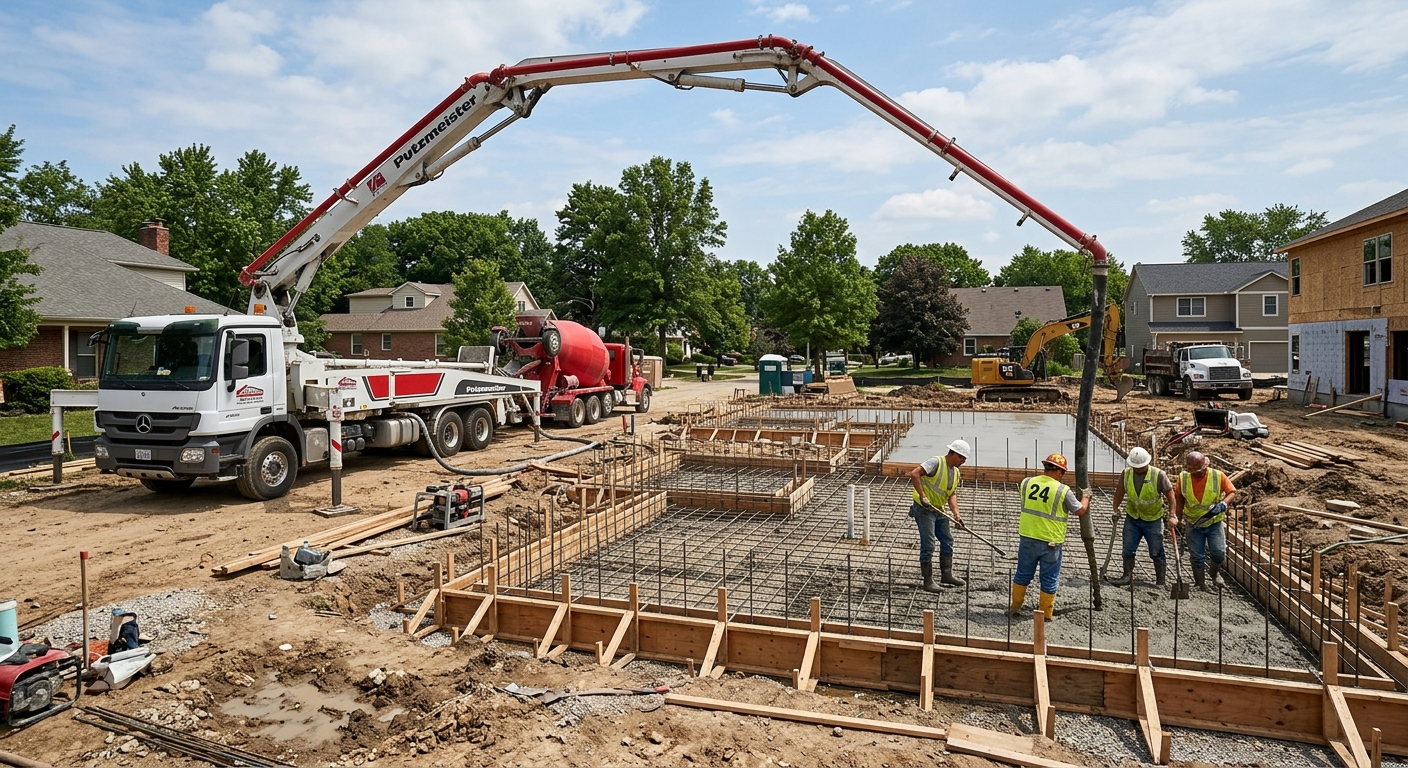
Concrete work options and costs in Seymour Heights
In Seymour Heights, concrete flatwork is a common home upgrade because the neighbourhood’s housing stock and lot layouts suit driveways, patios, and walkways that look good and perform well through British Columbia’s coastal-wet winters. With a population of 2,340 in the area (Statistics Canada, 2021 Census), you’ll also see a smaller—but busy—local market where a few crews can influence pricing during peak pour season. In the Lower Mainland–Southwest, concrete costs are shaped by mild winters but a shallow frost line design assumption (often around 450 mm / 18"), plus frequent freeze–thaw cycles and heavy rainfall that saturate soils. That means contractor pricing isn’t just “concrete plus labour”: it includes proper compacted granular base, air-entrained mixes, drainage attention, and scheduling/cure planning when nights stay cool and humidity stays high.
Demand is especially strong in pocket areas near main access routes through the Seymour Heights area, where residents tend to renovate driveways and add backyard patios rather than moving—so timelines can tighten when multiple projects overlap. If you’re budgeting, it helps to compare common options side-by-side, including decorative upgrades like stamped concrete (higher material and labour) versus standard broom-finished slabs (more predictable labour and curing).
Use the table below as a realistic starting point, then we’ll break down what pushes quotes up or down in the next section.
| Application |
Typical Size |
Key Spec |
Finish Option |
Price Range |
| Concrete driveway (standard broom finish) |
12 m x 3 m (about 36 m²) |
Air-entrained exterior slab, control joints |
Broomed texture, sealed |
$7,000 – $10,100 |
| Exposed aggregate driveway |
12 m x 3 m (about 36 m²) |
Air-entrained exterior mix, careful surface retarder |
Exposed aggregate with sealer |
$9,200 – $13,800 |
| Stamped concrete driveway or patio |
10 m x 4 m (about 40 m²) |
Air-entrained base + stamped top finish, joints |
Stone/brick stamp pattern with integral colour |
$12,000 – $18,500 |
| Plain concrete patio or walkway |
6 m x 4 m (about 24 m²) |
Air-entrained mix, compacted base |
Float/steel trowel or broomed edges |
$3,900 – $6,100 |
| Garage floor (interior slab) |
6 m x 7 m (about 42 m²) |
Vapour barrier as needed, 32 MPa concrete |
Light broom or smooth finish |
$8,200 – $12,600 |
| Foundation footings (structural, below frost) |
Per foundation project (footing length varies) |
Below design frost depth, engineered rebar |
Structural concrete with formwork |
$3,200 – $6,500 |
Prices are estimates only and vary by project scope, site access and material selection.
What affects the price of concrete work in Seymour Heights
In the Lower Mainland–Southwest, two homeowners can get quotes that look “for the same concrete” yet differ by 30–50%, especially when one site has heavy clay, poor drainage, or difficult truck access. The big drivers are the details that keep concrete from failing in British Columbia: footing depth decisions around frost protection, base preparation, mix design for freeze–thaw durability, and cure planning during coastal-cool, humid weather. Even though we don’t see the same long, hard winters as interior BC, the freeze–thaw cycles and saturated soils still force air-entrainment and careful jointing—so the cost isn’t optional.
Practically, that’s why exterior work tends to land in the region’s typical bands (for example, concrete driveway/slabs often run around $18 – $28 per square foot equivalent pricing logic in our market, while patios/walkways commonly reflect $16 – $26 ranges). Where the job gets more expensive isn’t always “more concrete”—it’s more excavation depth, more granular, more reinforcement, and longer cure management.
In Seymour Heights specifically, I often see costs rise when (1) existing fill has settled and we must over-excavate and replace base to support the slab, and (2) downspouts or surface water discharge issues require re-grading and drainage corrections before we pour. Costs can also be lower when the base is already well-drained and stable, and when truck access is straightforward—fewer removals and shorter labour time.
| Price Factor |
Why It Matters |
Cost Impact |
| Frost line depth — determines footing depth and form height |
Footings must extend below the design frost depth to prevent frost heave |
More excavation and forming can add labour and material cost |
| Site preparation — excavation, grading, compacted granular base |
Stable support reduces settlement cracks and helps drainage in wet soils |
Clay removal/replacement and hauling increases cost |
| Reinforcement — rebar or wire mesh requirement |
Controls cracking and improves structural performance |
Rebar spacing, chairs, and labour can raise the price |
| Mix design — air-entrainment and compressive strength spec |
Air voids improve freeze–thaw durability; strength supports long-term loading |
Requires specific mix ordering and quality control |
| Finish type — broom vs. stamped vs. exposed aggregate |
Decorative finishes demand more steps and tighter timing |
Stamped/exposed typically cost more than broom-finished slabs |
| Pour size and concrete truck access to site |
Access affects pumping distance, placement time, and crew size |
Pumping or multiple deliveries add labour and fees |
| Cold-weather curing precautions — heating and blankets |
Cool nights can slow strength gain and increase surface/edge problems |
Blankets/heating rental and added supervision increase cost |
| Control joint pattern and sealing cost |
Joints guide cracking; sealing reduces water intrusion and scaling |
Material + labour for sawcuts and sealers adds budget |
Permits & regulations in British Columbia
In British Columbia, how much permitting you need depends on whether the concrete work is structural or purely flatwork. Structural concrete work—such as footings, foundation walls, grade beams, and other parts that carry building loads—typically requires a building permit and often engineered drawings that the municipality must review. Concrete flatwork (patios, walkways, and many driveways) usually does not require a building permit, unless your project affects lot grading, ties into drainage/utility work, triggers impervious surface coverage concerns, or impacts municipal right-of-way requirements. Even when a permit isn’t usually required, it’s smart to confirm with your local authority before breaking ground so you don’t get forced to redo work.
Before hiring anyone in Seymour Heights, verify three practical items every time: (1) contractor liability insurance, (2) worker coverage (commonly WCB), and (3) that the company can legally perform the scope you’re buying. Step-by-step, here’s how homeowners can check:
- Look up the contractor/company name in British Columbia’s online registry resources (as applicable) to confirm credentials for the work type.
- Ask for an up-to-date Certificate of Insurance and ensure liability coverage is active and matches the job site address.
- Request proof of WCB coverage and confirm it applies to the crew doing the work.
- Ask for references on similar-scale concrete projects in the Lower Mainland–Southwest (driveway/patio base prep and finishing).
- Confirm whether disposal, permit handling (if needed), and any utility locates are included in the written quote.
Getting concrete right in Seymour Heights's freeze-thaw climate
The most common reason concrete underperforms in Seymour Heights is freeze–thaw damage paired with water sitting in the base. When water saturates soil and then cycles through freezing, it can push up poorly supported slabs, leading to cracking, spalling (flaking), and scaling—especially at edges and joints. Getting the specs right starts before the truck arrives: (1) base preparation with compacted granular to the correct depth for the local soil and drainage, (2) a mix design with proper air-entrainment for exterior durability, (3) a control joint pattern that limits random cracking, and (4) curing that achieves design strength even with cool nights and high humidity.
For exterior flatwork here, I typically recommend air-entrained concrete with an air content in the 5–7% range and a minimum 32 MPa compressive strength spec. Then control joints should be installed at spacing that matches standard practice so cracks form where you want them, not wherever moisture finds a weakness. Finally, apply penetrating sealer after the recommended cure time—often 28 days post-pour—to help repel de-icing salts and reduce water ingress. This combination is what prevents the “pretty day-one finish” from turning into rough, pitted surfaces over winter.
As a budgeting example, stamped concrete may cost more than a broom finish, but it’s justified when you’re upgrading appearance and are also prepared to pay for correct base prep and sealing. If you choose a decorative finish without matching drainage, air-entrainment, and joint/curing steps, you might pay for the look—and still get early deterioration.
| Spec |
Why It Matters in Seymour Heights |
What to Ask For |
Impact if Skipped |
| Compacted granular base (depth?) |
Supports slab and manages drainage through wet seasons and frost cycles |
Confirm base thickness and compaction test/verification approach |
Settlement, cracking, and edge failure |
| Air-entrained concrete mix (target air %?) |
Air voids help concrete survive freeze–thaw cycles without scaling |
Specify 5–7% air content for exterior flatwork |
Spalling and surface scaling in winter months |
| Compressive strength (MPa rating) |
Design strength supports loads and improves long-term durability |
Minimum 32 MPa |
Slower strength gain and reduced durability |
| Control joints (spacing per ACI guidelines) |
Limits random cracking where moisture can penetrate and worsen damage |
Ask for planned joint spacing and timing (cut schedule) |
Wider cracks and more water intrusion |
| Minimum 7-day curing period |
Cool nights and humidity can slow strength development |
Confirm curing method and protection during cool spells |
Weak surfaces, scaling risk, reduced lifespan |
| Penetrating sealer (when applied after cure) |
Repels water and helps protect from de-icing salts |
Penetrating sealer after cure (commonly around 28 days) |
Faster staining, scaling, and freeze–thaw deterioration |
How to choose a concrete work contractor in Seymour Heights
Choosing the right contractor matters in Seymour Heights because the “invisible” steps—base compaction, correct mix ordering, curing protection—are what determine whether your slab lasts or starts failing within a few winters. Start with British Columbia compliance and protection: verify the contractor’s credentials for the scope, request liability insurance documentation, and confirm workers are covered (WCB/WCB-equivalent coverage for the crew doing the work). Then build a paper trail: get itemised written quotes (not just a lump sum), with a breakdown of excavation/base prep, reinforcing, concrete supply, finishing, sawcutting, sealing, and any curing blankets/heating provisions if the season is cold or wet.
Here’s a practical approach: ask for 2–3 quotes and make sure they match scope line-by-line. A common pricing trap is “decorative finish” quoted without matching jointing/sealing or base prep—decorative concrete can run from roughly $22 – $36 per square foot equivalent in the Lower Mainland–Southwest, and you shouldn’t pay top-tier dollars for an under-specified foundation of granular, air-entrainment, and curing.
Warranty should be clear and in writing: workmanship warranty length, what’s covered (cracks, spalling, settlement), and whether it’s transferable if you sell the home. For payments, never pay more than 10–15% upfront; hold back an amount until the final finish and cleanup are complete. Finally, ask for a start date and completion estimate in writing, including how they plan to handle rain days and cold-night curing.
- Confirm the exact scope: demolition, excavation, hauling, base prep, reinforcement, formwork, finishing, sealing, disposal.
- Require air-entrainment and minimum compressive strength as explicit specs in the quote.
- Ask whether joints will be cut on a schedule and how joint layout will be planned.
- Get confirmation of cure protection (covers/blankets/heating) if weather may be cool.
- Verify liability insurance is current and provides adequate coverage for the project size.
- Verify WCB/workers’ coverage applies to the crew assigned to your job.
- Request references for similar driveways/patios with the same finish type (broom vs stamped vs exposed).
- Ensure concrete truck access and placement method (pumping/short-raise) is described.
- Make disposal/leftover material handling explicit (included vs extra).
- Insist on itemised labour + materials so you can compare quotes apples-to-apples.
- Review the warranty details in the contract before signing, including exclusions.
- Agree on a payment schedule with a holdback until substantial completion and final cure/sealer steps are done.
Concrete red flags I see in Seymour Heights: quotes that mention “concrete is concrete” without specifying air-entrainment; missing details on base thickness/compaction and drainage; no plan for curing in cool, humid weather; sawcut/jointing timelines left vague; and contracts with unclear warranty coverage or a payment schedule that demands large upfront deposits.
Frequently asked questions — concrete work in Seymour Heights
What is air-entrained concrete and why does it matter here?
Air-entrained concrete is mixed with tiny, evenly distributed air bubbles that give water a place to expand when it freezes. In Seymour Heights and across British Columbia’s Lower Mainland–Southwest, that matters because coastal-wet soils and frequent freeze–thaw cycles can saturate the slab and edges. If the mix isn’t air-entrained (or the air content is wrong), water can expand inside the cement paste and break the surface layer over time. That’s when homeowners start seeing scaling and spalling, especially near joints and around the driveway edge where water collects. When you’re budgeting, remember that exterior durability spec changes the mix ordering and quality control; it’s one reason exterior concrete typically lands in the expected driveway/patio cost bands (for example, driveways often reflect about $18 – $28 per square foot equivalent pricing in this market).
How do I prepare the base for a concrete slab?
Base prep is where good concrete jobs start and poor jobs usually fail later. In Seymour Heights, you want a stable, drained subgrade and a compacted granular base designed for the local soil and frost protection requirements. That typically means excavating to the right depth, grading for proper drainage (slight slope away from the house where applicable), placing compacted granular in lifts, and verifying compaction before the forms and reinforcement go in. If there are drainage issues (downspouts discharging toward the slab, low spots that pond water, or soft clay), address them during base prep—not after the concrete cures. Ask your contractor to state the base thickness, how they manage subgrade moisture, and what they’re using for granular and compaction control so your slab doesn’t settle or crack prematurely.
How do I compare concrete quotes?
Start by comparing scope and specs, not just totals. Ask each contractor to itemise the work: demolition/removal, excavation and disposal, granular base and compaction approach, reinforcement (if any), concrete supply with air-entrainment and minimum strength, finishing type, joint layout/sawcut timing, curing method, and whether sealer is included. Ensure the quotes align on size and thickness—one crew may price a 4-inch slab while another is assuming 5 inches or adding thicker edges. Also confirm inclusions like truck access, pumping (if required), and rain-day scheduling. In the Lower Mainland–Southwest, quote differences often come from cold-weather curing precautions and drainage/base quality; those details can shift the job by 30–50%. A stamped patio or driveway may run toward the higher band (roughly $22 – $36 per square foot equivalent), so you should confirm the decorative finish is backed by the same durability specs.
Can concrete be poured in cold weather in Seymour Heights?
Yes, concrete can be poured in cold weather in Seymour Heights, but it must be protected so it reaches strength as designed. The risk isn’t only freezing of the fresh concrete—it’s slow strength gain during cool nights and potential surface/edge problems when temperatures drop and humidity stays high. A competent contractor will plan for cold-weather curing: insulating blankets, curing protection, and appropriate heating methods if needed. They should also adjust their curing schedule and document how they maintained temperature and moisture during the first critical days. Don’t sign a contract that treats winter pours the same as summer. Ask specifically how they handle cold snaps and what steps they take so the mix still achieves minimum compressive strength and durability.
How do I maintain concrete in Seymour Heights's freeze-thaw climate?
Maintenance in Seymour Heights is mostly about keeping water from sitting in cracks and joints and protecting the surface from winter salts and moisture. First, sealing matters: use a penetrating sealer after the concrete has cured sufficiently (often around 28 days). That helps repel water and reduces staining and scaling risk. Second, keep joints clear and avoid filling them with the wrong material—joint behaviour is part of how concrete controls cracking. Third, when snow is moved, use methods that won’t gouge the surface near edges. If you use de-icing salts, don’t over-apply; salts can accelerate surface deterioration if the slab isn’t properly sealed. Regular sweeping and quick attention to pooled water around the driveway/patio are also practical—because in this climate, water is the trigger for freeze–thaw damage.
What causes concrete to spall in Seymour Heights winters?
Spalling is the flaking or scaling of the concrete surface, and in Seymour Heights it’s usually tied to freeze–thaw exposure plus water ingress. The most common causes are inadequate air-entrainment (or wrong air content), poor base preparation or drainage so water saturates the slab, and weak or interrupted curing that leaves the surface vulnerable. It can also happen when control joints are missing or incorrectly spaced, allowing cracks to open randomly and letting water travel deeper. Edge areas are frequent problem spots because water collects there and is harder to keep dry. If you notice spalling near joints or along the driveway edge, ask your contractor whether the original mix was air-entrained, what air content was targeted, and whether sealing was applied after proper cure timing. Fixing the root cause—spec and base/drainage—is essential to avoid repeating the problem in the next freeze–thaw season.