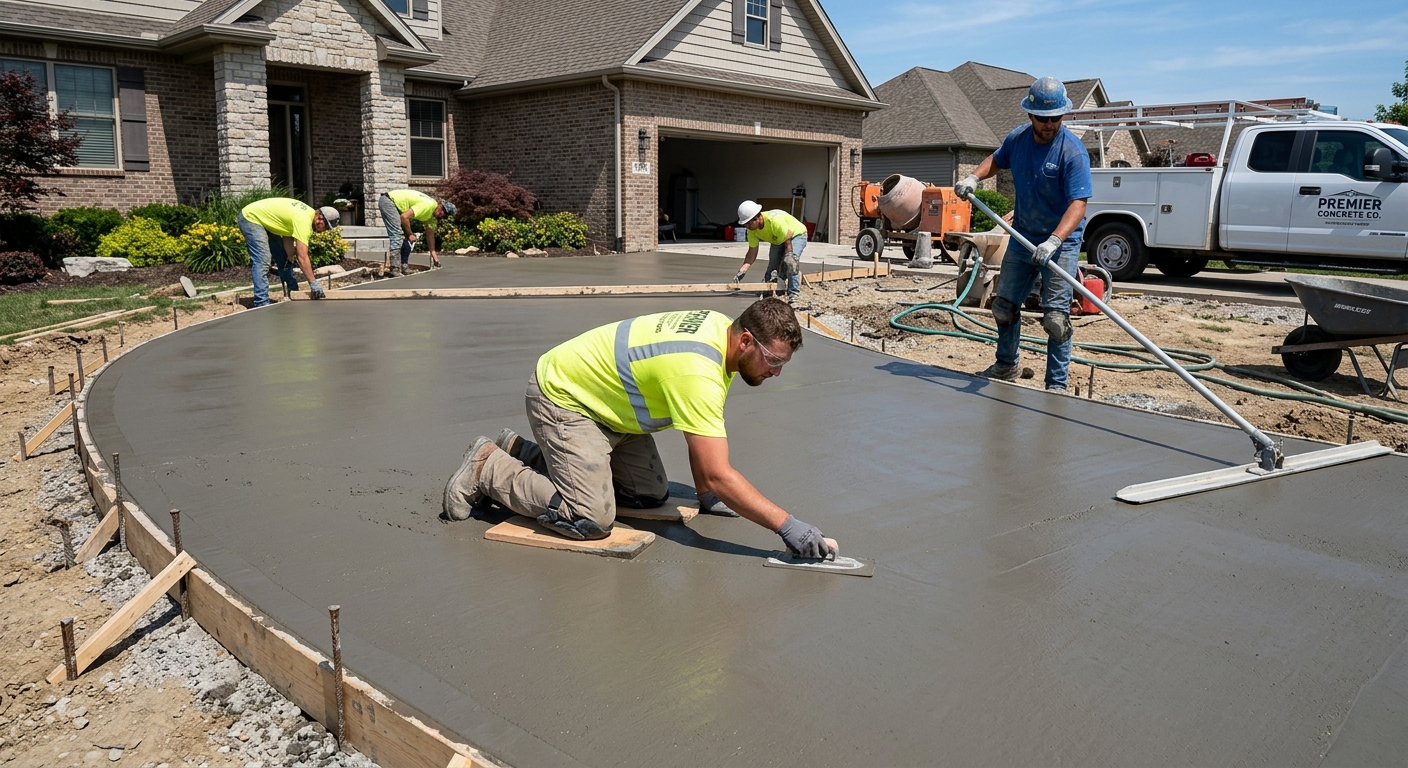
Concrete work options and costs in Saanich
Saanich homeowners commonly need concrete for driveways, patios and walkways, and it’s a busy market—single-detached homes make up about 46.6% of dwellings (Statistics Canada, 2021 Census). With 69.2% of households owning their homes (Statistics Canada, 2021 Census), many projects are renovations and upgrades: replacing aging slabs, improving drainage, or adding decorative finishes. You’ll also see demand spike around neighbourhoods like Ten Mile Point and portions of Royal Oak, where access for concrete trucks and steady local infill growth keeps crews booked for the dry-window months.
On Vancouver Island and the Coast, our pricing is shaped by a relatively shallow frost line compared with interior regions, but a real freeze–thaw cycle that still punishes the surface. That means exterior work needs air-entrained mixes, proper granular base, and a reliable control-joint and drainage plan—especially where sites stay wet. Contractor availability is also affected by weather: cool, damp stretches slow curing, and heavy rain can delay base prep and finishing, so reputable crews build weather contingencies into their quotes. Finally, the type of finish matters—broom finish is faster to place and cure, while exposed aggregate and stamped work require extra materials, layout time, and finishing discipline to keep the surface consistent.
Use the table below as a realistic “apples-to-apples” guide for Saanich projects. Then, when you request quotes, ask for the same specs (mix, base depth, reinforcement, joint spacing) so bids can be compared fairly.
| Application |
Typical Size |
Key Spec |
Finish Option |
Price Range |
| Concrete driveway (standard broom finish) |
400–600 sq. ft. |
Exterior air-entrained mix, compacted granular base, control joints |
Broom finish |
$16,000–$25,000 |
| Exposed aggregate driveway |
400–600 sq. ft. |
Air-entrained mix, base prep, retarder/bagging & wash timing controls |
Exposed aggregate |
$19,000–$30,000 |
| Stamped concrete driveway or patio |
300–500 sq. ft. |
Air-entrained mix, release agent, saw-cut pattern & seal system |
Stamped with textures |
$22,000–$35,000 |
| Plain concrete patio or walkway |
150–300 sq. ft. |
Exterior mix, compacted base, expansion allowance where required |
Broom or smooth trowel (as requested) |
$4,000–$8,000 |
| Garage floor (interior slab) |
400–600 sq. ft. |
Typical interior mix, vapor control considerations if needed |
Plain finish (broom/smooth) |
$14,000–$22,000 |
| Foundation footings (structural, below frost) |
Per linear foot or typical small foundation |
Below-frost excavation, granular bearing, formwork and rebar as engineered |
Structural formed concrete |
$50–$90 |
Prices are estimates only and vary by project scope, site access and material selection.
What affects the price of concrete work in Saanich
In Saanich, you can see the same concrete scope priced 30–50% apart across Vancouver Island and the Coast, and that gap usually comes down to specifications and site risk—not just “concrete cost.” A driveway bid might look similar at the surface, but one contractor can be building a stronger system (deeper granular base, proper drainage, air-entrainment, correct joint layout), while another may assume easy conditions or use a lighter spec. Labour availability also swings with weather windows, because wet excavation and delayed curing can impact crew scheduling and equipment costs.
The most important driver is frost management. Even though coastal BC has a milder climate than the interior, Vancouver Island and the Coast still experience freeze–thaw cycles, and local design typically places footings below the design frost band (commonly around 0.5–1.2 m for coastal BC). That requirement controls footing depth, form height, and the amount of excavation and backfill. Exterior slabs also require air-entrained concrete to survive repeated wetting and freezing, and that mix can be a bit more expensive than “standard” concrete. Cold-weather curing precautions—like insulating blankets or scheduling around cold snaps—can add cost when pours are pushed into shoulder seasons.
Two local examples: (1) a driveway on clay-rich or saturated areas often needs subgrade remediation and thicker granular base, which increases excavation and hauling; (2) if you want a stamped or exposed aggregate finish, you’re paying for extra labour and finishing discipline, and you can see it reflected in the stamped/decorative range (often $22,000–$35,000 for typical jobs). By contrast, a plain patio or walkway that stays simple (good base, correct slope, straightforward finishing) tends to land closer to the basic flatwork band (often $14,000–$22,000 for larger slabs, depending on size and access).
Finally, housing stock matters: with 56.3% of homes built before 1981 (Statistics Canada, 2021 Census), many sites involve older drainage patterns and disturbed soils around foundations and fences. Fixing that “hidden” groundwork is where budgets rise (or where well-scoped quotes protect you from surprises).
| Price Factor |
Why It Matters |
Cost Impact |
| Frost line depth — determines footing depth and form height |
Footings must sit below the design frost band to prevent heave and cracking |
Can add major excavation/formed concrete cost; biggest driver on foundation work (e.g., $50–$90 per linear foot range depending on conditions) |
| Site preparation — excavation, grading, compacted granular base |
Bad base leads to settlement and random cracking, especially with wet coastal soils |
Often shifts pricing by 10–25% based on required removal and granular thickness |
| Reinforcement — rebar or wire mesh requirement |
Controls cracking and supports load performance (driveways and garage floors) |
Material and placement labour; can add several thousand dollars on larger slabs |
| Mix design — air-entrainment and compressive strength spec |
Exterior air entrainment is critical for freeze–thaw durability |
Usually modest material premium but can be a major difference between “surface look” and long-term performance |
| Finish type — broom vs. stamped vs. exposed aggregate |
More steps, tighter timing, and higher material usage |
Stamped/exposed finishes commonly add labour and finishing materials (often pushing into $22,000–$35,000 jobs) |
| Pour size and concrete truck access to site |
Short access roads, tight turns, or limited staging add labour for pumping/placing logistics |
Can increase costs quickly if pumping, waiting time, or extra crews are needed |
| Cold-weather curing precautions — heating and blankets |
Cool, damp weather slows strength gain and increases surface risk |
Adds labour and materials when pours land in colder snaps; can shift bids by 5–15% |
| Control joint pattern and sealing cost |
Joints manage shrinkage; sealing helps repel de-icing salts and rain-driven staining |
Saw cutting + sealant system can add a few hundred to over a thousand dollars depending on size |
Permits & regulations in British Columbia
In British Columbia, structural concrete work—such as footings, foundation walls, and grade beams—typically requires a building permit and often engineered drawings reviewed by the municipality. This is the part of a project where load paths and frost depth compliance are critical. Concrete flatwork (patios, walkways, and most standard driveways) usually does not require a permit, provided it doesn’t change lot grading in a way that affects drainage, doesn’t increase impervious surface beyond municipal limits, and doesn’t impact municipal right-of-way requirements. That said, rules can vary based on the site plan, drainage direction, and whether the work touches statutory setbacks or sidewalk/curb areas—so confirm with the Saanich planning/building side before you break ground.
Step-by-step, here’s how a homeowner in Saanich should verify a contractor’s BC readiness:
- Check the contractor’s registration/licensing status through the appropriate online registry for BC (and ensure it matches the type of work claimed).
- Request a certificate of insurance showing liability coverage that’s valid for the job dates.
- Ask for proof of WSBC coverage (coverage letter or clearance details), and confirm it’s current.
- Verify the scope that permits (if needed) is included—who pulls the permit and who coordinates inspections.
- Get references for similar-scale concrete work in coastal conditions (freeze–thaw durability specs).
If you’re unsure whether your flatwork needs a permit due to grading or right-of-way impacts, ask the contractor to outline the exact compliance assumption they’re making—then verify that with the local authority before any concrete is ordered.
Getting concrete right in Saanich's freeze-thaw climate
Concrete failures in Saanich usually come down to three things: weak base preparation, the wrong mix for freeze–thaw durability, and skipping the process that protects the surface while it cures. In a coastal freeze–thaw environment, water is the enemy—if subgrade stays saturated or if the concrete surface can’t tolerate repeated freezing, you can see scaling (flake-off), minor spalling, and random cracking. To spec the job correctly, focus on five fundamentals.
First, base preparation: require compacted granular sub-base to the right depth for local soil conditions and to support frost protection. Second, mix design: insist on air-entrained concrete (typically 5–7% air for exterior flatwork) and a minimum 32 MPa compressive strength spec for durability and performance. Third, control joints: plan the saw-cut/control joint spacing so shrinkage cracking happens where you want it, not randomly. Fourth, curing: require a minimum 7-day curing period under proper protection; this matters even if winters are milder, because cool, damp conditions slow strength gain and increase early surface damage risk. Fifth, sealing: schedule a penetrating sealer after full cure (commonly at/after 28 days) to repel moisture and reduce staining and deterioration from salt and wetting.
When you compare options, you’ll often see a price difference that’s justified by durability. For example, if you choose stamped concrete over a broom-finish patio, the decorative mix and extra labour can land in the decorative band (often $22,000–$35,000 for typical driveway/patio scopes). If your goal is long-term surface resilience in a freeze–thaw zone, that premium only makes sense when the contractor also nails base prep, air entrainment, and jointing—otherwise you’re paying for aesthetics on top of a system that will still crack.
| Spec |
Why It Matters in Saanich |
What to Ask For |
Impact if Skipped |
| Compacted granular base (depth?) |
Reduces settlement and manages water before it reaches the slab |
Granular type and compacted depth (site-specific), plus proof of compaction |
Settlement and uneven cracking; early failure in wet areas |
| Air-entrained concrete mix (target air %?) |
Freeze–thaw cycling needs microscopic air bubbles for durability |
Air target typically 5–7% for exterior flatwork |
Spalling/scaling risk increases significantly over a few winters |
| Compressive strength (MPa rating) |
Strength gain supports load and reduces surface wear |
Minimum 32 MPa (or higher if specified) |
Surface deterioration and increased cracking under traffic |
| Control joints (spacing per ACI guidelines) |
Controls where shrinkage cracks occur |
Joint spacing plan and timing (saw-cut/formed joints) |
Random cracking and wider openings that invite water intrusion |
| Minimum 7-day curing period |
Cool, damp conditions slow strength gain on the coast |
Protection plan for cool weather (blankets/cover, if needed) |
Surface damage, scaling, and weakened performance |
| Penetrating sealer (when applied after cure) |
Helps repel moisture and reduces salt-driven wear |
Sealer applied after full cure—commonly at/after 28 days |
Faster staining, increased permeability, and reduced lifespan |
How to choose a concrete work contractor in Saanich
Choosing the right contractor in Saanich is mainly about verifying credentials and forcing clarity in the scope. In British Columbia, start by confirming licensing status through the appropriate online registry for the trade/activity they’re performing. Then request a certificate of insurance with liability coverage that matches the project value and dates. Next, ask for WSBC clearance details (or the applicable proof) so you know the crew is properly covered. If they can’t provide documents quickly and clearly, treat it as a red flag.
For pricing, don’t accept vague allowances. Get 2–3 itemised written quotes that break down labour and materials, including excavation, granular base, reinforcement, concrete supply, finishing, saw-cut timing, and—if included—sealant and disposal. Pay attention to exclusions: Who handles permit pulls (where required for structural work), where does haul-off go, and is site restoration included if excavation reveals unsuitable soil? A good quote will state what happens if subgrade conditions are worse than expected.
On warranty, ask for workmanship warranty length and what it actually covers (for example, cracking beyond a defined standard, spalling, or settlement). Also ask whether manufacturer product warranties apply to sealers or concrete admixtures and whether they’re transferable to you as the homeowner.
For payment schedule, never let the job start with a full advance. A typical safe structure is no more than 10–15% upfront, with progress payments tied to milestones and a holdback until completion and cleanup are done. Get a start date and completion estimate in writing so weather-driven delays don’t turn into cost surprises.
- Confirm BC licensing/registration and the correct scope for your work.
- Obtain liability insurance certificate and ensure coverage aligns with the project size.
- Verify WSBC coverage/clearance before work begins.
- Request a written concrete mix spec (air entrainment, strength target) not just “exterior concrete.”
- Ask for base prep details: granular type, depth, compaction expectations, and drainage approach.
- Require reinforcement details (mesh/rebar type, spacing, and placement height).
- Get a jointing plan: spacing, saw-cut timing, and whether expansion joints are included at transitions.
- Confirm curing approach: blankets/heating if pours are scheduled during cold snaps.
- Clarify finishing method (broom vs. smooth vs. exposed/stamped) and how they prevent re-tempering.
- Ask whether the quote includes sealers and when they’ll apply them after cure (commonly after 28 days).
- Make sure disposal/hauling and any landscaping restoration are included or itemised.
- Use milestone-based payments; keep a holdback until surfaces are sealed (if specified), cleaned, and accepted.
Concrete red flags I see in Saanich: (1) quotes that don’t mention air entrainment or joint spacing; (2) “one-size-fits-all” base depth without soil assessment; (3) asking for large deposits upfront; (4) no proof of WSBC coverage or valid insurance documents; (5) finishing and sealing plans that ignore cool, wet curing conditions in the freeze–thaw season.
Frequently asked questions — concrete work in Saanich
What is a concrete overlay and is it suited to Saanich?
Concrete overlay is a thin cementitious layer installed over an existing slab or wearing surface to improve appearance and level out minor deterioration without full removal. In Saanich, overlays can be suited to the right conditions—specifically when the original slab is still structurally sound, not heavily broken, and the surface preparation (grinding, cleaning, bonding) is done properly. The freeze–thaw climate on Vancouver Island can cause bond failures if moisture is trapped below the overlay, so drainage and surface condition matter. As a cost reference, many homeowners compare overlays against new flatwork budgets that commonly fall in the broader driveway/slab bands of about $16,000–$25,000, depending on size and access. If your slab has widespread cracking, settlement, or heaving, full replacement is often the more durable option.
How do I seal concrete to protect it in Saanich?
In Saanich, sealing is most effective when it’s done at the right time and with the right product. For exterior flatwork, use a penetrating sealer designed to repel water and reduce freeze–thaw damage and staining; apply it only after the concrete has fully cured—commonly at/after 28 days—and only when the surface is clean and dry. If the job involves de-icing salts, sealing helps reduce moisture and salt ingress, which can otherwise accelerate surface wear and spalling. Your contractor should also use proper joint sealing practices (if your system includes joint sealant) so water doesn’t migrate through cracks. If you’re budgeting, sealing is usually a smaller line item than redoing a failed slab, but it can be critical for long-term performance in our coastal wet/freezing cycles.
What is the difference between concrete and cement?
Cement is one ingredient—usually Portland cement—that reacts with water to create paste. Concrete is the full engineered mix that contains cement paste plus aggregates (sand and gravel/stone), water, and often admixtures like air-entrainment for freeze–thaw durability. In Saanich, “concrete for exterior flatwork” must be specified by the full mix performance (air content and compressive strength), not just by using “cement.” That’s why a careful contractor will state the air-entrainment target (typically 5–7% for exterior work) and the strength requirement. When you request quotes, ask for the mix design line item in writing so you’re comparing apples-to-apples, especially for driveways and walkways exposed to Vancouver Island freeze–thaw cycles.
How much does concrete work cost in Saanich?
Concrete costs in Saanich vary mainly by scope (removal vs. new, base prep, reinforcement), finish level, and site access. For a typical exterior driveway with standard broom finish, many projects land in the range of $16,000–$25,000 depending on size (often 400–600 sq. ft.) and site conditions. Decorative options like stamped concrete commonly cost more and can fall into the $22,000–$35,000 band for many driveway/patio scopes, because they require additional layout and finishing steps. Foundation footings are priced differently and are commonly referenced as a per-linear-foot range of about $50–$90 depending on excavation, depth below frost, and reinforcement requirements. If you’re comparing bids, the biggest differences usually come from base depth, drainage, and whether air-entrained concrete is actually specified for freeze–thaw durability.
How deep must footings be for Saanich's frost line?
For Saanich and coastal BC conditions, footings must generally extend below the design frost depth band used by local design assumptions—commonly around 0.5–1.2 m for coastal BC. The exact depth is determined by the project’s engineered design (and soil conditions), so the best answer for your home is the footing depth shown on the permit/engineering documents for the foundation. The important homeowner takeaway is that depth isn’t arbitrary: frost protection drives excavation volume, form height, and granular bearing work. If a contractor proposes shallow footings “because winters are milder,” that’s where long-term heave risk comes from. Ask to see how their quote aligns with below-frost design and what changes in excavation depth could do to your price.
Why does concrete crack in Saanich and how is it prevented?
Concrete cracks in Saanich mostly due to shrinkage and movement that must be controlled with proper jointing, plus freeze–thaw exposure when water gets into the system. Even with a shallow coastal frost depth, repeated wetting and freezing can create stress at the surface. The prevention approach is three-part: (1) build a strong base with correct granular thickness and compaction so the slab doesn’t settle; (2) use exterior air-entrained concrete and a proper strength spec—commonly at least 32 MPa—to reduce the risk of scaling and spalling; and (3) plan and cut control joints at the right spacing and timing so cracks form where intended. If you want a practical spec question: ask your contractor for the joint spacing plan and air-entrainment target before you sign. That’s the fastest way to avoid “pretty finish, poor durability.”