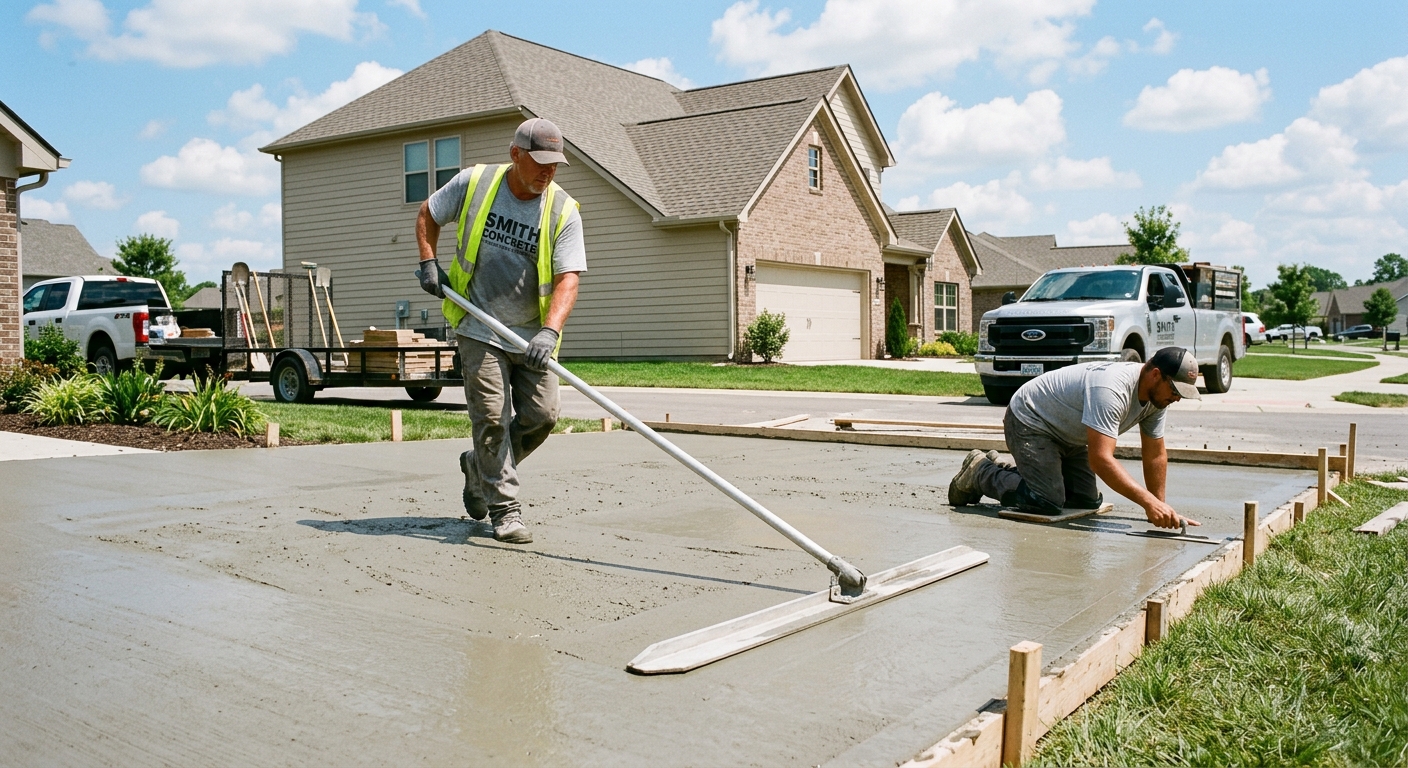
Concrete work options and costs in South Surrey
South Surrey is where homeowners commonly upgrade driveways, patios, and foundations to handle the Lower Mainland–Southwest climate. With a population of 77,170 (Statistics Canada, 2021 Census), the area’s ongoing infill and renovation market keeps concrete crews busy—especially around family-oriented pockets like Sunnyside and the Clayton/Grandview corridor. In practical terms, most concrete flatwork here supports either single-detached homes with heavy vehicle traffic or backyards that need durable outdoor surfaces that won’t spall after wet winters and freeze–thaw swings.
In the Lower Mainland–Southwest, mild winters and a shallow frost line still drive concrete design. We typically plan around frost depth of about 450 mm / 18", but exterior footings and thickened edges must still sit below the design frost level to reduce the risk of frost heave. Coastal rainfall also means drainage and base prep are a cost driver: compaction, granular base, and proper control joints are often what separate a long-lived driveway from one that needs patching sooner. Scheduling can also add cost—long cool, rainy stretches may force longer cure times and the use of curing blankets and sealers to achieve the right strength and surface durability.
Availability matters too: when multiple homeowners book summer pours, early-morning placement windows and truck access can influence labour and forming time. The most reliable way to budget is to compare finishes side-by-side, then match the spec to your site and exposure. Use the guide below as a starting point for common South Surrey options.
| Application |
Typical Size |
Key Spec |
Finish Option |
Price Range |
| Concrete driveway (standard broom finish) |
400–600 sq. ft. |
Air-entrained exterior mix, rebar where required, compacted granular base |
Broomed texture + control joints |
$18,000–$28,000 |
| Exposed aggregate driveway |
400–600 sq. ft. |
Air-entrained exterior mix, retarder or similar finishing approach |
Exposed aggregate with sealer |
$22,000–$33,000 |
| Stamped concrete driveway or patio |
300–500 sq. ft. |
Air-entrained exterior mix, reinforcement as needed |
Stamped pattern + integral or color hardener |
$22,000–$36,000 |
| Plain concrete patio or walkway |
200–400 sq. ft. |
Minimum 32 MPa mix (as specified), compacted base, control joints |
Brush or broom finish |
$16,000–$26,000 |
| Garage floor (interior slab) |
400–600 sq. ft. |
Vapour barrier and reinforcement as specified, proper subgrade compaction |
Float and trowel + broomed edges |
$18,000–$30,000 |
| Foundation footings (structural, below frost) |
Varies by house size |
Footings below design frost, engineered reinforcement and placement |
Structural pour (no surface finish) |
$200,000–$350,000 |
Prices are estimates only and vary by project scope, site access and material selection.
What affects the price of concrete work in South Surrey
In South Surrey and across the Lower Mainland–Southwest, quotes for “the same” concrete job can differ by 30–50% because the cost isn’t just concrete—it’s excavation, base engineering, reinforcement, scheduling, curing conditions, and finish labour. Across British Columbia, the differences get amplified: frost depth and freeze–thaw cycles change how deep footings must go and how durable exterior slabs must be. Colder regions have a shorter pour season and may require cold-weather curing precautions (heating, insulating blankets), which raises labour and equipment costs. Even within the Lower Mainland, saturated soils and drainage requirements can change the build-up by several steps.
For South Surrey, the local practice typically assumes a frost depth around 450 mm / 18", so exterior supports are placed below that to manage frost heave. That depth affects formwork height, excavation volume, and disposal. Freeze–thaw cycles also drive the mix design: exterior flatwork should use air-entrained concrete and proper control joints to limit cracking and scaling. Surface protection matters too—de-icing salt can accelerate spalling, so a penetrating sealer applied after cure is a smart part of the spec. If a contractor skips air entrainment or uses inconsistent curing, you may see early wear and costly patchwork.
Concrete finish choices are another pricing lever. A standard broom driveway commonly lands near the region’s driveway band of $18–$28, while decorative options like stamped concrete are usually priced toward $22–$36 depending on colour and pattern coverage. One concrete example: upgrading from plain broom to stamped concrete on a 400 sq. ft. driveway is often a real value if you’re aiming for curb appeal and planning to seal on schedule—done correctly, the additional finish labour and materials are typically worth it. However, paying extra for decorative finishes on a poorly drained slope (or without proper base prep) is where budgets get wasted fast.
| Price Factor |
Why It Matters |
Cost Impact |
| Frost line depth — determines footing depth and form height |
Footings and thickened edges must sit below the design frost to reduce frost heave |
Can add excavation and formwork labour; impacts schedule |
| Site preparation — excavation, grading, compacted granular base |
Wet coastal soils require engineered drainage and consistent compaction |
More granular and longer prep time can increase costs |
| Reinforcement — rebar or wire mesh requirement |
Controls cracking and supports loading, especially on driveways and garage slabs |
Additional labour for tying, chairs, and spacing |
| Mix design — air-entrainment and compressive strength spec |
Air entrainment helps exterior concrete survive freeze–thaw exposure |
Better materials can cost more but reduce early deterioration |
| Finish type — broom vs. stamped vs. exposed aggregate |
Higher labour and more materials for forming, stamping tools, retarder/finishing methods |
Decorative finishes typically push prices toward the higher band |
| Pour size and concrete truck access to site |
Access affects pump needs, setup time, and pour logistics |
Pump/extra crew time can raise labour costs |
| Cold-weather curing precautions — heating and blankets |
Cool nights and humidity slow strength gain and surface development |
Heating/blanket time adds cost in shoulder seasons |
| Control joint pattern and sealing cost |
Proper jointing reduces random cracking; sealing improves durability against salts and moisture |
Small materials cost, but a major long-term value driver |
Permits & regulations in British Columbia
In British Columbia, structural concrete work such as footings, foundation walls, grade beams, and other load-bearing elements generally requires a building permit, and engineered drawings are often reviewed before inspection. Concrete flatwork—like patios, walkways, and many driveways—typically does not require a permit by itself unless the work affects lot grading, drainage, or complies with impervious surface and municipal right-of-way requirements. Because rules can vary by the site and how the work interfaces with the property line, confirm with the local authority before breaking ground.
To protect yourself on a South Surrey project, verify three basics before the first forms go down. First, check contractor licensing through the Province’s online contractor registry (search the contractor’s legal name). Second, ask for a certificate of liability insurance that matches the job value and shows active coverage. Third, confirm coverage for workers through WSBC (WorkSafeBC); the contractor should be in good standing for the crews performing the concrete work.
Step-by-step: request their licence number and WSBC clearance/coverage confirmation, then compare the names on the certificate of insurance to the contractor’s legal name on the agreement. Finally, ask for references on similar-scale work in the Lower Mainland–Southwest (driveways, patios, and foundation repairs are very different), and ensure the quote clearly states whether permit pulling, inspections, and disposal are included.
Getting concrete right in South Surrey's freeze-thaw climate
Concrete failure in South Surrey usually isn’t “bad concrete”—it’s a spec mismatch for our wet coastal climate and freeze–thaw cycles. The most common problems I see are surface scaling, spalling near edges, and random cracking that shows up after a couple of winters. The fix is to build from the ground up with the right base, the right mix, and the right finishing and curing plan.
Start with base preparation: compacted granular sub-base to the correct depth for your soil and frost conditions, with drainage considerations so water doesn’t sit under the slab. Next, the mix design: for exterior flatwork, air-entrainment matters—target about 5–7% air (per the mix design plan) and specify minimum 32 MPa compressive strength so the concrete reaches design performance despite cool, humid curing conditions. Then control joints: place them to limit cracking to planned locations rather than letting shrinkage cracks run anywhere they want.
Curing is where many bids quietly differ. Plan for at least 7 days of proper curing; when pours are in cooler weather, curing blankets or other cold-weather measures may be needed to reach strength. Finally, sealing: apply a penetrating sealer after the concrete has cured (commonly at 28 days) to help repel de-icing salts and reduce moisture ingress.
Ask technical questions that target the failure mode you want to avoid: “What is the air content you’re ordering, and how will you protect the slab during cool, wet conditions?” A budget example: upgrading from a plain broom finish near the $18–$28 driveway band to stamped concrete typically costs more, but the added finish value is justified if the base, air-entrainment, jointing, and curing are done to a durable standard. Stamped concrete without the right exterior mix or curing is a shortcut that tends to fail early.
| Spec |
Why It Matters in South Surrey |
What to Ask For |
Impact if Skipped |
| Compacted granular base (depth?) |
Wet coastal soils and frost exposure require a stable, well-drained base |
Granular type and compaction method; base thickness matched to your site |
Settlement and cracking; uneven slab and premature surface wear |
| Air-entrained concrete mix (target air %?) |
Freeze–thaw cycling drives scaling risk without proper air entrainment |
Ordered air content (typically 5–7% for exterior flatwork) |
Spalling and scaling, especially near edges and joints |
| Compressive strength (MPa rating) |
Strength gain supports durability under loading and weather exposure |
Minimum 32 MPa (as specified on the job) |
Surface weakness, raveling, and faster deterioration |
| Control joints (spacing per ACI guidelines) |
Controls where cracks occur during shrinkage |
Planned joint layout, saw-cut timing, and spacing approach |
Random cracking and less predictable performance |
| Minimum 7-day curing period |
Cool nights and high humidity slow strength development |
Curing plan for your pour window (including blankets if needed) |
Reduced strength and surface defects |
| Penetrating sealer (when applied after cure) |
Repels moisture and helps protect against de-icing salt effects |
Sealer type and timing (commonly after 28 days) |
Higher risk of scaling/spalling over winter seasons |
How to choose a concrete work contractor in South Surrey
Choosing the right contractor is mostly about verifying coverage and match-quality, not just picking the lowest bid. In British Columbia, confirm licensing and insurance before you sign. For licensing, use the Province’s online contractor registry to confirm the company is active under the correct legal name and that the scope aligns with the work being quoted. For liability insurance, request a certificate showing current coverage limits and the same named insured as your agreement. For workers, the contractor should provide evidence of WSBC coverage for the crews performing the concrete work.
Next, get 2–3 itemised written quotes that break labour and materials clearly. You want to see what’s included for excavation, disposal, granular base, reinforcement, concrete supply, finish labour, curing plan, sealing, and any pump or formwork allowances. Avoid “lump sum” quotes that don’t describe exclusions—especially whether removal/haul-away of old concrete is included, and whether the contractor covers site prep to grade and drainage needs. Ask if permits and inspections are included if the scope crosses into structural work (like footings or foundation walls).
Warranty should be specific. Look for a workmanship warranty length and what it covers (cracking due to construction issues vs. cosmetic shrinkage), and confirm whether manufacturer product warranties for sealers or admixtures apply to your property. Payment schedule matters: never pay more than about 10–15% upfront; hold back a meaningful portion until the final finish, cleanup, and sealing steps are complete.
Finally, insist on a written timeline. A responsible contractor will provide a start date, expected duration, and plan for weather delays typical in South Surrey’s wet, cool cure windows.
- Confirm contractor licence details in the BC online registry before you approve the quote.
- Verify certificate of liability insurance is current and matches the legal name on the contract.
- Require WSBC coverage confirmation for the crews doing the pour.
- Get 2–3 itemised quotes with a line for excavation, granular base, reinforcement, and finishing.
- Ask whether old concrete removal and disposal are included.
- Confirm air-entrainment and minimum compressive strength are stated on the quote/spec.
- Ask how control joints are planned (spacing and saw-cut timing).
- Require a curing plan for South Surrey’s cool, humid conditions (blankets if needed).
- Clarify whether sealing is included, and when it’s applied (after cure).
- Check for pump requirements and concrete truck access—include any pump allowance if access is tight.
- Request a workmanship warranty in writing, including what triggers service and what doesn’t.
- Use a payment schedule that holds back most funds until completion and final curing/sealing steps.
Concrete contractor red flags in South Surrey include: refusing to confirm air-entrainment or strength targets, quoting exterior work without a base/drainge plan, asking for large upfront payments, vague language like “standard concrete” with no mix spec, and missing insurance/WSBC clearance documentation. If any of those show up, slow down before you pour.
Frequently asked questions — concrete work in South Surrey
What is a concrete overlay and is it suited to South Surrey?
A concrete overlay is a new layer of concrete placed over an existing slab after surface prep—often with grinding, patching, bonding agents, and joint work to control shrinkage. In South Surrey, it can be a good option when the existing slab is mostly structurally sound and the issue is surface wear (spalling in small areas, worn finish, or minor settlement). However, overlays are not the fix for major base failure, standing water, or widespread cracking that signals movement—water trapped under the old slab can keep damaging the assembly through future freeze–thaw cycles.
Cost-wise, overlays are frequently less than full replacement, but they still depend on prep and bonding requirements. If you’re pricing a typical driveway, replacement projects often land in the $18–$28 range; overlays may come in lower or similar once you factor in grinding, patching, and sealing. Because our coastal-wet conditions make drainage critical, ask your contractor how they’ll address slope, run-off, and any areas that pond.
How do I seal concrete to protect it in South Surrey?
Sealing helps protect concrete from moisture and de-icing salts, which matters in British Columbia where winter wet spells and freeze–thaw cycles can speed up surface scaling. For best results in South Surrey, use a penetrating sealer (not just a film-forming coating) and apply it after the concrete has fully cured—commonly at about 28 days. Before sealing, the surface should be clean, dry, and free of curing compounds or contaminants; otherwise the sealer may not penetrate properly.
Also confirm the contractor’s sealing plan includes the right coverage rate and reapplication interval. For exterior slabs like driveways and patios, sealing is often a small portion of the overall job but a meaningful durability boost, especially if you use salt or sand. If your quote doesn’t mention sealing timing and product type, ask what’s included and whether it’s scheduled to match weather windows.
What is the difference between concrete and cement?
Concrete is the final building material you see and use—it’s a mix of cement, water, sand, gravel (aggregate), and sometimes admixtures like air-entrainment. Cement is only one component within concrete, typically Portland cement. Homeowners sometimes think “cement” and “concrete” are interchangeable, but in construction practice they’re not: specs are written in terms of concrete performance (like air content and compressive strength), not just cement quantity.
For South Surrey exterior work, the critical part is the concrete mix design—especially air-entrainment for freeze–thaw durability and a minimum compressive strength (commonly 32 MPa in typical flatwork specs). Two jobs could both use “cement,” but the one ordered with the right air and proper curing will perform far better through wet winters and temperature swings.
How much does concrete work cost in South Surrey?
Concrete pricing in South Surrey depends on size, site access, excavation and drainage requirements, reinforcement, and the finish level. As a budgeting reference, driveway and slab work commonly falls into bands like $18–$28 for a standard concrete driveway/surface and $22–$36 for stamped & decorative concrete. Plain patios and walkways often land around $16–$26 depending on area and prep.
Your quote can move up or down based on foundation depth needs below frost, the condition of existing subgrade, how much reinforcement is required, and whether decorative finishes add labour. For example, switching from a broom finish to exposed aggregate can add material and finishing time, while overlays or replacement both still require proper base prep to avoid recurring freeze–thaw damage.
If you want a reliable estimate, ask for an itemised breakdown (base prep, rebar/wire mesh, concrete supply, forming, finish labour, curing plan, and sealing). That’s usually where the real difference between bids shows up.
How deep must footings be for South Surrey's frost line?
In South Surrey, design practice typically assumes a frost depth around 450 mm / 18". Even though the Lower Mainland–Southwest frost depth is shallower than interior or northern BC, exterior structural elements like footings must still be placed below the design frost level to reduce frost heave. Exact depth should follow engineered drawings or the applicable design requirements for your building and soil conditions.
Practically, that means excavation and formwork depth can become a major cost driver on foundation work, even if winter temperatures seem mild. Coastal rainfall and saturated soils also affect how well excavation walls hold and how drainage is managed during placement. A contractor should be able to explain the footing depth in relation to your specific plans and frost requirements and show how they’ll protect subgrade before and during concrete placement.
If your quote doesn’t mention “below frost” design intent (or doesn’t align with your engineer’s drawings), ask for clarification before work starts.
Why does concrete crack in South Surrey and how is it prevented?
Concrete cracking is common, especially in exterior slabs, and South Surrey is no exception. The usual causes are shrinkage, thermal movement, and subgrade conditions—compacted base that shifts, drainage that allows water to sit, or edges that move more during freeze–thaw. If air-entrainment is inadequate or curing is rushed in cool, humid conditions, surfaces can also scale and spall, which can be mistaken for “random” failure.
Prevention focuses on the full build: properly prepared and compacted granular base with attention to drainage, exterior air-entrained concrete mixes, correct control joint patterning (so cracks land where you plan them), and adequate curing time. In British Columbia, cool weather and prolonged rain can slow strength gain, so curing blankets or other cold-weather precautions may be needed.
When you compare quotes, look for explicit specs and a jointing plan—not just “we’ll pour it.” Cutting joints at the right time and sealing after cure are often what keep a driveway or patio from deteriorating after the first few winters.