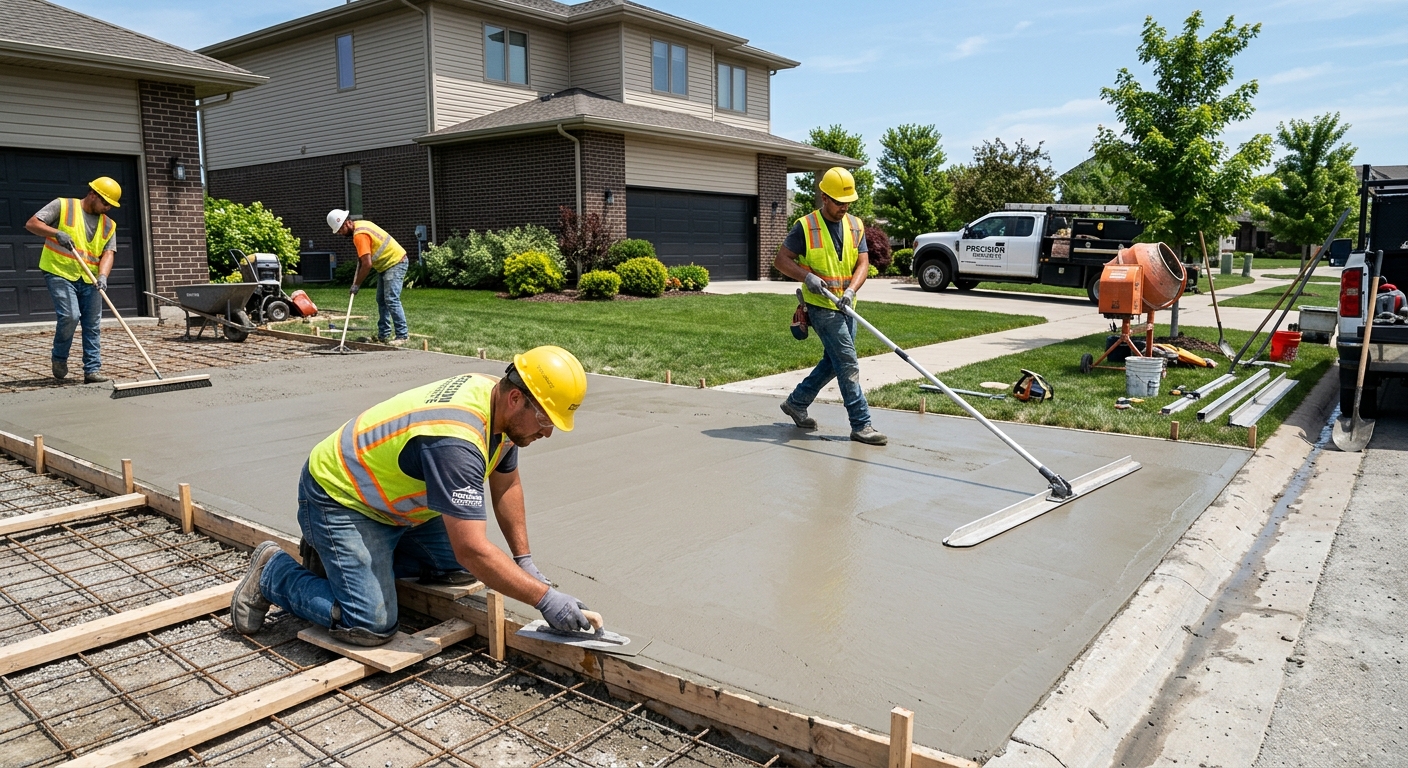
Concrete work options and costs in Coquitlam Town Centre
Concrete work in Coquitlam Town Centre typically falls into a few predictable categories—driveways, patios/walkways, garage slabs, and structural foundation items. In this market, most homeowners upgrading concrete flatwork are doing so in a neighbourhood of detached and duplex-style housing where exterior slabs see heavy day-to-day traffic. With Coquitlam’s population at 24,282 (Statistics Canada, 2021 Census), demand is steady, and tradesmen are busiest when weather windows open in spring.
Lower Mainland–Southwest pricing is shaped by our mild-but-wet winters and a shallow frost depth requirement (commonly designed around roughly 450 mm / 18"). Even though frost penetration is not as deep as in other parts of Canada, freeze–thaw cycles and saturated soils still drive costs: base prep usually includes compacted granular, improved subgrade drainage, air-entrained concrete mixes, and carefully placed control joints. Rain and high humidity also affect curing—contractors often schedule longer cure/conditioning periods and use curing blankets or sealers to reach durability targets.
In Coquitlam Town Centre, concrete work is especially in demand around the retail and transit core along Lougheed Highway and the surrounding town-centre blocks, where homeowners and property managers prioritize durable, crack-resistant driveways and patios that can handle winter moisture and spring re-freezing. Use the table below to compare typical costs for common options, then we’ll break down what changes the price in Section 2.
| Application |
Typical Size |
Key Spec |
Finish Option |
Price Range |
| Concrete driveway (standard broom finish) |
16 ft x 20 ft (320 sq ft) |
Air-entrained exterior mix, compacted granular base, control joints |
Broom finish, saw-cut joints |
$5,800–$8,900 |
| Exposed aggregate driveway |
16 ft x 20 ft (320 sq ft) |
Proper curing and surface retarder/aggregate exposure process |
Exposed aggregate finish |
$6,700–$10,200 |
| Stamped concrete driveway or patio |
12 ft x 20 ft (240 sq ft) |
Air-entrained exterior mix, integral colour, release agent |
Stamp pattern with colour hardener/antiquing |
$6,000–$9,100 |
| Plain concrete patio or walkway |
10 ft x 16 ft (160 sq ft) |
Compacted base, control joints where needed |
Broomed or light trowel finish |
$2,600–$4,150 |
| Garage floor (interior slab) |
20 ft x 22 ft (440 sq ft) |
Vapour barrier, fibre or mesh where specified, proper mix |
Steel-trowel finish or broom edge |
$7,300–$11,900 |
| Foundation footings (structural, below frost) |
Per-project allowance |
Excavation to below frost line, rebar, concrete designed for the foundation |
Structural plain concrete/formed footings |
$8,000–$20,000 |
Prices are estimates only and vary by project scope, site access and material selection.
What affects the price of concrete work in Coquitlam Town Centre
In Coquitlam Town Centre, two quotes for the “same” concrete project can differ by 30–50% because the expensive parts aren’t always visible. The visible surface may look identical, but labour and materials swing based on excavation depth, base build-up, rebar placement, concrete mix specification (especially air content), and how carefully crews manage curing during wet or cool stretches in the Lower Mainland–Southwest. The region also has a dense contractor market around the Vancouver–Surrey–Abbotsford corridor, so scheduling, crew availability, and truck logistics can affect unit costs.
Frost line depth and freeze–thaw cycles dictate every spec: exterior concrete must be designed so footings extend below the local design frost depth. In coastal BC, typical design assumptions commonly land around 0.5–1.2 m, depending on site conditions—still deep enough that forms, excavation, and disposal can quickly become the biggest line items. Every exterior slab should use air-entrained concrete mixes to survive freeze–thaw and moisture cycling. Colder regions often need additional heating for pours and longer cure protection; even in coastal BC, cool nights and prolonged rainfall can add curing/blanket time and delay scheduling, which costs money.
Examples in Coquitlam Town Centre that commonly move price up or down: a driveway on a tighter lot with limited truck access can add haulage time; poor drainage or saturated subgrade often requires extra granular and geotextile separation; and selecting stamped concrete can raise costs well above a standard broom driveway because of colour products and stamping labour (for reference, standard driveway pricing typically sits within an $18–$28 backbone band, while stamped work commonly falls higher in the $22–$36 range). If you’re pouring near an older home where drainage has shifted over years, you may also be paying more up front to correct grade rather than simply “adding concrete.”
| Price Factor |
Why It Matters |
Cost Impact |
| Frost line depth — determines footing depth and form height |
Footings must sit below the design frost zone to prevent heave |
Higher excavation and more forming per lineal foot |
| Site preparation — excavation, grading, compacted granular base |
Correct base prevents settlement and reduces cracking |
Extra granular, compaction labour, and disposal/haul time |
| Reinforcement — rebar or wire mesh requirement |
Controls cracking for structural elements and slabs |
Material cost plus labour to place and chair steel |
| Mix design — air-entrainment and compressive strength spec |
Air void system improves freeze–thaw durability |
Cost increase in concrete supply + more QA on placement |
| Finish type — broom vs. stamped vs. exposed aggregate |
Finishes add labour steps and sometimes extra products |
Stamped/exposed generally higher per square foot |
| Pour size and concrete truck access to site |
Access affects how much time crews spend pumping/placing |
Truck scheduling/pump fees and extended labour |
| Cold-weather curing precautions — heating and blankets |
Protects strength gain during cool, wet conditions |
Blankets, heaters, and longer scheduling windows |
| Control joint pattern and sealing cost |
Joints manage shrinkage; sealing reduces moisture/road salt impact |
Saw-cut labour and sealer material + cure-time coordination |
Permits & regulations in British Columbia
In British Columbia, structural concrete work—such as footings, foundation walls, and grade beams—typically requires a building permit and often involves engineered drawings that the municipality reviews as part of the permitting process. Concrete flatwork (like patios, walkways, and driveways) often does not require a permit by itself, but there are common exceptions: if the work affects lot grading, changes drainage patterns, impacts stormwater management, or involves municipal right-of-way/sidewalk tie-ins, you’ll want to confirm requirements before breaking ground.
For homeowners in Coquitlam Town Centre, the best approach is to verify expectations early. Step one: ask your contractor whether drawings or permits are required for the specific scope (foundation items always trigger this more often than slab-only work). Step two: confirm the contractor carries liability insurance and has the proper coverage for workers. Step three: request their documents before work starts, not after.
To check coverage, look for a certificate of insurance showing liability coverage, and request proof of workers’ coverage (WSIB/WCB). Then verify licensing: find the contractor’s registration or standing through the appropriate provincial/licensing registry your contractor provides. Finally, ask for clearance letters or documentation they can supply upon request.
When you’re comparing bids, ensure the quote states whether permit pulls are included (or clearly excluded) so you’re not surprised later.
Getting concrete right in Coquitlam Town Centre's freeze-thaw climate
Concrete in Coquitlam Town Centre can fail when the foundation or slab system can’t handle moisture, freeze–thaw cycling, and settlement. The biggest issues I see are inadequate base preparation, incorrect mix design (especially insufficient air-entrainment), poor jointing, and curing that’s shortened by wet weather. To spec the job correctly, start with base prep: excavate to the designed grade, then place compacted granular sub-base to the proper depth for your soil and drainage conditions. Next, specify mix design—exterior flatwork should use air-entrained concrete (commonly targeted at 5–7% air content) and a minimum 32 MPa compressive strength so it reaches design durability through winter cycles.
Control joints matter as much as the mix. Proper spacing limits random cracking by giving concrete a planned place to crack. After the pour, curing is critical: aim for at least a 7-day curing period under conditions that support strength gain, and protect during cool or damp spells. Finally, sealing: apply a penetrating sealer after the concrete has cured (typically around 28 days) to help repel moisture and road salts from de-icing.
Here’s a practical pricing example: if you’re choosing between a standard broom driveway and a stamped finish, the stamped option typically costs more per square foot because of integral colouring and stamping labour. But spending for the right base and air-entrained mix is non-negotiable in our wet-freeze environment—if a contractor tries to “save” there, the cheaper price is often what leads to spalling later. Ask your contractor pointed questions about air-entrainment, base depth/compaction, joint plan, and curing protection.
| Spec |
Why It Matters in Coquitlam Town Centre |
What to Ask For |
Impact if Skipped |
| Compacted granular base (depth?) |
Supports slab and reduces settlement under wet, freeze–thaw conditions |
Granular type, target thickness, and compaction testing/verification method |
Cracking, rocking, and premature surface deterioration |
| Air-entrained concrete mix (target air %?) |
Air voids protect against freeze–thaw scaling and spalling |
Documented air content target (commonly 5–7%) and approved mix design |
Spalling, scaling, and rough pitting within a few winters |
| Compressive strength (MPa rating) |
Ensures strength gain for durability and load performance |
Minimum 32 MPa specified for exterior flatwork (or as engineered) |
Reduced durability and higher risk of surface failures |
| Control joints (spacing per ACI guidelines) |
Guides where shrinkage cracks occur instead of random cracking |
Joint spacing plan and timing for saw-cut or formed joints |
Random cracking through the riding surface |
| Minimum 7-day curing period |
Strength development relies on adequate curing in cool/moist weather |
How curing is protected if rain/cool nights happen |
Surface weakness and poor long-term performance |
| Penetrating sealer (when applied after cure) |
Helps repel moisture and reduces damage from de-icing salts |
Sealer type and confirmation of application after cure (often around 28 days) |
Faster staining, scaling, and water ingress |
How to choose a concrete work contractor in Coquitlam Town Centre
Choosing the right contractor in Coquitlam Town Centre is mostly about verification and clarity. First, confirm British Columbia licensing/registration status through the contractor’s provided information and the relevant provincial registry they reference. Next, ask for a certificate of liability insurance (showing they’re insured for property damage and bodily injury) and request proof of WSIB/WCB coverage for their workers. Don’t accept “we’re covered” as a statement—ask to see the documents or copies.
Second, get 2–3 itemised written quotes. Ideally, each quote breaks labour and materials: excavation/disposal, granular base, reinforcement (mesh/rebar), concrete supply with specified air-entrainment, forms, finish labour, saw cutting, and sealer (if included). Watch for exclusions like “no allowance for pump”, “customer provides access”, or “disposal not included.” For timelines, request a start date and completion estimate in writing, and ask how weather delays are handled—rain and cool nights are common scheduling variables here.
Third, warranty and payment schedule matter. Require a workmanship warranty length in writing and clarify whether product/manufacturer warranties apply to integral products like sealers or admixtures. Payment should not exceed 10–15% upfront; use holdback until the work is complete and reviewed.
- Ask for the mix spec: air-entrainment target and minimum strength
- Confirm base depth/thickness and compaction expectations
- Require a joint plan (where and spacing) for driveways and patios
- Check that reinforcement is included when needed (mesh vs. rebar)
- Ensure truck access and pumping plans are discussed before quoting
- Request disposal haul details (is it included or an extra cost?)
- Confirm whether permits/engineering are included for structural items
- Ask how they protect curing in wet/cool weather (blankets, curing compound where allowed)
- Verify sealer type and whether it’s included (and when it will be applied)
- Get the warranty in writing, including who to contact for service
- Use itemised line items—avoid “lump sum” with vague scope
- Confirm the payment schedule and holdback amount before signing
Red flags I see in this market: contractors who won’t discuss air-entrainment or show mix documentation; quotes that skip base prep thickness/compaction; “too-cheap” stamped or exposed work that doesn’t explain materials; no proof of insurance/WSIB/WCB; and proposals with large upfront payments or no written warranty terms.
Frequently asked questions — concrete work in Coquitlam Town Centre
How do I maintain concrete in Coquitlam Town Centre's freeze-thaw climate?
In Coquitlam Town Centre and the rest of British Columbia’s Lower Mainland–Southwest, maintenance is mainly about controlling moisture and protecting the surface from freeze–thaw damage. Keep the concrete clean and remove debris that can trap water. Use a penetrating sealer (typically after full cure—often around 28 days) to help repel water and reduce the impact of de-icing salts used in winter. Avoid harsh chemical abrasion; instead, use gentle cleaners and a soft brush. During late fall and early spring, clear snow promptly so meltwater doesn’t repeatedly soak the slab edge and joints. If you notice hairline cracking at joints, don’t ignore it—have joints evaluated and resealed as needed to keep water from entering the slab system. (Statistics Canada, 2021 Census) tells us Coquitlam’s population is 24,282, and dense neighbourhood activity means driveways often see heavy traffic, so timely maintenance really pays off.
What causes concrete to spall in Coquitlam Town Centre winters?
Spalling is usually linked to moisture movement plus freeze–thaw action, and in our coastal-wet conditions that combination is common. The most preventable cause is inadequate air-entrainment in the concrete mix—without a correct air void system, water in the paste can expand when temperatures drop, breaking the surface layer. Poor base drainage can also keep the slab edge and subgrade saturated, increasing the number of freeze–thaw cycles around the concrete. Another driver is missing or incorrectly spaced control joints; random cracking can create pathways for water to enter and damage the surface over repeated winters. If de-icing salts are used, sealing becomes important because salts can accelerate deterioration. If you’re quoted at the low end of typical driveway pricing (for example, concrete driveway work often lands in a $18–$28 per square foot backbone range), confirm they’re still specifying air-entrained exterior mix, proper base prep, and jointing.
What is rebar and when is it required in British Columbia?
Rebar (reinforcing steel) is used to strengthen concrete and control cracking by adding tensile capacity to the slab or foundation. In British Columbia, whether rebar is required depends on the structural design and engineering requirements for the specific application. For example, foundation footings and foundation walls are typically engineered structural components and often require rebar per drawings, because they carry loads and resist movement. For exterior flatwork like driveways, reinforcement requirements may include wire mesh or rebar depending on slab thickness, intended loads (vehicle type/frequency), and local design practices. A contractor should base reinforcement on the thickness, subgrade preparation, and any engineering or local spec they’re working to. When comparing quotes in Coquitlam Town Centre, ask whether reinforcement is included, where it sits (proper chairs/tie placement), and what spacing/mats are being supplied—don’t rely on “it’s standard.”
How long does a concrete project take in Coquitlam Town Centre?
The “time on site” for concrete is often short, but the total project timeline in Coquitlam Town Centre can be longer because scheduling and curing depend on weather. For a driveway or patio, excavation and forming typically happen first day(s), followed by delivery and placement. The pour itself can be a few hours, but finishing, saw cutting (when required), and curing protection are critical. Minimum curing is often at least 7 days for strength development before heavy use, and many homeowners notice best durability after full cure—commonly around 28 days—when sealing is applied. Weather interruptions are common in the Lower Mainland–Southwest: cool nights, prolonged rain, and high humidity can delay placement or require curing blankets. So while crews may complete the work in under a week for many flatwork jobs, plan for coordination time, inspections (if structural permits are involved), and final handover after cure and any sealer window.
What is a concrete overlay and is it suited to Coquitlam Town Centre?
A concrete overlay is a new concrete layer placed on top of an existing slab after preparation—usually involving cleaning, patching, and often mechanical profiling to promote bonding. Overlays can be a good option when the original slab is still structurally sound but has surface defects like shallow scaling, minor spalling, or unevenness. In Coquitlam Town Centre, overlays can be suited to the freeze–thaw environment if the contractor does proper prep and addresses drainage and joint/edge conditions; otherwise, moisture can keep working through the slab system and cause failures at the interface. Overlays are also less suited when the original concrete has widespread structural cracking, significant base settlement, or failing drainage around the edges. Price-wise, overlays are sometimes attractive compared with full replacement, but the right choice depends on thickness requirements and bonding quality. Ask for an explanation of base condition, bonding method, and whether the mix includes the proper air-entrainment for exterior exposure.
How do I seal concrete to protect it in Coquitlam Town Centre?
Sealing helps protect exterior concrete from moisture and impacts from de-icing salts—important in Coquitlam Town Centre because wet weather and freeze–thaw cycles can accelerate scaling and spalling. The key is timing: most contractors wait until the concrete is fully cured before applying sealer, commonly around 28 days for exterior slab work, and only after verifying the surface is clean and ready to accept product. Use a penetrating sealer (not just a surface film) when appropriate for your slab type; it helps repel water while allowing the concrete to manage internal moisture. Before sealing, ensure joints and cracks are properly handled—sealer won’t “fix” water pathways if joints are neglected. Ask your contractor what product is used, how it will be applied, and whether they recommend re-application intervals. If your driveway or patio was priced in the standard broom range (such as the $18–$28 per square foot backbone), ask whether sealer is included or an add-on—durability often depends as much on sealing as on the initial concrete mix.