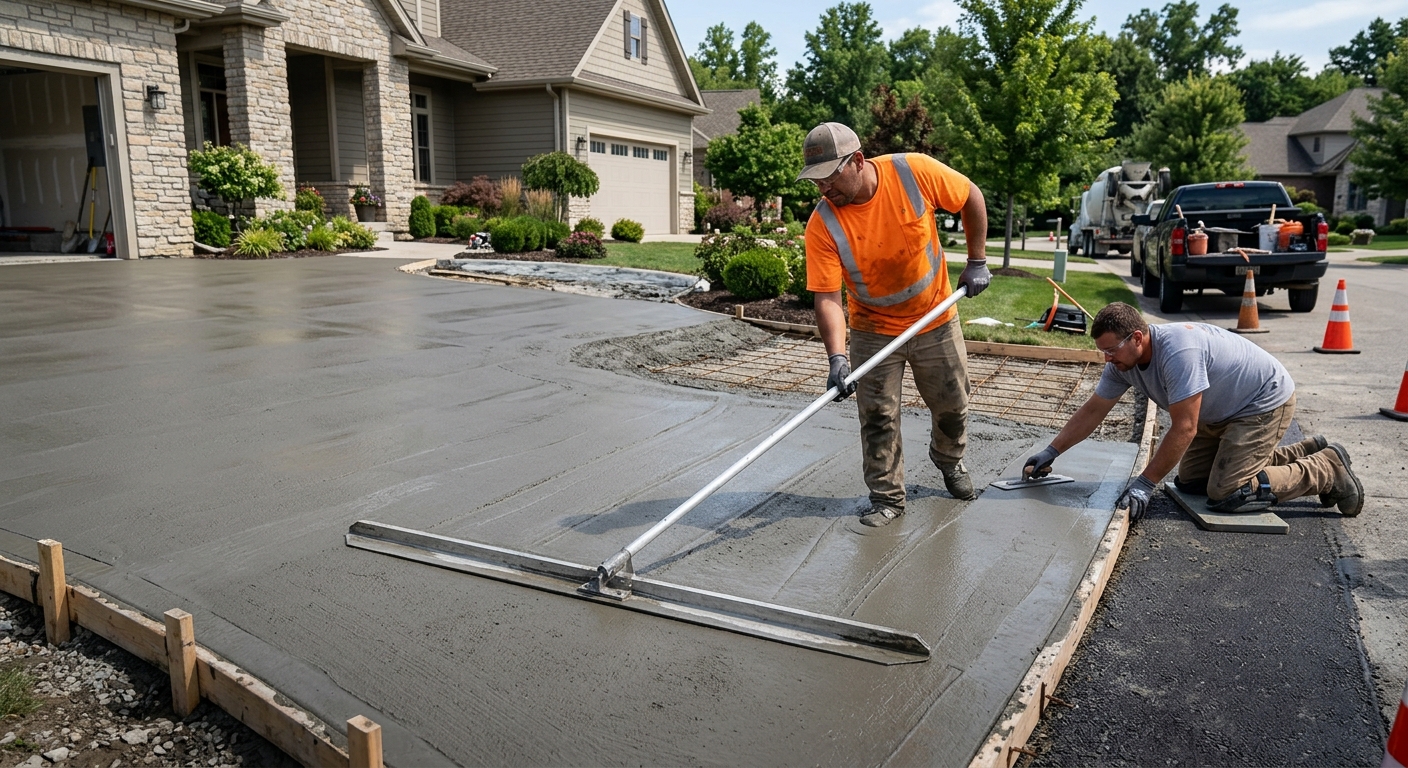
Concrete work options and costs in Royston
Royston homeowners typically choose concrete because it’s durable, low-maintenance, and fits the area’s wet, coastal winters. With a population of 1,616 (Statistics Canada, 2021 Census) and a housing stock that favours smaller lots and frequent renovations, concrete flatwork—especially driveways, patios and walkways—is a go-to upgrade. In the Lower Mainland–Southwest, contractor availability is steady, but pricing is shaped by the region’s shallow-yet-crucial frost management and by persistent moisture. Even when winters feel mild, we design for a frost depth around 450 mm / 18", and we still place footings and thickened edges below that level to reduce freeze–thaw and frost-heave risk. Heavy coastal rainfall also means base prep, drainage, and schedule planning matter as much as the pour itself.
For many properties near local activity nodes and busier lanes where access is tight, crews often spend extra time on excavation sequencing, form setup, and water management—costs that show up in the quote even when the visible concrete area looks “similar.” That’s why a broom-finished driveway may land in the low end of the market, while stamped or decorative work climbs quickly with labour, forms and finishing time. In Royston, trades are especially in demand around the core neighbourhoods where driveways connect directly to walkways and garages.
Below are realistic cost bands you’ll see for common concrete options in Royston, using the Lower Mainland–Southwest pricing framework as the backbone.
| Application |
Typical Size |
Key Spec |
Finish Option |
Price Range |
| Concrete driveway (standard broom finish) |
400–600 sq. ft. (37–56 m²) |
Air-entrained exterior mix, compacted granular base, control joints |
Broom finish + 7-day cure planning |
$7,200–$13,800 |
| Exposed aggregate driveway |
400–600 sq. ft. (37–56 m²) |
Exposed-aggregate design, proper surface wash timing, sealed finish |
Exposed aggregate with broom/texture wash |
$10,000–$16,800 |
| Stamped concrete driveway or patio |
300–500 sq. ft. (28–46 m²) |
Colour + stamp system, air-entrained mix, crack control strategy |
Stamped pattern with release + integral colour |
$9,600–$18,000 |
| Plain concrete patio or walkway |
200–400 sq. ft. (19–37 m²) |
Compacted base, grade to drain, air-entrained exterior mix |
Float/trowel then broom or light brush finish |
$3,200–$10,400 |
| Garage floor (interior slab) |
300–600 sq. ft. (28–56 m²) |
Vapour/ground prep as needed, fibre or mesh depending on use, curing |
Smooth-to-broom finish (finish level varies) |
$6,000–$15,600 |
| Foundation footings (structural, below frost) |
Varies by home design (per linear foot) |
Excavate below local frost spec, formwork, rebar cage placement |
Structural concrete only (not decorative) |
$200–$350 |
Prices are estimates only and vary by project scope, site access and material selection.
What affects the price of concrete work in Royston
In Royston and across the Lower Mainland–Southwest, it’s common to see quotes for the “same” driveway differ by 30–50%. The reason isn’t just the concrete. It’s the full build-up: excavation depth, base thickness and grading, drainage provisions, reinforcement requirements, mix design, forming complexity, and how long the job needs to wait out rain or cool nights. In other parts of BC, labour availability, hauling distances, and winter constraints can also shift the cost picture.
Frost line depth and freeze–thaw cycles dictate every exterior spec. Even with coastal conditions, we plan around a local frost depth around 450 mm / 18", which means exterior footings and thickened edges must extend below that design level to prevent frost heave. All exterior slabs in this zone should use air-entrained concrete mixes to survive repeated wetting and freezing. When it’s colder, the pour season can be shorter, and crews may need cold-weather precautions—insulating blankets and controlled curing—to reach design strength. De-icing salts (common on driveways in winter) accelerate surface spalling if the concrete isn’t properly specified and sealed.
In practice, you’ll notice cost differences for Royston jobs like these: replacing a small, well-drained walkway on compacted base may come closer to the lower end of the plain patio/walkway band (often around $16–$26 per sq. ft. framework), while a driveway with tight access, regrading, and thicker base pushes toward the higher end of driveway pricing because of extra prep and time. Older home lots with more fill or poor slope away from the house can require additional excavation and granular replacement—one of the biggest “hidden” drivers. As a reference point, foundations/footings are typically priced in the $200–$350 range per linear foot framework because excavation and reinforcing go deeper below frost.
| Price Factor |
Why It Matters |
Cost Impact |
| Frost line depth |
Determines footing depth and form height below local frost management level |
More depth = more excavation and concrete; often the largest structural driver |
| Site preparation |
Excavation, grading, removal of unsuitable soils, compacted granular base |
Can swing costs significantly on sloped or waterlogged lots |
| Reinforcement |
Rebar or wire mesh where required for load or crack control |
Material + labour to place, tie, and support reinforcement |
| Mix design |
Air-entrainment and compressive strength spec for freeze–thaw durability |
Exterior-specified mix can cost more but reduces early scaling/spalling |
| Finish type |
Broom vs. stamped vs. exposed aggregate changes finishing time and tooling |
Stamped/exposed typically adds labour and speciality materials |
| Pour size and concrete truck access to site |
Large pours and limited access require extra labour or multiple placements |
Truck placement constraints can add hours for forming and handling |
| Cold-weather curing precautions |
Heating/insulating blankets protect strength gain when nights are cool |
Adds materials and labour; critical for durability in cool periods |
| Control joint pattern and sealing cost |
Joints guide cracking; sealing reduces moisture and salt impacts |
Proper jointing avoids early cosmetic failures and reduces long-term repair risk |
Permits & regulations in British Columbia
In British Columbia, what needs a permit depends on the type of concrete work. Structural concrete work—such as footings, foundation walls, grade beams, and other load-bearing elements—typically requires a building permit. Many projects also involve engineered drawings reviewed through the municipality. Concrete flatwork (patios, walkways, and standard driveways) often does not require a permit unless it impacts lot grading, drainage, or impervious surface coverage limits, or affects municipal right-of-way areas. Before breaking ground in Royston, confirm requirements with the local authority and follow any setback or drainage conditions that apply.
As a homeowner, verify the contractor is properly set up to work in BC. Here’s a practical step-by-step approach:
- Check the contractor’s licence/credentials using the appropriate online registry listings (search the company name and individual trades linked to the project scope).
- Request a current certificate of liability insurance and confirm the coverage amount matches the job size and risks (especially excavation and equipment access).
- Ask about WSIB/WCB coverage (coverage must align with the contractor’s staffing and labour practices).
- Request clearance letters or proof of account status if applicable to their operating model.
- Confirm they can provide references on similar-scale concrete flatwork or structural scope in BC’s coastal-wet climate conditions.
Do this before the first site visit so you’re comparing apples to apples on legal compliance, not just finish style.
Getting concrete right in Royston's freeze-thaw climate
Concrete fails in Royston mainly through a predictable chain: water gets into the surface or joints, freeze–thaw cycling expands that damage, and weak base prep or poor mix design accelerates scaling or spalling. Even though the frost line is relatively shallow in Lower Mainland–Southwest, we still place footings and thickened edges below a design frost depth around 450 mm / 18" to limit frost heave. For exterior slabs and driveways, the key is a durable system: (1) base preparation, (2) air-entrained mix design, (3) correct control joints, (4) curing that reaches strength under cool/humid conditions, and (5) sealing after cure to repel de-icing salts.
To spec the job correctly, insist the contractor outlines base thickness and compaction method for your soil and drainage conditions, then confirms an air-entrained exterior mix (commonly 5–7% air content) with minimum compressive strength (often 32 MPa for exterior work unless engineering specifies otherwise). Control joints should be placed to manage shrinkage and temperature movement rather than letting random cracking occur. Curing is non-negotiable: plan for at least 7 days of curing under proper conditions, and in cold or rainy windows, use blankets/covered curing where required. Sealing is typically applied 28 days post-pour so the concrete is cured and ready to resist salt exposure.
When price comparisons confuse homeowners, the best example is decorative options: stamped concrete often costs more than broom-finish. A typical broom driveway can land around the $18–$28 per sq. ft. framework, while stamped moves into the $22–$36 per sq. ft. framework. That extra cost is justified when the contractor also budgets time for proper mix, jointing, and curing—not just the stamp itself. If you skip those fundamentals, you may save a little today and pay more for patching later.
| Spec |
Why It Matters in Royston |
What to Ask For |
Impact if Skipped |
| Compacted granular base (depth?) |
Reduces settlement and helps drainage in coastal-wet, freeze–thaw conditions |
Base depth and compaction proof plan for your site soil and slab thickness |
Uneven settling, cracking, and early spalling from trapped moisture |
| Air-entrained concrete mix (target air %?) |
Creates space for freezing water expansion to reduce scaling and surface loss |
Confirm air content target (commonly 5–7%) and exposure class |
Higher risk of scaling/spalling within a few winters |
| Compressive strength (MPa rating) |
Strength gain supports durability and surface abrasion resistance |
Minimum 32 MPa or engineered rating for the application |
Surface weakness, dusting and reduced freeze–thaw resistance |
| Control joints (spacing per ACI guidelines) |
Controls where shrinkage cracks form so they’re predictable and manageable |
Joint spacing plan and saw-cut timing |
Random cracking and moisture pathways that worsen freeze–thaw damage |
| Minimum 7-day curing period |
Cold nights and high humidity can slow strength gain if curing is rushed |
Weather plan: blankets/curing measures if needed |
Reduced strength, poor finishing, and weaker long-term performance |
| Penetrating sealer (when applied after cure) |
Repels de-icing salts and reduces water absorption |
Apply after cure (commonly at 28 days) and confirm product type |
Faster surface deterioration and staining from wet winters |
How to choose a concrete work contractor in Royston
Choosing a concrete contractor in Royston is mostly about verifying competence, not just picking the lowest number. Start with BC compliance. Ask for their contractor licence credentials and confirm they carry liability insurance suitable for excavation and concrete placement work. For worker coverage, request proof of WSIB/WCB coverage or clearance status. Where to look: use the relevant BC trade/contractor registry search for the company and/or individuals named on the estimate; then review the certificate of insurance directly (it should list the insured party, coverage limits, and policy expiry). For WSIB/WCB, ask for a clearance letter or proof of coverage matching the contractor’s labour practice.
Next, get 2–3 itemised written quotes. You want labour and materials breakdowns (excavation/base, rebar/mesh, formwork, finishing, curing/blankets, saw-cut joints, disposal, and sealing where included). Avoid lump-sum quotes that don’t specify what “included” means for drainage and base prep, because those are the cost drivers in this region’s freeze–thaw and coastal rainfall.
Pay attention to the warranty too. A good contractor provides a workmanship warranty length and clearly states what the warranty covers (and what it doesn’t). Confirm whether the product/manufacturer warranty is separate and whether it’s transferable to the homeowner.
On payment schedule, never pay more than 10–15% upfront. Hold back a portion until the forms are removed, joints are cut and sealed as specified, and cleanup is complete. Finally, insist on a written timeline with a start date and completion estimate that accounts for rain delays.
- Itemised labour/materials (base, reinforcement, finishing, curing)
- Explicit exclusion list (what’s not included, like drainage repairs or haul-off)
- Permit responsibility stated (pull included or homeowner handles it)
- Disposal and hauling included or priced separately
- Proof of air-entrained mix use for exterior work
- Control joint spacing plan
- Weather plan for curing during cool nights/rain
- Sealing included (and when) vs excluded
- Insurance certificate reviewed for correct company name and limits
- WSIB/WCB coverage proof or clearance letter requested
- Clear start/completion schedule and concrete pour scheduling plan
- Documented references on similar Royston/Lower Mainland–Southwest projects
Concrete red flags I commonly see in Royston: quotes that skip base prep or can’t explain granular thickness, no mention of air-entrained mix for exterior slabs, “we’ll pour and seal whenever we can” without cure timing, vague jointing details, and contractors who won’t provide insurance/coverage proof or references on comparable freeze–thaw conditions.
Frequently asked questions — concrete work in Royston
How do I seal concrete to protect it in Royston?
Sealing in Royston is about managing moisture and de-icing salt impact during freeze–thaw cycles. For most exterior driveways and patios, contractors typically apply a penetrating sealer after the concrete has fully cured—commonly around 28 days post-pour—so the sealer can work properly rather than trapping moisture. Before sealing, the surface should be clean and dry (no wet leaves, no recent pressure washing residue). Ask your contractor to match the sealer to the concrete finish (broom, exposed aggregate, or stamped) because some products leave different sheen levels. In Lower Mainland–Southwest, we also plan around rain timing; if the forecast threatens multiple wet days, sealing gets rescheduled. If you’re choosing between broom-finish and stamped, the seal is still the durability foundation either way.
What is the difference between concrete and cement?
In everyday terms, people use “cement” and “concrete” interchangeably, but they aren’t the same thing. Cement is one ingredient—typically Portland cement—that binds the other materials together. Concrete is the full mixture: cement plus sand, gravel (or crushed stone), water, and any additives (like air-entrainment for freeze–thaw durability). In Royston, that “air-entrainment” part matters because the local coastal-wet climate still brings enough freeze–thaw action to damage poorly specified exterior slabs. When you receive a quote, a good contractor won’t just say “concrete”—they’ll describe the mix design, target air content for exterior work, curing expectations, and whether the project is in the standard driveway/patio ranges (for example, plain patio/walkway frameworks around $16–$26 per sq. ft. and driveways around $18–$28 per sq. ft.).
How much does concrete work cost in Royston?
Concrete pricing in Royston depends on the application, size, access, and—most importantly—site prep and durability specs for the local climate. For a driveway, many homeowners see broom-finish work in the $18–$28 per sq. ft. framework, while stamped concrete typically sits higher, often around the $22–$36 per sq. ft. framework because of added finishing time and materials. Plain patios and walkways commonly fall into the $16–$26 per sq. ft. framework. Foundations/footings are usually quoted structurally using a per-linear-foot basis, often referenced in the $200–$350 framework due to excavation below frost, formwork, and reinforcement. Your quote may vary by 30–50% across the Lower Mainland–Southwest because base drainage, reinforcement, and curing/blanketing requirements can change even when the visible concrete area is the same. If your lot has drainage issues or extra fill, expect the budget to lean toward the higher end.
How deep must footings be for Royston's frost line?
In the Lower Mainland–Southwest, local concrete practice commonly assumes a design frost depth around 450 mm / 18". Footings and thickened edges should be placed below that design depth to reduce frost heave risk during freeze–thaw cycles. In practical terms, the exact depth depends on your soil conditions, drainage, and engineering requirements for the structure. A contractor should confirm the footing depth with the building/engineering plan rather than guessing. If you’re comparing quotes, ask: “What frost depth are you designing to, and what is the planned excavation depth below grade for my footings?” For exterior flatwork, the same climate concerns drive base prep and air-entrained mixes, even though the frost depth requirement is most critical for structural components. For structural footings, most homeowners see structural pricing referenced in the $200–$350 framework because excavation and reinforcement are labour-intensive.
Why does concrete crack in Royston and how is it prevented?
Concrete cracking in Royston is usually not a “bad concrete” problem—it’s movement and water management. Concrete shrinks as it cures, and it expands/contracts with temperature and moisture. In a wet coastal climate, water can also find pathways through poorly planned joints, then freeze–thaw worsens surface deterioration. The prevention strategy is to control where cracking happens: install control joints at the right spacing and saw-cut them at the correct timing. Proper base preparation and compaction reduce settlement cracks. The mix design matters too: exterior slabs should use air-entrained concrete so freezing water doesn’t aggressively scale the surface. Finally, curing and sealing protect the surface from the wet winters and de-icing salt impacts typical on driveways. Ask for the joint spacing plan and the air-entrainment confirmation—these details separate low-end “price” quotes from long-term performance. If you skip them, cracks are more likely to appear early and may require costly patching.
Stamped vs broom-finish concrete — cost difference?
Stamped concrete costs more than broom-finish because it involves added materials and significantly more skilled labour. Stamped work typically includes an integral colour or colour hardener system, release agents, stamp mats, and careful finishing to keep texture consistent. It also still requires the same durability fundamentals for Royston’s freeze–thaw climate: air-entrained mix, correct base prep, proper joints, correct curing timing, and sealing after cure. In the Lower Mainland–Southwest pricing framework, broom-finish driveways commonly fall around $18–$28 per sq. ft., while stamped concrete is often referenced around $22–$36 per sq. ft. That extra cost can be justified if the contractor also budgets time for proper curing and joint placement instead of rushing the finish. If your driveway area is small, the premium can feel sharper—so it’s smart to compare quotes with an itemised scope, not just the total number.