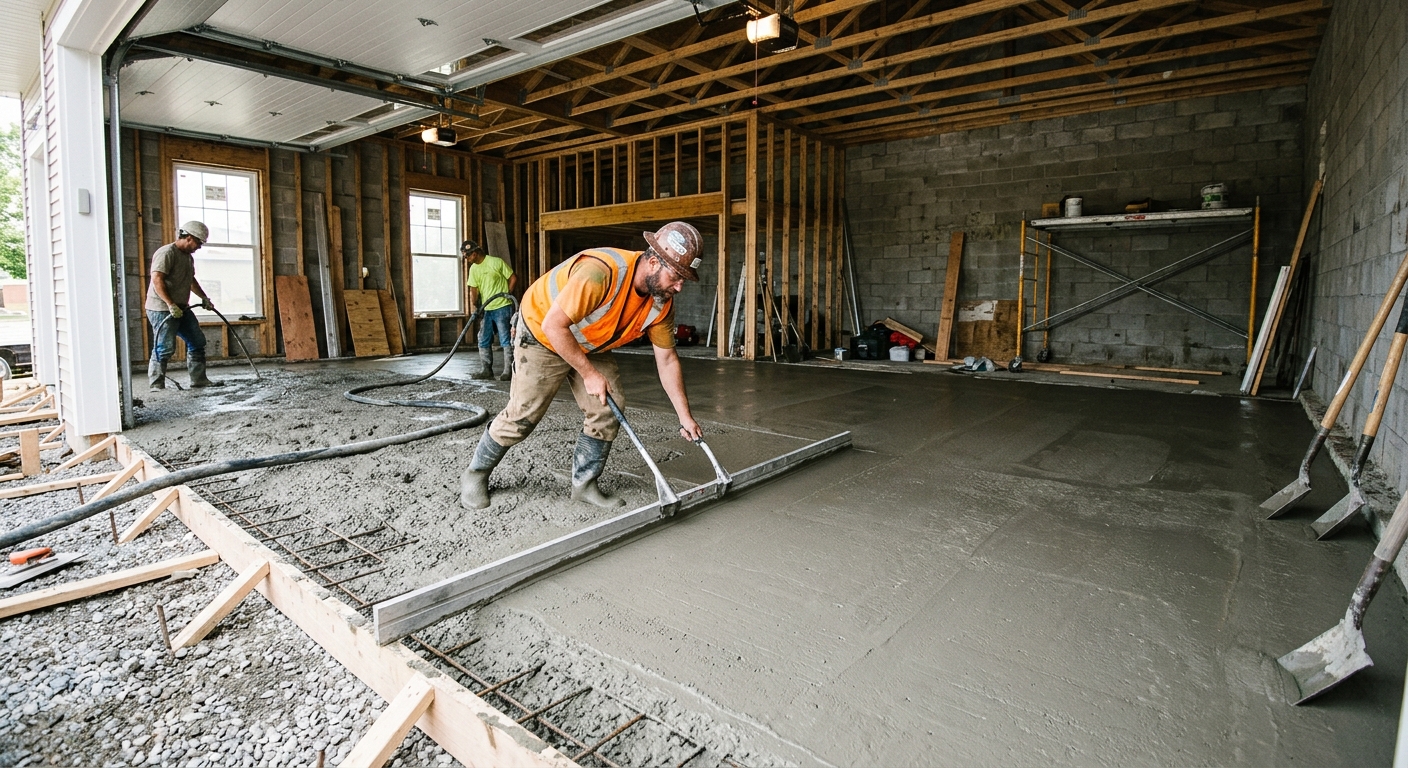
Concrete work options and costs in Fairview
Concrete contractors in Fairview are busy because homeowners rely on durable outdoor flatwork that can handle Lower Mainland–Southwest rain, cool nights and frequent freeze–thaw cycles. Fairview’s housing stock is dominated by single-family neighbourhoods—part of a broader Lower Mainland pattern where single-detached homes are a common backdrop for driveways, patios and walkways—so concrete is a frequent upgrade and replacement choice for front entrances and backyards. With a population of 33,620 (Statistics Canada, 2021 Census), there’s enough local demand to keep crews available, but pricing still tracks the wider Vancouver–Surrey–Abbotsford corridor because labour and trucking are regional.
In this climate, concrete costs are shaped by a frost-depth approach of about 450 mm / 18" for design assumptions, meaning exterior footings and thickened edges are built below that level to reduce frost heave risk. Even though winters are mild compared to interior BC, saturated soils and drainage issues still drive base preparation and mix requirements. For exterior pours, contractors commonly plan longer cure windows around prolonged rain and humidity, using curing blankets and sealers to reach reliable durability—especially for driveways, patios and garage entrances where de-icing salts are used.
If you’re comparing options, the “cheapest” mix usually isn’t the cheapest job in the long run. The right base, air-entrained mix and finishing method determine whether you get years of service or early scaling. Use the table below to benchmark typical project ranges before you request itemised quotes.
| Application |
Typical Size |
Key Spec |
Finish Option |
Price Range |
| Concrete driveway (standard broom finish) |
400–500 sq. ft. (approx. 20' x 20') |
~100 mm slab, air-entrained mix, control joints |
Broom finish, edging, basic sealer option |
$18,000 – $28,000 |
| Exposed aggregate driveway |
400–500 sq. ft. (approx. 20' x 20') |
Air-entrained mix, proper curing and wash timing |
Exposed aggregate (scored/finished) look |
$22,000 – $34,000 |
| Stamped concrete driveway or patio |
300–450 sq. ft. (varies by layout) |
Air-entrained mix, thicker wear surface where needed |
Stamped pattern + release + colour |
$24,000 – $42,000 |
| Plain concrete patio or walkway |
200–350 sq. ft. |
~100 mm slab, compacted base, control joints |
Broom or smooth steel trowel (slight texture) |
$3,500 – $9,000 |
| Garage floor (interior slab) |
300–600 sq. ft. |
Vapour barrier (as required), reinforcement option |
Steel trowel finish |
$9,000 – $18,000 |
| Foundation footings (structural, below frost) |
Varies by house size |
Excavation to below design frost depth, reinforcement |
Structural concrete only |
$10,000 – $35,000 |
Prices are estimates only and vary by project scope, site access and material selection.
What affects the price of concrete work in Fairview
In the Lower Mainland–Southwest region, two quotes for the “same” concrete job can differ by 30–50% because concrete flatwork pricing isn’t just about the cubic metres—it’s about how the contractor handles risk: frost protection, drainage, labour scheduling around wet weather, and the finishing system needed for durability. In Fairview and across British Columbia, mild winters can lower heating/curing costs versus interior regions, but coastal-wet conditions still add labour through extra prep, longer curing timelines and the need for protective practices when it’s cool and damp.
Frost depth and freeze–thaw cycles dictate key specifications. Even in coastal BC, local practice commonly targets a frost depth assumption around 450 mm / 18", and exterior structural elements are placed below that to prevent frost heave. Contractors also use air-entrained mixes so exterior slabs can survive repeat freeze–thaw events and saturated subgrades without rapid scaling. In colder regions with deeper frost, excavation and forming can push costs higher—so British Columbia pricing often sits lower than northern BC on depth alone, but Fairview still pays attention to base drainage and air content to prevent surface failure.
Concrete options also move the needle. A broom-finished driveway may land in the $18–$28 backbone range, while exposed aggregate or stamped finishes add labour and material complexity (timing, wash-out, colour/finishing systems), often pushing totals into the higher tier. For an example, upgrading a standard driveway to exposed aggregate can be justified when you expect faster visual wear in high-sun/high-salt entryways—especially if you live in an older neighbourhood where existing slabs were built with less refined drainage. Fairview’s ongoing home maintenance cycle can mean replacements after decades of service; when you’re removing older concrete, disposal and subgrade repair can add meaningful dollars even if the slab size stays the same.
| Price Factor |
Why It Matters |
Cost Impact |
| Frost line depth — determines footing depth and form height |
Footings/grade beams must sit below the design frost approach to prevent heave |
Higher excavation/form work; can add thousands on structural projects |
| Site preparation — excavation, grading, compacted granular base |
Drainage and compaction control settlement and prevent pumping/voids |
Often the biggest variable; poor access can increase labour and time |
| Reinforcement — rebar or wire mesh requirement |
Reduces cracking risk in garage slabs and structural elements |
Adds material + placement labour; increases cost but improves durability |
| Mix design — air-entrainment and compressive strength spec |
Air entrainment helps resist freeze–thaw scaling and surface damage |
Small per-yard cost, but critical to performance; wrong mix can fail early |
| Finish type — broom vs. stamped vs. exposed aggregate |
Finishing system complexity affects labour hours and rework risk |
Stamped/exposed typically cost more than broom due to skilled steps |
| Pour size and concrete truck access to site |
Impacts number of loads, pumping needs, and crew efficiency |
Limited access and longer carries can raise labour and pump charges |
| Cold-weather curing precautions — heating and blankets |
Controls early-age strength gain when temperatures drop |
Adds labour/material for blankets or temporary heating as needed |
| Control joint pattern and sealing cost |
Manages shrinkage cracking and protects from de-icing salt exposure |
Sealing adds a line item; skipped sealing can shorten surface life |
Permits & regulations in British Columbia
In British Columbia, structural concrete work generally needs a building permit and often engineered drawings reviewed as part of the permit process. This includes footings, foundation walls, and grade beams—anything that carries structural load or supports the building envelope. For concrete flatwork such as patios, walkways and driveways, a permit typically is not required unless the work affects lot grading, stormwater/impervious surface coverage rules, or changes drainage that could impact neighbouring properties or municipal right-of-way. Because requirements can be project-specific, confirm with the local authority before breaking ground.
For your Fairview project, verify your contractor properly. Step 1: ask the contractor for their liability insurance certificate (COI) showing job-site coverage and adequate limits for the scope. Step 2: confirm their workers’ compensation coverage (commonly referenced as WCB/WSIB equivalent coverage under provincial workers’ compensation frameworks). Step 3: check whether they have the correct British Columbia licence/registrations for the type of work they’ll perform by using the provincial registry tools available online. Step 4: request a clearance letter or proof of coverage documentation where applicable. Finally, ask for references on similar-scale local jobs—driveways with good drainage details and exterior sealing practices—so you can see how they handle Fairview’s wet-cool curing conditions.
Getting concrete right in Fairview's freeze-thaw climate
Concrete fails in Fairview mainly from three weaknesses: weak or poorly compacted base, inadequate air entrainment, and poor curing and sealing. Lower Mainland–Southwest weather can bring frequent freeze–thaw cycles and long stretches of rain, which increases the chance that water sits under slabs. When water freezes, it expands and can push at the slab edges and joints. That’s why base prep should include a compacted granular sub-base designed for local soil conditions and drainage control, with excavation and base depth aligned to the project’s frost protection strategy (often targeting below a ~450 mm / 18" design assumption for exterior frost risk).
Next, your mix design matters. For exterior flatwork, specify air-entrainment around 5–7% air and a minimum 32 MPa compressive strength, with proper control of water content at placement. Control joints are not optional—they guide cracking to predictable lines instead of random fractures. Curing is equally important: plan for minimum 7 days under suitable conditions, and in cool, damp weather consider curing blankets to protect early-age strength development. Finally, sealing is a practical layer of defence against de-icing salts and rain-driven surface wear; apply penetrating sealer after full cure, commonly at 28 days post-pour.
To avoid the most common failure—spalling from inadequate air-entrainment—ask your contractor directly: “What air content are you targeting, and how will you verify mix delivery?” If a quote looks low (for example, landing near the lower end of driveway pricing such as the $18–$28 backbone), compare what’s included for granular base depth, joint layout, and whether they’re budgeting for proper curing and sealing. Skipping those items can turn a mid-range price into a costly replacement sooner than you’d expect.
| Spec |
Why It Matters in Fairview |
What to Ask For |
Impact if Skipped |
| Compacted granular base (depth?) |
Controls settlement and prevents water from pooling under the slab during wet/cool periods |
Confirm granular depth and compaction requirements for your subgrade |
Cracking, uneven surface, accelerated wear and drainage problems |
| Air-entrained concrete mix (target air %?) |
Helps the concrete survive freeze–thaw scaling by creating protected micro-spaces |
Specify target air content (typically 5–7% for exterior flatwork) |
Spalling and surface scaling within a few winters |
| Compressive strength (MPa rating) |
Ensures durability and adequate early-age and long-term performance |
Minimum 32 MPa compressive strength (confirm mix design) |
Reduced strength gain; higher risk of premature surface deterioration |
| Control joints (spacing per ACI guidelines) |
Limits random cracking and helps joints stay serviceable through seasons |
Ask for a joint layout plan and typical spacing used for slabs of your size |
Uncontrolled cracks, trip hazards, water infiltration |
| Minimum 7-day curing period |
Protects early strength in cool, rainy conditions common in Fairview scheduling |
Confirm curing method and whether blankets/heaters are used when needed |
Lower performance and increased risk of cracking and scaling |
| Penetrating sealer (when applied after cure) |
Repels moisture and reduces salt attack on the surface |
Apply after proper cure (commonly 28 days post-pour) |
More frequent surface wear; salt-driven spalling becomes more likely |
How to choose a concrete work contractor in Fairview
Choosing a concrete contractor in Fairview is mostly about proving they’ll do the job the same way they described it in the estimate—and that they’re insured for the work they perform. Start with British Columbia licensing/registration for the trades involved in your scope. Then verify liability insurance (ask for a current certificate of insurance listing your address if possible) and confirm workers’ compensation coverage documentation so you’re not exposed if an incident happens on site.
Next, get 2–3 itemised written quotes rather than a single lump sum. An itemised quote should show labour and materials for excavation/base prep, concrete supply, reinforcement (if any), forms, finishing, curing items, joints, and disposal. Watch for exclusions like “subgrade to be assumed” or “drainage not included”—those phrases are where costs rise later. Also confirm whether the contractor includes permit pulling (if required for structural work), and whether they include concrete removal/disposal if you’re replacing existing slabs.
Warranty should be clear. Ask for a workmanship warranty length, what it covers (cracking, scaling, joint performance), and how product/manufacturer warranties are handled. For payment scheduling, never pay more than 10–15% upfront; insist on a holdback until the final walkthrough and cleanup are complete. Finally, require a written timeline: start date, concrete delivery window, and completion estimate. In Fairview’s wet-cool curing conditions, scheduling matters—good contractors plan for rain and cool nights instead of rushing.
- Confirm the correct British Columbia licence/registration for the scope being quoted.
- Request a current certificate of liability insurance before signing.
- Verify workers’ compensation coverage and ask for proof/clearance documentation.
- Get at least 2–3 itemised quotes with labour + materials, not just totals.
- Check that base prep includes compacted granular and disposal of unsuitable material (if found).
- Ensure the quote specifies air-entrained mix and the minimum strength target (e.g., 32 MPa).
- Ask for the control joint plan (layout and spacing) and joint sealing/edge details.
- Confirm curing method and whether blankets/heaters are used when temperatures drop.
- Verify finishing details: broom vs stamped/exposed and who performs the skilled steps.
- Make sure snow/de-icing salt exposure protection is addressed (sealer timing after cure).
- Clarify what’s excluded: permits, site drainage work, waterproofing tie-ins, hauling, pumping.
- Use a payment schedule with only 10–15% upfront and a holdback until final completion.
Concrete red flags in Fairview include: quotes that won’t state air content/curing details, “we’ll pour whenever” scheduling without rain/cold-weather planning, no mention of control joints and sealing, vague scope language around excavation and base depth, and contractors asking for full payment upfront or skipping itemised breakdowns.
Frequently asked questions — concrete work in Fairview
How long does a concrete driveway last?
In Fairview and across coastal-wet parts of British Columbia, driveway life is mainly driven by base preparation, drainage, air entrainment and how joints and surface protection are maintained. A well-built broom-finished driveway with proper control joints, adequate air-entrained mix, and timely sealing can reasonably last many years; performance usually drops faster when de-icing salts and moisture find unprotected cracks or when air content is too low for freeze–thaw exposure. If your driveway is near the typical $18–$28 backbone range, compare what that price includes for granular base depth, joint layout and curing. If sealing is deferred or curing is rushed during cool damp weather, you may see scaling sooner and spend on patching rather than simply enjoying long-term service.
What is air-entrained concrete and why does it matter here?
Air-entrained concrete is mixed with tiny air bubbles that act like pressure-release spaces when water in the concrete freezes. In Fairview’s Lower Mainland–Southwest climate, even though winters are milder than interior BC, repeated freeze–thaw cycles plus saturated subgrades can lead to scaling and spalling if the concrete isn’t designed for durability. That’s why your exterior flatwork should use an air-entrained mix—commonly targeting about 5–7% air—and include proper curing so the concrete reaches its design strength. When contractors omit air-entrainment to hit a lower price, the driveway may look fine initially but deteriorate after a couple winters. This is one reason quotes that look close at first can diverge later: the cheaper bid often costs you sooner through repairs.
How do I prepare the base for a concrete slab?
Base prep is where most driveway and patio performance is won or lost in Fairview. Your contractor should excavate to the required subgrade level, remove unsuitable soils, and place a compacted granular base sized for the slab and drainage needs. They should compact in lifts and verify the base is stable before concrete placement. Because the frost-risk approach in coastal BC practice is still tied to a design assumption around 450 mm / 18", exterior slabs and thickened edges are typically detailed to manage frost heave, even if the overall excavation depth is less than in colder provinces/regions. Ask your contractor to explain granular depth, compaction method, and how they’ll keep water from pooling. If you’re replacing an older slab, insist they address drainage problems rather than simply pouring over existing issues.
How do I compare concrete quotes?
To compare concrete quotes in Fairview, don’t focus only on the final number. Start by asking for an itemised breakdown: excavation and disposal, granular base materials and compaction, reinforcement (if applicable), concrete supply, finishing labour, joint layout, curing methods, and sealer timing. A broom-finished driveway often sits in the $18–$28 range, while stamped or exposed aggregate options tend to be higher because of skilled finishing steps and increased rework sensitivity. Look for exclusions like “subgrade to be assumed,” “no sealing included,” or “control joints by others”—those items can explain a large part of a price difference. Also compare schedule and weather planning: good contractors account for rain, cool nights and curing blankets so the concrete reaches strength.
Can concrete be poured in cold weather in Fairview?
Concrete can be poured in cold weather in Fairview, but only if the contractor uses cold-weather procedures that protect early-age strength. The key is controlling temperature at placement and during curing—using curing blankets, protecting from wind/chill, and planning around rain (because damp curing still needs temperature management). A reputable contractor will tell you what temperature limits trigger additional measures and will adjust the plan to hit the specified minimum strength and durability requirements. If they’re vague about curing or they simply say “it’ll be fine,” that’s a risk for freeze–thaw scaling and early cracking. For exterior work, ask specifically how they handle cool nights and whether they’ll extend curing time. This is especially important for driveway edges and areas exposed to salt.
How do I maintain concrete in Fairview's freeze-thaw climate?
Maintenance in Fairview is mainly about keeping water out of joints and protecting the surface from moisture and de-icing salt. Start with proper sealing: a penetrating sealer applied after full cure (commonly 28 days post-pour) helps repel moisture and reduces salt attack. After that, keep joints clean and re-check them seasonally—small debris or missing sealant can let water into cracks, accelerating freeze–thaw damage. For snow removal, avoid aggressive metal scraping that can damage the surface texture. If you see early scaling or spalling, address it promptly with the right patch material rather than waiting for larger sections to fail. If your driveway was built with correct air-entrainment and joint control at the beginning, maintenance will extend service life, and your repairs should be less frequent and smaller in scale.