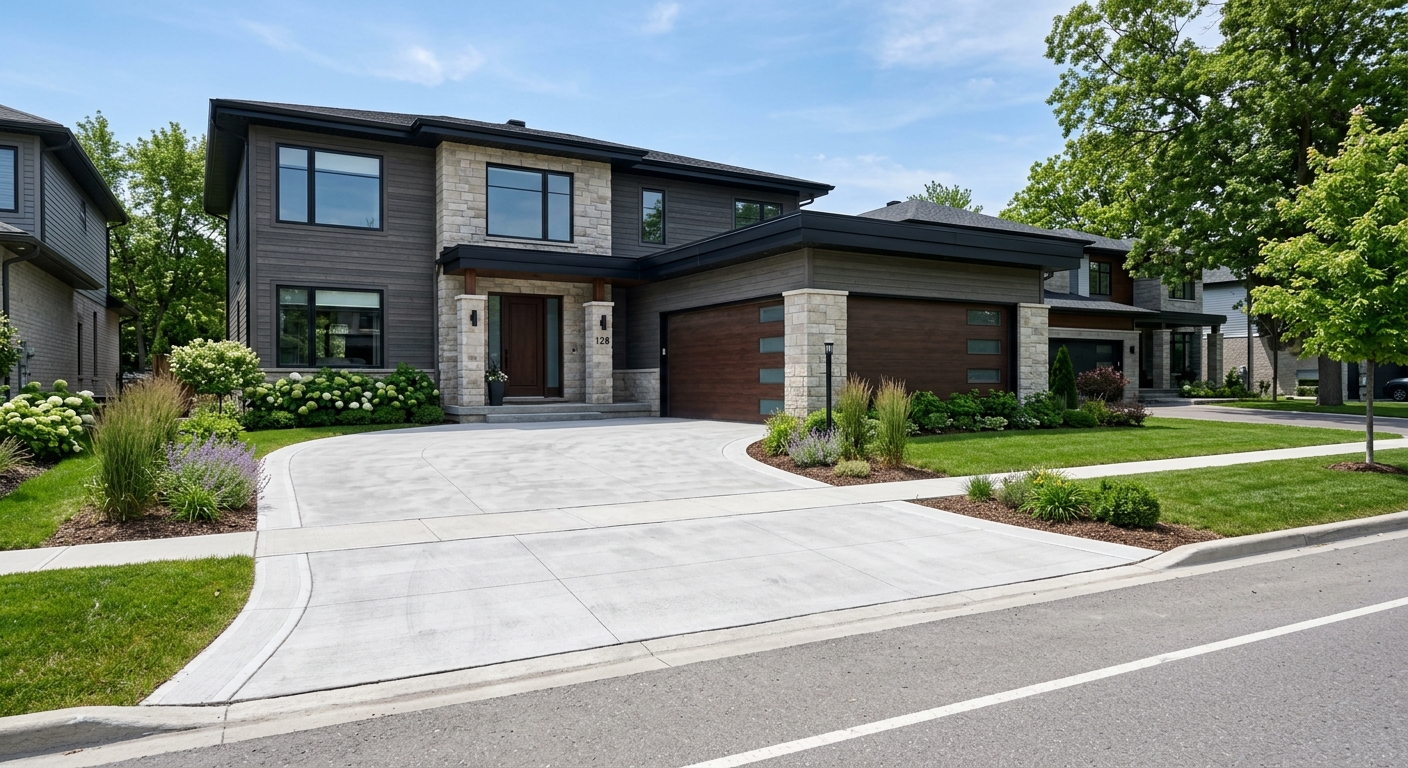
Concrete work options and costs in Maple Bay
In Maple Bay, concrete is one of the most cost-effective ways to create durable driveways, patios, and foundations for local homes. With a population of 2,640 (Statistics Canada, 2021 Census), the market is smaller than the big corridors, so scheduling can be tight during the spring and early summer. Maple Bay’s housing stock is also dominated by single-detached homes—this is the typical buyer who wants new or upgraded flatwork like driveways and walkways, and it’s a big driver of demand in neighbourhoods around Holland Avenue and the surrounding waterfront-access areas where sites often have tight access and changing grades.
Pricing here is shaped by the Lower Mainland–Southwest climate: we get mild winters, but the freeze–thaw cycles and coastal moisture still stress concrete surfaces. In typical code practice for this region, we design footings using a frost depth around 450 mm / 18", so foundations and thickened edges are placed below that level to reduce frost heave. Concrete also needs the right base prep (compacted granular and drainage) and air-entrained mix design to manage scaling and cracking when the ground repeatedly saturates and freezes at the surface. Because rains can slow finishing and curing, contractors often budget extra time for weather monitoring, curing protection, and longer cure windows in cool, humid stretches.
Below are current, realistic price bands for Maple Bay homeowners, then we’ll break down what pushes a quote up or down.
| Application |
Typical Size |
Key Spec |
Finish Option |
Price Range |
| Concrete driveway (standard broom finish) |
400 sq. ft. |
4"–5" slab, compacted base, joints |
Broom finish, standard colour |
$18,900–$28,000 |
| Exposed aggregate driveway |
400 sq. ft. |
Air-entrained mix, wash finish, edging |
Exposed aggregate |
$24,500–$34,500 |
| Stamped concrete driveway or patio |
350 sq. ft. |
Air-entrained mix, integral colouring, seal |
Stamp pattern + sealer |
$20,000–$39,000 |
| Plain concrete patio or walkway |
250 sq. ft. |
4" slab, compacted base, control joints |
Steel trowel or broom texture |
$4,000–$16,500 |
| Garage floor (interior slab) |
400 sq. ft. |
4" slab, vapour barrier, reinforcement option |
Power trowel or light broom |
$9,500–$20,000 |
| Foundation footings (structural, below frost) |
House footing lineal length 120 lin. ft. |
Excavation, formwork, rebar per engineer, below frost |
Structural concrete |
$24,000–$42,000 |
Prices are estimates only and vary by project scope, site access and material selection.
What affects the price of concrete work in Maple Bay
In the Lower Mainland–Southwest region, two quotes for “the same” concrete job can differ by 30–50% because the scope is rarely identical: base preparation depth, reinforcement, mix design, weather protection, and finish complexity all change labour time and material cost. Availability matters too—when crews are booked up around the Vancouver–Surrey–Abbotsford corridor, Maple Bay projects can carry higher mobilisation, especially if the truck can’t reach the pour point directly.
Climate specs drive many of the differences. Even though winters are milder, the freeze–thaw cycles and saturated soils in coastal BC dictate that footings and thickened edges extend below the design frost depth (here typically around 450 mm / 18") to reduce frost heave. Exterior slabs need properly air-entrained concrete to survive repeated moisture movement and surface scaling. When the season is cooler or rainy, contractors also use cold-weather curing precautions—blankets, timing changes, and sometimes enclosure measures—which raises costs versus a warm, stable window. De-icing salts can accelerate surface spalling on untreated or poorly air-entrained concrete, so sealing is a practical durability step.
In Maple Bay, I commonly see cost swings tied to a few site realities. For example, a driveway that requires deeper excavation for drainage and a thicker compacted granular base will land closer to the higher end of the driveway band (for instance, “standard” concrete often trends toward $18–$28 per sq. ft. depending on prep). A decorative upgrade like stamped concrete usually costs more than plain concrete (commonly closer to the $22–$36 per sq. ft. stamped/exposed band) because of integral colouring, stamping labour, and sealing. If your home is older, you may also deal with settled soil or tighter demolition/rebuild logistics that add hours. And while Maple Bay is relatively small (2,640 people, Statistics Canada, 2021 Census), that can mean fewer crews—so getting your site ready ahead of the scheduled pour date can protect your budget.
| Price Factor |
Why It Matters |
Cost Impact |
| Frost line depth |
Determines footing depth and form height below design freeze level |
Higher excavation and formwork if deeper than typical 450 mm/18" |
| Site preparation |
Controls drainage and load-bearing by excavation, grading and compacted granular base |
Can add substantial labour/materials if rework is needed |
| Reinforcement |
Reduces cracking and supports structural requirements |
Wire mesh/rebar increases materials and labour time |
| Mix design |
Air-entrainment and strength targets for exterior durability |
Specialty mix and testing can raise per-yard costs |
| Finish type |
Broom vs stamped vs exposed aggregate changes labour and curing/finishing time |
Stamped/exposed typically adds more cost than plain broom |
| Pour size and concrete truck access to site |
Access affects pumping/hand-carry, staging time and schedule |
Slower access can add crew hours and equipment charges |
| Cold-weather curing precautions |
Blankets, heat or scheduling protect strength gain in cool, wet conditions |
Increases overhead and materials; timing may shift |
| Control joint pattern and sealing cost |
Joints manage shrinkage cracking; sealing helps repel salt and moisture |
More layout work plus sealer material and application time |
Permits & regulations in British Columbia
In British Columbia, structural concrete work typically requires a building permit and often engineered drawings are reviewed by the municipality. That includes footings, foundation walls, grade beams, and any structural slab supporting a building load. Concrete flatwork—such as driveways, patios, and walkways—usually does not require a permit unless it affects lot grading, municipal drainage requirements, impervious surface coverage limits, or the municipal right-of-way (for example, work tied directly to a road frontage). Because rules can change depending on your lot and the proposed elevations, always confirm with the local authority before breaking ground.
For contractor accountability in Maple Bay, ask these items first: proof of liability insurance, proof of Workers’ Compensation coverage, and references for similar-scale projects. Step-by-step, you can verify:
- Check the contractor’s business information online (search their company name and “BC registration/licensing”) and request their certificate details.
- Request a current certificate of insurance showing liability coverage and the effective dates.
- Ask for clearance or coverage confirmation for WCB/coverage for workers on site.
- Confirm the scope of work in writing matches what the permit would cover (especially for any structural elements).
- Verify experience with exterior freeze–thaw durability (air-entrained mix, joints, curing, and sealing) on driveways and patios.
When in doubt, it’s reasonable to ask: “Will you pull any required permits, or is that my responsibility?” A reputable crew will clarify upfront.
Getting concrete right in Maple Bay's freeze-thaw climate
Concrete failures in Maple Bay are usually not about “bad concrete,” but about mismatched specs to our wet, coastal freeze–thaw pattern. The most common issue is spalling—surface scaling and flaking—when exterior slabs don’t have enough air-entrainment or the mix/curing doesn’t reach proper durability. Other problems include random cracking from missing or improperly spaced control joints, and uneven settling when the base isn’t excavated and compacted to the right depth.
To spec the job correctly for the Lower Mainland–Southwest, focus on five areas: (1) base preparation with a compacted granular sub-base sized for your local soil and to reduce pumping/voids; (2) mix design using air-entrainment—typically 5–7% air for exterior flatwork—and a minimum 32 MPa compressive strength; (3) control joints laid out to limit random cracking; (4) curing—minimum 7 days under appropriate conditions; and (5) sealing after cure to repel de-icing salts and moisture-driven deterioration.
Ask targeted questions before the pour: “What air content are you targeting for the mix?” and “How are you protecting the slab during cold, rainy nights?” If sealing is being offered, confirm application timing (commonly 28 days post-pour for many penetrating sealers) so you don’t trap moisture incorrectly.
Where price differences are justified: if a quote offers a lower driveway price near the bottom of the range ($18–$28 per sq. ft.), but skips air-entrainment, joint planning, or proper base thickness, you’ll pay later in patching and re-surfacing. Conversely, if you’re upgrading to stamped or decorative concrete (often $22–$36 per sq. ft.), the extra cost can be worth it when the contractor still budgets correct base prep and durable curing so the decorative surface doesn’t fail early.
| Spec |
Why It Matters in Maple Bay |
What to Ask For |
Impact if Skipped |
| Compacted granular base (depth?) |
Prevents voids and pumping under traffic; supports freeze–thaw durability |
Base depth and proof of compacted lifts suitable for your soil and frost protection |
Settling, uneven slab, early cracking |
| Air-entrained concrete mix (target air %?) |
Reduces damage from moisture freezing and thawing in exterior exposure |
Target 5–7% air for exterior flatwork and confirm mix design |
Spalling/scaling within winters |
| Compressive strength (MPa rating) |
Supports structural and surface durability under wet/cool conditions |
Minimum 32 MPa (or higher if specified for the application) |
Lower durability and higher risk of surface wear |
| Control joints (spacing per ACI guidelines) |
Controls shrinkage cracking locations to protect exterior surfaces |
Joint layout plan and spacing approach consistent with ACI principles |
Random cracking and water infiltration |
| Minimum 7-day curing period |
Ensures strength gain before exposure to moisture and temperature swings |
How curing is protected during cool nights/rain (blankets/covered conditions) |
Surface weakness, scaling, and reduced long-term performance |
| Penetrating sealer (when applied after cure) |
Repels salt and moisture; helps slow freeze–thaw driven deterioration |
Confirm sealer type and timing—commonly around 28 days post-pour |
Faster staining, salt damage and surface breakdown |
How to choose a concrete work contractor in Maple Bay
Choosing the right contractor in Maple Bay starts with verifying credentials and reducing “scope surprises.” In British Columbia, ask your contractor for (1) proof of liability insurance, (2) coverage for workers through WCB/WCB-style coverage, and (3) their business registration details and any applicable trade registrations. How to check: request current certificate of insurance (showing the policyholder and effective dates), ask for confirmation of coverage documentation for the workers who will be on site, and verify their company details through online business lookups. For your peace of mind, also request references for similar exterior work in wet, freeze–thaw exposure.
Next, get 2–3 itemised written quotes rather than lump-sum promises. You want a line-by-line breakdown covering excavation and disposal, base materials, reinforcement, concrete supply (including air-entrainment), finishing, joints, curing protection, and sealing (if included). Read exclusions carefully: will the quote include permit fees or permit support if structural work is involved, and is debris disposal included? Ask what happens if weather delays the pour—crews should be planning for rain and cold nights, not pretending it won’t affect curing.
For warranty, look for a workmanship warranty length and whether it’s practical for exterior exposure problems (not just “we’ll fix it if it crumbles tomorrow”). Confirm product/manufacturer warranties for sealers or decorative systems, and whether they are transferable to future owners. Payment schedule matters: never pay more than 10–15% upfront; hold back a portion until the finish, clean-up, and final sealing (or agreed finish steps) are complete. Finally, require a written start date and completion estimate.
- Request proof of insurance and ask for dates on the certificate.
- Confirm worker coverage via WCB/WCB documentation.
- Get an itemised quote (materials + labour + equipment).
- Ensure the quote specifies air-entrained mix and the intended strength (e.g., minimum 32 MPa).
- Ask for base depth and how subgrade drainage is handled.
- Confirm reinforcement requirements for the application (mesh vs rebar, structural cases).
- Ask how they protect concrete during cool nights/rain (curing plan).
- Require a joint layout plan and sealing timeline if exterior.
- Check access: where will the truck park, will pumping or cutting be needed?
- Clarify disposal and haul-away for excavated material.
- Discuss workmanship warranty terms in writing.
- Lock down a payment schedule with a holdback until final steps are done.
Red flags in Maple Bay: quoting decorative work without naming curing/sealer steps; skipping air-entrainment because “it’s mild here”; refusing to provide insurance/WCB proof; giving a low price but not including base compaction and drainage; and starting without a written scope that covers joints, reinforcement, and clean-up.
Frequently asked questions — concrete work in Maple Bay
What causes concrete to spall in Maple Bay winters?
Spalling in Maple Bay is usually tied to how exterior concrete handles moisture and freeze–thaw cycles. When water gets into the slab (through cracks or porous surfaces) and then freezes, it can expand and break the surface paste. The biggest driver is often inadequate air-entrainment: air bubbles in the mix give freeze water somewhere to expand, reducing internal damage. Poor or rushed curing during cool, rainy stretches can also limit strength development, making surfaces more vulnerable. Finally, de-icing salts can worsen the issue by accelerating deterioration if the concrete isn’t properly sealed. If you’re budgeting, don’t assume “mild winters” means no durability specs—an exterior driveway near the $18–$28 per sq. ft. range still needs the right mix, joints, and sealing to stay intact through British Columbia’s wet/snowmelt periods (Statistics Canada, 2021 Census).
What is rebar and when is it required in British Columbia?
Rebar (reinforcing steel) is embedded in concrete to improve tensile strength—concrete is strong in compression but weak in tension. In British Columbia, rebar requirements depend on what the concrete is supporting. Structural items like foundation walls, footings, grade beams, and engineered slabs typically require rebar per structural drawings. For exterior flatwork such as patios and some driveways, reinforcement may be required or recommended depending on slab thickness, soil conditions, and loads (for example, heavy vehicle traffic). The contractor should also coordinate with the engineer or local requirements where applicable—especially for work that affects structural support below frost depth (commonly around 450 mm / 18" in this region’s practice). The key for homeowners is to ask whether reinforcement is included in the quote and why it’s specified for your soil and use-case.
How long does a concrete project take in Maple Bay?
Project timelines in Maple Bay depend on weather, access, and how much preparation the job needs. For a typical exterior flatwork job, the “pour day” is fast—hours—but the overall schedule includes excavation, base prep, formwork, reinforcement placement, and curing protection. Cold, rainy nights can extend the calendar because contractors plan curing to reach design durability before the surface is exposed to freeze–thaw stress. Realistically, a plain concrete patio or walkway might be several days from site prep to finish work, while a driveway can take longer due to more base grading, joint layout, and edging details. Decorative work (stamped/exposed) adds extra steps for colour, texture application, and sealing coordination. If you’re comparing quotes, focus on whether they include curing/backup protection; it’s often the hidden reason one plan finishes sooner while another is safer and more durable.
What is a concrete overlay and is it suited to Maple Bay?
A concrete overlay is a new concrete surface poured over a prepared, bonded existing slab. It can be a good option when the old slab is largely sound—no major structural failure, heaving, or widespread base failure—because the overlay restores the top surface without full demolition. In Maple Bay’s freeze–thaw climate, overlay success hinges on the prep: cleaning, crack treatment, surface profiling, and ensuring drainage so water doesn’t keep migrating beneath. If the original slab has failed due to poor base compaction or moisture issues, an overlay can fail early. Overlay can also be more expensive than replacing when extensive grinding, patching, or drainage corrections are required. For homeowners comparing options, it’s often easier to budget for full removal and re-pour if there’s movement; otherwise, an overlay may be justified to save time and cost.
How do I seal concrete to protect it in Maple Bay?
Sealing helps protect concrete from moisture intrusion and the effects of de-icing salts, which matter in British Columbia when freeze–thaw cycles stress exterior surfaces. The timing is critical: many penetrating sealers are applied after the concrete has fully cured—commonly around 28 days post-pour—so you don’t trap excess moisture. Preparation matters as much as product choice: the surface must be clean and dry enough to bond properly, and any curing compound residue should be handled correctly by the installer. For driveways and patios in Maple Bay, sealing should be included as part of the durability plan, especially if you anticipate salt use or frequent winter dampness. If you’re deciding between plain broom-finish concrete and a decorative finish, sealing is still required for long-term appearance; stamped work, often priced around the $22–$36 band, is typically more important to protect with the right sealer system.
What is the difference between concrete and cement?
Concrete and cement are related, but they’re not the same. Cement is one ingredient—a fine powder (typically Portland cement)—that reacts with water to form the paste that binds everything together. Concrete is the full building material: cement plus water plus aggregates (sand and gravel/crushed stone), sometimes with additives like air-entrainment for exterior freeze–thaw durability. In Maple Bay, the distinction matters because the performance problems we care about—like spalling from freeze–thaw stress—are driven by the overall concrete mix design and curing, not by the cement type alone. For example, exterior concrete should include air-entrainment (often 5–7% air) and reach appropriate strength (minimum 32 MPa) before exposure. When comparing quotes in British Columbia, ask about the concrete mix specifications—air content, strength target, and curing plan—rather than just “cement brand.”