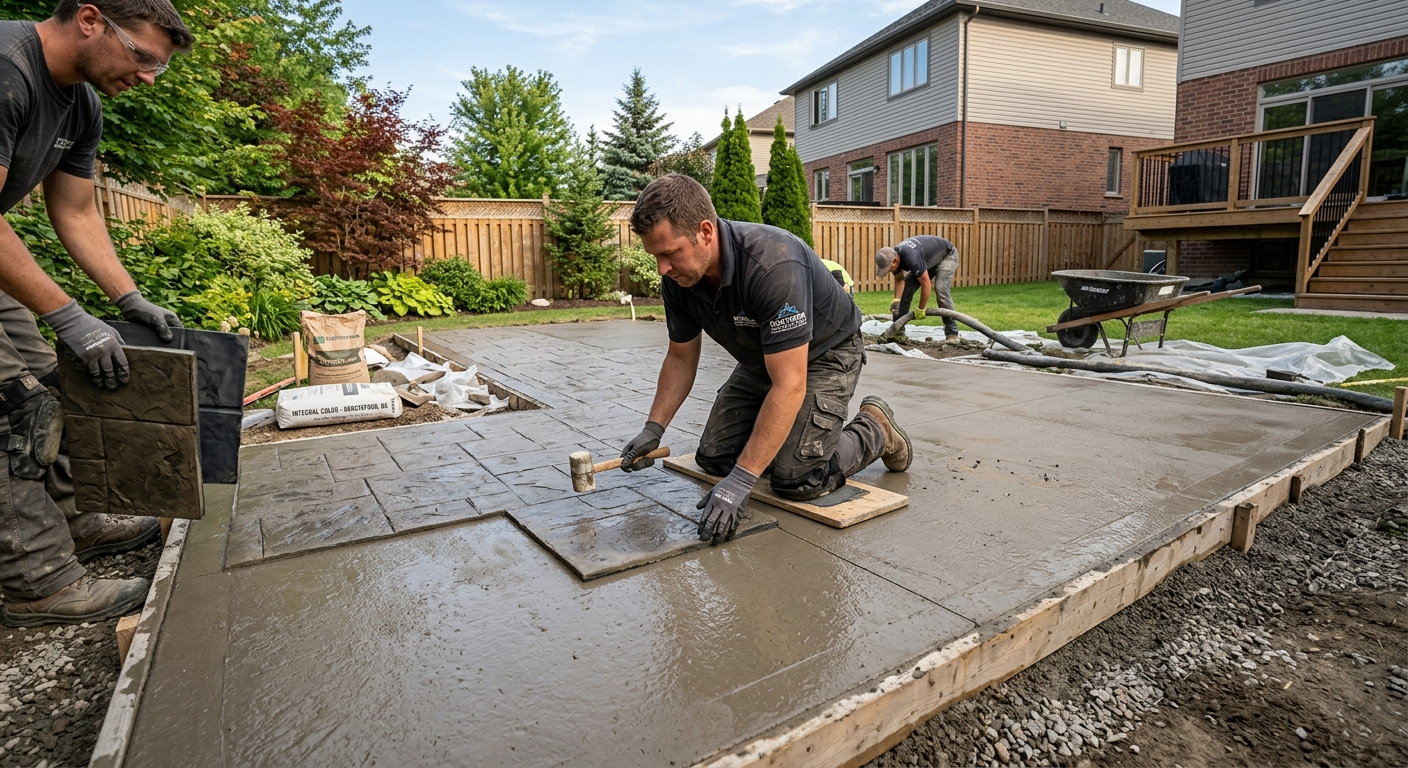
Concrete work options and costs in Boundary
Concrete work in Boundary is primarily driven by the Lower Mainland–Southwest climate—mild winters on paper, yet a shallow frost line that still demands frost-protected design and careful curing around coastal rain. With a total population of 1,585 (Statistics Canada, 2021 Census), the local market is smaller than Vancouver, so crews can be busier when projects ramp up in Abbotsford and Chilliwack, pulling availability into the Boundary area. That timing effect matters because slab and driveway work is sensitive to prolonged wet weather, cool nights, and short “work windows” when subgrades are thawed and can be properly compacted.
Homeowners typically choose concrete flatwork because it fits the predominant housing pattern—many households rely on durable surfaces for driveways, patios, and walkways, and they want a finish that holds up to de-icing salt and freeze–thaw cycling. In this region, codes and practice commonly assume a frost depth around 450 mm / 18", so footings, piers, and thickened edges are placed below that to reduce frost heave risk. The result is straightforward: concrete quotes often look different between “looks the same” projects because base prep, air-entrained mix selection, reinforcement, and curing/finish sequencing change with site conditions and material choices.
In Boundary—especially around the Midway area where rural lots are common—driveways and patios in older properties are frequently scheduled alongside drainage improvements. Next, here’s a practical cost comparison to help you align scope with budget before you request bids.
| Application |
Typical Size |
Key Spec |
Finish Option |
Price Range |
| Concrete driveway (standard broom finish) |
400 sq. ft. (about 20' x 20') |
Air-entrained exterior mix; control joints; compacted granular base |
Broom finish |
$7,200–$11,200 |
| Exposed aggregate driveway |
400 sq. ft. (about 20' x 20') |
Air-entrained exterior mix; proper curing; surface retarder |
Exposed aggregate |
$9,500–$14,000 |
| Stamped concrete driveway or patio |
300 sq. ft. (about 15' x 20') |
Air-entrained mix; integral colour; seal coat |
Stamped / textured |
$8,000–$12,500 |
| Plain concrete patio or walkway |
160 sq. ft. (about 8' x 20') |
Air-entrained mix; compacted base; control joints |
Broom or smooth trowel edge |
$2,500–$4,200 |
| Garage floor (interior slab) |
480 sq. ft. (about 20' x 24') |
Vapour barrier (as needed); proper base; fibre or mesh where specified |
Light broom / finish to suit use |
$7,500–$13,000 |
| Foundation footings (structural, below frost) |
Approx. 40 linear ft. of footings |
Engineered footing size; rebar; excavation below frost depth |
Structural concrete |
$7,000–$14,000 |
Prices are estimates only and vary by project scope, site access and material selection.
What affects the price of concrete work in Boundary
In the Lower Mainland–Southwest, the same “new driveway” can land 30–50% apart from one contractor quote to another because the cost drivers are mostly hidden until you compare specs: excavation and disposal, base thickness and compaction, reinforcement, concrete mix requirements (especially air-entrainment), finishing productivity, and curing/season scheduling. In British Columbia, coastal rainfall and frequent freeze–thaw cycles mean contractors spend more effort protecting the subgrade, managing moisture, and planning pour timing. That’s why labour and material rates can shift quickly even when the visible finish looks similar.
The frost line depth dictates footing and thickened edge design. While Boundary is in coastal BC where frost depth is commonly around 0.5–1.2 m depending on conditions, the practical takeaway is consistent: footings must extend below the design frost depth to prevent frost heave. Exterior slabs also need air-entrained concrete to survive freeze–thaw cycling and resist scaling. When cold weather hits, crews may need curing blankets and temperature control to hit the minimum strength timeline—those precautions add direct labour and equipment cost. Finally, de-icing salt in winter accelerates surface wear; properly specified sealing later on is often the difference between “still smooth” and “roughing up” by the next season.
Local examples in Boundary: (1) a sloped yard in rural areas can add regrading and longer forming days; (2) clay or saturated pockets increase granular base depth and undercut/replace work; and (3) access constraints near older lots can force smaller placements or extra time for concrete delivery and finishing. Those factors can push standard driveway work toward the upper end of the local $18–$28 per sq. ft. band, while simpler patios may stay closer to $16–$26 per sq. ft. Even a modest difference in thickness (for example, adding 1" of base and more granular undercut) can shift labour, truck counts, and compaction time in the final total—often by the amounts you see between bids.
| Price Factor |
Why It Matters |
Cost Impact |
| Frost line depth — determines footing depth and form height |
Controls excavation and the structural concrete volume needed to prevent frost heave |
Can add thousands in excavation and forming; also increases schedule risk |
| Site preparation — excavation, grading, compacted granular base |
Saturated or poor soils require undercut/replacement and more base thickness for stability |
Often the largest swing factor; can shift 30%+ between quotes |
| Reinforcement — rebar or wire mesh requirement |
Reduces cracking and improves durability for driveways and structural slabs |
Material cost plus labour for placement; affects time and layout |
| Mix design — air-entrainment and compressive strength spec |
Exterior freeze–thaw exposure requires air-entrained mix and proper strength |
Higher mix spec and QA can increase material cost but reduces failures |
| Finish type — broom vs. stamped vs. exposed aggregate |
Complex finishes require more labour steps, materials, and careful curing |
Stamped/exposed typically moves you to the upper end of regional bands |
| Pour size and concrete truck access to site |
Access affects pumping, short-haul charges, and time for placement/finishing |
Poor access can add truck charges and labour time |
| Cold-weather curing precautions — heating and blankets |
Protects early strength gain during cool nights and damp conditions |
Blankets/heaters plus labour can add several hundred to over a thousand |
| Control joint pattern and sealing cost |
Joints manage cracking; sealing helps repel salts and reduces scaling |
Skipping either increases long-term surface failure risk |
Permits & regulations in British Columbia
In British Columbia, structural concrete work generally triggers municipal oversight. That means projects like foundation footings, foundation walls, grade beams, and retaining-wall concrete typically require a building permit, and many of these jobs rely on engineered drawings that the municipality reviews. Concrete flatwork—such as driveways, patios, and walkways—often does not require a permit by default, unless it affects lot grading, stormwater discharge, or impervious surface coverage limits, or if the work touches municipal right-of-way areas (for example, sidewalks/curbs or specific drainage tie-ins).
For your Boundary project, treat permits as a verification step before the first shovel hits the ground. Step-by-step: (1) ask the contractor whether a permit is required for the exact scope (footings vs. driveway only); (2) confirm they carry liability insurance; (3) verify WSIB/WCB coverage (the exact plan details are usually shown in their clearance documentation or insurance materials); and (4) request references on similar-scale work in BC, especially exterior freeze–thaw exposure.
To verify properly, you can look for the contractor’s business listing/licence online, review their certificate of insurance for active coverage dates and limits, and request their clearance documentation for WSIB/WCB. If they can’t provide these documents quickly and clearly, it’s a red flag—especially on structural work that must meet local inspection expectations.
Getting concrete right in Boundary's freeze-thaw climate
Concrete failure in Boundary is usually predictable: water gets in, freeze–thaw cycling widens micro-cracks, and the surface can scale or spall—especially when air-entrainment or curing is wrong. The way to spec the job correctly starts with the base, then the mix, then the joints, curing, and sealing. First, base preparation: use compacted granular sub-base to the right depth for local soil and frost-protection needs. Contractors should also address drainage so water doesn’t remain under the slab during coastal-wet seasons.
Second, mix design: for exterior work, specify an air-entrained concrete mix (target 5–7% air for typical exterior flatwork) and a minimum 32 MPa compressive strength. Third, control joints: they should be placed with a spacing that limits random cracking and allows cracks to form in intended locations. Fourth, curing: in Boundary’s cool, damp stretches, it’s not enough to “pour and walk away”—plan for minimum 7 days of curing under suitable conditions, and use curing blankets when cold weather slows strength gain. Finally, sealing: a penetrating sealer applied after cure (commonly at 28 days post-pour) helps repel de-icing salts and reduces moisture-driven surface deterioration.
What to ask: “What is your air content target, what base thickness are you using, and what’s your joint spacing plan?” Those answers reveal whether the contractor is building for freeze–thaw durability.
Dollar example: if an exposed aggregate driveway quote is higher because it includes stricter base prep and confirmed air-entrainment, that extra cost can be justified. A standard broom driveway might land near the $18–$28 per sq. ft. band, while stamped/exposed can run higher due to labour and materials—often the difference is not just the look, but the quality steps that reduce early scaling and costly rework.
| Spec |
Why It Matters in Boundary |
What to Ask For |
Impact if Skipped |
| Compacted granular base (depth?) |
Stabilizes slab and controls moisture movement under freeze–thaw conditions |
Confirm base thickness and whether undercut/replace is included if soils are soft |
Settlement, rocking, and accelerated cracking |
| Air-entrained concrete mix (target air %?) |
Helps concrete resist scaling and spalling in freeze–thaw exposure |
Ask for the target air content (typically 5–7% for exterior flatwork) |
More surface deterioration and freeze–thaw failure within a few seasons |
| Compressive strength (MPa rating) |
Ensures durability and adequate strength gain under BC weather timing |
Confirm minimum 32 MPa and how strength is protected in cold/cool conditions |
Surface weakness, raveling, and premature wear |
| Control joints (spacing per ACI guidelines) |
Directs cracking to predictable lines and reduces random裂 failure paths |
Request planned joint spacing and sawcut timing |
Random cracks, tripping hazards, and water infiltration |
| Minimum 7-day curing period |
Protects early strength in high humidity and cool nights |
Confirm curing method (wet cure/blankets) and timeframe |
Low surface strength and increased scaling risk |
| Penetrating sealer (when applied after cure) |
Repels de-icing salts and reduces moisture-driven surface wear |
Ask for sealer application after full cure (often around 28 days post-pour) |
Faster surface roughening and loss of appearance/durability |
How to choose a concrete work contractor in Boundary
Choosing the right concrete contractor in Boundary starts with verification. In British Columbia, make sure the company can show liability insurance (certificate of insurance with active dates) and provide clear proof of WSIB/WCB coverage. Step-by-step: (1) ask for their insurance certificate and check that it matches their business name; (2) request their WSIB/WCB clearance documentation; (3) confirm they are properly licensed/registered for the work they’re quoting; and (4) call 1–2 references on comparable exterior jobs so you can see how the concrete looks after winter.
Next, compare quotes correctly. Get 2–3 itemised written quotes with a labour + materials breakdown (not just a lump sum). You want the line items for excavation and disposal, granular base and compaction, forms, reinforcement (rebar/mesh), concrete supply and air-entrainment spec, finishing steps, curing methods, and sealing/curing protection. Carefully read what’s excluded: is permit included if required, is disposal included, is site restoration included, and are overhead and access costs shown?
Ask about warranty. Look for a workmanship warranty length and confirm whether any product/manufacturer warranties are separate and transferable. Payment should be staged: never pay more than 10–15% upfront; hold back a portion until completion and cleanup. Finally, insist on a written timeline with a start date and estimated completion—because in Boundary’s wet/cool seasons, schedule gaps can affect curing and surface durability.
- Provides insurance certificate and WSIB/WCB documentation before contract signing
- Lists concrete mix spec (air-entrainment and strength) in writing
- Describes base thickness and compaction method
- Includes reinforcement details (rebar/mesh size, placement, and spacing) where appropriate
- States joint pattern and sawcut timing
- Explains curing plan for cool, damp Boundary conditions
- Includes sealing plan and timing for exterior flatwork
- Shows truck access/pour plan (pumping or placement constraints)
- Clarifies disposal, backfill, and grading/restoration scope
- Gives itemised quote totals you can compare apples-to-apples
- Provides references from similar-size driveway/patio projects
- Uses a written contract with start date, completion estimate, and warranty terms
Concrete contractor red flags for Boundary: vague “standard concrete” specs with no air-entrainment details; no plan for drainage or base prep (especially on wetter lots); refusing to put joint spacing and curing steps in the scope; asking for large upfront payments; or promising exterior freeze–thaw durability without discussing sealing and curing blankets when conditions are cool.
Frequently asked questions — concrete work in Boundary
How long does a concrete driveway last?
In Boundary, a properly built concrete driveway commonly lasts 20 to 30 years (and sometimes longer) when the job is designed for freeze–thaw and wet-season moisture. The biggest determinants are air-entrained concrete, correct base preparation, appropriate control joint placement, and curing in cool damp conditions. If the driveway is frequently exposed to de-icing salts, sealing at the right time helps slow surface deterioration. As a reality check on value, driveways priced near the local $18–$28 per sq. ft. band usually include more complete base and durability steps than the lowest bids. If a contractor skips those steps, the driveway may show scaling or spalling within only a few seasons in a Boundary winter.
What is air-entrained concrete and why does it matter here?
Air-entrained concrete is formulated with tiny air bubbles that allow water that enters the concrete to expand during freezing without breaking the paste. In Boundary and the broader Lower Mainland–Southwest, freeze–thaw cycling plus coastal wetness means moisture moves in and out of concrete surfaces repeatedly, which is exactly what air-entrainment is designed to reduce. For exterior flatwork, contractors typically target about 5–7% air (depending on mix design) to manage durability. If you don’t specify air-entrainment, you can see surface scaling and spalling even when the driveway “looks fine” at first. That’s why reputable quotes should mention air content and not just “regular concrete.”
How do I prepare the base for a concrete slab?
Base prep is where most long-term performance is won or lost in Boundary. The contractor should excavate to suitable depth, remove soft/unstable material, and then place compacted granular sub-base in lifts with proper moisture and compaction. The base depth should match the frost-protection and stability needs of the slab location, and drainage must be handled so water doesn’t sit under the slab. On wetter sites, expect undercut/replacement and more granular. Ask your contractor what thickness they’re using, how they verify compaction, and whether disposal/backfill and site grading are included. A driveway or walkway may be within the $16–$26 per sq. ft. range, but weak base prep will reduce lifespan and increase cracking risk quickly under freeze–thaw conditions.
How do I compare concrete quotes?
To compare concrete quotes in Boundary, don’t compare only the total price—compare the scope and specifications. Ask for an itemised breakdown that includes excavation and disposal, granular base thickness, reinforcement (rebar/mesh), concrete mix strength, air-entrainment details, finishing steps, curing method, and whether sealing is included for exterior work. Confirm joint pattern and sawcut timing, since those control cracking locations. Check exclusions: permit pull responsibility, backfill/topsoil restoration, and whether truck access/pumping is priced for your site. If one bid is much lower than the others within the local $18–$28 driveway band, it’s often because the cheaper contractor is cutting corners on base prep, mix spec, or curing. The best way to avoid surprises is to make both sides answer the same technical checklist questions.
Can concrete be poured in cold weather in Boundary?
Yes, concrete can be poured in cold weather in Boundary, but it must be protected so it reaches strength at the right rate. The issue isn’t just “temperature”—it’s cool nights, damp conditions, and curing delays that slow early strength gain. Reputable contractors plan with curing blankets, wind protection, and (when needed) heating to keep concrete warm enough during the critical early period. They also adjust pour timing and insulation to match conditions so finishing doesn’t compromise the surface. Ask the contractor what curing plan they use when temperatures drop, and whether they can provide a schedule that protects the slab for at least 7 days. If a contractor tells you to pour and leave it unattended in cold, wet weather, that’s a durability risk.
How do I maintain concrete in Boundary's freeze-thaw climate?
Maintenance in Boundary focuses on reducing water and salt exposure at the surface. First, apply a penetrating sealer after the concrete has cured—commonly around 28 days post-pour for many products—so moisture and de-icing salts don’t penetrate as easily. Second, use de-icing products carefully: excessive salt and harsh chemical exposure can accelerate surface wear, which is why sealing and good joint sealing matter. Keep drainage around the driveway or patio clear so runoff doesn’t collect along edges or near joints. Inspect seasonally for small cracks and spalls; early repairs are cheaper than waiting until water migrates deeper. With a proper build and reasonable care, a driveway or patio priced within the normal local ranges can stay attractive and functional through multiple Boundary winters.