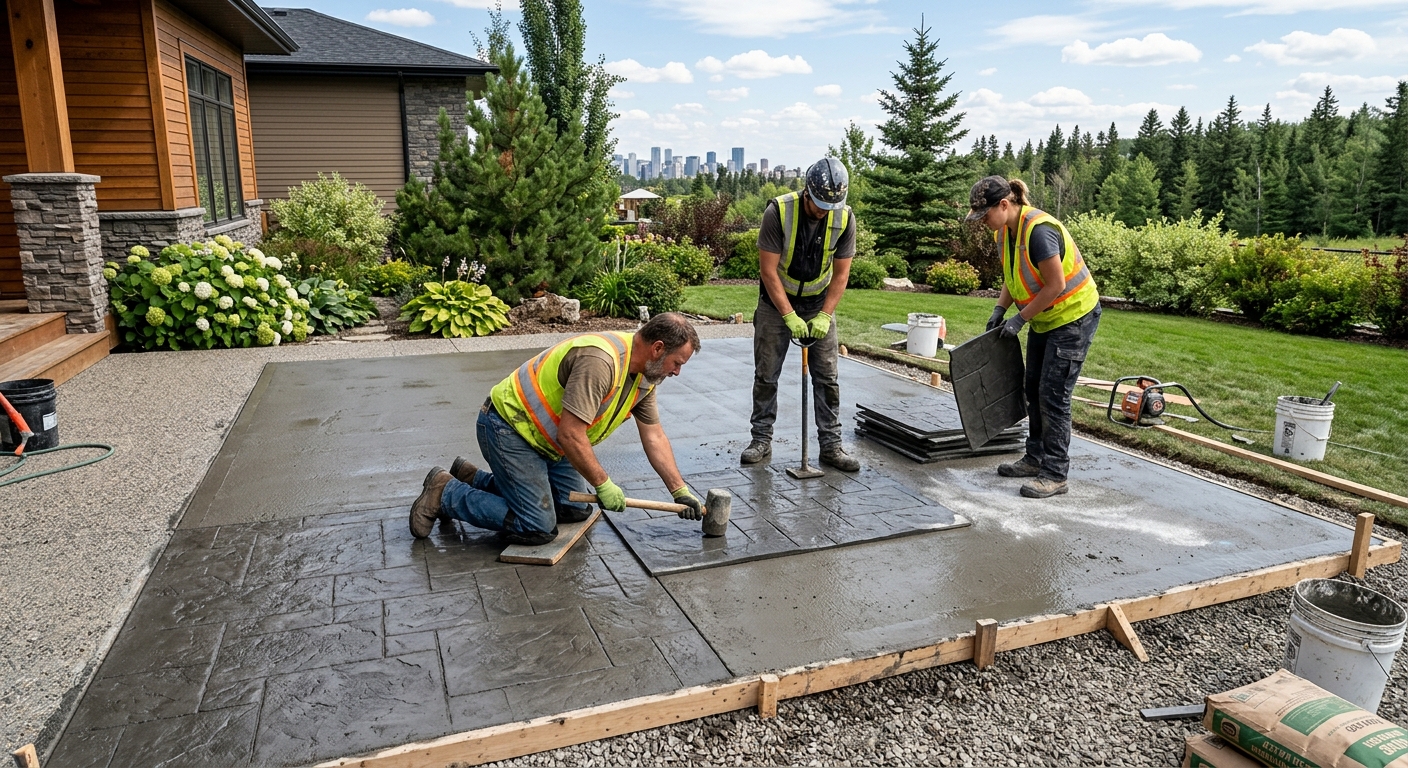
Concrete work options and costs in Cedar Valley
Cedar Valley homeowners typically choose concrete because it’s dependable, easy to maintain, and suited to the neighbourhood build patterns across the Lower Mainland–Southwest. With a population of 8,080 (Statistics Canada, 2021 Census), the demand level is steady, and most concrete flatwork is tied to existing single-family homes—often single-detached properties—where driveways, patios, and walkways get replaced as landscaping and drainage get updated. If you’re in the Cedar Valley–Salmon River area or the newer service lanes near the core, you’ll notice concrete trades are especially busy because access is tight and these lots often need careful base prep to protect exterior slabs.
Lower Mainland concrete pricing can feel higher than you expected not because winters are extreme, but because the soil and drainage conditions are relentless. Even with a shallow design frost depth (commonly assumed at about 450 mm / 18" for local planning), footings, piers, and thickened edges still must sit below frost to reduce freeze–thaw heave risk. That means more excavation and more formwork than “just a slab.” Add coastal-wet rainfall, cool nights, and frequent freeze–thaw cycles, and you get longer scheduling, more labour for drainage and air-entrained mix design, and curing controls. The result: quotes can move quickly depending on your site conditions, rebar requirements, truck access, and finish selection.
Use the table below to compare common options and what you’re paying for. Then, when you call for quotes, match your spec to your site—not just the finish name.
| Application |
Typical Size |
Key Spec |
Finish Option |
Price Range |
| Concrete driveway (standard broom finish) |
400–600 sq ft |
Air-entrained mix; compacted granular base; control joints |
Broom finish with sealer-ready surface |
$8,000–$14,500 |
| Exposed aggregate driveway |
400–600 sq ft |
Air-entrained mix; proper curing to achieve clean aggregate exposure |
Exposed aggregate (sandblasted or wash finish) |
$12,500–$19,500 |
| Stamped concrete driveway or patio |
300–600 sq ft |
Air-entrained mix; integral color; joint detailing for freeze–thaw |
Stamped pattern (wood/stone look) |
$14,000–$24,000 |
| Plain concrete patio or walkway |
150–400 sq ft |
Compacted granular base; air-entrained exterior mix |
Smooth or broom, light texture |
$2,500–$7,500 |
| Garage floor (interior slab) |
300–600 sq ft |
Vapour control as applicable; proper subgrade; fibre or mesh as specified |
Float finish (trowel if required) |
$6,000–$12,000 |
| Foundation footings (structural, below frost) |
Typical home footing run varies |
Excavate below design frost; reinforced structural concrete |
Structural formwork and rebar placement |
$18,000–$35,000 |
Prices are estimates only and vary by project scope, site access and material selection.
What affects the price of concrete work in Cedar Valley
In Cedar Valley and across the Lower Mainland–Southwest, the same “driveway replacement” can land 30–50% apart in price depending on frost-protection details, drainage conditions, and how much rework is needed to get a solid base. The broader reason you see spread across British Columbia is that concrete isn’t just poured—it’s engineered on-site. Frost depth planning, freeze–thaw exposure, and curing logistics change the mix spec, the base thickness, the labour hours, and sometimes the pour schedule.
In our region, footings and any thickened slab edges must be placed below the design frost depth to prevent frost heave. Local practice commonly assumes around 450 mm / 18" for planning, but excavation depth still varies with soil conditions, drainage, and how close you are to existing structures. Exterior slabs should be air-entrained (typically around 5–7% air content for durability) and detailed with control joints so cracks happen in predictable lines—not randomly. When colder nights or wet spells push the schedule, cold-weather curing precautions (blankets, timing adjustments, and sometimes form protection) can add cost. Also, because de-icing salts can accelerate spalling, properly sealing driveways and patios is a cost-effective durability step.
Two examples from Cedar Valley: (1) A driveway over saturated subgrade often costs more because contractors must remove unsuitable material, import granular base, and rebuild drainage before they can even place concrete—this is where “cheap slab” estimates fail. (2) A stamped or exposed-aggregate option may cost more, but if you’re replacing the entire driveway anyway, the finish upgrade can be worth it; for instance, standard broom-finish driveway work often sits in the $18–$28 per sq ft range, while stamped concrete commonly climbs toward the $22–$36 per sq ft band for the same overall area.
| Price Factor |
Why It Matters |
Cost Impact |
| Frost line depth — determines footing depth and form height |
Footings must sit below the design frost planning depth to resist freeze–thaw movement |
Higher excavation and formwork; can materially increase foundation-related costs |
| Site preparation — excavation, grading, compacted granular base |
Wet or unstable soils require replacement/extra base and careful drainage |
Often the single biggest swing on driveway/sidewalk jobs |
| Reinforcement — rebar or wire mesh requirement |
Improves performance for thicker slabs, garage floors, and exterior loads |
Additional material and labour; increases totals if thickness or load class changes |
| Mix design — air-entrainment and compressive strength spec |
Exterior freeze–thaw durability depends on air content and strength |
Higher material cost; reduces scaling/spalling risk if installed correctly |
| Finish type — broom vs. stamped vs. exposed aggregate |
Complex finishes take more labour, stamping equipment, and curing control |
Stamped/exposed typically increases price versus broom-finished concrete |
| Pour size and concrete truck access to site |
Short access routes may require small trucks, pumping, or more handwork |
Can add labour hours, pump charges, and downtime |
| Cold-weather curing precautions — heating and blankets |
Cool nights and humidity can slow strength gain |
Adds cost for protection, scheduling flexibility, and sometimes extended cure time |
| Control joint pattern and sealing cost |
Jointing controls random cracking; sealing helps reduce salt-driven surface damage |
Small material cost, but labour to saw, clean, and apply sealer affects total |
Permits & regulations in British Columbia
In British Columbia, structural concrete work—things like foundation walls, grade beams, and building footings—usually requires a building permit, and municipalities often expect engineered drawings reviewed as part of permit approval. That includes concrete that directly supports the structure and affects load paths. For concrete flatwork such as patios, walkways, and driveways, permits are commonly not required if the work stays within typical lot grading and doesn’t change established runoff patterns or conflict with municipal impervious surface limits or right-of-way rules. However, rules can still apply if you’re changing drainage, elevating or lowering finished grades, or tying into existing municipal services.
Before you break ground in Cedar Valley, your practical steps are: (1) confirm whether your project scope is treated as structural or flatwork by contacting the municipality’s building/planning office; (2) verify the contractor’s liability insurance and request a current certificate; and (3) confirm WCB coverage (and any relevant worker protection registrations for the crew). Ask for references on similar-size jobs (same slab type, same exposure level, and similar access constraints). A reputable contractor can also explain their curing plan for cool, rainy conditions and provide written details on base prep and jointing—those details are often what separate compliant work from “minimum spec” pours.
To verify, start with the contractor’s online licence registry listing, then review the COI for the coverage effective dates, and finally request written proof of clearance/registration where applicable. If anything is unclear, treat it as a red flag and ask for documentation before scheduling.
Getting concrete right in Cedar Valley's freeze-thaw climate
Cedar Valley concrete failures almost always trace back to three things: water, inadequate base support, and poor freeze–thaw durability. Even though winters in the Lower Mainland–Southwest are mild compared with interior BC, the shallow frost planning and frequent freeze–thaw cycles still stress exterior concrete. When saturated soils meet freeze conditions, frost heave can lift slabs or crack edges. When the surface repeatedly wets and dries, you can also get scaling and spalling—especially if air content and joint sealing aren’t done properly.
To spec the job correctly, start with base preparation: excavate to the required depth for a compacted granular sub-base and ensure drainage paths are clear. Next is mix design: for exterior flatwork, require an air-entrained mix (commonly targeting about 5–7% air content) and a minimum 32 MPa compressive strength. Then, control joints: place joints to limit random cracking; your contractor should lay them out based on panel dimensions and finishing sequence, not “whatever fits.” Curing matters in coastal-wet seasons—plan for at least 7 days of proper curing conditions (and extra precautions if nights are cool or rain is persistent). Finally, sealing: apply a penetrating sealer after the cure window (often around 28 days post-pour) to repel de-icing salt and reduce water uptake.
A useful cost example: upgrading from a basic broom-finish driveway to stamped can raise price (often aligning with the stamped band around $22–$36 per sq ft). But if your base prep and air-entrainment are “value engineered” down to minimum, you’ll pay twice later—repairs after spalling typically cost more than the finish upgrade ever would. In Cedar Valley, durability specs are the best return on investment.
| Spec |
Why It Matters in Cedar Valley |
What to Ask For |
Impact if Skipped |
| Compacted granular base (depth?) |
Supports the slab and reduces moisture-related movement during freeze–thaw cycles |
Confirm base depth and whether unsuitable soil is removed; ask for compaction method |
Settlement, cracking, and faster surface deterioration |
| Air-entrained concrete mix (target air %?) |
Exterior exposure in coastal-wet conditions demands freeze–thaw durability |
Ask for target air content (typically about 5–7%) and exterior mix designation |
Spalling/scaling risk increases significantly |
| Compressive strength (MPa rating) |
Ensures strength gain for durability and abrasion resistance |
Ask for minimum 32 MPa (or higher if engineered); request batch documentation |
Surface wear, reduced durability, and weaker long-term performance |
| Control joints (spacing per ACI guidelines) |
Controls where cracks open during shrinkage and thermal movement |
Ask for planned joint spacing and whether joints will be saw-cut at the right timing |
Random cracking and wider openings for water intrusion |
| Minimum 7-day curing period |
Cool nights and high humidity slow strength development |
Ask how curing will be protected during rainy/cool periods |
Lower strength, poor surface durability, increased cracking risk |
| Penetrating sealer (when applied after cure) |
Reduces water absorption and helps protect against de-icing salt effects |
Ask for sealer type and confirm application after curing (often around 28 days) |
Faster salt/water damage and reduced lifespan |
How to choose a concrete work contractor in Cedar Valley
Choosing the right contractor in Cedar Valley comes down to verifying credentials, comparing apples-to-apples scope, and confirming that the technical specs match our freeze–thaw reality. In British Columbia, you should verify licensing through the appropriate public contractor licence registry, and request a certificate of liability insurance showing the coverage is current and adequate for your job. Next, confirm worker coverage and registration (WCB-related coverage) so you’re not exposed to uninsured work risk.
Get 2–3 itemised written quotes, not lump sums. The best quotes break down labour and materials (excavation and disposal, granular base, reinforcement, concrete supply, finish work, joint sawing, and sealing). Read exclusions carefully: ask whether permits (if needed), scheduling allowances for weather, and concrete truck access/pumping are included. Also confirm whether demolition is included (and how much disposal is allowed), because removals often drive costs on replacement projects.
Warranty should be in writing. Ask for the workmanship warranty length and what it covers (cracks, spalling, joint performance), and whether product/manufacturer warranties apply to admixtures/sealers. Payment should protect you: never pay more than 10–15% upfront; hold back a portion until the job is complete and cured (and the finish is acceptable). Finally, insist on a start date and completion estimate in writing, because coastal rain can delay pours and curing windows.
- Ask what frost-depth and base-prep approach they use for exterior slabs
- Require a written mix spec including air-entrainment (exterior work)
- Confirm reinforcement plan (mesh/rebar) and slab thickness assumptions
- Check their COI for liability coverage and expiry dates
- Verify WCB/worker coverage status with documentation
- Ask for references from similar driveways/patios in the Lower Mainland–Southwest
- Get itemised labour/materials—not “concrete supply and labour” lumping
- Clarify if saw-cut joints and timing are included
- Confirm curing method during cool or rainy periods (blankets/sealer timing)
- Ask if disposal, haul-away, and protection of landscaping are included
- Require a written timeline and weather contingency plan
- Keep a holdback until sealant cure timing and final inspection are done
Red flags I see in Cedar Valley concrete jobs: quotes that ignore drainage/base prep, no mention of air-entrainment for exterior work, “we’ll pour whenever” without curing protection planning, payment schedules asking for more than 15% upfront, and vague scope language that doesn’t include joints, disposal, or sealing.
Frequently asked questions — concrete work in Cedar Valley
How deep must footings be for Cedar Valley's frost line?
For Cedar Valley in British Columbia, contractors typically design for a shallow but real frost penetration. In local practice across the Lower Mainland–Southwest, the planning assumption for frost depth is commonly around 450 mm / 18" for design purposes, but actual footing depth depends on your soils, drainage, and how the foundation interacts with existing grades. The safest approach is that footings and any thickened edges sit below the design frost depth and are founded on stable, properly prepared material. If your property has saturated areas or poor drainage (common in coastal-wet conditions), excavation and sub-base preparation often need to be deeper than the minimum expectation to avoid frost heave. Ask your contractor to describe how they determine excavation depth and how they protect against freeze–thaw movement.
Why does concrete crack in Cedar Valley and how is it prevented?
Concrete cracking in Cedar Valley is usually normal shrinkage and thermal movement, but the key is where it cracks. The Lower Mainland–Southwest climate adds frequent freeze–thaw cycles and wet/dry conditions, so water management is just as important as the mix. Cracking prevention starts with a well-compacted granular base, a correctly air-entrained exterior mix (to resist freeze–thaw durability issues), and a deliberate control joint pattern. Control joints are designed so cracks occur along planned joints rather than randomly through the slab. Proper curing and timing (including protecting in cool, humid weather) also reduce early shrinkage cracking. Finally, sealing after the cure window helps reduce water and salt uptake, which protects cracked joints from becoming pathways for deterioration.
Stamped vs broom-finish concrete — cost difference?
Stamped concrete typically costs more than broom-finished concrete because it adds integral colour work, stamping labour, and tighter finishing control during curing windows. In Cedar Valley, a standard broom-finish driveway commonly falls within the $18–$28 per sq ft pricing band, while stamped concrete often aligns with the $22–$36 per sq ft band for driveway and patio work. The difference can be justified when you’re already rebuilding the driveway/flatwork and want improved curb appeal, but it’s not a durability shortcut. Whether you choose stamped or broom finish, the freeze–thaw essentials—air-entrainment, compaction, proper joints, and curing—still drive longevity. If a quote prices stamped work without those durability details, it’s usually a sign the cost is being cut where it shouldn’t be.
When is the best time to pour concrete in Cedar Valley?
In British Columbia’s Lower Mainland–Southwest, the best time to pour concrete is when temperatures allow proper curing and when you can manage rainfall and cool nights. Many contractors prefer late spring through early fall for exterior work because air temperatures are more stable, and it’s easier to protect curing concrete from prolonged moisture. That said, good crews can pour in shoulder seasons if they plan for curing blankets, surface protection, and schedule around storms. The biggest risk period is often when nights get cool and rain persists—strength gain can slow, and finishing becomes more sensitive. Ask the contractor for their weather contingency plan and how they ensure minimum curing conditions. A reputable contractor will treat schedule as part of the spec, not as an afterthought.
How long does concrete take to cure?
Concrete curing has two parts: initial strength gain and the longer time needed to reach durability targets. For Cedar Valley projects, a typical minimum standard is at least 7 days of proper curing conditions before you treat the surface as ready for normal light use. Full performance continues beyond that, and that’s why many exterior protection steps—like penetrating sealer—are planned after the cure period. For example, penetrating sealer is commonly applied around 28 days after the pour so the concrete has developed enough maturity to accept the sealer and maximize water repellency. If temperatures are cool or rainy, contractors should protect the slab longer or use curing measures to support strength gain. Always ask what curing method they’ll use and what you should expect before using vehicles or heavy loads.
Do I need a permit for concrete work in British Columbia?
In British Columbia, it depends on what you’re building with the concrete. Structural concrete work—such as foundation footings, foundation walls, and grade beams—usually requires a building permit and often engineered drawings reviewed by the municipality. For typical concrete flatwork like patios, walkways, and driveways, permits are often not required as long as the work doesn’t materially change lot grading, drainage patterns, or conflict with impervious surface/right-of-way rules. In Cedar Valley, if your concrete replacement includes drainage changes, elevating/relocating grades, or tie-ins that could affect runoff, you should verify with the local authority before starting. Also, always confirm your contractor is insured and properly covered, and ask for documentation before demolition or forms go in.