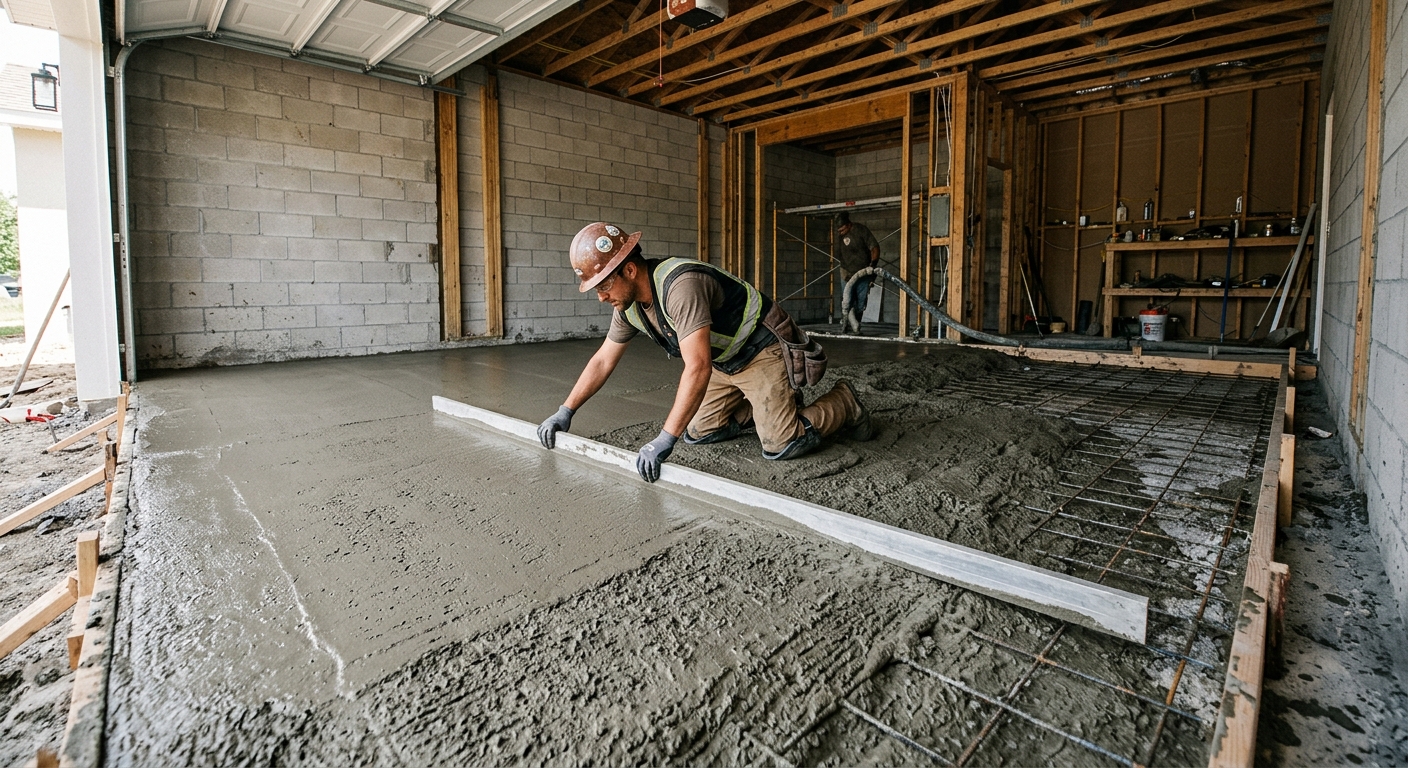
Concrete work options and costs in Sapperton
Sapperton homeowners typically choose concrete flatwork because it’s durable, predictable to schedule, and blends well with the area’s older, family-oriented housing stock. With a population of 6,327 (Statistics Canada, 2021 Census), the local market is small enough that scheduling and crew availability can swing by season. In practice, most driveway and patio work is driven by single-detached and low-rise homes, where you’ll see frequent projects around Burnaby Lake / Central Sapperton and nearby residential lanes.
In the Lower Mainland–Southwest, mild winters and a shallow frost line still drive concrete design because freeze–thaw cycles and coastal rainfall can saturate soils and stress slabs. Typical specs in this region assume a frost depth around 450 mm / 18", so footings and thickened edges are placed below that to reduce frost heave risk. That impacts excavation, forming, and how soon we can remove forms. We also plan around rain and cool nights; curing blankets, longer cure windows, and air-entrained mixes are common for exterior work.
For homeowners, the biggest pricing differences usually come down to base preparation, reinforcement, and the finish choice—standard broom textures cost less, while stamped or exposed aggregate require heavier surface preparation and more labour. Below is a practical range guide for common Sapperton projects, so you can compare apples to apples before you request itemised quotes.
| Application |
Typical Size |
Key Spec |
Finish Option |
Price Range |
| Concrete driveway (standard broom finish) |
400–500 sq. ft. |
Compacted granular base, control joints, air-entrained mix |
Broom finish |
$18,000–$28,000 |
| Exposed aggregate driveway |
400–500 sq. ft. |
Engineered base, proper cure/retarder timing |
Exposed aggregate (light wash) |
$22,000–$34,000 |
| Stamped concrete driveway or patio |
300–450 sq. ft. |
Surface hardener/tint, release agent, control joint plan |
Stamped pattern + colour |
$22,000–$40,000 |
| Plain concrete patio or walkway |
200–300 sq. ft. |
Air-entrained mix, compacted base, joints as required |
Float + light broom |
$16,000–$26,000 |
| Garage floor (interior slab) |
400–600 sq. ft. |
Vapour control as needed, joints, appropriate thickness |
Broom finish |
$12,000–$22,000 |
| Foundation footings (structural, below frost) |
Varies by home plan |
Excavate below frost depth (~450 mm / 18"), reinforced concrete |
Formed concrete |
$200,000–$350,000 |
Prices are estimates only and vary by project scope, site access and material selection.
What affects the price of concrete work in Sapperton
In the Lower Mainland–Southwest, it’s common to see the same concrete job quoted 30–50% apart. A lot of that gap isn’t “random”—it’s usually base preparation quality, the mix spec, reinforcement decisions, access logistics, and how contractors handle rain and curing. Two crews can pour the same-looking driveway, but if one quote includes a deeper, better-compacted granular base with proper drainage and air-entrained concrete, the durability will be much better in Sapperton’s wet, fluctuating temperatures.
Climate specs matter here because freeze–thaw cycles drive every exterior decision. Footings and thickened edges must extend below the regional design frost depth (about 450 mm / 18" in typical Lower Mainland practice) to reduce frost heave, and exterior slabs should be air-entrained to better survive repeated wetting, freezing, and scaling. In colder regions, the pour season is shorter and contractors often use cold-weather curing precautions (heating, insulated blankets), which raises excavation, forming, and material costs—less so in Sapperton than in the north, but still relevant during shoulder-season cold snaps. Also, de-icing salt accelerates surface wear; sealing becomes part of a maintenance plan, especially for driveways.
In Sapperton specifically, cost can go up if your lot has tight access from side streets, if soils are saturated and require more base work, or if we need additional drainage. It can go down when the existing grade is stable and accessible and the project is a simple rectangle with minimal excavation. As a ballpark anchor, a standard broom-finish driveway may land in the $18–$28 per sq. ft.-type band, while stamped or exposed aggregate typically pushes up toward the $22–$36 range because of surface prep and added materials.
| Price Factor |
Why It Matters |
Cost Impact |
| Frost line depth |
Determines footing depth and form height |
More excavation and concrete when below-frost conditions require deeper placement |
| Site preparation |
Excavation, grading, compacted granular base |
Heavier base work and disposal if soils are poor or saturated |
| Reinforcement |
Rebar or wire mesh requirement |
Material + tying/labour; cost increases for thicker slabs or structural work |
| Mix design |
Air-entrainment and compressive strength spec |
Exterior durability improvements; higher-spec concrete can add to material cost |
| Finish type |
Broom vs. stamped vs. exposed aggregate |
More labour, hardeners/tint/release agents, and finishing steps for decorative work |
| Pour size and concrete truck access to site |
Length of hose/boom time and setup |
Tighter lots may require more labour and time for placement and finishing |
| Cold-weather curing precautions |
Heating and blankets |
Can add material and labour when night temperatures drop |
| Control joint pattern and sealing cost |
Limits random cracking and protects surface |
Better joint layout and sealer add cost but reduce long-term repairs |
Permits & regulations in British Columbia
In British Columbia, you generally need a building permit for structural concrete work such as footings, foundation walls, and grade beams—especially when the work is part of a new foundation, addition, or significant structural modification. Municipal review often expects engineered drawings for structural components, and the municipality may also require inspection at key stages (for example, before pour or after forms are set).
Concrete flatwork—driveways, patios, and walkways—often does not require a permit by default. However, it may require permits or additional approvals if it changes lot grading, affects stormwater handling, touches impervious surface coverage limits, or impacts municipal right-of-way areas (for example, work near boulevards/sidewalks). Before breaking ground, confirm requirements with your local authority.
For contractor verification in Sapperton (Burnaby area), don’t rely on verbal assurances. Step-by-step: (1) confirm the contractor is properly registered for the work they claim to do (look up their details through provincial/registry listings where applicable for contractors); (2) request a current certificate of insurance showing liability coverage; (3) ask for proof of worker coverage (WSIB/WCB) for their crews—if they can’t provide it promptly, that’s a major red flag; (4) ask for recent references on similar-scale concrete projects; (5) verify they include permit pulls and inspections when required by your scope.
Getting concrete right in Sapperton's freeze-thaw climate
Concrete failures in Sapperton’s Lower Mainland–Southwest climate usually trace back to water management, cold-season curing, and mix design. Freeze–thaw cycles plus saturated soils can weaken the bond between paste and aggregate and push water into surface pores; when temperatures swing below freezing, scaling and spalling become more likely. The key is to spec the whole system—sub-base, concrete mix, joints, curing, and sealing—so the slab can move slightly without random cracking, while resisting surface damage.
Start with base preparation: we want compacted granular sub-base to the correct depth for your soil and drainage conditions so the slab doesn’t settle or “pump” under load. Next, mix design: for exterior slabs, air-entrained concrete at roughly 5–7% air content is typical for freeze–thaw durability, with a minimum 32 MPa compressive strength for many exterior applications. Then control joints: plan joint locations and spacing to limit random cracking (joints aren’t optional—they’re how you control where cracks happen). Curing matters in our damp, cool schedule: aim for at least 7 days under proper conditions, and if it’s cold, we use curing blankets and protection so strength development isn’t compromised. Finally, sealing: apply a penetrating sealer after the pour—often around 28 days after—so water and de-icing salts are less likely to attack the surface.
When the lowest bid skips air entrainment or shortens curing, the “savings” often show up as early scaling. For a practical comparison, homeowners sometimes add stamped finish that moves the driveway from a standard $18–$28 band toward the $22–$36 decorative range; that premium is usually justified when the contractor also includes correct base prep, joint layout, and proper curing. Decorative colour won’t prevent spalling—spec compliance does.
| Spec |
Why It Matters in Sapperton |
What to Ask For |
Impact if Skipped |
| Compacted granular base (depth?) |
Prevents settlement and reduces frost-related movement under exterior slabs |
Ask for the proposed base thickness and compaction method, based on site soil and drainage |
Uneven slab, pumping, and premature cracking |
| Air-entrained concrete mix (target air %?) |
Reduces freeze–thaw scaling and spalling in saturated coastal conditions |
Confirm air content target (commonly 5–7% for exterior flatwork) and that it’s measured on pour day |
Spalling, surface scaling, and faster durability loss |
| Compressive strength (MPa rating) |
Ensures the slab reaches design strength for loading and freeze–thaw exposure |
Ask for minimum 32 MPa (or project-specific design strength) and timing to reach strength |
Soft slab, surface defects, and reduced service life |
| Control joints (spacing per ACI guidelines) |
Controls cracking locations as the slab shrinks/expands with weather |
Ask for the joint layout and spacing plan before pour |
Random cracking and water infiltration into cracks |
| Minimum 7-day curing period |
Critical in cool, wet stretches so strength develops properly |
Confirm curing protection plan; ask what happens if it’s rainy/cold |
Weak surface, dusting, scaling, and reduced durability |
| Penetrating sealer (when applied after cure) |
Repels water and helps resist de-icing salt damage |
Ask for sealer type and timing (often after full cure, commonly around 28 days) |
Faster staining and surface wear, especially on driveways |
How to choose a concrete work contractor in Sapperton
Choosing the right contractor in Sapperton is mostly about proof. In British Columbia, verify licensing/registration and insist on clear paperwork for liability insurance and worker coverage (WSIB/WCB). How to check each: (1) ask for their current certificate of insurance and confirm it covers the scope of your project and has active dates; (2) request proof of WSIB/WCB coverage for their crews—if they’re subbing out, make sure the coverage is in place for the people on your site; (3) confirm they can provide references for similar-scale concrete flatwork and decorative work in the Lower Mainland–Southwest; (4) ask whether they include engineering/permits for structural portions (footings/foundations) when your scope triggers them.
Then get 2–3 itemised written quotes with a labour + materials breakdown (not just a lump sum). Pay attention to inclusions: excavation disposal, compacted granular base depth, reinforcement, control joint plan, de-icing considerations, sealing, and whether the contractor manages rain-day scheduling and curing protection. Make sure exclusions are stated clearly—especially if they exclude barriers, sawcutting, or sealer.
For warranty, ask for the workmanship warranty length and what it covers (cracks, surface scaling, settlement). Confirm if product/manufacturer warranties apply to sealer/admix products and whether they’re transferable to you. On payment schedule, never pay more than 10–15% upfront; hold back a portion until the job is complete and walk-through punch list items are addressed. Finally, get a start date and completion estimate in writing, so you’re not relying on “we’ll fit you in” promises.
- Ask for base thickness, compaction method, and drainage plan in writing.
- Confirm the mix is air-entrained for exterior work and meets minimum strength.
- Request a control joint layout (locations + spacing) before pour.
- Verify reinforcement plan (mesh vs rebar, slab thickness, load needs).
- Confirm curing protection for cool nights and rain (blankets/sealer timing).
- For decorative work, confirm tint/hardener/release materials and curing steps.
- Make sure sawcutting/joint finishing is included (not “as needed”).
- Ask whether sealing is included and when it will be applied (after cure).
- Check insurance dates and that coverage matches your project address.
- Require WSIB/WCB proof (for crews and any subcontractors).
- Get a written timeline with pour-day scheduling and contingency for weather.
- Avoid quotes that don’t specify scope details or list major exclusions.
Concrete red flags in Sapperton include: skipping air-entrainment talk, vague “we’ll do proper base” language without depth/compaction, promises that ignore curing time in wet/cool weather, refusal to provide insurance/WSIB proof, and a payment schedule that asks for most funds upfront.
Frequently asked questions — concrete work in Sapperton
How do I maintain concrete in Sapperton's freeze-thaw climate?
In Sapperton and across the Lower Mainland–Southwest, maintenance is mostly about keeping water and de-icing salts from attacking the surface. Start with a good base clean: remove organic debris and grit that holds moisture near edges and joints. After your concrete has fully cured (often around 28 days for exterior sealing), apply a penetrating sealer so water absorption drops. Re-seal on a practical cycle—many driveways need attention every few years depending on traffic and how often salt is used. In winter, avoid piling snow directly onto fresh or unsealed edges and try to use sand instead of aggressive salt blends where possible. If you notice minor joint widening, address it early with appropriate joint sealant so water can’t travel down into the slab.
What causes concrete to spall in Sapperton winters?
Spalling in Sapperton is usually a freeze–thaw durability problem driven by water and the concrete mix. When exterior concrete isn’t properly air-entrained, water that enters the surface pores can freeze, expand, and pop off small chips—often seen as flaking/scaling that worsens with repeated cycles. Saturated soils and poor drainage increase how much water reaches the slab. Over time, de-icing salts amplify damage by accelerating surface deterioration. Another contributor is inadequate curing in cool, damp weather—if strength development is interrupted, the surface can be more vulnerable. If you’re budgeting, remember that durable exterior slabs typically cost within the region’s flatwork bands (for example, driveways often land around the $18–$28 range depending on scope), and the lower end is only realistic when specs and base prep are correctly handled.
What is rebar and when is it required in British Columbia?
Rebar (reinforcing steel) is used to control cracking and add tensile capacity to concrete. Whether it’s required depends on the structure type and design loads—not just the thickness of the slab. In British Columbia, structural concrete like foundation footings, grade beams, and foundation walls almost always involves engineered reinforcement and typically needs permits/inspections as part of structural work. For exterior flatwork such as driveways and patios, some projects use wire mesh or rebar based on thickness, soil conditions, and expected loading (for example, heavy vehicles, uneven settlement risk, or poor subgrade). In the Lower Mainland–Southwest, we also consider frost heave potential (typical practice assumes about 450 mm / 18" frost depth), so reinforcement decisions tie to how the slab is supported below frost. Always ask for the reinforcement plan in your written quote and whether an engineer is involved for structural elements.
How long does a concrete project take in Sapperton?
Project duration in Sapperton depends on scope, access, and weather-driven curing requirements. For a typical residential driveway or patio, excavation and base prep can take a couple of days, while forming and placing concrete usually happens in one main pour. After that, curing is the limiting factor for how soon you can use the surface properly. Even when forms come off quickly, exterior concrete should still cure for at least 7 days under good conditions before you treat it as fully ready, and many finish/return-to-service expectations are based on strength gain over a longer period. Decorative finishes may add a day for tinting/stamping and careful protection. Rain and cool nights can extend timelines in the Lower Mainland–Southwest because we may need curing blankets or schedule adjustments to protect the slab.
What is a concrete overlay and is it suited to Sapperton?
A concrete overlay is a new layer placed over an existing slab after surface preparation. It can be suited to Sapperton homes when the original concrete is still structurally sound (not heavily cracked or settled) and the existing surface can be properly prepared for bond. Overlays can be a cost-effective alternative to full removal, but they’re not the best option when there are significant sub-base issues, major spalling, or drainage problems underneath—because the new layer can still fail if water continues to get trapped or if the slab moves. If you’re considering an overlay, ask for a concrete condition assessment: crack mapping, check for settlement, and a plan for drainage and joint repair. In many cases, a new pour in the $18–$28 driveway band (standard broom) or a decorative option around the higher decorative ranges offers a longer “reset,” especially if the existing slab is already showing freeze–thaw scaling.
How do I seal concrete to protect it in Sapperton?
Sealing in Sapperton is mainly about reducing water absorption so freeze–thaw and de-icing salt damage slow down. The timing matters: sealers perform best after the concrete has cured—commonly around 28 days for exterior concrete—so the slab is dry enough for the product to penetrate properly. Before sealing, the surface should be clean and free of dust, laitance, and organic matter. Choose a penetrating sealer intended for exterior use and confirm whether it’s compatible with your concrete finish and any previous coatings (if you have them). Apply per label instructions, typically in dry weather with no heavy rain expected for the curing window. If your driveway sees salt, you’ll usually benefit more from a quality sealer plus a good joint maintenance plan, since joints are natural water paths.