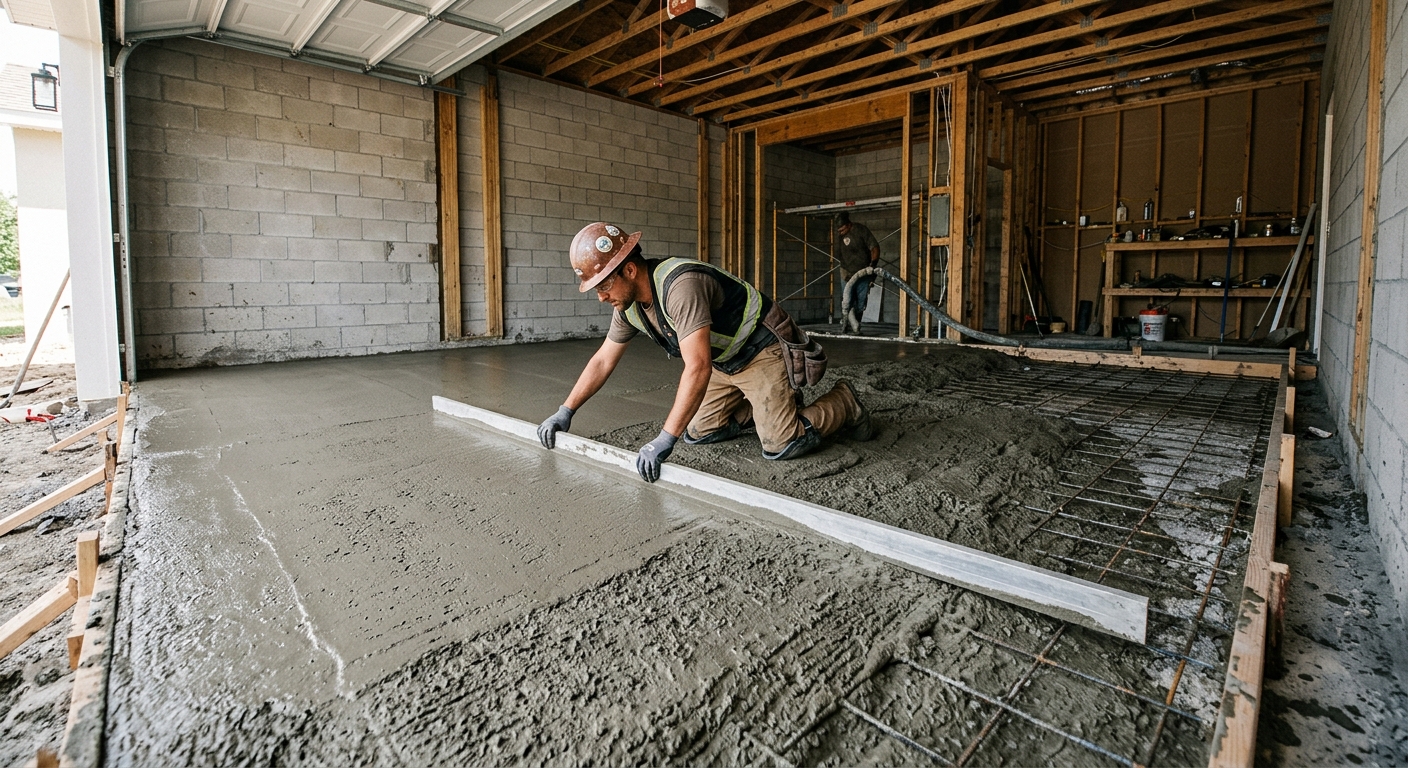
Concrete work options and costs in Parkway
Concrete work in Parkway, British Columbia is shaped by a coastal-wet climate and a surprisingly shallow frost depth—typically planned around about 450 mm (18")—so concrete flatwork and foundations are detailed to resist freeze–thaw damage and saturation. Parkway is a smaller community (population 1,600, Statistics Canada, 2021 Census), which means contractor availability can be tighter than in larger centres, but it also allows crews to focus on quality on neighbourhood streets in demand—particularly around the more established residential blocks where homeowners renew driveways and add patios each spring.
In the Lower Mainland–Southwest, many homes are single-detached and often have older asphalt driveways that need replacement for drainage and appearance. Even when the job looks “simple,” the Lower Mainland–Southwest region’s recurring freeze–thaw cycles and heavy coastal rainfall drive base preparation and finishing schedules, affecting labour and material costs. We also commonly plan pours around prolonged rain and cool nights, using curing blankets, sealers, and longer cure times to reach design strength and durable surface performance.
Below are typical scope-based price ranges for the most common projects—so you can compare quotes apples-to-apples before you contact contractors in Parkway.
Prices shown reflect typical typical sizes for homeowner work in the Lower Mainland–Southwest, where frost-protection specs, air-entrained mixes, and site drainage are standard for exterior slabs.
| Application |
Typical Size |
Key Spec |
Finish Option |
Price Range |
| Concrete driveway (standard broom finish) |
400–600 sq ft |
4–5" slab on compacted granular base; air-entrained mix; joints |
Broom finish |
$18,000–$28,000 |
| Exposed aggregate driveway |
400–600 sq ft |
Same structural base as standard; proper curing to expose stones |
Exposed aggregate |
$22,000–$34,000 |
| Stamped concrete driveway or patio |
300–500 sq ft |
Air-entrained exterior mix; reinforcement as required; release + curing control |
Stamped patterns |
$22,000–$36,000 |
| Plain concrete patio or walkway |
200–400 sq ft |
4" slab on compacted base; drainage attention; joints |
Plain trowel/broom |
$16,000–$26,000 |
| Garage floor (interior slab) |
400–700 sq ft |
Vapour barrier (as applicable); 4" slab with reinforcement per design |
Smooth trowel or light broom |
$12,000–$22,000 |
| Foundation footings (structural, below frost) |
Varies by house |
Excavate below frost plan (commonly ~450 mm design concept); reinforced concrete |
Structural concrete only |
$200,000–$350,000 |
Prices are estimates only and vary by project scope, site access and material selection.
What affects the price of concrete work in Parkway
Two homeowners can get quotes for what looks like the same driveway or patio in Parkway and still see a 30–50% difference. In the Lower Mainland–Southwest, pricing swings because contractors build in the “real costs” of getting concrete to perform in wet, coastal conditions—especially around drainage, base preparation, air-entrainment, and scheduling around rain and cool nights. When crews can’t safely place or cure concrete (or when rework is likely due to poor staging), labour and material allowances rise fast.
Frost depth and freeze–thaw cycles dictate every exterior spec. Local practice typically assumes a frost depth around 450 mm / 18", so footings, piers and thickened edges are placed below that to prevent frost heave. Exterior slabs also need air-entrained concrete to manage freeze–thaw scaling, and thicker or more reinforced sections can be required where soils are saturated or poorly draining. Compared with colder BC regions, Parkway’s frost requirements are less extreme than inland or northern areas, but our rainy shoulder seasons still affect curing. That often means longer cure times, protective curing blankets, and sometimes a higher crew cost to hit the right placement window. De-icing salts, used on driveways, can accelerate spalling if the surface isn’t properly protected—so sealing becomes part of the durability equation.
For example, a basic broom-finish driveway in the $18,000–$28,000 band might move toward the higher end when the site needs extra granular excavation for drainage and proper compaction, or when access restrictions increase truck time. A stamped driveway in the $22,000–$36,000 range is justified when reinforcement and release/curing control are dialled in—cutting down the risk of uneven colour, surface defects, and early wear in our coastal humidity.
| Price Factor |
Why It Matters |
Cost Impact |
| Frost line depth — determines footing depth and form height |
Footings and thickened edges must sit below the design frost plane to prevent frost heave. |
Higher excavation and formwork if deeper than assumed. |
| Site preparation — excavation, grading, compacted granular base |
Wet soils and saturated subgrades lead to settlement and cracking without engineered base prep. |
Extra truckloads of granular, compaction passes, and drainage work. |
| Reinforcement — rebar or wire mesh requirement |
Cracks are reduced (not eliminated) and slabs perform better under loads. |
Material and placement labour increases, especially for larger slabs. |
| Mix design — air-entrainment and compressive strength spec |
Air-entrainment helps concrete survive freeze–thaw; strength spec supports durability. |
Higher material cost and more strict batching/QA handling. |
| Finish type — broom vs. stamped vs. exposed aggregate |
Higher-detail finishes require more skill, extra steps, and tighter curing control. |
More labour time for form cleanliness, release timing, washing/exposure. |
| Pour size and concrete truck access to site |
Smaller access can increase pumping, chaulking, or manual placement time. |
Pump fees, wait time, and higher crew hours. |
| Cold-weather curing precautions — heating and blankets |
Cool nights and rainy periods slow strength gain and can affect surface quality. |
Blankets, heaters, and longer scheduling windows. |
| Control joint pattern and sealing cost |
Joints manage cracking; sealing helps repel moisture/road salts. |
Saw-cut labour and sealer materials added to the scope. |
Permits & regulations in British Columbia
In British Columbia, structural concrete work generally requires a building permit, and municipalities often request engineered drawings or reviews for items like foundation systems. Concrete flatwork—patios, walkways, and driveways—often does not require a permit, but it can if it affects lot grading, surface drainage, impervious surface coverage limits, or the municipal right-of-way. If you’re changing elevations near the foundation or modifying drainage routes, it’s smart to ask before breaking ground.
Here’s what typically DOES require a permit in Parkway (British Columbia): new or modified foundation walls, grade beams, structural footings, and any work that changes load paths or structural capacity. What typically does NOT require a permit: replacing an existing driveway slab in a similar footprint, or building a standard-sized patio/walkway, provided drainage and grading remain compliant.
Step-by-step, homeowners can verify a contractor properly:
- Ask for their certificate of liability insurance and confirm the coverage includes concrete work.
- Ask for proof of WSBC/WCB coverage (work status and payroll class should match).
- Confirm the company’s licensing/registration details through the appropriate online provincial tools and by checking the contractor’s business information matches your contract.
- Request a clearance letter or current coverage documentation before scheduling.
- Verify references for similar-scope jobs in the Lower Mainland–Southwest (driveways/patios on compacted granular base with freeze–thaw specs).
Finally, confirm whether your specific Parkway address needs a permit by contacting the municipality or checking their posted requirements—especially if you’re changing slopes or drainage.
Getting concrete right in Parkway's freeze-thaw climate
In Parkway, concrete failures usually trace back to water and timing. Even with a frost depth concept around 450 mm / 18", our wet coastal weather encourages saturated subgrades, and freeze–thaw cycles can drive surface scaling and spalling when concrete isn’t designed for the exposure or when the base isn’t prepared correctly. The right approach is not just “pour and finish”—it’s base prep, mix design, joints, curing and sealing done in the proper order.
Start with (1) base preparation: compacted granular sub-base placed to the right depth for local soils and drainage paths. If soils are soft or hold water, you’ll see settlement or cracking that finish work can’t fix. Next (2) mix design: exterior flatwork should use air-entrained concrete (target about 5–7% air content) and meet a minimum 32 MPa compressive strength so the slab gains strength and resists freeze–thaw stress. Then (3) control joints: they need a spacing pattern that limits random cracking into manageable lines. For (4) curing, plan for a minimum 7-day curing period under proper conditions; in cool, humid weather, crews often add blankets or seal-curing protection to prevent surface damage and achieve consistent strength gain. Finally (5) sealing: apply a penetrating sealer after cure (commonly around 28 days) to help repel de-icing salt and reduce moisture migration.
If you compare a plain patio to a stamped one, the price difference is often justified by finish detailing and additional steps, not by “more concrete.” For example, a plain patio in the $16,000–$26,000 band may hold steady with standard broom/texturing, while a stamped driveway in the $22,000–$36,000 range costs more because release timing, colouring consistency, and curing control are tighter to protect long-term appearance in Parkway’s moisture cycle.
| Spec |
Why It Matters in Parkway |
What to Ask For |
Impact if Skipped |
| Compacted granular base (depth?) |
Correct granular depth and compaction prevent settlement and help drainage during coastal rainfall and freeze–thaw. |
“What is the granular base depth and compaction method for my soil conditions?” |
Cracking, uneven slabs, premature failure around edges and joints. |
| Air-entrained concrete mix (target air %?) |
Air bubbles provide freeze–thaw durability for exterior slabs exposed to wetting and winter temperature swings. |
“What is your target air content (about 5–7% for exterior flatwork) and how do you verify it?” |
Higher risk of scaling and spalling over a few seasons. |
| Compressive strength (MPa rating) |
Strength controls long-term durability and resistance to wear and moisture movement. |
“Confirm the mix meets at least 32 MPa and state how strength is documented.” |
Surface wear, accelerated degradation, and inconsistent curing results. |
| Control joints (spacing per ACI guidelines) |
Joints manage shrinkage cracking patterns; they’re critical in damp, temperature-cycling climates. |
“Provide a joint layout plan and spacing appropriate to my slab size.” |
Random cracking, wider cracks, and greater moisture entry. |
| Minimum 7-day curing period |
Cool nights and high humidity slow strength gain; curing controls surface integrity. |
“Will you protect the slab for at least 7 days in cool/rainy conditions (blankets/sealers as needed)?” |
Surface dusting, reduced strength, and finishing defects. |
| Penetrating sealer (when applied after cure) |
Sealer reduces moisture and de-icing salt impacts that can worsen freeze–thaw damage. |
“When exactly will you apply penetrating sealer (commonly after ~28 days cure)?” |
Faster staining, moisture ingress, and durability loss in winter cycles. |
How to choose a concrete work contractor in Parkway
Choosing a concrete contractor in Parkway, British Columbia is mostly about verifying capability and accountability, not just the lowest line price. Start by confirming the contractor’s coverage: request their certificate of liability insurance and ensure the policy explicitly covers concrete-related operations. Next, verify WSBC/WCB coverage—this protects you and the workers if an accident happens on site. You should be able to see current documentation before work begins, and reputable firms will provide it without pressure. If a company can’t produce proof of coverage or references, that’s a strong warning sign in a tight Lower Mainland–Southwest labour market.
Then get 2–3 itemised written quotes. Ask for a breakdown by labour and materials, including excavation, granular base, reinforcement, concrete supply/mix design, finishing, saw-cutting, and sealing. Also check what’s excluded: permit fees, disposal, regrading, or repairs to existing drainage. Make sure the quote states whether a permit is pulled (if required) and who handles site protection and debris removal.
Warranty matters too. Ask for workmanship warranty length, what it covers (cracks, surface scaling, joint performance), and whether product/manufacturer warranties are included and transferable if you sell. For payment schedule, never agree to more than 10–15% upfront—hold back a portion until the concrete is complete, cured as scheduled, and sealed if included. Finally, insist on a written timeline with start date and completion estimate that accounts for rain delays and curing needs in our coastal climate.
- Provide WSBC/WCB clearance documentation and current certificate of insurance before signing.
- Use a written scope that names slab thickness, base thickness, and reinforcement (if required).
- Confirm air-entrained mix for exterior work and at least 32 MPa compressive strength.
- Require joint layout details (locations and spacing) and saw-cut timing.
- Ask how they protect curing concrete during cool nights or rain (blankets/coverings).
- Confirm whether sealing is included and the application timing after cure.
- Check truck access plan (or pumping) so costs aren’t “surprise add-ons.”
- Ensure excavation spoils disposal is included or clearly excluded.
- Look for clear line items—no vague “concrete works” lump totals.
- Ask for a proof of mix delivery process (batch tickets or QA notes if available).
- Review warranty terms in writing and understand how claims are handled.
- Confirm start date, weather contingency plan, and curing/closure period expectations.
Concrete red flags in Parkway include: quotes that omit air-entrainment or joint layout; contractors who want large deposits upfront (over 15%); vague timelines that ignore rain/cold curing needs; no written scope for base depth or drainage; and “one-size-fits-all” recommendations that don’t address your soil or existing slope/grade at the driveway or patio.
Frequently asked questions — concrete work in Parkway
When is the best time to pour concrete in Parkway?
The best time in Parkway, British Columbia is typically when you have stable daytime temperatures and less persistent rain—often late spring through summer, with an eye on forecasted night temperatures. Even though the local frost depth concept is shallow (about 450 mm / 18"), freeze–thaw cycles still stress exterior slabs when they stay wet. That’s why crews schedule around coastal-wet weather and cool nights. If you must pour near shoulder season, expect extra curing protection (covers/blankets) and potentially a longer cure timeline to reach the needed strength. For homeowners getting estimates, ask your contractor how they plan curing when rain returns mid-week and how they manage slab protection until the curing period is complete.
How long does concrete take to cure?
Concrete curing is usually discussed in two parts: strength gain and practical readiness. In Parkway, for typical exterior slabs, plan for at least a minimum 7-day curing period under proper conditions (temperature, moisture, and protection from rain/rapid drying). Full performance and durability typically develop over 28 days, which is why sealing is commonly scheduled after cure—often around 28 days post-pour—so the sealer can penetrate properly and help repel moisture and de-icing salt. If your contractor tells you it’s “walkable in a day” and ignores curing protection, that’s a major quality risk. Always ask for the curing plan in writing, especially if your pour date lands during cool, humid weather.
Do I need a permit for concrete work in British Columbia?
In British Columbia, it depends on what concrete work you’re doing. Structural concrete items such as footings, foundation walls, and grade beams generally require a building permit, often supported by engineered drawings reviewed by the municipality. Concrete flatwork like patios and driveways usually does not require a permit if you’re keeping the footprint and addressing drainage and grading within municipal expectations. In Parkway, the permit question becomes critical if the work changes lot grading, impervious surface impact, or affects how water flows near the foundation. Before you start, confirm with your municipality (and ask your contractor whether permit handling is included). A good contractor can also provide proof of appropriate coverage and references on similar-scale projects.
Concrete vs pavers for a patio in Parkway?
Concrete and pavers both work well in Parkway’s Lower Mainland–Southwest climate, but the decision usually comes down to durability requirements, maintenance tolerance, and how water will move on your site. Concrete patios—when built with compacted base, correct joints, and an exterior air-entrained mix—handle freeze–thaw stress well, especially when control joints are planned and sealing is applied after cure. Pavers can be attractive for colour options and repairs, but they rely on a stable base and good edge restraint; saturated subgrades can still shift. If you’re comparing pricing, plain concrete patios and walkways often fall in the $16,000–$26,000 band depending on size and site access. Ask what base depth and drainage plan each option includes—this is where performance is won or lost in our coastal-wet conditions.
How long does a concrete driveway last?
With proper specs, a concrete driveway in Parkway can last many years—often comparable to other well-built exterior slabs in the Lower Mainland–Southwest—because the design focuses on drainage, air-entrained concrete, and crack control. The biggest longevity drivers are whether the contractor prepared a compacted granular base, used exterior air-entrained mix to resist freeze–thaw scaling, and placed joints at the right spacing. Sealing after cure (commonly after about 28 days) also helps reduce moisture and salt impact. If your quote is in the $18,000–$28,000 range for a standard broom-finish driveway, make sure the scope includes base prep, joints, and exterior durability steps—otherwise lifespan can drop due to spalling around edges and uncontrolled cracking.
What is air-entrained concrete and why does it matter here?
Air-entrained concrete is mixed with an intentional amount of microscopic air bubbles that give the water in concrete somewhere to expand when it freezes. In Parkway and across British Columbia’s coastal-wet environment, repeated wetting and freeze–thaw cycles can cause surface scaling and spalling if the concrete isn’t designed for that exposure. For exterior flatwork, contractors commonly target about 5–7% air content and use a mix that meets at least 32 MPa compressive strength. This matters because de-icing salt and moisture from rainfall keep concrete surfaces cycling through damaging temperature states. When you’re getting quotes, ask directly: “Is the concrete air-entrained for exterior exposure, and how will you verify mix compliance?” It’s one of the most important questions you can ask to avoid premature failure.