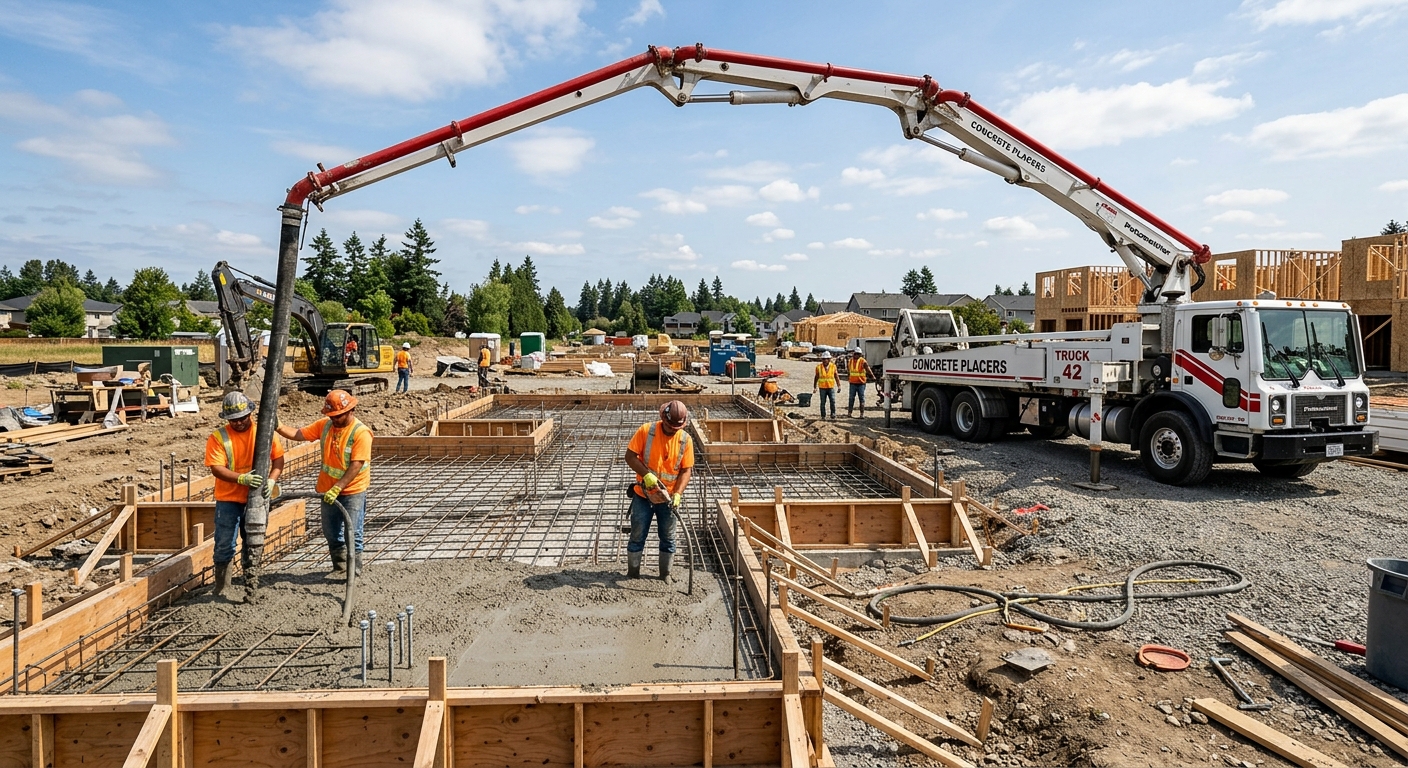
Concrete work options and costs in Anmore
Anmore’s concrete work is all about doing flatwork and foundations right for Lower Mainland–Southwest conditions: damp air, frequent wetting, and freeze–thaw cycles that can scale or spall poorly built surfaces. With 71.1% of dwellings in Anmore being single-detached homes, most concrete demand centers on driveways, front steps, patios, and walkways—plus thickened edges and footing systems for new basements and structural foundation upgrades. That fits the local housing mix well, since homeowners make up 91.3% of households (Statistics Canada, 2021 Census), and they tend to invest in long-lived outdoor upgrades.
Pricing here is shaped less by “winter cold” than by how we manage shallow frost risk and moisture. Local practice assumes a frost depth around 450 mm / 18", so we place footings, piers, and thickened edges below that to avoid frost heave. The coastal-wet climate also means slower, rain-interrupted curing windows; contractors typically plan pours around prolonged drizzle and high humidity, often using curing blankets, sealers, and longer set/curing times to reach durable performance. In practical terms, that can put cost pressure on excavation/formation time and on concrete mix selection (air-entrained for exterior flatwork).
In Anmore, demand is especially strong around the central village area and the newer in-fill pockets where homeowners want a clean broom-finished driveway and low-maintenance patio surfaces that can handle de-icing salts and wet seasons. The options below show typical price bands, so you can compare like-for-like before you book measurements and base prep.
| Application |
Typical Size |
Key Spec |
Finish Option |
Price Range |
| Concrete driveway (standard broom finish) |
400 sq. ft. |
Air-entrained mix, compacted base, control joints |
Broom finish |
$7,200 – $11,200 |
| Exposed aggregate driveway |
400 sq. ft. |
Air-entrained mix, proper curing and finishing sequence |
Exposed aggregate |
$9,200 – $13,600 |
| Stamped concrete driveway or patio |
300 sq. ft. |
Air-entrained mix, joints and sealer for exterior durability |
Stamped (pattern + colour hardener) |
$8,000 – $12,500 |
| Plain concrete patio or walkway |
200 sq. ft. |
Compacted base, control joints, air-entrainment |
Smooth or light broom |
$3,600 – $5,200 |
| Garage floor (interior slab) |
450 sq. ft. |
Vapour barrier (if required), reinforced slab, proper thickness |
Float and broom-finish top |
$8,500 – $14,500 |
| Foundation footings (structural, below frost) |
Per project allowance |
Below design frost depth (~450 mm / 18" plus as required by soils/engineering) |
Structural concrete |
$6,000 – $14,000 |
Prices are estimates only and vary by project scope, site access and material selection.
What affects the price of concrete work in Anmore
In the Lower Mainland–Southwest region, the same concrete job can land 30–50% apart from one quote to another, even when the finished area looks identical. That spread usually comes from differences in excavation depth, base build-up, reinforcement, concrete mix design, and curing/seasonal precautions—items that are easy to overlook until you see the subgrade prep plan and the materials spec. Contractors who build for local conditions (not a “one-size-fits-all” driveway) often charge more up front, but you get better resistance to scaling and cracking in our wet winters and spring thaws.
Frost-line and freeze–thaw cycles dictate nearly every exterior specification in British Columbia. While our local practice often references a shallow design frost depth around 450 mm / 18", exterior slabs and their edges still need footings and thickened sections placed below that line to prevent frost heave. Every exterior slab should use air-entrained concrete to withstand repeated wetting and cooling that can otherwise attack the surface. Colder regions need deeper excavations and more heated/insulated curing to protect early strength; even though we’re milder than inland BC, saturated soils and rain delays still increase the “hands-on” time for protection, blankets, and scheduling.
Two common Anmore examples: (1) a driveway on wet, poorly draining soils usually needs thicker compacted granular base and better under-drainage, pushing price toward the top of the driveway bands (for reference, concrete driveway pricing commonly sits around $18 – $28 per sq. ft.). (2) stamped concrete costs more than broom finish because of extra labour for forms, stamps, and colour, but the step-up is justified when you want a cohesive look across driveway + patio (often in the $22 – $36 per sq. ft. band depending on pattern, colour, and site conditions). Housing age matters too: older lots can mean uneven backfill and buried drainage patterns from pre-1980 builds, which adds time to locate, protect, and re-grade.
| Price Factor |
Why It Matters |
Cost Impact |
| Frost line depth |
Determines footing depth and form height |
More excavation/formwork increases labour and material; typically shifts exterior foundations toward the higher range when soils demand deeper support. |
| Site preparation |
Excavation, grading, compacted granular base |
Uneven subgrade or poor drainage adds truckloads, compaction time, and sometimes underdrains—can be a major cost driver. |
| Reinforcement |
Rebar or wire mesh requirement |
Extra steel and correct placement chairs/spacers increase labour; skipping reinforcement often leads to premature cracking. |
| Mix design |
Air-entrainment and compressive strength spec |
Air-entrained mix and specified strength can raise material cost but reduces scaling/spalling risk in freeze–thaw conditions. |
| Finish type |
Broom vs. stamped vs. exposed aggregate |
Stamped/exposed aggregate adds surface labour, timing, release agents, and sealer—usually the biggest line-item difference for flatwork. |
| Pour size and concrete truck access to site |
Access limits can require pumping and extra staging |
Short access routes or steep drives increase set-up and labour; pumping and clean-up add cost. |
| Cold-weather curing precautions |
Heating and blankets |
Rain, high humidity, and cool nights can require longer cure protection to hit strength and durability targets. |
| Control joint pattern and sealing cost |
Controls cracking and reduces moisture/ion intrusion |
Better joint layout plus proper sealing costs more than a basic “trowel and go” approach, but it reduces long-term maintenance. |
Permits & regulations in British Columbia
In British Columbia, structural concrete work usually requires a building permit because it supports the building’s stability and must align with the Building Code and municipal requirements. That typically includes: foundation walls, grade beams, structural footings, piers, and concrete that forms part of the building’s primary structure. Municipal staff may also request engineered drawings or reviews, depending on the scope and soil conditions.
Concrete flatwork—patios, walkways, driveways, and garage slab top upgrades—typically does not require a permit by default. However, you should expect a permit or at least municipal review if your project affects lot grading, drainage, or impervious surface coverage limits, or if work is near a municipal right-of-way. Always confirm with the local authority before breaking ground, especially in Anmore where drainage management matters.
Before signing with a contractor in Anmore, verify three things: (1) licensing (where applicable) and business legitimacy, (2) liability insurance, and (3) WSIB/WCB coverage. In practice, you can check licensing and contractor standing through the province’s online contractor resources, then request a certificate of insurance and confirm the coverage limits. For workers’ compensation, ask for a clearance letter or proof of account status from the appropriate board, and keep it on file with your contract documents.
Finally, ask for references on similar-scale work in the Vancouver–Surrey–Abbotsford corridor so you can match their process to freeze–thaw and rainy scheduling demands.
Getting concrete right in Anmore's freeze-thaw climate
Concrete failure in Anmore is rarely “mysterious”—it’s usually a predictable outcome of weak base prep, wrong mix for exterior exposure, poor curing, or missing joints. The two most visible symptoms are (1) surface scaling and flaking (often from inadequate air-entrainment) and (2) random cracking from shrinkage restraint when control joints aren’t planned and sealed. In Lower Mainland–Southwest conditions, frequent wetting and cool nights mean the surface is constantly cycling through temperatures and moisture states that attack the top few millimetres if the mix isn’t designed for it.
To spec the job correctly, start with base preparation: we excavate to the right depth for local soil conditions and frost-protected design, then place and compact granular sub-base to achieve firm, uniform support. Next is mix design—ask for an air-entrained concrete mix (commonly targeting about 5–7% air content for exterior flatwork) and a minimum 32 MPa compressive strength for the class of exposure your slab will face. Then plan control joints: spacing should limit random cracking and give the slab “planned break lines.” For curing, budget for minimum 7 days under proper conditions; in cool and rainy weather, curing blankets and careful scheduling are what help it reach design strength. After curing, seal the surface: apply a penetrating sealer about 28 days post-pour to repel de-icing salts and moisture.
Ask technical questions during the quote review: “Will you use air-entrainment?” “What’s the target air content?” “How deep is the compacted base?” and “What’s the joint spacing plan?” For a dollar example, a basic broom-finish driveway can come in lower (often around $18 – $28 per sq. ft.), but spending on proper air-entrained mix, correct base thickness, and sealing is usually the difference between a driveway that looks good for years and one that needs patching sooner in our wet freeze–thaw seasons.
| Spec |
Why It Matters in Anmore |
What to Ask For |
Impact if Skipped |
| Compacted granular base (depth?) |
Stable support reduces settlement and cracking when soils get saturated and thaw |
Confirm excavation depth, granular type, and compaction testing (or documented compaction method) |
Uneven support leads to cracking, rocking slabs, and faster deterioration near edges |
| Air-entrained concrete mix (target air %?) |
Helps resist freeze–thaw scaling and surface spalling in exterior exposure |
Target air content (typically 5–7% for exterior flatwork) and verify mix design is air-entrained |
Surface scaling/spalling increases, especially where de-icing salts get traction |
| Compressive strength (MPa rating) |
Design strength must be achieved despite cool nights and humidity |
Minimum 32 MPa (or the specified class for your exposure) and delivery ticket documentation |
Lower strength reduces durability and increases cracking risk |
| Control joints (spacing per ACI guidelines) |
Controls where shrinkage cracking happens in wet-cool seasonal swings |
Joint layout drawing, spacing, and whether joints are cut or formed on schedule |
Random cracking and wider gaps that trap moisture and accelerate surface damage |
| Minimum 7-day curing period |
Proper curing is critical in humid, rainy, or cool weather windows |
How curing will be protected each day (blankets/sealer curing regimen where needed) |
Weak surface and reduced durability; higher chance of scaling and early wear |
| Penetrating sealer (when applied after cure) |
Repels moisture and helps protect from de-icing salt exposure |
Confirm sealer is applied about 28 days post-pour (after cure) and the product type |
Moisture/ions penetrate faster, worsening spalling and making future patching more frequent |
How to choose a concrete work contractor in Anmore
When you hire a concrete contractor in Anmore, verify British Columbia coverage the right way—before you sign. Start with liability insurance: request a current certificate of insurance and confirm it’s in force for the project period. Next, confirm WSIB/WCB coverage for workers (ask for a clearance letter or proof of active account status). Then check that the contractor’s business details and any relevant trades standing are verifiable online, so you’re not relying on word-of-mouth alone.
Get 2–3 itemised written quotes that break out labour and materials (not just a lump sum). For concrete, the difference is usually in base build-up, reinforcement, mix design, and finishing/sealing. Ask whether a permit is included if your work triggers a municipal requirement, and whether demolition and haul-away/disposal are part of the scope. A well-written estimate will clearly state what’s excluded (for example, tree root removal, imported topsoil, drainage upgrades, or snow/temporary access constraints).
Warranty matters too. Ask for a workmanship warranty length that covers cracking/settlement issues associated with installation, and understand whether there’s separate product/manufacturer coverage. Also ask whether warranties are transferable to future owners.
For payment, never pay more than 10–15% upfront. Use a holdback until the job is complete and sealed/cured per spec. Finally, require a start date and a realistic completion estimate in writing, since wet weather and cure time affect scheduling in the Lower Mainland.
- Request proof of liability insurance and confirm it covers your address.
- Ask for WSIB/WCB clearance or proof of account status (not just a verbal claim).
- Insist on itemised pricing: excavation, base, rebar/mesh, concrete supply, forming, finish, joints, sealing.
- Confirm air-entrained mix is included for all exterior slabs.
- Ask for compressive strength spec (minimum 32 MPa for typical exterior exposure).
- Require joint layout details (spacing and timing of cutting/installation).
- Clarify curing approach for cool, wet periods (blankets/protection).
- Confirm sealer type and whether it’s applied around 28 days post-pour.
- Check what’s included for demolition and concrete disposal/haul-away.
- Verify if they provide compaction method/testing documentation.
- Review site access plan for concrete trucks or whether pumping is included.
- Make sure timeline and protection measures are written into the contract.
Red flags in Anmore: quotes that won’t specify mix design/air content, skipping or “discounting” control joints, vague base thickness with no compaction plan, crews that can’t show prior local flatwork in freeze–thaw conditions, and contracts that require full payment upfront or omit sealing/curing responsibilities.
Frequently asked questions — concrete work in Anmore
Do I need a permit for concrete work in British Columbia?
In British Columbia, structural concrete like footings, foundation walls, grade beams, and piers typically requires a building permit and may need engineered drawings reviewed by the municipality. Concrete flatwork—driveways, patios, and walkways—often does not require a permit, as long as you’re not changing lot grading, drainage patterns, or impervious surface coverage limits, and you’re not working within municipal right-of-way constraints. Because Anmore has many properties where drainage and slope management matter, it’s smart to confirm with the local authority before you pour.
Regardless of permits, make sure your contractor provides liability insurance and workers’ compensation proof (WSIB/WCB) and can provide references on similar jobs in the Vancouver–Surrey–Abbotsford corridor.
Concrete vs pavers for a patio in Anmore?
Concrete and pavers can both look great in Anmore, but they behave differently in our wet, freeze–thaw climate. Pavers tolerate some movement because you can lift and re-level individual units, which is helpful if subgrade settles. However, pavers still depend on the right base and jointing stone; if the base drains poorly, you can get weed growth and uneven edges.
Concrete offers fewer joints and a smoother maintenance routine, especially for a small patio connected to a driveway apron. Plain concrete patios often land around $16 – $26 per sq. ft. depending on thickness, base prep, and finish. If you want a decorative look closer to stone or tile, stamped concrete usually costs more but can outperform pavers on visual consistency and cleaning. Ask your contractor how they’ll handle drainage away from the house in both options.
How long does a concrete driveway last?
A well-built concrete driveway in Anmore commonly lasts 20 to 30 years, and sometimes longer, but the life span depends heavily on design details that fight freeze–thaw and moisture. Exterior concrete needs air-entrainment, proper compaction and granular base depth, correct control joint placement, and curing protection. Sealing after cure is also a practical step in British Columbia because de-icing salts and coastal rainfall can accelerate wear and spalling if the surface isn’t protected.
Cost matters here: a broom-finished driveway often falls around $18 – $28 per sq. ft. When a quote is much lower, it sometimes means they’ve minimized base prep, reinforcement, or used a less durable mix. You’ll usually see earlier cracking and surface scaling sooner when exterior specs are cut.
What is air-entrained concrete and why does it matter here?
Air-entrained concrete is mixed with tiny, evenly distributed air bubbles that act like pressure relief chambers when water in the concrete freezes. In Anmore and the Lower Mainland–Southwest, exterior surfaces repeatedly get wet and then cool, so freeze–thaw stresses can concentrate near the surface. Without adequate air-entrainment, the cement paste can lose integrity, leading to scaling and spalling—flakes or pop-outs that worsen over time.
For exterior flatwork, ask contractors for a target air content (often 5–7% for exterior driveways/patios) and confirmation that the delivered mix is air-entrained. Also make sure control joints and curing are done correctly; even the best mix can’t compensate for poor base support or rushed curing.
How do I prepare the base for a concrete slab?
Concrete performance starts under the slab. Base prep in Anmore should include excavation to the required elevation, removal of soft/organic material, and placement of compacted granular sub-base to achieve a stable, uniform support layer. Drainage matters: if water can pool under or beside a slab, freeze–thaw pressure and settlement risks go up. Your contractor should explain how they’ll grade away from the house and whether any underdrainage is needed based on your site.
In quotes, watch for specifics: base thickness, granular type, and how they’ll compact. A properly prepared base doesn’t just reduce cracking—it helps control the long-term look. If the contractor can’t show how they’ll build the base to local frost-protected design depth and handle moisture, it’s a sign to ask more questions.
How do I compare concrete quotes?
To compare concrete quotes in Anmore, insist on like-for-like scope and specifications. Start by ensuring each quote includes the same basics: excavation limits, granular base build-up, reinforcement (rebar/mesh placement), air-entrained mix for exterior work, control joint plan, curing approach, and whether sealing is included. If one quote is just a number, it’s hard to tell what was cut.
Next, translate quotes into your real cost driver: price per sq. ft. and included labour/materials. For example, if driveways are quoted at $18 – $28 per sq. ft. but one is substantially below that, ask what spec differences exist. Finally, review exclusions: permit pull, demolition and disposal, pumping requirements, and site access. A clear, itemised quote with technical details is the best predictor of a durable result in British Columbia’s freeze–thaw climate.