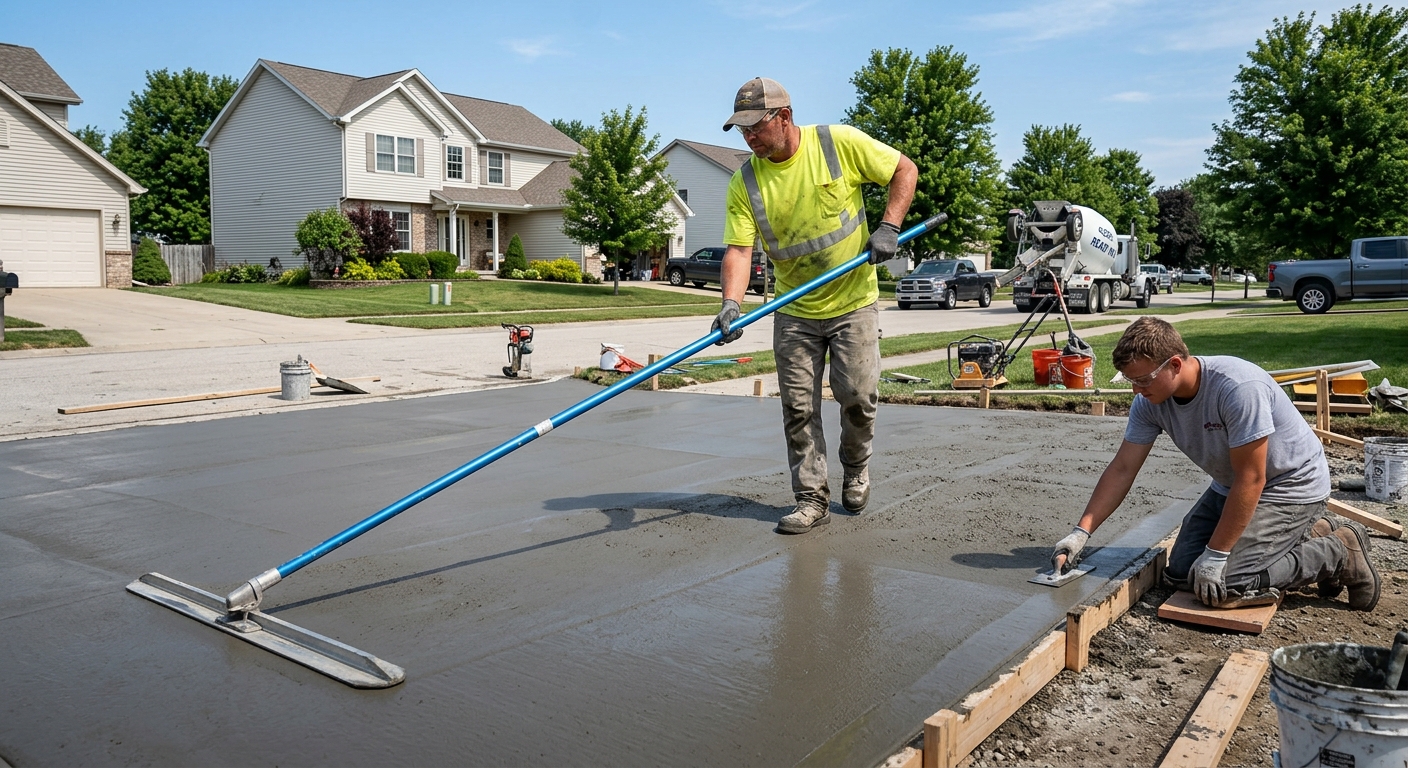
Concrete work options and costs in Duncan
Duncan homeowners are busy planning driveways, patios, and walkways every year—and with 41.8% of local dwellings being single-detached homes, there’s steady demand for durable concrete flatwork that can handle wet winters and the inevitable freeze–thaw swings. (Statistics Canada, 2021 Census). In a town of 5,047 residents, a smaller contractor pool compared with larger centres means scheduling and equipment availability can move the price, especially when multiple projects line up after a wet spell.
On Vancouver Island and the Coast, costs are shaped by a relatively shallow frost line paired with frequent surface freeze–thaw. That combination means specs don’t get “simpler”—they get more particular: footings and foundations must still sit below frost to prevent heave, and exterior slabs need properly air-entrained concrete to reduce scaling and random cracking. Cool temperatures and saturated soils also slow strength gain, so good contractors plan curing protection (thermal blankets, good drainage, and surface protection) and price in weather contingencies.
If you’re near West Duncan or closer to the town core, you’ll often see crews busy with replacement driveways and small patios because access is easier and many older homes (61.3% built before 1981) are due for upgrades. Older lots also commonly need more subgrade review—soft spots, drainage corrections, and reinstatement of damaged edges—which is one reason “same-size” bids can vary.
Below is a practical comparison of common options and what typically drives the range, so you can discuss the details with your estimator before you sign.
| Application |
Typical Size |
Key Spec |
Finish Option |
Price Range |
| Concrete driveway (standard broom finish) |
400–500 sq. ft. |
Air-entrained exterior mix; 4"–5" slab on granular base; control joints |
Broom finish |
$6,400–$11,250 |
| Exposed aggregate driveway |
400–500 sq. ft. |
Air-entrained mix; proper curing to expose aggregate; sealed/ready for wet climates |
Exposed aggregate finish |
$8,000–$13,750 |
| Stamped concrete driveway or patio |
300–450 sq. ft. |
Air-entrained exterior mix; reinforced where required; colour hardener/antique release |
Stamped & textured pattern |
$6,600–$15,750 |
| Plain concrete patio or walkway |
200–300 sq. ft. |
Exterior mix; compacted granular base; edge form and joints |
Float/wood trowel or broom edge |
$2,800–$6,600 |
| Garage floor (interior slab) |
300–500 sq. ft. |
Min. 4" slab; vapour barrier where applicable; jointing plan |
Plain finish (steel trowel optional) |
$6,000–$11,000 |
| Foundation footings (structural, below frost) |
Per linear foot of footing |
Below frost elevation; engineered sizing; rebar cage; concrete placed for strength |
Formed structural concrete |
$50–$90 |
Prices are estimates only and vary by project scope, site access and material selection.
What affects the price of concrete work in Duncan
In Duncan, it’s common to see quotes for the “same” driveway or patio swing by 30–50% across Vancouver Island and Coast—mainly because the real costs are in prep, drainage, and durability upgrades, not the concrete itself. Two contractors can both pour a 400 sq. ft. slab, yet one may include proper granular base depth, the right air-entrainment and curing protection, and a disciplined control-joint plan, while the other has more assumptions or exclusions. When a job goes sideways (soft subgrade, unexpected disposal, or weather delays), the difference shows up quickly.
Locally, frost line depth and freeze–thaw cycling dictate nearly every spec. Exterior footings must extend below the design frost depth to prevent frost heave, and every exterior slab should be air-entrained to survive surface wetting and freezing cycles. In colder regions, the pour season is shorter and cold-weather curing (heating, insulating blankets) can add cost; on coastal BC it’s often less severe than the interior, but cool, damp conditions still slow strength gain, so curing protection and scheduling around heavy rain matter. De-icing salts also accelerate surface spalling, which is why sealing and good jointing are essential, not optional.
In Duncan specifically, older homes and 61.3% of dwellings built before 1981 often mean the existing base has been disturbed or drained poorly over the years. That can add excavation and granular replacement costs. Conversely, a newer lot with stable soil and easy truck access can land closer to the lower end of our price bands—such as standard broom-finished driveways in the $16–$25 per sq. ft. backbone range—while a stamped job with higher labour intensity may push you toward the $22–$35 per sq. ft. range where decorative set-up is justified.
Next, you’ll want to know which line items truly move the needle—use the factors below to compare quotes like-for-like.
| Price Factor |
Why It Matters |
Cost Impact |
| Frost line depth |
Determines footing depth and form height below frost to prevent heave |
Higher excavation can add significant labour and concrete volume |
| Site preparation |
Excavation, grading, compacted granular base affects settlement and cracking |
Soft spots and drainage fixes add extra hours and materials |
| Reinforcement |
Rebar or mesh improves strength and controls cracking in the service conditions |
Pricing increases with steel supply, placement time, and chairing |
| Mix design |
Air-entrainment and compressive strength spec are critical for freeze–thaw durability |
Upgraded mix and testing requirements can raise unit costs |
| Finish type |
Broom vs. stamped vs. exposed aggregate changes labour, timing, and consumables |
Decorative finishes typically increase cost due to workmanship time |
| Pour size and concrete truck access to site |
Access controls placement speed and whether pump/extended hoses are needed |
Pump access or limited access increases staging and labour |
| Cold-weather curing precautions |
Heating/blankets protect early-age strength gain when temperatures drop |
Adds materials and crew time during short cold snaps |
| Control joint pattern and sealing cost |
Joint spacing and sealing reduce random cracking and surface scaling in wet winters |
Sealing and additional saw-cut layout can add a measurable add-on |
Permits & regulations in British Columbia
In British Columbia, structural concrete work—such as footings, foundation walls, and grade beams—generally requires a building permit, and it’s common to have engineered drawings reviewed by the municipality prior to placement. Concrete flatwork (patios, walkways, driveways) often does not require a permit, unless it affects lot grading, drainage, impervious surface coverage limits, or the municipal right-of-way. Because each Duncan property and lot situation can differ, confirm requirements with your local authority before breaking ground.
Before you sign with a contractor, verify three basics: (1) licence/eligibility to do the work in BC, (2) liability insurance, and (3) WCB coverage (WorkSafeBC). Step-by-step, here’s what I suggest a homeowner do in Duncan:
- Ask the contractor for their certificate of insurance and confirm it matches your project address and includes appropriate liability limits.
- Request proof of WorkSafeBC coverage or a clearance documentation they can provide to you.
- Find their business registration details and any relevant trade/registration information through provincial/online registries (your contractor should give you the exact name to search).
- Check references for similar scope (driveways, slabs, or footings) and ask what they encountered with site access and curing weather.
- Confirm in writing whether permits (when required) are pulled by the contractor or the homeowner.
Doing those checks up front protects you from schedule delays and ensures the spec is built for our coastal freeze–thaw reality.
Getting concrete right in Duncan's freeze-thaw climate
Concrete failures we see in Duncan usually trace back to one thing: water and temperature working together against weak specs—especially when the base isn’t properly prepared or the mix isn’t air-entrained. Freeze–thaw cycles drive expansion and contraction at the surface, and if air content is too low, you get spalling (chipping and flaking) and rough scaling. The fix is to spec the job correctly and then protect it during early curing.
Start with base preparation: use compacted granular sub-base to the correct depth for local soil conditions so the slab doesn’t settle or pump fines. Next is mix design. For exterior flatwork, target air-entrainment around 5–7% and ensure a minimum 32 MPa compressive strength. Then plan control joints to limit random cracking; joints aren’t just aesthetic—they’re a crack-management system.
For curing, allow a minimum 7-day curing period under proper conditions, and be extra careful with cool snaps and heavy rain. In practice, cold weather protection (insulating blankets or other approved measures) can cost more in the short term, but it prevents surface damage and improves long-term durability. Finally, sealing: apply a penetrating sealer after the concrete has cured (commonly around 28 days) to help repel de-icing salts and reduce water ingress at the surface.
Use this as your checklist when you meet your estimator—ask directly about air content, base depth, joint spacing, and curing protection. For example, if you compare a plain broom driveway to stamped concrete, you may see a difference similar to moving from roughly the $16–$25 per sq. ft. backbone range into the $22–$35 per sq. ft. decorative range. The extra cost is justified when the contractor uses proper air-entrainment, reinforcement strategy, and the right curing/finishing timing—not when it’s just “looks” without durability planning.
| Spec |
Why It Matters in Duncan |
What to Ask For |
Impact if Skipped |
| Compacted granular base (depth?) |
Controls settlement and prevents frost-related movement |
Base depth and compaction method matched to soil and slab thickness |
Edge cracking, pumping, and loss of support |
| Air-entrained concrete mix (target air %?) |
Improves freeze–thaw resistance in Duncan’s wet/cold cycles |
Air content target around 5–7% for exterior flatwork |
Spalling and scaling within a few winters |
| Compressive strength (MPa rating) |
Ensures long-term durability under traffic and moisture cycling |
Minimum 32 MPa rating for the specified mix |
Reduced strength gain and higher surface wear |
| Control joints (spacing per ACI guidelines) |
Limits random cracking by creating intentional crack lines |
Planned joint spacing and saw-cut timing |
Random cracks that open up and allow water ingress |
| Minimum 7-day curing period |
Builds early-age strength before weather stress hits |
Protection plan for cool/wet days; curing expectations in writing |
Surface damage, weaker slab, and premature deterioration |
| Penetrating sealer (when applied after cure) |
Repels moisture and helps manage de-icing salt exposure |
Sealer applied after cure (often 28 days), with product details |
Faster water penetration and spalling/scale risk |
How to choose a concrete work contractor in Duncan
Choosing the right contractor matters as much as the mix. In British Columbia, your contractor should be able to show you proof of liability insurance, WorkSafeBC coverage, and appropriate trade eligibility for the scope. Here’s how to check each:
- Licence/eligibility: ask for the exact business legal name and any relevant registrations, then verify online through provincial business/trade resources.
- Liability insurance: request a certificate of insurance and confirm it covers your project period and property address.
- WorkSafeBC: ask for proof of coverage or a clearance letter they can provide upon request.
- References: request 2–3 similar completed projects in BC (driveways/flatwork or footings), ideally with freeze–thaw durability outcomes.
Then get 2–3 itemised written quotes. You want a breakdown that separates labour, concrete supply, granular base/excavation, reinforcement, forms, disposal, and finishing. Avoid “lump sum only” bids without scope detail—especially in Duncan where site prep and drainage corrections can make or break durability.
Read exclusions carefully: is demo and disposal included? Is permit pulling included where required? Are saw-cut joints and sealing in the price? For warranty, ask for both a workmanship warranty length and any product/manufacturer warranty, and whether it transfers to a new homeowner. Payment should be structured so you never pay more than 10–15% upfront; hold back a portion until the job is completed and cleaned up. Finally, insist on a written start date and completion estimate—weather-driven delays are real on Vancouver Island.
- Ask for their plan for air-entrainment and exterior curing protection.
- Confirm slab thickness, base depth, and compacted granular specification.
- Ask how they stage concrete truck access and placement (no shortcuts on pumping/hosing).
- Verify the control joint layout (pattern and timing).
- Confirm whether reinforcement is used where required by the design and use.
- Get details on sealing type and when it’s applied.
- Ask how they handle drainage and subgrade remediation if soft spots appear.
- Confirm finishing schedule so curing isn’t interrupted by rain exposure.
- Review what’s included for site protection and cleanup.
- Ensure dump/disposal fees are included (or listed separately).
- Ask who is responsible for permits when structural work is involved.
- Keep everything in writing: scope, schedule, warranty, and any weather contingencies.
Red flags I see in Duncan include: quotes that don’t discuss air-entrainment for exterior work, missing jointing/sealing details, large upfront deposits (over 15%), vague warranties, and contractors who refuse to provide insurance/WorkSafeBC proof or references for similar coastal freeze–thaw projects.
Frequently asked questions — concrete work in Duncan
How do I compare concrete quotes?
Start by comparing quotes line-by-line, not just total price. Ask each contractor to break out excavation and disposal, granular base depth and compaction, reinforcement (rebar/mesh), concrete mix spec (including air-entrainment for exterior), finishing, and whether control joints and sealing are included. In Duncan, freeze–thaw durability is everything, so a “cheap” slab that skips air-entrainment or adequate base prep will cost more later. Also compare whether they include weather contingencies (blankets or protection on cool, wet days) and how they handle site access. If one bid comes in closer to the lower backbone (for example, a broom-finished driveway pricing in the $16–$25 per sq. ft. range) but doesn’t clearly state the mix and joint plan, don’t assume it’s the better value. A proper quote will be specific to your lot conditions and schedule in British Columbia.
Can concrete be poured in cold weather in Duncan?
Yes, you can pour in Duncan during cool weather, but it must be managed correctly. Coastal BC can still have cold snaps and long wet periods, which slow strength gain and increase the risk of surface damage if the concrete is left unprotected. A professional contractor will plan cold-weather curing—typically by controlling exposure time, using insulating blankets, and monitoring conditions so the concrete reaches safe early-age strength before weather stresses it. They should also specify the mix used for exterior freeze–thaw durability (air-entrained) so the slab holds up over multiple winters. Ask what temperature range they’ll pour in, what protection they use, and whether those costs are included. The job timing and added protection can raise the price, but it’s usually cheaper than repairing spalled or scaled surfaces in a few seasons.
How do I maintain concrete in Duncan's freeze-thaw climate?
Maintenance in Duncan is about managing water and salts, because wetting plus freezing is what stresses the surface. First, keep drainage functioning—don’t allow downspouts to discharge onto your new slab or against foundation edges. Second, avoid aggressive de-icing practices; when de-icing salts are necessary, use them sparingly and choose products that are less harsh. Third, sealing matters: ask your contractor what penetrating sealer is used and when it should be applied (often around 28 days after the pour). A good seal helps repel moisture and can slow scaling/spalling at the surface. Finally, watch your control joints and edges—if you see joint deterioration or small spalls growing, address them early. In British Columbia’s coastal freeze–thaw conditions, proactive sealing and drainage checks usually extend the service life more than repainting or cosmetic patching.
What causes concrete to spall in Duncan winters?
Spalling (chipping/flaking) usually happens when water enters near the surface and then freezes, expanding and breaking the concrete skin. In Duncan, repeated wetting and freeze–thaw cycles are hard on exterior slabs, especially if the concrete isn’t properly air-entrained or if curing/protection was inadequate. Another common contributor is a weak surface due to cold-weather problems or early-age damage after the pour. Subgrade or base issues can also worsen it—settlement can create stress points where water collects. The most preventable cause is mix design: exterior work should be air-entrained (commonly targeted around 5–7% air for durability). If a bid doesn’t clearly specify that, you’re taking a risk. Getting proper joints and sealing also reduces water ingress, which directly lowers spalling risk over multiple coastal winters.
What is rebar and when is it required in British Columbia?
Rebar is steel reinforcing bar placed within concrete to increase strength and control cracking. In British Columbia, whether rebar is required depends on the design and loading, not a “one-size-fits-all” rule. For structural elements like foundation footings, grade beams, and some walls, reinforcement is typically specified by engineered design and local building requirements. For slabs-on-grade like driveways, reinforcement might be required based on thickness, soil conditions, expected loads, and design details. In practice in Duncan, older lots sometimes have variable subgrade support, and reinforcement can help manage stress and cracking when paired with a properly compacted granular base. Ask your contractor whether rebar or wire mesh is included for your specific scope and request the reasoning tied to slab thickness, base preparation, and intended use. A well-prepared quote should state reinforcement type and placement plan clearly.
How long does a concrete project take in Duncan?
Timelines vary by project size, site access, and weather, but there’s a typical rhythm. For a standard patio or walkway, the process often takes about 1–2 weeks total from initial prep to final finish/cleanup, even though the actual pour may be completed in a single day. Driveways are commonly a bit longer—often 1–3 weeks—because excavation, forms, base compaction, reinforcement placement, and finishing steps take time, plus curing protection if temperatures are cool. For structural foundation footings, expect longer schedules due to excavation, inspections/engineering steps, and the need to coordinate reinforcement and concrete placement below frost. In coastal BC, cool and wet weather can add delay for curing protection. Your contractor should give you a written start date and an estimate for completion, including weather contingencies. If one quote is dramatically faster but doesn’t discuss curing and protection, be cautious.