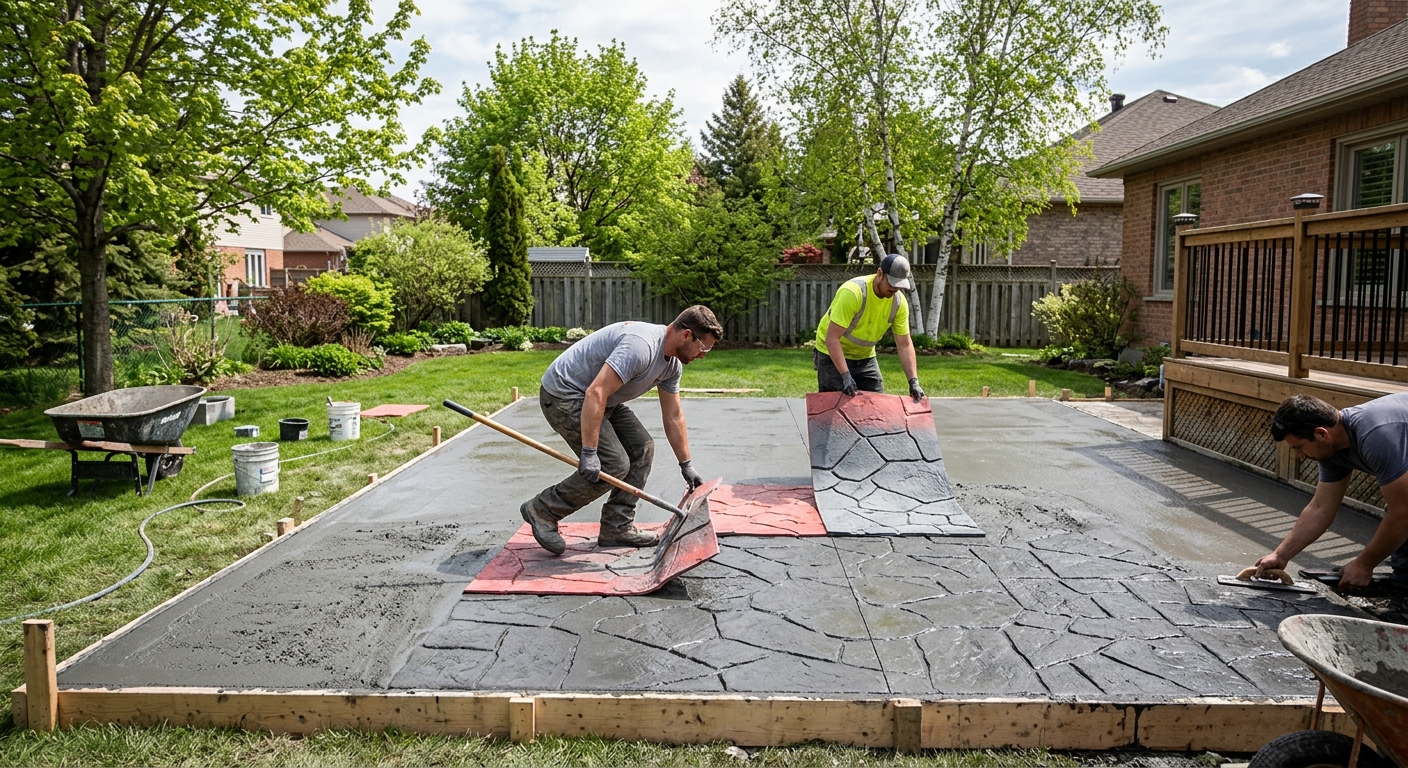
Concrete work options and costs in Prince Rupert
In Prince Rupert, concrete projects are often decided as much by weather windows and access as by the final square footage. With single-detached homes making up 56.7% of dwellings and 75.3% of homes built before 1981, many homeowners are refreshing older driveways, replacing settling steps, or upgrading exterior walkways in established neighbourhoods like Lincoln Park and the West End. North Coast conditions matter: frequent freeze-thaw cycles push contractors to dig to frost-safe depths, compact a properly graded base, and use air-entrained mixes for exterior slabs. Coastal wet weather also makes curing management critical—if rain or early freezing hits fresh concrete, the surface can weaken or spall, and finish quality can suffer.
That’s why quotes for the “same” job can vary. Smaller sites around Prince Rupert can also require extra effort for excavation, dewatering, and scheduling concrete deliveries so trucks arrive when the crew is ready. You’ll often see mobilization added more visibly on patios and walkways where the formwork is straightforward but access, staging, and rain control take more time. At the same time, standard broom-finished work stays more predictable when the base and jointing are done to spec.
Below is a practical comparison of typical options and price ranges you can expect locally, including structural footing work set below frost depth. Use the table to anchor your budget before you request itemised quotes.
| Application |
Typical Size |
Key Spec |
Finish Option |
Price Range |
| Concrete driveway (standard broom finish) |
400–600 sq. ft. |
Air-entrained exterior mix; compacted granular base; control joints |
Broom finish, stamped not included |
$12,000–$22,000 |
| Exposed aggregate driveway |
400–600 sq. ft. |
Air-entrained mix; washed aggregate; proper curing and surface protection |
Exposed aggregate (wash process) |
$15,000–$27,000 |
| Stamped concrete driveway or patio |
300–500 sq. ft. |
Air-entrained mix; colour hardener; integral release agent |
Stamped patterns (e.g., slate/fieldstone look) |
$18,000–$35,000 |
| Plain concrete patio or walkway |
120–300 sq. ft. |
Slab on compacted base; air-entrained exterior mix; sealed if desired |
Broom or light trowel finish |
$9,000–$18,000 |
| Garage floor (interior slab) |
300–520 sq. ft. |
Typically 4 in. slab; vapour control as needed; reinforcement based on use |
Steel trowel or broom finish |
$10,000–$19,000 |
| Foundation footings (structural, below frost) |
Per house/partial foundation; typically 20–60 linear ft. depending on scope |
Excavate to frost depth; reinforced footings; drainage considerations |
Structural concrete finish is typically not decorative |
$28,000–$48,000 |
Prices are estimates only and vary by project scope, site access and material selection.
What affects the price of concrete work in Prince Rupert
In Prince Rupert and across the North Coast, it’s normal to see different crews price the same general concrete scope by 30–50%. The biggest reason isn’t always labour—it’s the spec needed to survive the freeze-thaw rhythm and wet coastal conditions. Even when you choose the same concrete truck size, contractors may price differently based on excavation and base prep, reinforcement decisions, and whether cold-weather curing precautions are required to protect early strength gain. From there, finish choice and control joints change both material handling and finishing time.
Two local technical drivers explain much of the variation. First, frost depth: in coastal BC, it’s commonly less than inland provinces but still high enough that footings must be set below the design frost depth to prevent frost heave. Second, freeze-thaw: exterior slabs are typically air-entrained to survive repeated expansion and contraction. Where cold weather delays a pour, contractors may need insulated blankets or temporary heat to keep curing on track. That’s one reason exterior flatwork can land closer to the higher end of the $12,000–$22,000 driveway band or the upper end of the $9,000–$18,000 walkway/patio band even for “small” jobs.
Concrete in Prince Rupert also gets pricier when the site is older or poorly drained. Homes built before 1981 (75.3% of the housing stock) often have grading and drainage that need correction—adding compacted granular base, improving sub-drainage, or addressing water that undermines the slab. On the other hand, costs can be lower when access is straightforward and the base is already at proper grade, especially on interior garage slabs where freeze-thaw risk is reduced.
| Price Factor |
Why It Matters |
Cost Impact |
| Frost line depth — determines footing depth and form height |
Footings must extend below design frost depth to limit heave |
More excavation and higher formwork; often the biggest cost driver on foundations |
| Site preparation — excavation, grading, compacted granular base |
Wrong sub-base thickness/compaction leads to settlement and surface cracking |
Can swing the quote significantly depending on soil/water and haul distance |
| Reinforcement — rebar or wire mesh requirement |
Supports slab performance and reduces crack opening under load |
Materials and labour; sometimes required for heavier driveways or irregular loads |
| Mix design — air-entrainment and compressive strength spec |
Exterior durability depends on air entrainment for freeze-thaw resistance |
Typically modest material cost, but avoids expensive rework and premature spalling |
| Finish type — broom vs. stamped vs. exposed aggregate |
Decorative work needs colour control, specialised forms and more curing discipline |
Stamped/exposed aggregate increases labour and material consumables |
| Pour size and concrete truck access to site |
Small pours may require more staging time and careful pump/placement planning |
Mobilization and access charges can add up fast on tight lots |
| Cold-weather curing precautions — heating and blankets |
Protects early strength gain and surface integrity before rain or freezing |
Extra labour/materials; can push schedules into costly off-window hours |
| Control joint pattern and sealing cost |
Joints guide cracking and sealing reduces de-icing salt damage |
More labour planning; sealer adds materials but reduces surface deterioration |
Permits & regulations in British Columbia
In British Columbia, structural concrete work—such as foundation footings, foundation walls, and grade beams—usually requires a building permit and is often supported by engineered drawings that the municipality reviews as part of the permit process. Concrete flatwork like driveways, sidewalks, patios, and walkways often does not require a permit by default, but it can still trigger requirements if the work impacts lot grading, drainage, impervious surface coverage limits, or the municipal right-of-way (for example, when tying into a curb or altering a frontage sidewalk). Always confirm with the local authority before you break ground.
For contractor verification in Prince Rupert, take these steps:
- Ask for a certificate of liability insurance showing active coverage and your project address/jobsite listed if possible.
- Confirm coverage for workers through the provincial worker coverage framework (commonly referenced as WCB coverage) and ask for proof of clearance.
- Verify the contractor’s business registration and the right to operate, then check any public licence/registration listings that apply to the type of work they perform in BC.
- Request references for projects with similar scope (exterior flatwork in coastal freeze-thaw conditions is different from interior slabs).
Then make sure the scope in your quote aligns with what’s required for permits—ideally the contractor should clarify whether a permit pull is included or excluded.
Getting concrete right in Prince Rupert's freeze-thaw climate
Concrete fails in Prince Rupert most often when the slab or footing can’t handle moving moisture and repeated freeze-thaw. You can’t “finish your way out” of poor base prep or the wrong mix. In practice, the specification should start with base preparation: excavate to the correct level and install a compacted granular sub-base that supports the slab at the right depth for local frost considerations. Next, use a mix designed for exterior exposure—air-entrainment helps protect the paste from freeze-thaw damage. For exterior flatwork, it’s typical to target roughly 5–7% air content and use a minimum 32 MPa compressive strength specification. Third, control joints must be planned to manage where shrinkage cracking and movement occurs, and they should be sealed where appropriate to reduce water and salt intrusion. Finally, curing is where many smaller crews under-budget: concrete needs proper protection for strength gain, and in cold snaps you may need heating and insulated blankets to keep conditions favourable. Sealing is usually applied after curing (commonly around 28 days post-pour) to repel de-icing salts and slow surface deterioration.
If you’re comparing options, you should understand what you’re buying. For example, switching from a basic broom-finish slab to a coloured and stamped option can add meaningful labour and material time—often reflected in the $18,000–$35,000 range for stamped work. That extra cost is justified when you want a premium finish and the contractor maintains strict mix, curing, and jointing discipline. If the contractor doesn’t plan for proper base and curing, the cheaper version can actually cost more long-term due to spalling and early repairs—especially in British Columbia’s coastal wet cycles.
| Spec |
Why It Matters in Prince Rupert |
What to Ask For |
Impact if Skipped |
| Compacted granular base (depth?) |
Stops settlement and supports freeze-thaw movement without pumping fines |
Ask for sub-base thickness and compaction targets based on soil and slab thickness |
Cracks, dips, and early slab deterioration from poor bearing |
| Air-entrained concrete mix (target air %?) |
Air voids protect concrete from freeze-thaw expansion and scaling |
Confirm air content target (typically 5–7% for exterior flatwork) and exposure class intent |
Spalling and surface scaling that can start after just a few winters |
| Compressive strength (MPa rating) |
Minimum strength supports durability and handling before and after curing |
Ask for 32 MPa minimum (or higher if engineered) and test/certification documentation |
Lower-than-expected strength and higher risk of surface damage |
| Control joints (spacing per ACI guidelines) |
Guides cracking to predictable lines during shrinkage and movement |
Ask how joints will be laid out and the intended spacing, plus whether they’ll be sealed |
Random cracking and more water pathways to the base |
| Minimum 7-day curing period |
Coastal curing conditions still need time for strength gain before rain/freezing hits |
Ask what curing method will be used and how cold/rain is managed during set |
Surface weakness, reduced durability, and finish defects |
| Penetrating sealer (when applied after cure) |
Repels de-icing salts and moisture that drive freeze-thaw damage |
Confirm sealer type and timing—typically after full cure (often 28 days post-pour) |
Faster spalling and staining, especially on driveway edges |
How to choose a concrete work contractor in Prince Rupert
Choosing the right contractor in British Columbia starts with proof and process, not just a low number. Ask who pulls permits (if required), then verify licensing/registration applicable to their work category and request their certificate of liability insurance for your job. For worker coverage, ask for proof of WCB coverage/clearance—contractors who can’t provide documentation usually won’t be properly set up for site work in Prince Rupert. Also request photos and references from similar projects: exterior flatwork in a freeze-thaw coastal climate is very different from dry interior work.
Next, get 2–3 itemised written quotes. You want a labour + materials breakdown that clearly lists excavation/base prep, reinforcement, the concrete mix spec (air-entrainment and strength), formwork, finishing, joints, and curing/blanket provisions. Avoid “lump sum” quotes without detail—on North Coast projects, access and preparation can be the difference between a long-lasting slab and a call-back.
Read the scope like a checklist: what’s excluded (permit fees, disposal, dewatering, insulation/blankets, sealing), what’s included, and whether concrete supply includes air-entrainment for exterior exposure. Ask for warranty terms for workmanship, plus whether any product warranty applies and if it’s transferable. For payment, use a schedule that keeps risk low: never pay more than about 10–15% upfront, and hold back remaining funds until the job is complete and final grading/cleanup is confirmed. Get a written start date target and completion estimate, especially during the shorter workable windows in cold or wet periods.
- Provide current liability insurance certificate and proof of WCB coverage/clearance
- Show similar Prince Rupert or North Coast exterior slab work references
- Itemise excavation and disposal—don’t assume “haul away” is included
- Confirm sub-base depth, granular type, and compaction method
- Ask for the concrete mix spec: air-entrainment and minimum compressive strength
- Confirm reinforcement plan (mesh vs rebar) for your load and slab type
- Verify joint layout and whether joints are sealed
- Ask how they manage rain/cold during the first 24–72 hours and curing to strength gain
- Clarify access: concrete truck reach, staging, and whether they use pump/alternatives
- Get timeline in writing: pour day, curing protection steps, and when you can use the area
- Understand warranty length and what is covered for spalling/cracking
- Avoid large upfront deposits; plan retainage/holdback until final inspection
Local red flags in Prince Rupert include: vague scope that doesn’t mention air-entrained mix or curing blankets, refusing to show proof of insurance/WCB coverage, omitting joint and drainage details, finishing too fast after rain/freezing risk, and quoting only per-square-foot without addressing access, haul, and dewatering needs.
Frequently asked questions — concrete work in Prince Rupert
What is a concrete overlay and is it suited to Prince Rupert?
A concrete overlay is a new concrete layer placed over an existing slab (often after patching, cleaning, and bonding preparation). In Prince Rupert, overlays can be suited to driveways or walkways when the original slab is structurally sound and well bonded—think of it as levelling and refreshing the surface rather than rebuilding the foundation. The climate matters: freeze-thaw cycles and coastal moisture will punish weak bond lines, so surface prep (grinding/cleaning, repair of delaminated areas, and installing proper bonding strategy) is critical. If the existing slab has heaved, has major settlement, or drains poorly, an overlay can fail sooner than a full replacement.
Cost-wise, homeowners often compare overlays to standard pours in the $12,000–$22,000 driveway band. If the existing slab is failing, paying for an overlay can land you in “temporary fix” territory. Ask your contractor to inspect for hollow sound areas, mapping cracks, and drainage issues before deciding.
How do I seal concrete to protect it in Prince Rupert?
Sealing in British Columbia (especially in coastal Prince Rupert) is mainly about reducing water and de-icing salt penetration. For exterior concrete, the usual approach is to let the slab fully cure first—often around 28 days post-pour—then apply a penetrating sealer designed for concrete. Preparation matters: the surface should be clean and dry, with contaminants removed; otherwise, the sealer won’t penetrate evenly. In Prince Rupert’s wet conditions, we also pay attention to weather timing so the sealer can set without rain washing it off.
If you’re planning work like a broom-finished patio or walkway (commonly in the $9,000–$18,000 range), ask whether sealing is included in your quote or offered as an add-on. A good contractor will explain the sealer type, application timing, and when it’s safe to use the surface afterward.
What is the difference between concrete and cement?
Concrete is the finished construction material—cement plus water plus aggregates (sand and gravel), and sometimes admixtures like air-entrainment agents. Cement is only one component inside concrete; it acts like the binder that reacts with water to form strength. That’s why “cement” wording in casual conversations can be misleading when you’re comparing durability specs. In Prince Rupert, the mix design for exterior slabs is more than just cement quantity: air-entrainment and appropriate compressive strength are what help concrete resist freeze-thaw damage and scaling.
When you get a quote, ask for the concrete mix specification for exterior exposure (not just “it’s concrete”). A contractor who can clearly state air content expectations (commonly about 5–7% for exterior flatwork) and minimum strength is usually offering a more durable solution for the North Coast climate.
How much does concrete work cost in Prince Rupert?
Concrete costs in Prince Rupert depend on the project type, access, excavation, and the durability specs needed for freeze-thaw and wet coastal conditions. As a baseline for planning, driveway concrete is often priced in the $12,000–$22,000 range, while patios and walkways are commonly in the $9,000–$18,000 range. Stamped driveway or patio work typically sits higher, often reflected in the $18,000–$35,000 band due to added labour and finishing steps.
Foundation footings are a different category: structural work set below frost depth commonly lands in the $28,000–$48,000 range depending on linear footage, reinforcement, dewatering, and excavation conditions. Keep in mind Prince Rupert’s housing context—many homes are older (75.3% built before 1981), which can mean drainage and base issues that add prep cost.
How deep must footings be for Prince Rupert's frost line?
Footing depth must be determined by design frost depth requirements and the specific engineering/soil conditions for the site. In coastal BC, the design frost depth is generally lower than inland locations, but it’s still significant enough that footings must be set below it to reduce the risk of frost heave. Because the correct depth can vary by local conditions and whether there’s insulating strategy, engineering, or specific municipal requirements, there isn’t a single “one number” depth that fits every Prince Rupert lot.
What you can do as a homeowner is ask your contractor whether the foundation work is being built to the design frost depth and whether the job requires engineered drawings. If engineered drawings are part of the permit process, they will typically show the required footing embedment depth, reinforcement details, and drainage provisions.
Why does concrete crack in Prince Rupert and how is it prevented?
Concrete cracking is common in Prince Rupert because the slab experiences shrinkage during curing, movement from moisture changes, and freeze-thaw stresses over time. Cracks that form randomly are often tied to poor base preparation, missing or poorly planned control joints, and curing problems—especially when rain or cold interrupts early strength gain. The North Coast climate makes this worse because water can find pathways, then freeze and expand.
Prevention is mostly about correct specification: compacted granular base to the right depth, air-entrained concrete for exterior freeze-thaw durability, proper control joint placement to guide where cracking will occur, and a curing plan that protects the concrete long enough to gain strength. Sealing after cure can further reduce salt and moisture intrusion. If you’re budgeting for exterior flatwork, don’t cut corners on these steps just to stay near the lower end of the $12,000–$22,000 driveway band—repairs later can cost more than doing it right the first time.