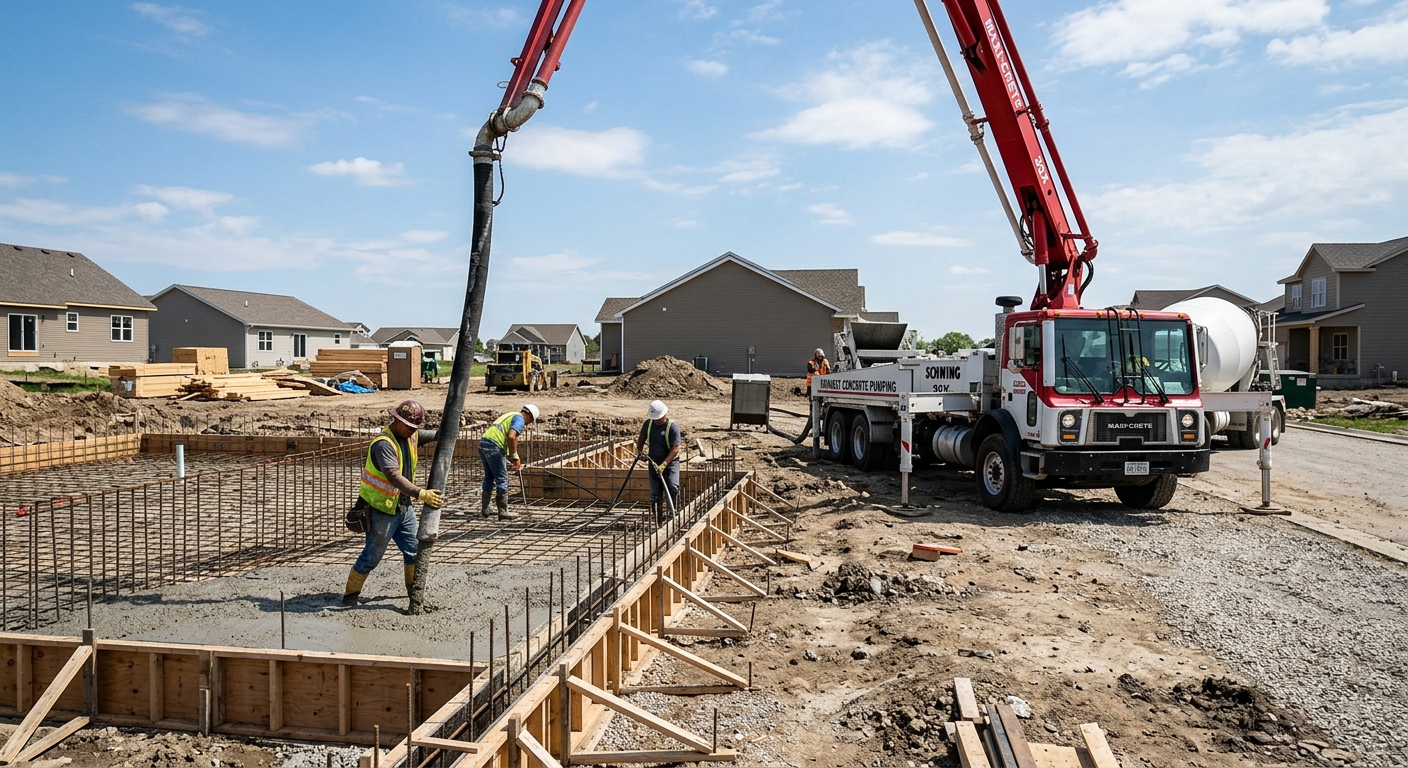
Concrete work options and costs in Kamloops
In Kamloops, choosing the right concrete option is usually less about “which mix is best” and more about matching the job to Thompson–Okanagan freeze–thaw conditions, frost depth, and how your property drains. Kamloops has a lot of single-detached housing—50.3% of dwellings in the 2021 Census—so driveways, patios and walkways are constant demand items. And with homeowner households making up 70.1% of households (Statistics Canada, 2021 Census), many projects are planned as long-term upgrades rather than quick fixes.
Our interior climate creates a cost reality you can feel in every quotation. Freeze–thaw cycling around the city means exterior concrete needs air-entrained mixes, well-compacted granular base, and a control-joint layout that limits random cracking. We also plan for frost-appropriate footings: local building practice assumes frost in the 45–60 cm range, so footings and foundations should sit below that depth—not just a minimum that leaves the concrete vulnerable to heaving and cracking. Because the pour season can be shorter in colder shoulder months, excavation, forming, and cold-weather curing precautions (insulating blankets and/or heated protection) can add labour and equipment time.
That’s why concrete contractors are especially busy in established areas such as NorKam, where older housing stock (many homes built before 1981) leads to frequent driveway, walkway and foundation updates. Below is a practical comparison of common options and typical budget ranges so you can transition into the cost factors that drive your quote.
| Application |
Typical Size |
Key Spec |
Finish Option |
Price Range |
| Concrete driveway (standard broom finish) |
400–600 sq. ft. |
Frost-appropriate granular base; air-entrained mix |
Broom finish + joints |
$7,200–$16,800 |
| Exposed aggregate driveway |
400–600 sq. ft. |
Proper finishing timing; air-entrained mix |
Exposed aggregate (spray/scrub) |
$9,000–$20,700 |
| Stamped concrete driveway or patio |
300–500 sq. ft. |
Integral colour + release agent; air-entrained mix |
Stamp pattern + sealer-ready surface |
$9,000–$19,000 |
| Plain concrete patio or walkway |
200–400 sq. ft. |
Compacted base + control joints |
Float/trowel or light broom |
$3,000–$9,600 |
| Garage floor (interior slab) |
300–500 sq. ft. |
Vapour barrier + reinforcing (as required) |
Broom finish |
$6,000–$14,500 |
| Foundation footings (structural, below frost) |
Per linear foot (varies by design) |
Excavation, forming, rebar; pour below frost |
Structural concrete |
$220–$350 |
Prices are estimates only and vary by project scope, site access and material selection.
What affects the price of concrete work in Kamloops
In the Thompson–Okanagan, two quotes for what looks like the “same” concrete job can differ by 30–50% once you account for climate-spec details and how much work the contractor includes. A basic broom-finished driveway priced in a hurry can fall apart prematurely here, because the city’s interior freeze–thaw cycles push moisture through the surface and joints. The contractor who builds for frost—compacted granular base, air-entrained concrete, and a control-joint layout—often costs more up front, but that’s where the durability savings come from.
Frost line depth drives nearly every design decision in the region. Footings must extend below the design frost depth to prevent frost heave, and exterior slabs require air-entrained mixes to survive repeated freezing and thawing. On top of that, Kamloops projects often get scheduled around a shorter practical pour season. Cold-weather curing precautions—warming materials, protecting pours with insulating blankets, and preventing rapid temperature drops—add labour and equipment costs. Finally, de-icing salt in winter accelerates surface deterioration, so sealing is a practical “cheap insurance” step for exterior flatwork.
Real examples from Kamloops: (1) A driveway upgrade on a tight city-side access lot can jump in labour because the crew spends more time on staging and smaller batching logistics. (2) A backyard patio poured on soft fill or poor drainage often needs additional excavation and granular base—turning a plain patio budget into a driveway-style prep budget. (3) A stamped driveway is typically priced higher—often aligning with ranges near $24–$38 per sq. ft. for decorative work—because of integral colouring, stamp tooling time, and finishing consistency. The payback is aesthetic value, not structural strength.
| Price Factor |
Why It Matters |
Cost Impact |
| Frost line depth |
Determines footing depth and form height |
More excavation and forming; higher labour and materials |
| Site preparation |
Excavation, grading, compacted granular base |
Soft subgrade removal and thicker base increase costs |
| Reinforcement |
Rebar or wire mesh requirement |
Additional materials plus labour for placement and supports |
| Mix design |
Air-entrainment and compressive strength spec |
Premium mix; better durability but slightly higher unit costs |
| Finish type |
Broom vs. stamped vs. exposed aggregate |
Stamp tools, release agents, and finishing labour add expense |
| Pour size and concrete truck access to site |
Pumping, chute placement time, and staging limits |
Long carries, limited access, or pump needs raise labour |
| Cold-weather curing precautions |
Heating and blankets |
Protective equipment and labour to maintain curing conditions |
| Control joint pattern and sealing cost |
Limits random cracking; repels meltwater/salts |
More layout time and sealant materials |
Permits & regulations in British Columbia
In British Columbia, the key difference is whether the work is considered structural or it changes site grading and drainage. Structural concrete work—such as footings, foundation walls, and grade beams—typically requires a building permit, and engineered drawings are often reviewed by the municipality. Concrete flatwork (driveways, patios, and walkways) usually does not require a permit on its own, as long as it doesn’t significantly affect lot grading, drainage patterns, or impervious surface requirements. However, if your project ties into a drainage swale, changes stormwater flow, or affects municipal right-of-way conditions, permits or approvals may be triggered. Always confirm with the local authority before breaking ground.
For your project in Kamloops, start with contractor accountability. Step one is verifying licensing by checking the contractor’s business information on the province’s online registries (where applicable for the trade). Step two is confirming liability insurance: ask for a Certificate of Insurance showing the jobsite and coverage limits. Step three is confirming WSIB/WCB coverage (Workers’ compensation): request documentation/clearance letters and ensure the coverage is active for the time of work. Step four is references—ask for 2–3 recent projects on similar scopes (exterior flatwork or below-frost foundations). Finally, make sure the written quote references who is pulling any required permits and what the scope includes, so you’re not surprised after the fact.
Getting concrete right in Kamloops's freeze-thaw climate
Concrete fails in Kamloops when moisture finds a path and the freeze–thaw cycle expands that path faster than the material and detailing can handle. The two biggest culprits we see are inadequate base preparation and poor mix design—especially insufficient air-entrainment. If the base isn’t properly compacted and drained, the slab can settle or pump water. If the mix isn’t air-entrained for exterior exposure, water in the concrete pores expands during freezing and causes spalling and surface scaling.
To spec the job correctly, build the layers in this order: (1) base preparation with a well-compacted granular sub-base sized for local soils and frost conditions; (2) a freeze–thaw-ready mix with air-entrainment and a minimum compressive strength target; (3) control joints placed to encourage cracking in planned locations; (4) curing protection, including minimum time and temperature considerations—particularly in shoulder-season pours; and (5) sealing after the concrete has fully cured to reduce salt and meltwater penetration.
Here’s a practical dollars-and-sense example: upgrading from a basic driveway to an exposed aggregate driveway might add several thousand dollars, but it isn’t because the structure becomes stronger—it’s because finishing labour and materials are higher. The structural protection comes from correct base, correct mix, and joints. If you compare options that both meet air-entrainment and frost-appropriate specs, the cheaper quote can be justified. If the lower price cuts corners on prep or mix, the “savings” can show up as repairs in just a few winters.
| Spec |
Why It Matters in Kamloops |
What to Ask For |
Impact if Skipped |
| Compacted granular base (depth?) |
Helps resist frost effects and slab settlement |
Granular base depth based on soil + frost conditions; compaction verification |
Uneven settling, cracking, and premature surface breakdown |
| Air-entrained concrete mix (target air %?) |
Protects against freeze–thaw expansion damage |
Air-entrainment targeted around 5–7% for exterior flatwork |
Spalling and scaling during winter cycles |
| Compressive strength (MPa rating) |
Supports durability and load performance |
Minimum 32 MPa (as required by design/scope) |
Reduced long-term strength and higher risk of surface failures |
| Control joints (spacing per ACI guidelines) |
Limits random cracking from shrinkage and temperature movement |
Joint spacing set to ACI guidance and local slab dimensions |
Random wide cracks and water intrusion |
| Minimum 7-day curing period |
Strength gain depends on curing conditions |
Concrete protected to support at least 7 days under proper conditions |
Weaker concrete surface and more early cracking/scaling |
| Penetrating sealer (when applied after cure) |
Reduces water and de-icer salt impact |
Penetrating sealer applied after cure (often around 28 days) |
Faster salt-related deterioration and staining |
How to choose a concrete work contractor in Kamloops
Choosing the right contractor in Kamloops is mostly about verifying accountability and reading the scope like a contract, not a brochure. First, confirm British Columbia licensing status for the trade/contracting entity (where applicable) and ensure they provide proof of liability insurance that covers your jobsite. Next, ask for their active WSIB/WCB coverage documentation (or clearance letter). Don’t rely on verbal assurances—request certificates and dates so coverage is valid during your pour window. Finally, review references for projects with similar exposure: exterior flatwork and, if relevant, below-frost foundation work.
Second, get 2–3 itemised written quotes. You want labour and materials separated (excavation, forms, granular, rebar/wire mesh, concrete supply, finishing, joints, and sealing), not one lump sum. Third, read inclusions and exclusions: is permit pulling included if your scope triggers it? Is excavation and disposal included? Is snow/ice removal part of the prep plan for a winter edge-of-season pour? Fourth, check warranty details: workmanship warranty length, whether product warranties apply to materials used, and whether those warranties are transferable to subsequent owners. Fifth, payment schedule matters—avoid large deposits. A common safe approach is no more than 10–15% upfront, with a holdback until job completion and cleanup.
Ask for timeline details in writing, including start date and estimated completion. With Thompson–Okanagan freeze–thaw conditions, a realistic schedule also protects curing performance.
- Request proof of liability insurance with jobsite coverage dates.
- Verify WSIB/WCB coverage is active (ask for clearance documentation).
- Get an itemised quote: excavation, base, reinforcement, concrete, finishing, joints, sealing.
- Confirm who supplies and compacts the granular base (and the specified thickness).
- Ask about air-entrainment and minimum strength targets for exterior work.
- Require the control-joint plan (spacing and saw-cut vs. formed joints).
- Ask how the contractor handles cold-weather curing (blankets/heating if needed).
- Confirm sealing timing if you’re doing exterior flatwork.
- Ensure disposal and haul-away are listed if excavation is required.
- Check concrete truck access assumptions (chute distance, pump needs, site staging).
- Look for a written workmanship warranty and how long it lasts.
- Use a payment schedule with a holdback until completion and final walkthrough.
Concrete red flags in Kamloops include: missing air-entrainment details in the quote, no mention of frost-appropriate base or joint layout, vague curing/protection promises for shoulder-season pours, quotes that exclude disposal/excavation yet assume “level ground,” and contractors who ask for large upfront payments without a staged agreement.
Frequently asked questions — concrete work in Kamloops
Do I need a permit for concrete work in British Columbia?
In British Columbia, structural concrete such as footings, foundation walls, and grade beams typically requires a building permit and often engineered drawings reviewed through the municipal process. For concrete flatwork—like driveways, patios, and walkways—permits are commonly not required unless the work affects lot grading, drainage, impervious surface limits, or municipal right-of-way conditions. In Kamloops, it’s smart to confirm early because changing surface elevations can alter how meltwater runs during freeze–thaw cycles. Before you sign, ask the contractor whether any permits are needed for your specific scope and get that responsibility clearly written into the contract.
Concrete vs pavers for a patio in Kamloops?
Concrete and pavers can both work well in Kamloops, but freeze–thaw reliability depends on base construction more than the surface choice. Concrete offers a monolithic slab and can be very durable when air-entrained mix, proper joints, and correct curing are included. Pavers can be excellent visually, and if one section shifts you can sometimes replace small areas without redoing the whole pad. The trade-off is that pavers require meticulous base preparation and compaction to avoid rocking. Cost-wise, plain concrete patios are often budgeted in the $14–$24 band for concrete patio/walkway work, while decorative options like stamped concrete typically land higher. Choose based on how you want it to look and how maintenance-friendly you want the system to be.
How long does a concrete driveway last?
A well-built concrete driveway in Kamloops commonly lasts decades, but lifespan hinges on the details: frost-appropriate base prep, correct drainage, air-entrainment for freeze–thaw, and a joint pattern that controls cracking. If those elements are missing, you can see scaling and spalling within a few winters due to water and de-icer salt movement. A basic broom-finished driveway is often priced around the local driveway band of $18–$28 per sq. ft. (or the project range derived from size). A higher upfront budget can be justified when it funds thicker granular base, correct mix design, and sealing—especially if you expect heavy winter use or you’re de-icing frequently.
What is air-entrained concrete and why does it matter here?
Air-entrained concrete is designed with microscopic air bubbles that give expanding ice somewhere to go when water freezes inside the concrete. That’s crucial in Kamloops because our Thompson–Okanagan freeze–thaw cycles repeatedly move moisture through the slab, and the wrong mix can lead to surface scaling or spalling. For exterior flatwork, contractors typically target air content in the 5–7% range and use an appropriate strength specification (commonly minimum 32 MPa, depending on the design). When a quote doesn’t clearly state the air-entrainment spec, it’s a risk—especially in a region where the practical pour season can shorten and curing protection must be planned.
How do I prepare the base for a concrete slab?
Base prep is where most long-term performance is won or lost in Kamloops. You want the contractor to excavate to a frost-appropriate depth, remove unsuitable material, grade correctly for drainage, and install a well-compacted granular base (often in layers) to support the slab without pumping water. The contractor should compact to a specified target and confirm thickness based on soil and frost considerations. Because freeze–thaw cycling is relentless, good drainage matters as much as concrete thickness. Ask in your quote what granular material is used, what the depth is, and how they’ll handle soft spots. Also ask how they’ll protect the concrete during curing if you’re near colder periods.
How do I compare concrete quotes?
To compare quotes in Kamloops, don’t just look at the total price—compare what you’re actually getting. Ask for itemised pricing so you can see whether excavation, disposal, granular base thickness, reinforcement (if needed), and finishing are included. Confirm air-entrainment and minimum compressive strength specs for exterior work, and ask about the joint plan and sealing. If one contractor quotes stamped or exposed aggregate, check that the finishing steps are included (integral colour/release agent and finishing timing), because that’s where labour differences show up. As a reference point, driveway work often sits around the $18–$28 band for standard concrete, while stamped finishes typically land higher. Finally, verify warranty and make sure the payment schedule and start dates are written down.