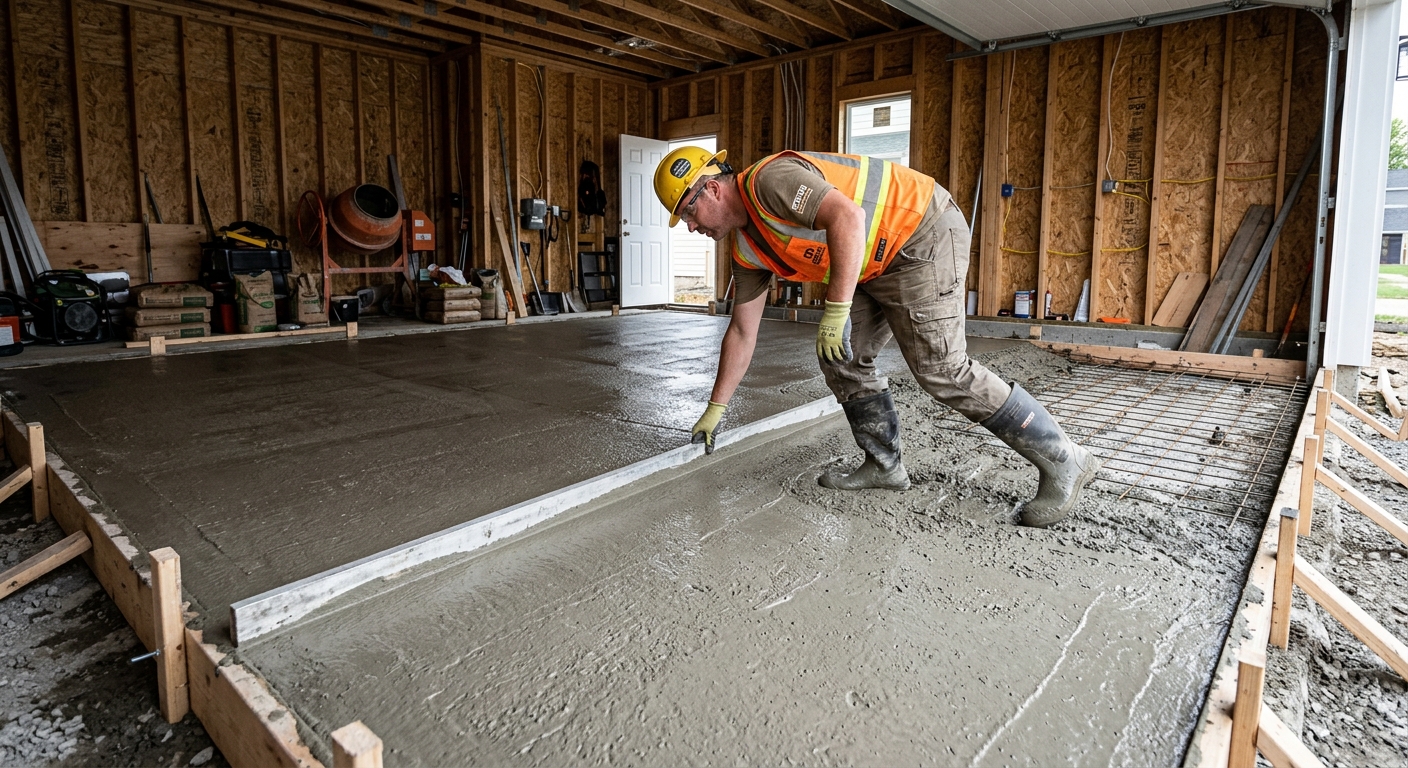
Concrete work options and costs in Revelstoke
Revelstoke’s concrete work is mostly driven by the reality that we live with frequent freeze–thaw cycles. That matters because the primary market for concrete flatwork—driveways, patios, and walkways—is homeowners in a city where single-detached houses make up 75.7% of dwellings, and 74.9% of households are owner-occupied (Statistics Canada, 2021 Census). In Thompson–Okanagan, frost depth assumptions are not “optional”: local practice targets footings and foundations below frost to help prevent heaving and cracking, rather than relying on shallow depths. Shorter shoulder-season pour windows in the interior also push costs upward when heating, insulated curing blankets, or extra protection are needed to keep the concrete gaining strength.
We see especially strong demand in and around the downtown core and along the Highway 23 corridor, where older neighbourhood lots often need durable, simple-to-maintain surfaces that can handle winter sanding and thawing water. That demand, combined with the need for good base preparation (well-compacted granular and drainage), is why Revelstoke bids can land above “generic BC” pricing. For flatwork you’ll typically budget around $18–$28 for concrete driveways and $14–$24 for patios and walkways, while foundation work sits in a separate category because frost-appropriate excavation and reinforcing are labour-heavy.
Below is a practical comparison of common concrete options you’ll see in Revelstoke—use it to align apples-to-apples with your quotes.
| Application |
Typical Size |
Key Spec |
Finish Option |
Price Range |
| Concrete driveway (standard broom finish) |
10 ft x 20 ft (200 sq. ft.) |
Air-entrained exterior mix, proper granular base, control joints |
Broom finish |
$3,600–$5,600 |
| Exposed aggregate driveway |
10 ft x 22 ft (220 sq. ft.) |
Air-entrained exterior mix, base prep, saw-cut joints |
Exposed aggregate (retarder + wash) |
$5,000–$7,600 |
| Stamped concrete driveway or patio |
10 ft x 20 ft (200 sq. ft.) |
Air-entrained exterior mix, sealer system, joint detailing |
Stamped pattern + colour |
$5,200–$7,900 |
| Plain concrete patio or walkway |
12 ft x 12 ft (144 sq. ft.) |
Air-entrained mix, thickened edges where needed |
Straight trowel or light broom |
$1,900–$3,500 |
| Garage floor (interior slab) |
20 ft x 22 ft (440 sq. ft.) |
Vapour/insulation considerations as required, mesh or rebar as specified |
Broom/steel trowel depending on use |
$4,800–$8,200 |
| Foundation footings (structural, below frost) |
Typical house perimeter + piers |
Excavation to below frost, reinforcing, concrete placement plan |
Structural concrete only |
$9,000–$15,000 |
Prices are estimates only and vary by project scope, site access and material selection.
What affects the price of concrete work in Revelstoke
If you’re comparing quotes for the “same” concrete job across Thompson–Okanagan and other parts of British Columbia, it’s common to see 30–50% differences. The reason isn’t just contractor markup—specs change with frost depth, freeze–thaw exposure, and how long the crew can pour and finish before temperatures drop. In Revelstoke, we assume frost in the 45–60 cm range for exterior design, and many placements require footings and foundations to extend below the design frost zone to prevent frost heave. Exterior slabs also need air-entrained concrete so the freeze–thaw cycle doesn’t break down the surface (scaling and spalling are the giveaways when the mix isn’t right).
Cost swings happen because colder interior pockets have a shorter practical pour season, and that can add heating, insulated blankets, or extra protection to hit strength targets before freezing. De-icing salt used in the interior can accelerate surface deterioration, so sealing is often the difference between “it looks good now” and “it holds up through winters.” For example, going from a plain broom-finish driveway to stamped concrete can move you from roughly the $18–$28 per sq. ft. backbone for standard driveways into a higher stamped & decorative band; that added labour (forms, stamp mats, colouring) is usually justified when you’re dealing with a long, highly visible exposure area.
Two practical Revelstoke examples: (1) If your soil needs over-excavation and replacement to achieve proper compaction, excavation and granular hauling push the job upward. (2) If your base is already well-drained and access is simple for a chute or pump, you can hold closer to the lower end of the $14–$24 patio/walkway band; conversely, difficult truck access can force more labour time and re-planning. Housing stock adds another factor—about 66.4% of homes were built before 1981 (Statistics Canada, 2021 Census), so many properties have older grades and drainage patterns that require careful base and drainage work before you ever pour.
| Price Factor |
Why It Matters |
Cost Impact |
| Frost line depth — determines footing depth and form height |
Footings must be below frost to reduce heaving risk in winter |
Can add excavation and forming time; higher frost-appropriate depth increases labour |
| Site preparation — excavation, grading, compacted granular base |
Concrete performance depends on a stable, drained base |
Over-excavation, haul-off, and granular supply can raise the total significantly |
| Reinforcement — rebar or wire mesh requirement |
Controls cracking and improves load capacity |
Material cost plus installation labour; heavier reinforcement increases price |
| Mix design — air-entrainment and compressive strength spec |
Air-entrainment helps exterior concrete survive freeze–thaw cycles |
Upcharge for correct mix and testing; wrong mix often costs more later |
| Finish type — broom vs. stamped vs. exposed aggregate |
Finish method changes labour, materials, and curing steps |
Stamped and exposed aggregate typically cost more than plain broom |
| Pour size and concrete truck access to site |
Smaller or hard-to-access sites require more equipment and labour time |
Chute/pump planning, extra labour, and waiting time can increase cost |
| Cold-weather curing precautions — heating and blankets |
Concrete must protect from freezing while it gains strength |
Heating equipment and insulation blankets can add noticeable daily costs |
| Control joint pattern and sealing cost |
Joints manage shrinkage/cracking; sealing protects from salt and moisture |
Saw cuts and proper sealant application add line-item cost but improve durability |
Permits & regulations in British Columbia
In British Columbia, structural concrete work typically needs a building permit. That includes footings, foundation walls, grade beams, and any structural foundation elements engineered for a house, addition, or structural underpinning. In most cases, the municipality expects engineered drawings for structural components, and inspections are part of the process (e.g., before concrete is poured and after key stages). For concrete flatwork—patios, walkways, and driveways—permits are usually not required when you’re simply placing concrete on your own usable grade. However, permits may be triggered if your project changes lot drainage, affects lot grading, touches municipal impervious surface coverage requirements, or involves work near a municipal right-of-way.
Before you break ground in Revelstoke, verify two things for every contractor: (1) appropriate licensing, where applicable for the scope, and (2) insurance and work coverage. Step-by-step: start by asking the contractor for a certificate of insurance showing liability coverage, confirm it includes your project address, and ensure their Workers’ Compensation coverage is active (WCB/WSBC clearance letter). Then check online: look for the contractor listing/registry entry through the appropriate provincial registry tools, and request the company’s current clearance letter number or documentation for confirmation. Finally, ask for references on similar jobs (driveway/patio thickness and base prep, and any structural foundation work if they claim it).
Getting concrete right in Revelstoke's freeze-thaw climate
Concrete can fail fast in Revelstoke when it’s treated like “just a slab.” The biggest causes we see locally are inadequate base preparation, poor drainage, and concrete that isn’t air-entrained for the region’s freeze–thaw cycles. If water gets trapped under or in the surface and freezes repeatedly, the expansion forces pull apart paste and rock, leading to scaling and spalling.
To spec the job correctly, start with base preparation: use a compacted granular sub-base to the right depth for local soil conditions and ensure proper slope and drainage so water doesn’t pond. Next, the mix design: for exterior flatwork in interior BC, require air-entrained concrete with a target air content in the 5–7% range and a minimum 32 MPa compressive strength (higher if the engineer specifies it). Control joints are critical—plan for saw-cut or tooled joints to limit random cracking and keep crack locations predictable. Curing is where many DIY or rushed pours fall short: plan for a minimum 7-day curing period under conditions that prevent freezing or rapid drying. When cold weather is possible, crews should use insulating blankets and/or controlled heating to keep the concrete on track for strength gain. Finally, apply a penetrating sealer after cure—typically around 28 days post-pour—so the surface resists de-icing salts and repeated wetting.
If you’re deciding between options, a local dollar example is common: a stamped driveway often costs more than a broom-finish driveway (often landing in the higher decorated range), but the price difference is justified when you’re also budgeting for correct air-entrainment, joint detailing, and proper sealing—those are the measures that actually stop winter damage. A beautiful stamp won’t last long if the mix and base aren’t right.
| Spec |
Why It Matters in Revelstoke |
What to Ask For |
Impact if Skipped |
| Compacted granular base (depth?) |
Prevents settlement and reduces water movement that freezes beneath slabs |
Confirm design thickness and compaction method (e.g., engineered thickness) |
Uneven cracking, pumping, and accelerated freeze–thaw deterioration |
| Air-entrained concrete mix (target air %?) |
Durable paste resists freeze–thaw expansion |
Ask for target air content (commonly 5–7% for exterior flatwork) |
Spalling/scaling even if the finish looks fine at first |
| Compressive strength (MPa rating) |
Ensures strength gain for winter exposure and loading |
Minimum 32 MPa unless engineer/spec says higher |
Lower durability, surface damage, and premature failure |
| Control joints (spacing per ACI guidelines) |
Limits random cracking caused by shrinkage and temperature movement |
Joint layout plan and cutting/sawing timing |
Wider uncontrolled cracks and water intrusion at joints |
| Minimum 7-day curing period |
Strength develops reliably before freeze risk |
Confirm curing protection plan in cool or damp conditions |
Weak surface, scaling, and early deterioration |
| Penetrating sealer (when applied after cure) |
Helps resist de-icing salt penetration |
Ask for application timing around 28 days post-pour (after cure) |
More salt damage and higher likelihood of surface breakdown |
How to choose a concrete work contractor in Revelstoke
Start with proof, not promises. In British Columbia, ask your contractor for their liability insurance certificate and confirmation of Workers’ Compensation coverage (WCB/WSBC clearance letter). For licensing, check the appropriate provincial registry listing available online for their business details, and make sure the person/company you hire matches the insured entity on the certificates. If they’re doing structural foundation work, request references on similar-scale projects and confirm they understand freeze-depth requirements and inspection sequencing.
Next, get 2–3 itemised written quotes rather than a single lump sum. A strong quote breaks down labour and materials (excavation and haul-off, granular base, reinforcing, concrete volume, finishing, saw cuts, and sealing) and clearly states what’s included versus excluded. Look for line items like disposal, permits (if needed), and access planning—if those aren’t listed, you can end up paying surprise change orders.
Warranty matters too. Ask for the workmanship warranty length and what it covers (cracks due to mix/base issues vs cosmetic finish issues). Also ask whether manufacturer warranties on products are transferable and what proof is required. For payment schedule, a common homeowner-safe practice is never paying more than 10–15% upfront, then holding back the remainder until the job is complete and deficiencies are corrected. Finally, demand a written timeline with start date and completion estimate—especially because shoulder-season cold can force protection measures.
- Provide insurance certificate (liability) and WCB/WSBC clearance letter before scheduling.
- Use a written scope: thickness, reinforcement, and finish are specified—not “as required.”
- Confirm frost-depth expectations and base prep method for your lot.
- Ask when control joints will be cut and how joint spacing will be handled.
- Verify air-entrainment and minimum compressive strength are in writing for exterior work.
- Request curing/protection plan for cool weather (blankets/heating if needed).
- Get an itemised quote including excavation, granular supply, rebar/wire mesh, and disposal.
- Clarify equipment access (chute vs pump) and whether truck waiting fees apply.
- Confirm sealing product type and timing (after cure, typically around 28 days).
- Ask for photos of recent local jobs in Revelstoke (similar finish and exposure).
- Review warranty terms in plain language and confirm what’s not covered.
- Keep payment staged with a meaningful holdback until the final inspection/cleanup.
Concrete contractor red flags in Revelstoke: they won’t commit to air-entrainment and curing protection in cold weather; they treat frost-appropriate footing/foundation specs as optional; they provide a lump-sum quote with no base prep or reinforcement details; they ask for most of the money upfront; or they refuse to show insurance/WSIB/WCB documentation and recent references.
Frequently asked questions — concrete work in Revelstoke
Concrete vs pavers for a patio in Revelstoke?
Both options work in Revelstoke, but the freeze–thaw climate changes how you compare durability. Concrete patios (with air-entrained mix, proper granular base, and well-planned control joints) are often more uniform and easier to maintain—especially with de-icing salt exposure. Pavers can perform very well too, but they rely on consistent base compaction and jointing sand staying stable; if water migrates or the base shifts, you can get uneven surfaces over time. In cost terms, a plain concrete patio/walkway is commonly in the $14–$24 band, while upgrades like stamped finishes cost more. If your grade drains well and you want a monolithic surface, concrete is usually the lower-risk choice. If you want easier section-by-section replacement later, pavers may fit better.
How long does a concrete driveway last?
A well-built driveway in British Columbia can last 25+ years, but “lasts” depends on the specs that fight our interior freeze–thaw cycles. The big drivers are air-entrainment for exterior exposure, a compacted granular base with drainage, correct jointing, and a reasonable sealing strategy against salt. A standard broom-finish driveway typically sits around the $18–$28 backbone band, but the cost difference you should care about is whether the contractor actually installs the durable details—not just the finish. If your driveway is poured too shallow on poor subgrade or without the right mix, scaling can start sooner and you’ll see spalling near edges and low spots. When you choose sealing and joint control properly, you reduce water entry paths that lead to early deterioration.
What is air-entrained concrete and why does it matter here?
Air-entrained concrete is mixed with tiny, evenly distributed air bubbles that give freezing water a place to expand without breaking the cement paste. In Revelstoke’s Thompson–Okanagan climate, freeze–thaw cycles are frequent enough that this isn’t a “nice to have”—it’s essential for exterior durability. Without sufficient air entrainment, the surface can scale or spall even if the driveway looks okay during the first few seasons. When contractors specify exterior air-entrained mix and use appropriate curing protection in cool weather, you’re paying for long-term performance rather than just the initial appearance. This is why two “similar” quotes can differ: a correct mix design costs more, but it prevents the failures that are expensive to redo. Always ask for written confirmation of air-entrainment for any exterior slab.
How do I prepare the base for a concrete slab?
Good base prep is what separates durable concrete from cracked, uneven concrete in British Columbia. For Revelstoke, the contractor should excavate to the correct depth, remove organic/soft material, grade to the proper slope, and place compacted granular (often in lifts) to achieve the required density. The goal is to prevent settlement and keep water from pooling under the slab—pooling water becomes freeze–thaw damage later. Ask your contractor to explain how they’ll handle drainage (including edge conditions), what thickness of granular they plan, and how they’ll compact it. If your lot has older grades (common in homes built before 1981, which make up 66.4% of the housing stock locally), base and drainage corrections can be more involved. A thorough base prep plan should be visible in an itemised quote.
How do I compare concrete quotes?
In Revelstoke, the fastest way to compare quotes is to compare scope, not just totals. Ask each contractor for an itemised breakdown: concrete volume, granular base thickness, excavation and disposal, reinforcement (mesh vs rebar), finishing method (broom vs stamped vs exposed aggregate), joint layout, curing/protection plan, and whether sealing is included. Make sure the air-entrained mix and minimum compressive strength are stated for exterior work; otherwise you’re comparing different levels of durability. Check access conditions: if one quote assumes easy truck access and another requires pumping/chute planning, totals won’t be apples-to-apples. If one contractor’s pricing lands near the $14–$24 patio band but theirs includes proper base prep and sealing, they may be the better value. Finally, confirm warranty terms and the payment schedule (generally no more than 10–15% upfront).
Can concrete be poured in cold weather in Revelstoke?
Yes, but it’s not “set and forget.” In British Columbia’s interior, winter and shoulder-season conditions can freeze fresh concrete before it gains enough strength, which harms durability and can increase scaling risk. In Revelstoke, competent contractors will use a cold-weather curing plan such as insulating blankets and/or controlled heating, monitor temperatures, and follow timing so the concrete cures properly. The key is that they must protect the slab long enough to meet strength targets—this is why cold-weather pours often cost more. When you get a quote, ask how they’ll protect concrete at night, what equipment they’ll use, and how curing will be handled for at least the minimum 7-day period (or longer if specs require). If a contractor promises quick results without a curing/protection plan, that’s a major concern for exterior work exposed to freeze–thaw cycles.