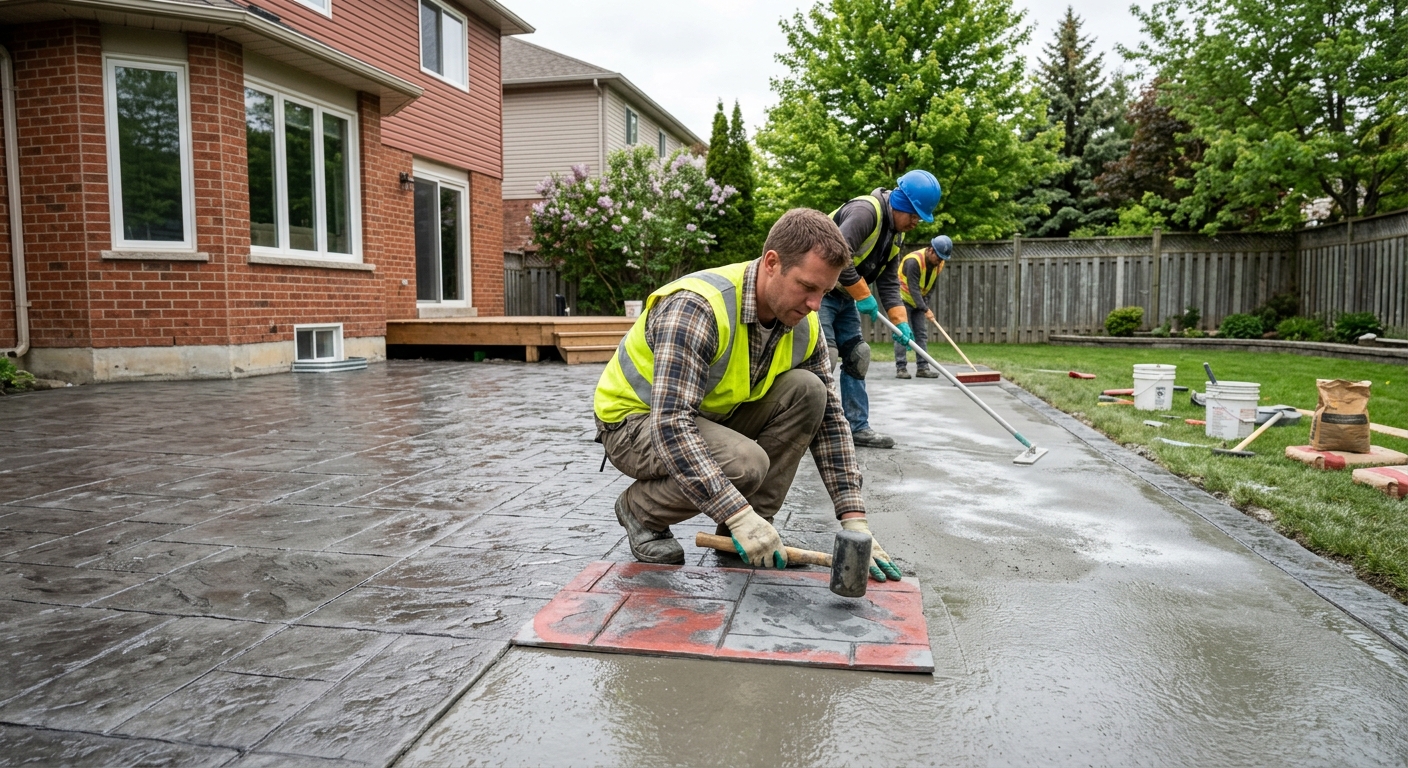
Concrete work options and costs in Gold River
Gold River homeowners typically reach out for concrete because the town’s housing mix is heavily oriented to flatwork: with 68.9% of dwellings being single-detached homes (Statistics Canada, 2021 Census), driveways, patios, walkways, and garage floors are common upgrades. You’ll also see a lot of older construction—77.0% of homes were built before 1981 (Statistics Canada, 2021 Census)—so many projects are part replacement, section removals, and refinishing rather than brand-new builds.
On Vancouver Island and the Coast, our concrete designs are shaped by a relatively shallow frost line paired with frequent freeze–thaw cycles in wetter, higher-elevation pockets. That combination changes the “invisible” parts of the job—air-entrained mixes, deeper granular base, reliable drainage, and well-planned control joints—so two contractors can quote the same visible finish but land on different total specs and costs. Weather also matters: cool, rainy stretches can slow curing and increase protection and scheduling time, while cold snaps require extra blankets and careful timing to protect early-age strength.
In Gold River, concrete flatwork demand is especially high around residential areas with active road access and frequent retrofit work, such as the downtown corridor and nearby neighborhoods along Highway 28A. From a budgeting standpoint, standard broom finishes cost less than decorative options, while structural foundation work is the highest-impact scope because it must be built below frost with proper reinforcement and drainage.
Use the table below to compare common options and realistic price bands, then we can narrow it to your site conditions and the finish you want.
| Application |
Typical Size |
Key Spec |
Finish Option |
Price Range |
| Concrete driveway (standard broom finish) |
400–600 sq. ft. |
Air-entrained mix, compacted granular base, control joints |
Broom finish, basic saw-cut joints |
$3,600 – $9,500 |
| Exposed aggregate driveway |
400–600 sq. ft. |
Air-entrained mix, consistent aggregate gradation, proper cure timing |
Exposed aggregate surface |
$7,000 – $13,500 |
| Stamped concrete driveway or patio |
300–500 sq. ft. |
Air-entrained mix, release agent technique, joint layout plan |
Stamp pattern + optional color hardener |
$6,500 – $16,000 |
| Plain concrete patio or walkway |
200–350 sq. ft. |
Compact base, reinforcement where needed, drainage slope |
Float + broom or light broom |
$2,800 – $6,800 |
| Garage floor (interior slab) |
300–500 sq. ft. |
Vapour barrier (when required), fibre or mesh, proper thickness |
Smooth trowel or broom finish (slab-top) |
$4,500 – $10,500 |
| Foundation footings (structural, below frost) |
Per project (varies by house) |
Excavation to design depth, reinforced footings, drainage provisions |
Not a finish-driven item; structural placement quality |
$12,000 – $35,000 |
Prices are estimates only and vary by project scope, site access and material selection.
What affects the price of concrete work in Gold River
In Gold River and the broader Vancouver Island and Coast region, it’s common to see concrete quotes for the “same” driveway or patio swing by 30–50%. The visible finish might look similar, but the pricing differences usually come from deeper specs: base preparation, frost protection details, reinforcement, and the mix design needed to survive our wetting-and-freezing conditions. On top of that, labour availability and equipment mobilization (especially for small, remote pours) can change pricing from one contractor to another.
Frost line depth and freeze–thaw cycles dictate the entire exterior spec package. Footings and foundations must extend below the design frost depth to prevent frost heave. In coastal BC, design frost depths are typically around 0.5–1.2 m, but we still build below frost and rely on granular base and drainage to keep the ground from becoming saturated and heaving. For exterior slabs, air-entrained concrete is non-negotiable—usually in the 5–7% air range for exterior flatwork—to reduce scaling and spalling during repeated freezing.
Cold weather also plays a cost role. While winters are milder than interior BC, cool temperatures and rain can slow curing strength gain and force better protection (insulating blankets, curing practices, and scheduling around colder snaps). And because people in the region use de-icing in the shoulder seasons, sealing becomes more important to manage surface deterioration.
Two practical Gold River examples: (1) If your driveway subgrade is soft, saturated, or has old fill, the cost climbs because excavation and replacement granular base are labour- and equipment-heavy; (2) If you choose stamped concrete, you’ll pay more for forms, texture mats, and colour work—often justified when you’re upgrading 400–600 sq. ft. However, a well-built broom-finished slab can be the smarter value where drainage is already solid; broom concrete flatwork often lands around the lower end of our $16–$25 per sq. ft. band for driveways when access is straightforward.
| Price Factor |
Why It Matters |
Cost Impact |
| Frost line depth — determines footing depth and form height |
Deeper excavations increase labour and material, and affect foundation geometry |
Can add significant excavation/formwork time; common swing in structural scopes |
| Site preparation — excavation, grading, compacted granular base |
Good base controls settlement and limits frost movement |
Soft or saturated soils can increase costs materially |
| Reinforcement — rebar or wire mesh requirement |
Helps control cracking and improves slab durability |
More steel and placement labour; price increases with thicker/heavier slabs |
| Mix design — air-entrainment and compressive strength spec |
Air reduces freeze–thaw damage; strength spec supports early durability |
Upgraded mixes cost more but reduce failures and repairs |
| Finish type — broom vs. stamped vs. exposed aggregate |
Decorative finishes require additional labour and tighter timing |
Stamped/exposed often pushes pricing toward the upper portion of the flatwork band |
| Pour size and concrete truck access to site |
Access limits placement speed and can require pumps or extra handling |
Low-access sites can add truck/pumping and labour time |
| Cold-weather curing precautions — heating and blankets |
Maintains early strength gain and reduces surface damage |
Protection materials and added set-up time can increase the job cost |
| Control joint pattern and sealing cost |
Joints manage shrinkage; sealing helps repel salts and water ingress |
Proper joint layout and post-cure sealing add line-item costs, but improve longevity |
Permits & regulations in British Columbia
In British Columbia, most structural concrete work requires a building permit, and in many cases engineered drawings reviewed by the municipality. That typically includes footings, foundation walls, grade beams, and other elements that support the building structure. Concrete flatwork—like patios, walkways, and driveways—often does not require a permit by itself, unless it affects lot grading, drainage, or impacts impervious surface coverage limits or municipal right-of-way requirements. Before breaking ground in Gold River, confirm with the local authority so your project doesn’t get delayed after the fact.
For your contractor, don’t rely on promises—verify insurance and clearance documents. Start by asking for their liability insurance certificate showing the effective dates and limits. Then check they have the appropriate workplace coverage (commonly referred to as WCB) for workers on site. If their crews include any subcontractors, ask for their certificates as well. For licensing, homeowners in BC should verify the contractor’s authorization through the appropriate online registry listing for the trade they perform and make sure it matches the scope (formwork/reinforcing work versus flatwork typically still falls under concrete contracting scopes).
Step-by-step homeowner checks in BC:
- Ask for a recent certificate of insurance and confirm it covers the concrete scopes being performed.
- Request their workplace coverage documentation (WCB) for the workers who will be onsite.
- Confirm their licence/registration status via the online registry tied to their trade.
- Check references for comparable projects in similar access conditions (small lots, steep grades, or older homes).
- Request the permit plan if structural work is included (footings/foundation elements).
Getting concrete right in Gold River's freeze-thaw climate
Concrete fails in Gold River mainly when water finds weak points and then freezes repeatedly. The usual culprits are inadequate base preparation, missing air-entrainment, poor drainage, and control joints that aren’t planned to “tell the concrete where to crack.” On Vancouver Island and the Coast, even with a relatively shallow frost depth, frequent wetting and freeze–thaw cycles can cause surface scaling and spalling if the mix and curing aren’t right. This is especially relevant in a community where many homes are older (77.0% built before 1981), since replacement slabs often sit over disturbed soils, old fill, or marginal drainage paths.
To spec the job correctly, focus on five things. (1) Base prep: compacted granular sub-base to the right depth for the soil and frost requirements, with drainage so the slab doesn’t sit in saturated conditions. (2) Mix design: exterior flatwork should be air-entrained with target air content typically around 5–7% and a minimum 32 MPa compressive strength. (3) Control joints: spacing planned to minimize random cracking—especially important for driveways and patios that experience daily freeze–thaw. (4) Curing: minimum 7 days under appropriate conditions; if it’s cool or damp, protection is critical so early-age strength doesn’t lag. (5) Sealing: apply a penetrating sealer after the cure period—commonly around 28 days post-pour—so de-icing salts and moisture are less likely to penetrate.
When comparing options, the price difference should reflect durability. For instance, stamped or exposed finishes cost more than broom-finish, often because they require tighter timing and additional finishing steps. If your base drainage is uncertain, it’s usually better to invest first in correct base, air-entrainment, and joints than to jump straight to decorative stamping; a durable broom finish can outperform a decorative slab built on the wrong subgrade.
| Spec |
Why It Matters in Gold River |
What to Ask For |
Impact if Skipped |
| Compacted granular base (depth?) |
Controls settlement and limits frost movement in freeze–thaw conditions |
Confirm granular base depth for your soil and slab thickness, plus proof of compaction |
Settling, cracking, and accelerated surface deterioration |
| Air-entrained concrete mix (target air %?) |
Reduces freeze–thaw damage and helps prevent scaling/spalling |
Request air content target (typically 5–7% for exterior flatwork) and mix documentation |
Spalling and flaking, especially in wet-cold cycles |
| Compressive strength (MPa rating) |
Supports long-term durability and resistance to weathering |
Minimum 32 MPa (or project-specific spec) and confirmation of mix design |
Lower durability and increased early-life cracking risk |
| Control joints (spacing per ACI guidelines) |
Directs shrinkage cracking to predictable lines |
Joint spacing plan for your slab size and exposure conditions |
Random cracking and water ingress into cracks |
| Minimum 7-day curing period |
Strength gain is slower in cool, rainy weather |
How curing will be protected during cold snaps and damp periods |
Surface weakness, dusting, and increased damage susceptibility |
| Penetrating sealer (when applied after cure) |
Repels moisture and de-icing salts that can worsen scaling |
Apply after cure—often around 28 days—compatible with your concrete and finish |
Higher water penetration and faster surface breakdown |
How to choose a concrete work contractor in Gold River
Choosing the right concrete contractor in Gold River is mostly about verifying coverage, reading the scope carefully, and making sure the quote matches the durability requirements for our freeze–thaw climate. First, confirm British Columbia licensing/registration for the trade they are performing (formwork, finishing, or concrete contracting) and that the registration matches the job scope you’re buying.
Next, verify liability insurance and workplace coverage for their crew. Ask for a current certificate of insurance (including the effective dates and limits) and request documentation for workplace coverage (WCB) for workers who will be on site. If subcontractors are involved, require their certificates too. Then get 2–3 itemised written quotes that break down labour and materials (concrete, base materials, rebar or mesh, forming, finishing, disposal). Avoid “lump sum only” quotes unless the scope is extremely detailed.
Read the scope: what’s included or excluded for excavation, hauling, granular supply, reinforcement placement, joint cutting, and sealing? Ask whether permit pulling is included (for structural work) and whether disposal of excess material is covered. For warranty, look for a workmanship warranty length and whether it’s tied to specific failures (like cracking due to inadequate base or curing). Also ask about product/manufacturer warranties for sealers and decorative systems, and whether warranties transfer if you sell the property.
Payment schedule matters: never pay more than 10–15% upfront, and hold back a portion until the finish and clean-up are complete. Get a written start date and a completion timeline that accounts for weather—on Vancouver Island and the Coast, rain and cool snaps can change scheduling even when the design is correct.
- Confirm their BC registration/licence matches the work being quoted.
- Verify liability insurance certificate (effective dates, limits, job coverage).
- Verify WCB/workplace coverage for workers on the project.
- Get 2–3 quotes with labour + materials line items (not just one lump sum).
- Ensure the quote states slab thickness, base prep, and compaction expectations.
- Ask for the mix type (air-entrained for exterior) and strength spec.
- Confirm reinforcement details (mesh vs rebar, placement position).
- Require an explicit control joint plan (spacing and where joints are cut).
- Ask about curing method and what happens if it’s too cold or wet.
- Clarify if sealing is included and when it will be applied (after cure).
- Check disposal/haul-away is included or quoted separately.
- Use a payment schedule with a holdback until completion and punch-list items.
Concrete red flags in Gold River: (1) they won’t discuss air-entrainment or show mix information for exterior slabs; (2) they suggest skipping granular base depth or compaction “to save money”; (3) they promise decorative finishing without a joint plan or curing protections; (4) they ask for large upfront payments (well beyond 10–15%); and (5) their quotes avoid specifying slab thickness, reinforcement, or drainage responsibilities.
Frequently asked questions — concrete work in Gold River
How deep must footings be for Gold River's frost line?
For Gold River and most coastal BC designs, footings are typically placed below the design frost depth—often in the range of 0.5–1.2 m for coastal climates—so the foundation isn’t pushed by frost heave during freeze–thaw cycles. The exact depth depends on your engineered design, soil conditions, and local requirements for the specific site. Because freeze–thaw is driven by moisture as much as temperature, contractors also need good drainage and granular base around the foundation. If your lot has saturated soils or drainage problems, the “real-world” performance may depend more on drainage details than on a number alone. For budgeting, structural work (footings) is priced far above flatwork; for typical projects, foundation/footings often fall within a broad band like $12,000 – $35,000 depending on house size, access, and reinforcement needs.
Why does concrete crack in Gold River and how is it prevented?
Concrete cracking in Gold River is usually shrinkage and thermal movement that happens as the slab cures and then cycles through wet and freeze–thaw conditions. Random cracking is more likely when there’s inadequate base preparation, insufficient control joint planning, or poor curing protection during cool, rainy periods. Prevention is mostly about giving the slab predictable “break lines” (control joints at the right spacing and depth), building on a compacted granular base that limits settlement, and using exterior-appropriate air-entrained concrete. Since older homes are common in the area—77.0% built before 1981 (Statistics Canada, 2021 Census)—replacement slabs may encounter disturbed subgrade, making base remediation especially important. Good contractors also plan for drainage and sealing to reduce water ingress. Decorative finishes don’t remove the need for joints; they just make joint planning and curing timing more critical.
Stamped vs broom-finish concrete — cost difference?
Stamped concrete costs more because it requires additional materials and labour: texture mats, release agents, often more colour steps, and tighter finishing control so the surface doesn’t set before detailing is complete. In Gold River, the climate adds scheduling complexity too—protecting the slab during cool periods is more critical for any finish that relies on consistent surface timing. As a homeowner reference, broom-finish driveways typically land in the lower part of the regional driveway band (for example, around $3,600 – $9,500 for many standard-size pours), while stamped driveways/patios often land higher, commonly in a range like $6,500 – $16,000 depending on size and colour complexity. If your main goal is durability and drainage, broom finish can be excellent value. If your goal is curb appeal, stamped is justified—provided the contractor still nails air-entrainment, base prep, joint layout, and curing protections.
When is the best time to pour concrete in Gold River?
The best time to pour concrete in Gold River is when you can protect the slab during curing and avoid long stretches of heavy rain or temperatures that force aggressive cold-weather measures. Coastal BC winters can be milder than interior regions, but cool temperatures and saturated soils still slow strength gain and raise the risk of surface damage if protection isn’t used. Practically, many contractors schedule exterior flatwork for late spring through early fall, then adjust with blankets and curing plans if a cold snap is forecast. The contractor should also plan pour sequencing and have the curing protection materials ready. If you’re deciding between finish options, timing matters more for stamped or exposed aggregate because surface work is sensitive to setting conditions. When scheduling, ask whether their quote includes weather contingencies and how they’ll handle a storm window—this often determines whether “cheap weather” turns into expensive rework.
How long does concrete take to cure?
Concrete has two timelines: strength gain and final readiness. For most projects, you should plan for at least 7 days of proper curing conditions before expecting normal light use. In Gold River’s cool, wet climate, contractors often protect the slab longer if temperatures stay low. For sealing, many manufacturers and installers recommend waiting until about 28 days post-pour so the concrete has fully dried and stabilized. If de-icing salt is expected during the season, sealing after cure is an important durability step, particularly for exterior slabs exposed to freeze–thaw cycles. The key point is that “curing” isn’t just time—it’s temperature, moisture control, and protection from rain or cold snap. A good contractor will spell out curing method, whether they use blankets, and how they’ll keep the surface from being damaged during early-age strength development.
Do I need a permit for concrete work in British Columbia?
In British Columbia, the need for a permit depends on what concrete work you’re doing. Structural concrete work such as footings, foundation walls, and grade beams typically requires a building permit and often engineered drawings reviewed through the municipality. Concrete flatwork—patios, walkways, and driveways—often does not require a permit by itself, but you should confirm if it affects lot grading, drainage, right-of-way considerations, or impervious surface rules. For Gold River homeowners, it’s smart to verify before you start excavation, because late permit requirements can force rework. Also ensure your contractor is properly covered: ask for their liability insurance certificate and workplace coverage documents (WCB) and request the relevant BC registration/licence information through the applicable online registry for the trade. If you’re ordering a quote, ask whether permit pulling is included for any structural scope.