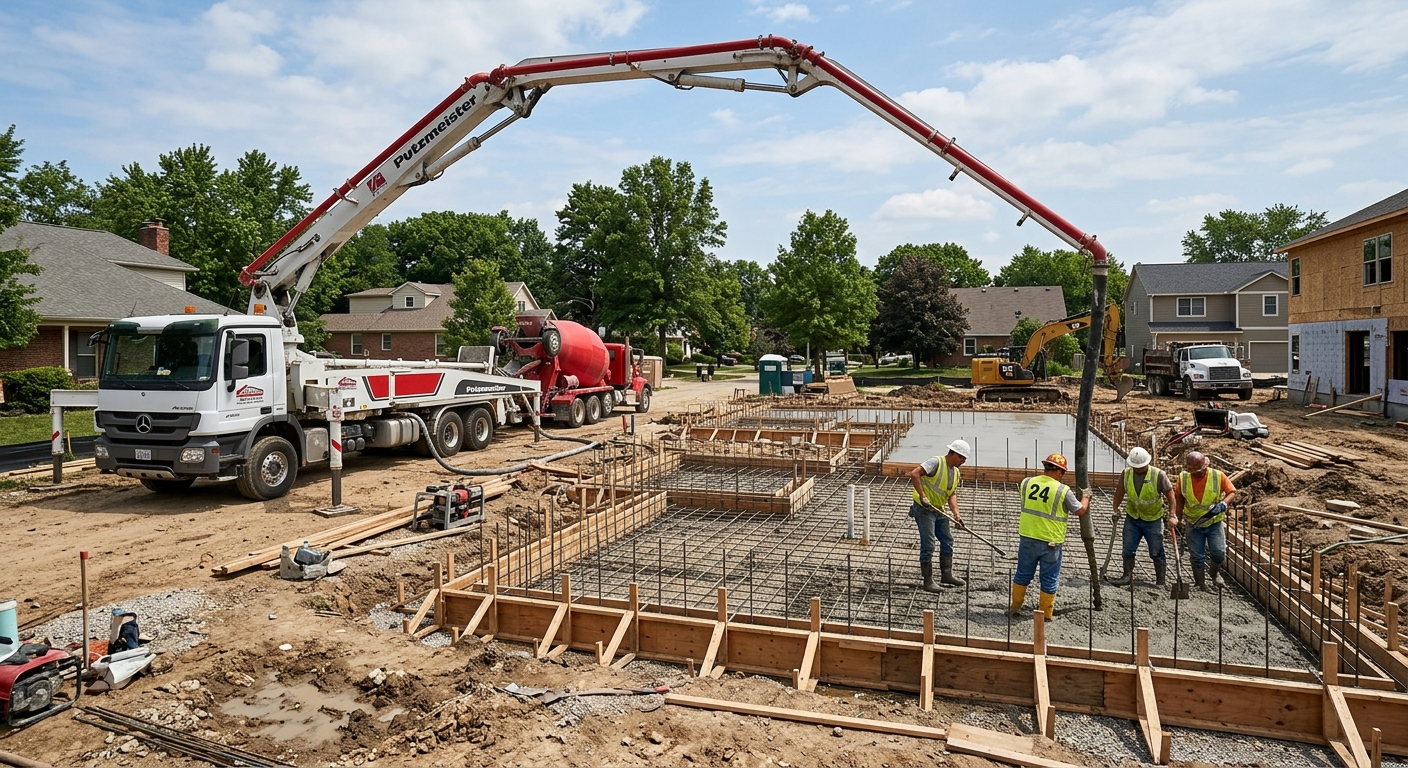
Concrete work options and costs in Port Alberni
Port Alberni homeowners often start with a driveway, patio, or walkway, because most properties here are older and the flatwork takes the brunt of wet weather and freeze–thaw. With 67.8% of dwellings being single-detached homes, exterior concrete flatwork is a top use for our crews—driveways, landing pads, and garden walkways. The housing stock is also established: 74.3% of homes were built before 1981, so many jobs begin with replacements of cracked slabs and worn edges, plus better drainage and base corrections.
On Vancouver Island and the Coast, costs are shaped by relatively shallow frost depth compared to interior BC, but the freeze–thaw cycle is still frequent in places with inland moisture and heavier soils. That means contractors must build for frost protection: properly graded granular base, air-entrained concrete, and control joints that limit random cracking. On top of that, frequent rain can slow site prep and scheduling, while cold snaps require curing protection so the concrete develops strength instead of surface scaling. In Port Alberni, this trade demand is especially steady around Alberni Valley (including the waterfront and downtown service area), where a lot of homes sit near established grading and require careful tie-ins to existing curbs and sidewalks.
Below is a practical comparison of common options. Use it to sanity-check quotes—then read the specifications, because the finish is only part of what you’re paying for.
| Application |
Typical Size |
Key Spec |
Finish Option |
Price Range |
| Concrete driveway (standard broom finish) |
400–600 sq. ft. |
Air-entrained exterior mix, compacted base, control joints |
Broom finish |
$6,500–$12,000 |
| Exposed aggregate driveway |
400–600 sq. ft. |
Air-entrained mix, proper curing to hold texture, jointing |
Exposed aggregate |
$9,000–$15,500 |
| Stamped concrete driveway or patio |
300–500 sq. ft. |
Air-entrained mix, release agents, stamped pattern, sealing |
Stamped & sealed |
$10,000–$18,000 |
| Plain concrete patio or walkway |
150–300 sq. ft. |
Compacted sub-base, air-entrained exterior slab, edge forms |
Broom or light trowel finish |
$2,600–$6,600 |
| Garage floor (interior slab) |
400–600 sq. ft. |
Vapour barrier (if specified), reinforced slab, interior cure |
Trowel + light finish |
$6,500–$12,500 |
| Foundation footings (structural, below frost) |
Per project (typical 1–2 storey) |
Excavation, formwork, rebar, engineered spec below frost |
Structural concrete |
$8,000–$22,000 |
Prices are estimates only and vary by project scope, site access and material selection.
What affects the price of concrete work in Port Alberni
On Vancouver Island and the Coast, two quotes for the “same” concrete job can differ by 30–50% because the scope isn’t truly identical—especially in Port Alberni, where drainage, frost protection, and curing requirements directly affect what’s needed to avoid callbacks. The biggest driver is foundation and slab specification: frost line depth and freeze–thaw cycles dictate that exterior work must sit below the local design frost depth and use air-entrained concrete so the slab can tolerate wetting and freezing. In coastal BC, the frost depth is often in the range of about 0.5–1.2 m, and while that’s shallower than the interior, we still see enough cycle-driven movement to crack poorly prepared slabs.
Cost also shifts with weather windows. Compared to milder months, colder snaps and saturated soils can force contractors to add curing protection (insulating blankets, temperature management) and to reschedule truck deliveries, which can raise labour and overhead. De-icing salts accelerate surface damage, so sealing is more than cosmetic—on driveways and steps, it’s part of long-term durability.
Here are concrete examples from Port Alberni that move the number: (1) fixing a driveway base after removing an old slab—if the granular sub-base is soft or contaminated, the excavation and re-compaction add cost even if the new pour size is unchanged; (2) upgrading from broom-finish to exposed aggregate or stamped—decorative options can be justified, but they raise material and labour time.
As a quick reality check: a standard broom driveway often lands in the $16–$25 per sq. ft. tier, while stamped & decorative work tends to push toward the $22–$35 per sq. ft. band because of additional finishing steps and sealing. For older homes built before 1981, expect more edge repairs, tie-ins, and sometimes thicker sections to match existing elevations—those adjustments show up as dollars, not just “finish upgrades.”
| Price Factor |
Why It Matters |
Cost Impact |
| Frost line depth — determines footing depth and form height |
Footings must sit below design frost to prevent heave and long-term cracking. |
Higher excavation and formwork; can materially change foundation cost. |
| Site preparation — excavation, grading, compacted granular base |
Loose or wet subgrade leads to settlement and joint failure. |
Often one of the biggest variability items between quotes. |
| Reinforcement — rebar or wire mesh requirement |
Controls cracking and improves load performance in slabs. |
Adds material and labour; depends on slab use and engineering. |
| Mix design — air-entrainment and compressive strength spec |
Freeze–thaw durability relies on air-entrainment for exterior exposure. |
Improves lifespan; typically increases per-cubic-yard cost slightly. |
| Finish type — broom vs. stamped vs. exposed aggregate |
Decorative finishes require extra steps, curing and sealing. |
Stamped/exposed usually raises cost per square foot. |
| Pour size and concrete truck access to site |
Long carries, restricted access, or multiple pours increase labour time. |
Can add truck and crew time charges; affects overall total. |
| Cold-weather curing precautions — heating and blankets |
Cool, wet conditions slow strength gain and increase surface scaling risk. |
May require temporary protection and monitored curing. |
| Control joint pattern and sealing cost |
Joints limit random cracks; sealing helps repel salt and moisture. |
Less “seen” than the finish, but crucial for durability. |
Permits & regulations in British Columbia
In British Columbia, the key distinction is whether the concrete work is structural or whether it’s non-structural flatwork with no impact on grading and drainage. Concrete structural work—such as footings, foundation walls, grade beams, and other engineered foundation elements—normally requires a building permit and, for many projects, engineered drawings reviewed through the municipal process. Concrete flatwork like driveways, patios, and walkways often does not require a permit, unless it affects lot grading, creates/changes impervious surface coverage beyond municipal expectations, or ties into municipal right-of-way features.
For a Port Alberni homeowner, a simple step-by-step approach is best. First, ask the contractor for proof they’re registered and insured: request a current certificate of liability insurance (the COI should list the project address/coverage type if available). Next, confirm their WCB coverage status (in BC you’ll typically see it documented through their WCB account or clearance letter). Then, verify they have the appropriate contractor registration for the scope of work by checking their standing through the province’s online registry where applicable.
Finally, ask for references on similar-scale jobs (especially exterior slabs that must perform through Vancouver Island wet winters). Don’t start excavating until permit responsibilities are clearly assigned—if engineered drawings are required, it should be in the contract, not assumed.
Getting concrete right in Port Alberni's freeze-thaw climate
Concrete failures in Port Alberni are usually preventable, and most start with either the wrong base preparation, poor mix design, or skipping the curing/protection steps that matter in a wet, freeze–thaw environment. For exterior slabs, the specification has to reflect that cycle: water moves into the slab and edges, then freezes and expands. If the concrete isn’t air-entrained and the base isn’t compacted correctly, you’re more likely to see surface scaling, spalling, and random cracking.
Spec the job in this order. (1) Base preparation: compacted granular sub-base to the depth required for local soil conditions and frost performance, with drainage to keep the base from staying saturated. (2) Mix design: for exterior flatwork, air-entrainment typically targets about 5–7% air, with a minimum 32 MPa compressive strength specification for durability. (3) Control joints: plan spacing to limit random cracking—joints must be cut at the right time so the slab cracks where you intend. (4) Curing: plan for a minimum 7-day curing period under proper conditions; in cold snaps you’ll need protection so the slab reaches strength instead of being damaged early. (5) Sealing: apply a penetrating sealer 28 days post-pour to help repel de-icing salts and reduce water absorption.
Ask technical questions: “What air content are you placing?”, “What’s the joint spacing plan for my driveway width?”, and “How will you protect the slab if temps dip overnight?” A clear dollar example: if a homeowner chooses stamped concrete, the added finish and sealing steps may push the project from a broom-finish driveway toward the $22–$35 per sq. ft. tier, but that’s justified only when the base, air content, joints and curing are still built to the same durability standard. Paying for decoration without paying attention to freeze–thaw spec is how you end up redoing work.
| Spec |
Why It Matters in Port Alberni |
What to Ask For |
Impact if Skipped |
| Compacted granular base (depth?) |
Helps prevent settlement and limits water staying under the slab through wet coastal seasons. |
Exact granular base depth and compaction method (and whether weak subgrade is removed). |
Uneven support leads to cracking and joint failure. |
| Air-entrained concrete mix (target air %?) |
Freeze–thaw durability depends on protected micro-voids inside the concrete. |
Target air content (typically 5–7%) and confirmation it’s an exterior-rated mix. |
More spalling and surface scaling in winter cycles. |
| Compressive strength (MPa rating) |
Strength gain supports wear resistance and reduces early damage. |
Minimum compressive strength (typically 32 MPa or as engineered/spec’d). |
Weaker early concrete can chip, scale and crack sooner. |
| Control joints (spacing per ACI guidelines) |
Controls where shrinkage and movement cracks occur. |
Proposed joint spacing and timing of saw-cutting or tooling. |
Random cracking across visible faces. |
| Minimum 7-day curing period |
Cool, damp weather slows strength gain and raises risk if you load or expose too early. |
Protection plan for cool/wet conditions and when you can drive on it. |
Surface damage, reduced performance and possible debonding. |
| Penetrating sealer (when applied after cure) |
Helps limit water and salt intrusion from coastal winter conditions. |
Sealer type and timing (typically after 28 days). |
Faster deterioration and higher chance of scaling in salted areas. |
How to choose a concrete work contractor in Port Alberni
Start by verifying three things in British Columbia: licensing/registration (for the work they’re doing), liability insurance, and WCB coverage. For liability insurance, request a current certificate of insurance and confirm it covers the type of work (excavation, forming, concrete placement). For WCB, ask for proof of coverage or a clearance letter as applicable so you’re not left holding risk if an injury happens on site. Then verify their registration/standing for the scope—don’t rely on a verbal “we’re insured” answer.
Next, get 2–3 itemised written quotes rather than lump-sum estimates. You want line items for labour, concrete supply, base prep (excavation, disposal, granular), reinforcement, forms, finishing, control joints, curing protection, and sealing—plus whether permits are handled and whether disposal is included. A well-written quote will say exactly what’s excluded, such as repairing damaged landscaping beyond a defined area or replacing electrical/gas conduits.
Warranty matters too: ask for a clear workmanship warranty length and whether it covers cracking, scaling, or only major defects. Confirm the product/manufacturer warranty (if any) and whether it transfers to you. For payment schedule, a common safe approach is no more than 10–15% upfront, with holdback until the job is complete and cured as required.
Finally, request the timeline in writing: start date, pour date, expected cure protection period, and final completion estimate. In Port Alberni, rain and cold snaps can affect sequencing, so the contractor should show they plan for weather—especially for exterior slabs.
- Confirm their BC registration/standing for the scope of work.
- Request a current certificate of liability insurance.
- Verify WCB coverage (clearance letter or documented proof).
- Ask for 2–3 local references on driveways or patios built for freeze–thaw climates.
- Get itemised pricing: excavation/base prep, concrete supply, rebar/mesh, forming, finishing, joints, curing protection, sealing.
- Ensure the quote states concrete spec: air-entrainment and compressive strength target.
- Confirm control joint plan (spacing and timing of cuts).
- Ask who removes and disposes concrete and excess soil (and where)
- Clarify permit responsibility if the work impacts grading, right-of-way features, or includes structural elements.
- Request written curing and protection plan for cold snaps and rain delays.
- Review warranty details: length, coverage limits, and exclusions.
- Use a payment schedule with 10–15% max upfront and holdback until final acceptance.
Concrete red flags in Port Alberni include: quotes that ignore air-entrainment for exterior slabs, refusing to discuss base depth/compaction, vague joint spacing (“we’ll cut it later”), starting without confirming permit or drainage expectations, and pushing large deposits before cure/protection is complete.
Frequently asked questions — concrete work in Port Alberni
How do I compare concrete quotes?
When comparing quotes in Port Alberni, don’t just compare the total price—compare the concrete spec and the scope. Ask each contractor to itemise base prep (excavation, granular depth, compaction), reinforcement (mesh or rebar where required), and finishing (including control joints and sealing). For exterior work, require confirmation of an air-entrained mix and a minimum strength rating (commonly 32 MPa or as specified). If one quote is much cheaper, it’s often because it assumes less excavation, less granular work, fewer joints, or no curing protection—those are exactly the items that lead to cracking and scaling in our wet winters. Use local price bands as a sanity check: a basic broom driveway often lands around the $16–$25 per sq. ft. tier, while stamped/decorative work typically pushes toward $22–$35 per sq. ft. if the durability spec is done right (not just the look).
Can concrete be poured in cold weather in Port Alberni?
Yes, concrete can be poured in cold weather in British Columbia, including Port Alberni, but it must be done with protection. The issue isn’t pouring itself—it’s how you protect the slab so it can reach strength safely. In a freeze–thaw climate, cool temperatures and overnight dips can slow strength gain and increase the chance of surface scaling if the concrete isn’t protected. A reputable contractor will plan for curing blankets, temperature monitoring, and scheduling so trucks arrive on time and the placement stays consistent. They should also specify the curing duration and when you can drive on or load the slab. If you’re comparing quotes, ask whether cold-weather curing precautions are included or treated as an extra—weather contingencies can be built into pricing when the season is borderline.
How do I maintain concrete in Port Alberni's freeze-thaw climate?
Maintenance in Port Alberni is mostly about managing water and salt, and preventing small surface issues from becoming larger failures. Keep drainage flowing away from the slab—if water pools, the freeze–thaw cycle concentrates moisture at the same spots and accelerates scaling. For driveways and steps, use a penetrating sealer applied after the concrete has cured—typically around 28 days—so the surface repels water and helps resist de-icing salt intrusion. Avoid aggressive scraping that can damage the surface layer. For repairs, patch small chips early with concrete-compatible repair materials before moisture gets under the surface. Also watch control joints: if sealant is missing or washed out, have it addressed. This is especially relevant in older neighbourhoods with driveways that were built before modern durability specs became standard; many homeowners notice scaling during the first few winters after a replacement if sealing is skipped.
What causes concrete to spall in Port Alberni winters?
Spalling usually happens when water enters the concrete and then freezes, expanding pressure near the surface. In Port Alberni’s coastal freeze–thaw conditions, spalling is most commonly linked to inadequate air-entrainment, poor curing, or insufficient surface protection. If the mix wasn’t designed for exterior exposure (the air-void system is missing or outside the target), freeze–thaw stress breaks the surface layer over time. Base issues can contribute too: if the slab settles or edges hold water, freeze–thaw damage focuses at seams and low spots. Early loading before adequate curing can also weaken the surface. When you see repeated flaking/small pop-outs after wet winters, it’s a sign to revisit the mix and finishing process. That’s why durable exterior slabs in BC are designed with air-entrainment and then sealed after cure to reduce salt and water penetration.
What is rebar and when is it required in British Columbia?
Rebar (reinforcing steel bars) is used to improve tensile strength and control cracking in concrete, particularly in slabs that must carry load or resist movement. In British Columbia, the need for rebar or mesh depends on the structure and how it’s engineered—not just “what’s common.” For example, structural elements like footings and many foundation components require reinforcement to meet engineering requirements, especially because they support the building through seasonal ground movement. For interior slabs like garage floors, reinforcement may be included to reduce cracking depending on thickness, use, and soil conditions. For exterior driveways and patios, many projects use reinforcement or thickening where warranted, but the exact requirement should come from the slab design and the contractor’s spec. Ask your contractor to explain what reinforcement they’re using (mesh versus rebar), how it’s supported to maintain cover, and whether it’s based on engineering or standard practice for your slab type.
How long does a concrete project take in Port Alberni?
Timelines vary by the type of concrete work, site conditions, and weather. For a typical exterior flatwork project in Port Alberni (like a patio or walkway), the on-site work is often a few days: excavation/base prep, forming, placement, finishing, and curing protection setup. The actual pour day is usually only a day, but the schedule depends on rain and temperature. Curing time is essential—while concrete gains strength quickly, a minimum 7-day cure period is commonly important before you treat it as fully durable, and sealing is typically done closer to 28 days after the pour. Driveways are often longer due to larger area, truck access planning, and joint layouts. If the project is more complex—like structural foundation footings—engineering, inspection scheduling, and excavation can add weeks. A good contractor will provide start date and completion estimate in writing, including how they handle weather delays in the Vancouver Island and Coast climate.