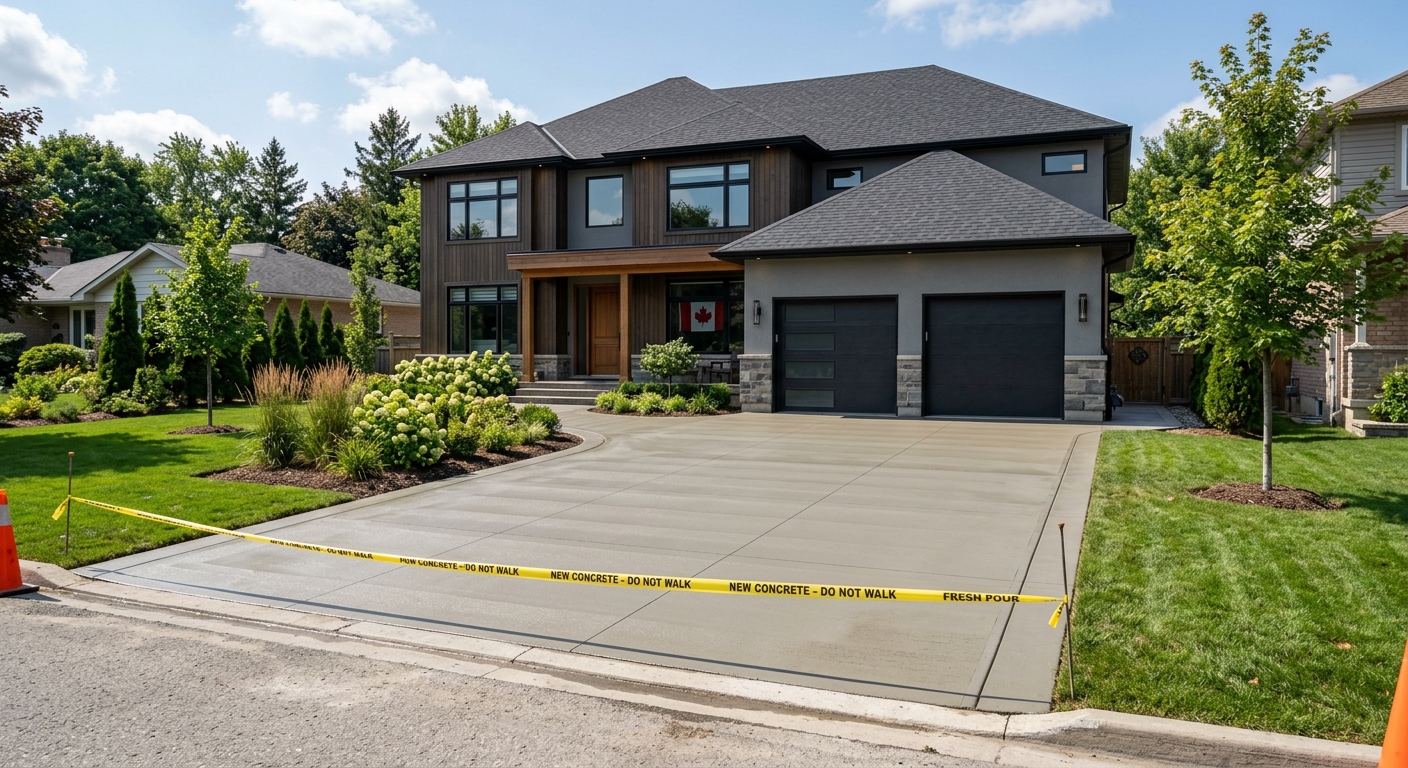
Concrete work options and costs in Port Moody
Port Moody homeowners typically run into concrete decisions in three main categories: driveways, patios/walkways, and foundation-related work. With single-detached houses making up about 30.1% of dwellings in the city and roughly 75.6% of households owning their home (Statistics Canada, 2021 Census), it’s no surprise that concrete flatwork is one of the most frequent exterior upgrades—especially in family-friendly pockets like Barber Street and the trails corridor near Moody Centre.
In the Lower Mainland–Southwest, concrete pricing isn’t just about formwork and finishing. Mild winters and a shallow frost line still require footings and thickened edges to be built below the design frost depth (local practice often assumes about 450 mm / 18"). On top of that, our coastal-wet conditions mean frequent freeze–thaw cycles, saturated soils, and heavy rainfall that can affect excavation visibility, base moisture, and curing schedule. Contractors commonly include air-entrained mix design and plan for longer curing/keel-down times when cool nights and high humidity slow strength gain.
Availability also plays a role: when demand spikes in the Vancouver–Surrey–Abbotsford corridor, truck scheduling, labour crew availability, and material lead times can nudge costs toward the top of the local bands—particularly for decorative work. That’s why a standard broom-finished driveway may land in one range, while exposed aggregate or stamped work can jump noticeably. Use the table below to benchmark typical scope and price expectations before you request itemized quotes.
| Application |
Typical Size |
Key Spec |
Finish Option |
Price Range |
| Concrete driveway (standard broom finish) |
400–600 sq. ft. |
Compacted granular base, air-entrained exterior mix, control joints |
Broom finish |
$18,000–$28,000 |
| Exposed aggregate driveway |
400–600 sq. ft. |
Air-entrained exterior mix, proper curing, controlled surface retarding |
Exposed aggregate |
$22,000–$34,000 |
| Stamped concrete driveway or patio |
300–500 sq. ft. |
Air-entrained exterior mix, colour hardeners as selected, joints planned |
Stamped pattern with integral colour |
$22,000–$36,000 |
| Plain concrete patio or walkway |
200–400 sq. ft. |
Compacted base, mesh/rebar as needed, joints for cracking control |
Plain finish (steel-trowel or broom edge) |
$16,000–$26,000 |
| Garage floor (interior slab) |
300–500 sq. ft. |
Vapour barrier (when specified), reinforcement, proper thickness |
Float and trowel / burnished edge |
$14,000–$24,000 |
| Foundation footings (structural, below frost) |
Per project / per linear metre basis |
Engineered design, excavation to depth below frost, structural rebar |
Not applicable (structural concrete) |
$200–$350 |
Prices are estimates only and vary by project scope, site access and material selection.
What affects the price of concrete work in Port Moody
In Port Moody and across the Lower Mainland–Southwest, it’s common to see quotes for the “same” concrete job vary by 30–50% once you account for base preparation, frost protection, mix design, and how the contractor handles curing during cool, wet stretches. Even when the finishing look is similar, the hidden drivers—excavation depth, subgrade conditions, reinforcement, and air-entrainment—can change the labour hours and materials required.
Frost depth and freeze–thaw cycles dictate nearly every exterior spec in this region. Footings and thickened edges must extend below the design frost depth to prevent frost heave, and exterior slabs should be made with air-entrained concrete to handle repeated freezing and thawing. The Lower Mainland’s frost line is shallower than many interior or northern areas, but we still design for freeze–thaw and saturated soils—so you still pay for granular base, drainage detailing, and proper jointing rather than “cheap-out” on thickness. Colder regions often require deeper excavations and short pour seasons, which can push costs higher; in Port Moody, costs are usually steadier, but prolonged rain and high humidity can require curing blankets and longer schedule coordination to reliably reach design strength.
Two practical examples: (1) If your subgrade is soft or repeatedly saturated, excavation may need to go deeper and more granular may be required—pushing driveway work toward the higher end of the driveway band of $18,000–$28,000. (2) If you want stamped or decorative work, the extra labour for forms, texture mats, colour, and sealing typically aligns with $22,000–$36,000 for stamped concrete driveway/patio style scopes. Local housing stock built before 1981 (33.1% of homes) also matters—older lots often have mature landscaping, tighter access, and less predictable drainage, which can raise demo/disposal and base-prep costs.
| Price Factor |
Why It Matters |
Cost Impact |
| Frost line depth — determines footing depth and form height |
Controls excavation depth and concrete volume below frost |
Higher excavation and more forming can add significant labour/material cost |
| Site preparation — excavation, grading, compacted granular base |
Sets the platform; poor prep leads to settlement and cracking |
Soft soils or extra granular can move pricing toward the top of the band |
| Reinforcement — rebar or wire mesh requirement |
Improves crack control and load capacity |
Steel/rebar and tying time can noticeably increase labour |
| Mix design — air-entrainment and compressive strength spec |
Air entrainment helps resist freeze–thaw scaling/spalling |
Correct mix typically adds small material cost but prevents failures |
| Finish type — broom vs. stamped vs. exposed aggregate |
Impacts labour time, materials, and curing steps |
Decorative finishes generally cost more per square foot |
| Pour size and concrete truck access to site |
Determines crew time, hose/pump needs, and scheduling |
Limited access can trigger pumps, extra labour, or smaller batches |
| Cold-weather curing precautions — heating and blankets |
Ensures strength gain despite cool nights and delays from rain |
Heating/blanks can add daily costs and extend schedule |
| Control joint pattern and sealing cost |
Joints manage shrinkage/thermal movement; sealing helps durability |
Proper jointing and sealers add material and labour but improve longevity |
Permits & regulations in British Columbia
In British Columbia, structural concrete work generally needs municipal coordination and a building permit. That typically includes footings, foundation walls, grade beams, and any concrete elements tied to engineered structural support. For many of these scopes, you should expect engineered drawings to be reviewed and/or required as part of permit approval. If your project involves underpinning, foundation repairs, or a new structural addition, plan on permit requirements.
Concrete flatwork—like patios, walkways, and driveways—often does not require a building permit, unless it affects lot grading, drainage, impervious surface coverage limits, or the municipal right-of-way (for example, work near a sidewalk/curb or changes to stormwater flow). Even when a permit isn’t required, homeowners should still confirm details with the local authority before breaking ground, especially if excavation impacts existing drains or mature landscaping.
For contractor compliance in Port Moody, verify three things step-by-step: (1) Licensing/registration: look up the contractor in the appropriate provincial registry listings (the contractor should provide their business registration details and credentials). (2) Liability insurance: request a current certificate of insurance showing adequate limits for general liability and naming you as appropriate for the work. (3) Workplace coverage: ask for proof of WCB/WSIB-equivalent coverage documentation where applicable in BC. If the contractor can’t provide certificates or clear references from similar-scale jobs, treat it as a red flag and request alternatives before you commit.
Getting concrete right in Port Moody's freeze-thaw climate
Concrete commonly fails in Port Moody because freeze–thaw cycles and our coastal-wet conditions stress the slab surface and foundation interface. When water gets in—through poor drainage, cracked surfaces, or inadequate finishing/curing—it freezes, expands, and leads to scaling and spalling. In practical terms, the fix is to spec the job correctly from the ground up, not just to choose a “pretty finish.”
Start with base preparation: use compacted granular sub-base to the correct depth for local soil and frost protection, with attention to subgrade drainage so the base stays stable during heavy rain. Next, get the mix design right: for exterior flatwork, specify air-entrained concrete (commonly about 5–7% air content for exterior exposure) and a minimum compressive strength such as 32 MPa to meet durability expectations. Then address control joints: use a rational joint spacing plan to limit random cracking—especially critical on driveways that see thermal movement and occasional vehicle loads.
Curing is where many projects silently lose performance. Plan for a minimum 7-day curing period under protective conditions; in cooler or damp periods, contractors should use curing blankets/sealers (as appropriate) and manage temperature to prevent early surface damage. Finally, sealing matters: a penetrating sealer is typically applied after the slab has cured—often around 28 days post-pour—to improve resistance to de-icing salt and winter moisture.
Here’s a real-world decision point: a sealed plain patio might fall into the $16,000–$26,000 band, while stamped work can land in the $22,000–$36,000 range. The price difference is justified when you’re paying for the added surface preparation, colour system, and longer finishing time; but skipping air-entrainment or jointing is never the place to save money. Ask specifically how they prevent spalling by protecting the concrete from freeze–thaw water entry.
| Spec |
Why It Matters in Port Moody |
What to Ask For |
Impact if Skipped |
| Compacted granular base (depth?) |
Supports the slab and reduces water/ice movement under freeze–thaw |
Documented base depth, compaction method, and drainage notes |
Settlement, edge cracking, and accelerated deterioration |
| Air-entrained concrete mix (target air %?) |
Improves freeze–thaw durability in exterior exposure |
Air content target (commonly 5–7% for exterior flatwork) on ticket/spec |
Scaling and spalling in Port Moody winters |
| Compressive strength (MPa rating) |
Ensures strength gain and long-term surface durability |
Minimum 32 MPa (or as engineered) and proof of mix design |
Surface weakness, reduced abrasion resistance |
| Control joints (spacing per ACI guidelines) |
Controls where cracking occurs under shrinkage and temperature swings |
Joint spacing plan tied to slab dimensions and finish type |
Random cracking patterns and costly repairs |
| Minimum 7-day curing period |
Cold nights and humidity slow early strength development |
Protection plan (curing blankets/conditions) and curing schedule |
Surface damage, weaker top layer, increased scaling risk |
| Penetrating sealer (when applied after cure) |
Repels moisture and de-icing salts after the slab has matured |
Sealer type and target application window (commonly around 28 days) |
Faster staining, scaling, and surface erosion |
How to choose a concrete work contractor in Port Moody
Choosing the right contractor in Port Moody comes down to proof and clarity. Start by verifying British Columbia credentials and insurance. Ask for their current business details and confirm they can legally contract for the work scope you’re hiring for. Next, request a certificate of liability insurance showing coverage relevant to construction activities. For workforce protection, ask for documentation of WCB/WSIB-equivalent coverage where applicable in BC. A legitimate concrete crew should also be willing to show recent photos and references for driveways, patios, and any foundation work on comparable lots.
Then get 2–3 itemised written quotes. You want labour and materials breakdowns—not a lump sum that hides what’s included. Ensure excavation and disposal are addressed, confirm whether rebar/wire mesh is included, and ask about base depth and drainage detailing. Also ask whether the quote includes permits (if needed), sawcutting/jointing plan, and whether sealing is included or a separate line item.
Warranty matters. Look for a workmanship warranty stated in writing (not just verbal assurance), plus details on manufacturer/product warranty where applicable. Clarify whether warranties are transferable to future owners. For payment, never pay more than 10–15% upfront; use a holdback until the work is complete, cured, and finalized. Finally, insist on a written start date and a realistic completion timeline—especially because rain and cool nights can extend curing and finishing schedules in the Lower Mainland.
- Request proof of current insurance and coverage documents before signing.
- Ask for references on similar concrete flatwork in Port Moody or nearby Lower Mainland neighbourhoods.
- Verify base depth, compaction method, and drainage are explicitly included.
- Confirm air-entrained mix and target air content for exterior pours.
- Get a jointing plan (spacing and location) in the written scope.
- Ask how they protect concrete during cool/wet weather (curing blankets/heating if needed).
- Clarify reinforcement (rebar vs wire mesh) and where it will be placed.
- Ensure disposal and hauling of excavated material are included or priced.
- Check whether sealing is included; if not, get a clear optional line item and timing.
- Confirm equipment access (truck, pump/hosing) and labour adjustments for tight sites.
- Review the warranty length and what failures it covers (not just “cosmetic”).
- Use a payment schedule with a holdback until cure and final grading/cleanup are complete.
Concrete red flags in Port Moody: vague scopes that don’t mention base prep or air-entrainment; photos that show finished work with no jointing details; contractors who won’t provide insurance certificates or coverage proof; quotes that treat control joints and sealing as optional “extras” without explanation; and crews that rush curing or can’t describe how they’ll manage cool, damp days during placement.
Frequently asked questions — concrete work in Port Moody
What is air-entrained concrete and why does it matter here?
Air-entrained concrete is mixed with tiny, evenly distributed air bubbles that act like pressure relief during freezing. In Port Moody and the Lower Mainland–Southwest, exterior slabs still face freeze–thaw stress: coastal moisture and temperature swings get water into small pores and along edges, and that water expands when it freezes. Without adequate air entrainment, the surface can scale or spall over winter cycles even if the slab looks fine in summer. This is one reason credible exterior concrete bids include air-entrained mix design and control joint planning—rather than just focusing on finish. If you’re comparing quotes for a driveway in the $18,000–$28,000 band, ask each contractor to state the mix specification on the ticket or written scope, including air-entrainment and strength requirements.
How do I prepare the base for a concrete slab?
Base prep is where most long-term performance is decided. For Port Moody exterior flatwork, your contractor should excavate to the correct depth, remove unsuitable or organic material, and install a compacted granular sub-base to a thickness that supports the slab and accounts for frost protection practice (often around 450 mm / 18" design assumptions for the region). They should compact in lifts and confirm grade/slope so water drains away rather than sitting under the slab. Good base prep often includes attention to subgrade drainage and moisture control, especially on lots with saturated soils after heavy rain. When you request a quote, ask for the base depth, the compaction method, and whether they’re including granular, drainage detailing, and proper elevations around existing services.
How do I compare concrete quotes?
To compare quotes in British Columbia fairly, match apples to apples. Ask for itemized pricing that separates excavation and base prep, reinforcement, concrete supply/mix design, forming, finishing, jointing, curing protection, and sealing (if included). For example, if one contractor prices your driveway closer to the $18,000–$28,000 band and another comes in near the top, confirm whether the higher bid includes deeper/engineered base prep, proper air-entrainment mix design, and more robust joint planning. For decorative work, stamped concrete often falls into a $22,000–$36,000 range; confirm what’s included (integral colour, colour hardeners, number of stamp mats, and sealer). Also check exclusions: disposal, permit work (if your scope affects grading/impervious limits), and truck access/pumping. A good quote should be specific, not vague.
Can concrete be poured in cold weather in Port Moody?
Yes, concrete can be poured in cold weather in Port Moody, but it must be managed correctly. Cool nights and damp conditions can slow strength gain and increase the risk of surface damage if protection isn’t used. Contractors typically maintain curing conditions with insulated blankets and, when necessary, heating practices so the concrete doesn’t freeze before it reaches adequate early strength. The key is planning: scheduling around rain windows, ensuring the right mix for the temperatures, and protecting freshly placed concrete. If you’re getting quotes outside the ideal season, ask how they handle temperature control, what protection they use, and whether they’ll extend the curing period. In a wet coastal climate, they should also describe how they prevent mud/re-wetting of the base before placement.
How do I maintain concrete in Port Moody's freeze-thaw climate?
Maintenance in Port Moody is mostly about keeping water out of the slab’s surface system and managing winter chemistry. Start with curing and sealing: after installation, a penetrating sealer is commonly applied around 28 days post-pour to repel moisture and reduce staining/erosion from de-icing salts. After that, inspect joints and edges seasonally—if joints are missing sealant where needed, water can migrate and worsen freeze–thaw scaling. Use de-icing products carefully; heavy salt use can accelerate surface wear, especially on unsealed or poorly cured slabs. Also keep drainage clear: if downspouts or landscaping directs water onto your driveway or patio, fix the grading/flow. For decorative finishes like stamped or exposed aggregate, avoid harsh abrasives and prefer gentle cleaning methods.
What causes concrete to spall in Port Moody winters?
Spalling usually happens when moisture gets into the concrete and freezes, then the expansion breaks down the surface layer. In Port Moody, the most common triggers are inadequate air entrainment, poor curing, and water management issues at joints/edges. If the mix doesn’t have the right air void system, freeze–thaw cycles can cause scaling and then spalling even if the concrete was initially strong enough to “seem” fine. Another contributor is insufficient base prep or drainage, where water sits under or against the slab. De-icing salts can further intensify damage by drawing moisture into the surface. When comparing quotes for exterior work in the Lower Mainland–Southwest, make sure the contractor explicitly includes air-entrained mix design, a joint plan, and curing protection. If a bid doesn’t mention these fundamentals, treat it as incomplete—especially in a climate with repeated freeze–thaw cycles.