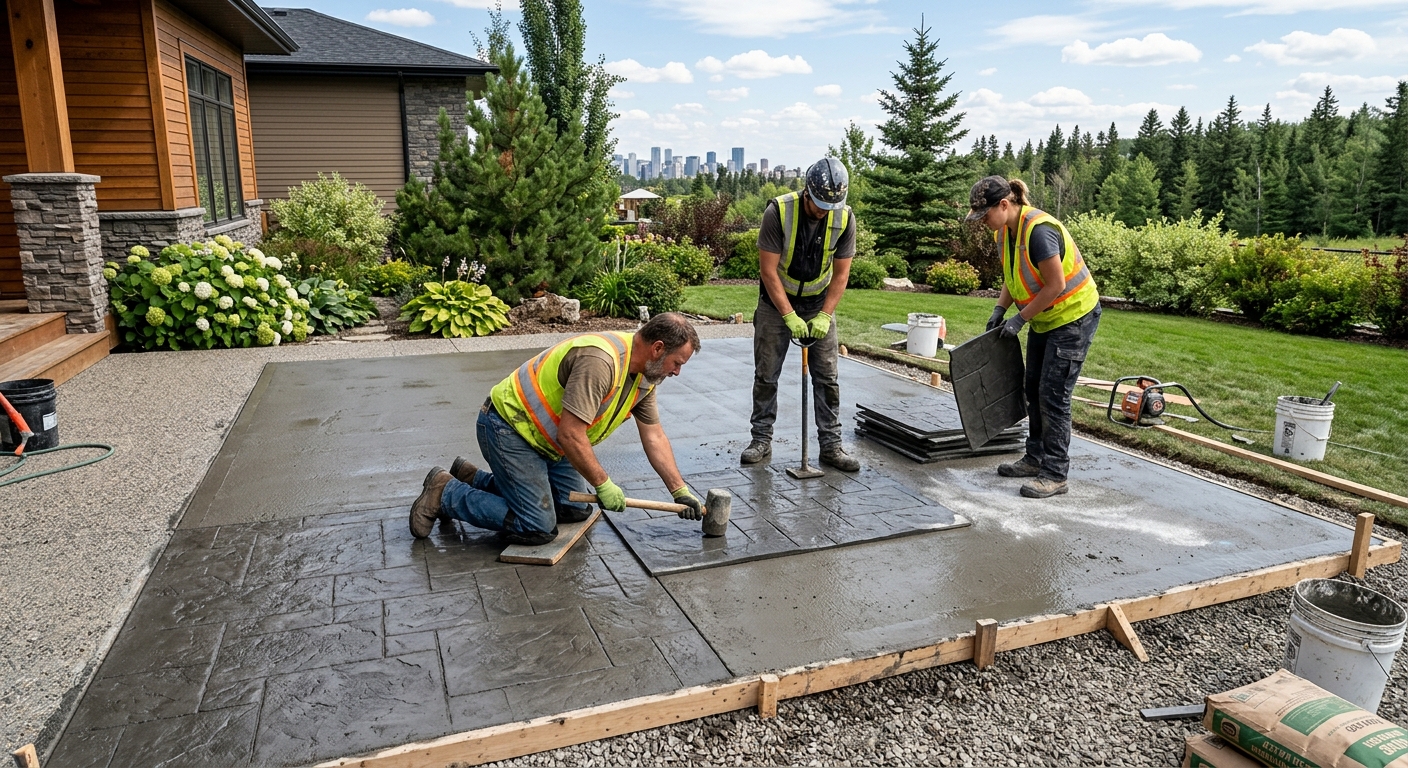
Concrete work options and costs in North Cowichan
Concrete work in North Cowichan is in steady demand, largely because most homeowners here are living in single-detached neighbourhoods—single-detached homes make up 62.5% of dwellings (Statistics Canada, 2021 Census). With 10,575 homeowner households (76.9% of households own), driveways, patios, walkways, and garage floors are common upgrades, especially as older properties get refreshed or accessory buildings are added. Even the home age mix matters: 42.6% of homes were built before 1981 (Statistics Canada, 2021 Census), and many of those projects involve replacing cracked flatwork, correcting drainage, or reworking front-entry steps.
Vancouver Island and the Coast pricing is shaped by our freeze–thaw cycles and a relatively shallow frost line. Contractors in North Cowichan typically design footings and foundations to sit below frost, using proper granular base and drainage so the ground can’t heave and push slabs upward. Costs also reflect the real-world scheduling challenge: cool, wet weather slows curing, and winter rain can disrupt forming and finishing if crews can’t access the site quickly.
In areas like Duncan and the larger North Cowichan corridor up toward Shawnigan Lake, we often see strong demand for exterior flatwork—driveways and patios—because land grading and drainage are frequent issues. That’s why the same “average” job can come in noticeably different. Use the comparison table below to understand what changes most between options, then match it to your goals and site conditions.
| Application |
Typical Size |
Key Spec |
Finish Option |
Price Range |
| Concrete driveway (standard broom finish) |
400 sq ft (approx. 20 ft x 20 ft) |
Air-entrained exterior mix, compacted granular base |
Broomed, 4–6 in slab with control joints |
$6,400–$10,000 |
| Exposed aggregate driveway |
400 sq ft (approx. 20 ft x 20 ft) |
Air-entrained mix, proper curing schedule |
Exposed aggregate, sealed after cure |
$8,000–$12,500 |
| Stamped concrete driveway or patio |
350 sq ft (approx. 20 ft x 17 ft) |
Air-entrained exterior mix, reinforcement as needed |
Stamp mats + release + colour hardeners |
$9,000–$13,500 |
| Plain concrete patio or walkway |
200 sq ft (approx. 10 ft x 20 ft) |
Exterior air-entrained mix, drainage slope |
Float + light broom / trowel edge |
$2,800–$4,400 |
| Garage floor (interior slab) |
500 sq ft (approx. 20 ft x 25 ft) |
Vapour barrier, properly compacted base |
Steel trowel finish, light broom edges |
$7,000–$10,500 |
| Foundation footings (structural, below frost) |
Per linear foot (typical 18–24 in width) |
Excavation, granular bedding, rebar as required |
Reinforced concrete footings, below frost depth |
$300–$750 |
Prices are estimates only and vary by project scope, site access and material selection.
What affects the price of concrete work in North Cowichan
In North Cowichan, it’s common to see concrete quotes for similar work come back 30–50% apart across Vancouver Island and Coast and the broader BC market. The gap usually isn’t because “one contractor is cheaper”—it’s because the specs differ in ways that directly affect durability. On projects like driveways and patios, our local climate pushes everyone toward air-entrained mixes, quality base prep, and the right control joint strategy, so bids that look alike on paper can perform very differently over a few winters.
Frost line depth and freeze–thaw cycles drive most of the design. Exterior footings and foundations generally need to extend below the design frost depth (in coastal BC, about 0.5–1.2 m, depending on site and conditions) to reduce heave and random movement. For slabs, the concrete needs air-entrainment to survive repeated wetting and freezing; if you don’t get the air content right, you can see surface scaling and spalling sooner. Cold-weather curing precautions also change costs: in coastal BC you may not face interior-style heating for months, but crews still price in blankets, temperature monitoring, and scheduling around rain so concrete can gain strength properly. De-icing salt can be brutal on unsealed or poorly finished surfaces—sealing is a small line item compared to premature replacement.
Local conditions raise or lower cost in practical ways. For example, rough grading near Duncan or Shawnigan Lake access can mean extra excavation and hauling, increasing labour and disposal. If your existing driveway base is soft, bidders may include granular base rebuild (adding cost) rather than “pouring over” unsuitable material. Finish choices move prices too: a basic broom-finish driveway can land around the $16–$25 per sq ft range, while stamped or exposed aggregate typically trends higher due to forms, materials, and skilled finishing labour—often justified when you want curb appeal, not just function. With older homes built before 1981 making up 42.6% of the housing stock (Statistics Canada, 2021 Census), drainage retrofits and replacement of settled approaches are common, and those site fixes can be the difference between a smooth job and a costly rebuild.
| Price Factor |
Why It Matters |
Cost Impact |
| Frost line depth — determines footing depth and form height |
Deeper footings reduce frost heave and settlement movement |
Medium to high (excavation and forming scale with depth) |
| Site preparation — excavation, grading, compacted granular base |
Proper base controls voids and prevents slab settlement |
High when soil is poor or access is tight |
| Reinforcement — rebar or wire mesh requirement |
Reinforcement helps control cracking under load and movement |
Low to medium (depends on slab thickness and design) |
| Mix design — air-entrainment and compressive strength spec |
Air entrainment improves durability in freeze–thaw cycles |
Medium (material cost + QA checks) |
| Finish type — broom vs. stamped vs. exposed aggregate |
Complex finishes require more labour and materials |
Medium to high |
| Pour size and concrete truck access to site |
Smaller access windows add labour for placement and pumping/hosing |
Medium (can change workflow and crew time) |
| Cold-weather curing precautions — heating and blankets |
Protects early-age concrete so strength develops safely |
Low to medium, higher in colder/wetter snaps |
| Control joint pattern and sealing cost |
Joints limit random cracking; sealing protects against salts and scaling |
Low to medium but can prevent expensive callbacks |
Permits & regulations in British Columbia
In British Columbia, structural concrete work typically needs a building permit. That includes things like footings, foundation walls, and grade beams, because these elements carry structural load and are usually reviewed with engineered drawings. For concrete flatwork—such as driveways, patios, and walkways—permits are often not required by default, but they can come into play if your project affects lot grading, stormwater management, impervious surface coverage, or the handling of work near municipal right-of-way areas. In North Cowichan, it’s also smart to confirm any side yard or frontage work requirements before excavation.
Step-by-step, here’s how a North Cowichan homeowner can verify a contractor’s qualifications in BC:
- Check contractor registration/licensing information through the appropriate provincial online listings (look for the company name and any individual trades involved).
- Request a Certificate of Insurance and confirm it’s current and covers the scope of concrete work (general liability).
- Ask for proof of WCB coverage (or clearance letter, if applicable) so you’re protected if a worker is injured on site.
- Get insurance details for subcontractors—don’t rely on verbal assurances.
- Ask for references on similar-scale projects in your area (Duncan, Chemainus, Shawnigan Lake) and confirm the dates—recent work tells you how they operate in our current coastal conditions.
Always confirm permit requirements with the local authority before breaking ground, especially if you’re touching drainage patterns or structural elements.
Getting concrete right in North Cowichan's freeze-thaw climate
Concrete failure in North Cowichan is usually not “mystery cracking”—it’s predictable outcomes of base issues, incorrect mix, and poor early-age protection in our coastal freeze–thaw conditions. The big ones we see over time are spalling and scaling from inadequate air-entrainment, random cracking from poor control joint planning, and settlement-related cracking when the granular base isn’t compacted to the right depth for local soil conditions.
To spec your job correctly, start with base preparation: install a compacted granular sub-base to the proper depth for your soil and frost strategy, and build the right drainage slope so water doesn’t sit against the slab. Next, mix design matters in a region with frequent wetting and freezing: exterior flatwork should target 5–7% air content and a minimum 32 MPa compressive strength, with air-entrainment verified through batch information or certified documentation. Then, control joints: place and detail control joints early in the slab design so cracks occur at planned locations instead of randomly. Curing is another make-or-break step: protect the slab for at least 7 days under good conditions, and use blankets or curing protection if cold snaps arrive. Finally, sealing helps protect against de-icing salts and coastal grime: apply a penetrating sealer after the cure period (commonly at 28 days) so moisture can’t ride into the surface.
Ask technical questions that prevent spalling: “What air-entrained mix are you using for exterior exposure?” and “How are you verifying cure protection temperatures during the first week?”
As a dollars-and-scope example, if a basic driveway is quoted around the $16–$25 per sq ft band, spending the extra labour on proper joints and a quality finish may only add a few thousand dollars—but avoiding early surface scaling can mean not replacing the slab years sooner. Stamped concrete costs more (often within the $22–$35 per sq ft band), and it’s only “worth it” when the base and mix are equally well done, not just when colour is added.
| Spec |
Why It Matters in North Cowichan |
What to Ask For |
Impact if Skipped |
| Compacted granular base (depth?) |
Controls settlement and supports the slab through freeze–thaw movement |
Granular type, target thickness, compaction method and testing (where applicable) |
Settlement cracking, rocking edges, premature failure |
| Air-entrained concrete mix (target air %?) |
Helps resist scaling and spalling from repeated wetting/freezing |
Target air content (typically 5–7% for exterior), mix design sheet or batch details |
Surface scaling/spalling within a few seasons |
| Compressive strength (MPa rating) |
Ensures strength gain and durability under loading and temperature cycling |
Minimum 32 MPa rating (or higher if specified by engineer/structural design) |
Reduced durability and increased cracking risk |
| Control joints (spacing per ACI guidelines) |
Limits random cracking during shrinkage and temperature changes |
Proposed joint layout, saw-cut timing, and finish around joints |
Uncontrolled random cracks, water infiltration, rough repairs |
| Minimum 7-day curing period |
Early-age protection matters in cool/wet coastal conditions |
Curing method and schedule; temperature monitoring if cold weather hits |
Weak surface, scaling, reduced long-term performance |
| Penetrating sealer (when applied after cure) |
Repels moisture and helps manage salt exposure impacts on surfaces |
Confirm sealer type and application window (commonly after 28 days cure) |
Faster deterioration from salt and water absorption |
How to choose a concrete work contractor in North Cowichan
Choosing the right contractor in North Cowichan is mostly about verification and clarity. Start by confirming British Columbia licensing/registration for the company and any trades they rely on. Next, request proof of liability insurance (a current Certificate of Insurance showing coverage limits relevant to your job) and verify it matches the scope—driveways and slabs should be explicitly covered. Finally, ask for WCB coverage documentation (or a clearance letter, if applicable). If a contractor can’t provide these items quickly, treat it as a warning sign.
Then get 2–3 itemised written quotes. Don’t accept a vague lump sum with no breakdown. You want to see labour, excavation/disposal, granular base, reinforcement, concrete supply, forming, finishing, control joints, curing/protection, and sealing (if included). Look for what’s excluded: Is permit pulling included for structural work? Is old concrete disposal included? Are you paying extra for a pump, hoses, or added crew time due to truck access constraints? These details explain most price swings.
Warranty matters too: ask for workmanship warranty length and what conditions void it. Product/manufacturer warranties are different—sealing products and admixtures can have separate coverage and should be documented. For payment, avoid large upfront payments; a common rule of thumb is keeping deposits around 10–15% upfront, with holdback until completion and final cleanup. Get a timeline in writing with a start date window and a completion estimate, since rain and cold snaps can affect curing and finish quality in coastal BC.
- Confirm licensing/registration details for BC and the specific trade involved.
- Verify current liability insurance with coverage matching the project size.
- Provide WCB clearance/coverage documentation for workers.
- Request at least two references from similar North Cowichan projects.
- Get quotes that break down excavation, base, reinforcement, concrete supply, finishing and curing.
- Ask whether control joints are included and how/when they’ll be cut.
- Confirm air-entrained mix requirements for exterior flatwork.
- Ask who handles disposal of old concrete and how haul distances are handled.
- Clarify sealing: is it included, and what product and timing after cure?
- Review the schedule for curing protection if temperatures drop.
- Use a written contract with scope, exclusions, and warranty terms in plain language.
- Set payment milestones—keep holdback until final inspection/cleanup.
Concrete red flags in North Cowichan include: (1) “pouring over” soft or inadequately compacted base without remediation, (2) no clear plan for air-entrainment and curing protection during cool or wet periods, (3) missing or poorly detailed control joints, (4) a quote that excludes disposal or drainage corrections but assumes conditions will “work out,” and (5) contractors who won’t provide insurance/WCB proof or recent references.
Frequently asked questions — concrete work in North Cowichan
What is the difference between concrete and cement?
Concrete is the full material system used for slabs and foundations: cement plus water plus aggregates (sand and gravel), and often admixtures like air-entrainment for exterior exposure. Cement is only one ingredient inside the mix. In North Cowichan, where Vancouver Island and the Coast see frequent wetting and freeze–thaw cycles, the “concrete” portion matters most: an air-entrained exterior mix is critical for durability against scaling and spalling. That’s why you’ll hear contractors talk about air content targets and curing protection rather than just “cement type.” When you compare quotes in British Columbia, ask what mix design they’re using (including air-entrainment) and how they’ll cure the slab in the first week and protect it during cold snaps.
How much does concrete work cost in North Cowichan?
Concrete pricing in North Cowichan generally falls into predictable bands once you match finish and scope. For example, a concrete driveway or slab commonly lands around $16–$25 per sq ft for standard work in this region, while patios and walkways often run around $14–$22 per sq ft. Stamped and decorative finishes typically trend higher, often within the $22–$35 per sq ft band, because of extra labour and finishing materials. Foundation/footings are usually quoted by structural needs and depth (commonly in the $50–$90 per unit basis depending on how your estimate is structured). Your site conditions—like excavation depth, access for the concrete truck, and whether drainage or base rebuild is required—are usually what moves the price most.
How deep must footings be for North Cowichan's frost line?
For North Cowichan, the frost depth is typically relatively shallow compared with interior BC, but it still matters. Coastal BC design generally expects footings to extend below frost—often in the approximate range of 0.5–1.2 m depending on site conditions and how the design is set. The exact depth for your project should be based on your engineer’s/architect’s foundation design and the local geotechnical conditions if required. The key point: you don’t “guess” footing depth from a neighbour’s job. If footings end too high, frost heave can lead to settlement cracks and uneven floors. When contractors price foundation work in British Columbia, deeper excavation and form height can be a major cost driver because it affects labour, disposal and concrete volume.
Why does concrete crack in North Cowichan and how is it prevented?
Concrete cracks mainly because of shrinkage, temperature movement, and—most importantly for freeze–thaw climates—movement at the base when drainage and support aren’t right. In North Cowichan, repeated wetting and freezing adds stress, so exterior slabs need air-entrained concrete and correct early-age curing. Cracking is also controlled through a planned joint system: control joints are designed to take the cracking and keep it from turning into random failures across the panel. Prevention starts before the pour: proper compacted granular base, correct slab thickness, and drainage slope. Then during construction: place joints on schedule (often saw-cut timing), and protect curing for at least 7 days under suitable conditions. Finally, sealing after cure helps reduce water penetration that can worsen damage over seasons.
Stamped vs broom-finish concrete — cost difference?
Stamped concrete usually costs more than broom-finish because it involves additional materials and more skilled labour. Besides the air-entrained exterior mix, stamped work requires stamp mats, release agents, colour hardeners and a more careful finishing process to keep lines and textures consistent. In North Cowichan, broom-finish driveway/flatwork often trends around $16–$25 per sq ft depending on scope and access, while stamped/decorative concrete commonly sits in the $22–$35 per sq ft band. The price difference is most justified when the base prep, reinforcement decisions, joint pattern, and curing protection are equally solid—otherwise the added aesthetics won’t prevent performance problems. When comparing quotes, insist that the drainage, base depth, and joint plan are the same between the options, then you’ll be comparing finish rather than durability.
When is the best time to pour concrete in North Cowichan?
The best time to pour concrete in North Cowichan is when you can maintain safe conditions for placement and curing—meaning fewer heavy rain interruptions and temperatures that allow concrete to gain strength properly. Coastal BC winters can be mild, but cool temperatures and saturated soils slow strength gain and increase surface damage risk if contractors don’t protect the slab. Practically, late spring to early fall is often the most straightforward window for driveways and patios because crews can stage materials and manage curing with fewer interruptions. That said, good contractors will pour in colder periods when needed if they plan weather contingencies: temperature monitoring, proper blankets/insulation where required, and an adjusted curing approach. When you ask for a schedule, get the start date and completion estimate in writing, and ask how they’ll protect the slab during the first 7 days if conditions turn wet or cold.