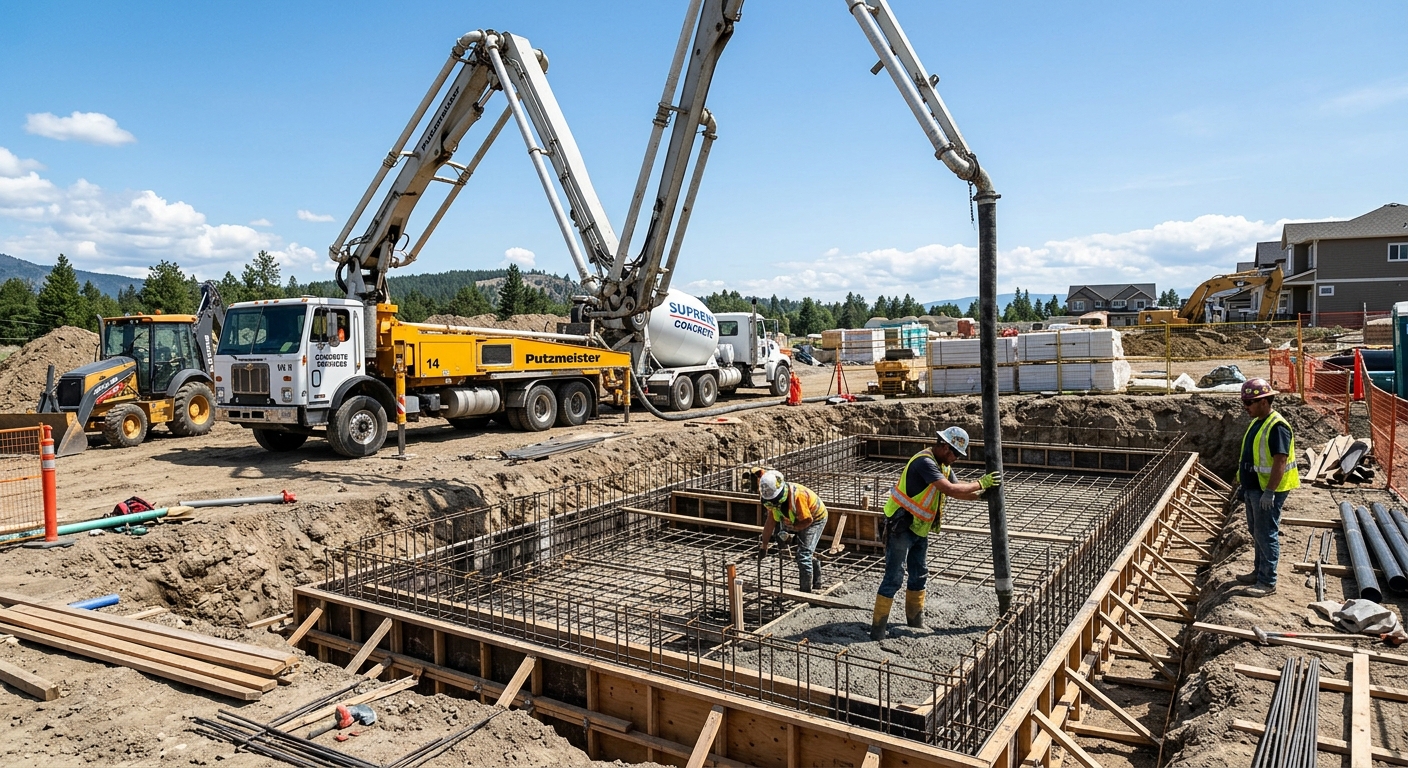
Concrete work options and costs in Lions Bay
Lions Bay homeowners typically build concrete flatwork on a lot shaped by steep grades, drainage patterns, and salt-air exposure along Howe Sound. In a town where 95.0% of dwellings are single-detached homes (Statistics Canada, 2021 Census), the most common projects are driveways, patios, walkways, and sometimes interior garage slabs—work that’s highly visible and has to perform through Lions Bay’s wet winters and freeze–thaw cycles. Another local factor is the age of the housing stock: 65.3% of homes were built before 1981 (Statistics Canada, 2021 Census), which often means older drainage details and changing soil conditions around foundations and existing flatwork.
In the Lower Mainland–Southwest region, pricing is influenced by a shallow but important frost depth design assumption (commonly around 450 mm / 18"). Contractors still place footings, piers, and thickened edges below that effective frost zone to reduce frost heave risk. At the same time, coastal rainfall and cool nights extend scheduling and curing time—so base prep, proper air-entrainment mixes, jointing, and curing practices are built into the labour rate. Availability also matters: in busy Vancouver–Surrey–Abbotsford corridors, crews can be booked ahead, which can affect your total cost when a project needs rescheduling due to heavy rain.
In Lions Bay, concrete trade demand is especially steady around the village core and along the main commuter routes, where homeowners often replace worn asphalt with broom-finished concrete or upgrade to exposed aggregate for traction and curb appeal. Use the comparison below to discuss options with your contractor and align cost with durability goals.
| Application |
Typical Size |
Key Spec |
Finish Option |
Price Range |
| Concrete driveway (standard broom finish) |
400–600 sq. ft. |
Compacted granular base; air-entrained exterior mix; control joints |
Broom finish, saw-cut joints |
$18,000–$28,000 |
| Exposed aggregate driveway |
400–600 sq. ft. |
Proper curing to achieve clean exposure; air-entrained mix; drainage attention |
Exposed aggregate surface with sealed finish |
$22,000–$34,000 |
| Stamped concrete driveway or patio |
300–600 sq. ft. |
Air-entrained mix; integral colour or release system; joint pattern planning |
Stamped patterns (slip-resistant where needed) |
$24,000–$38,000 |
| Plain concrete patio or walkway |
200–400 sq. ft. |
Compacted base; air-entrained mix for exterior; minimal grade slope management |
Broom finish or trowelled-to-finish |
$8,000–$18,000 |
| Garage floor (interior slab) |
400–600 sq. ft. |
Vapour control as required; minimum thickness; mesh or fibres as specified |
Steel-trowel finish; optional sealer |
$10,000–$20,000 |
| Foundation footings (structural, below frost) |
Per project (common “small” replacement scope) |
Excavation to frost depth; reinforcement; placement below design frost zone |
Structural concrete with required forms and curing |
$200–$350 |
Prices are estimates only and vary by project scope, site access and material selection.
What affects the price of concrete work in Lions Bay
For the same driveway size, it’s common to see quote swings of 30–50% across the Lower Mainland–Southwest and other parts of British Columbia. The difference is usually not “mystery markup”—it’s rooted in frost-depth design, freeze–thaw exposure, how prepared the subgrade is, and whether the contractor can schedule the pour and curing window with minimal rain disruption. In coastal-wet areas like Lions Bay, crews also rely on air-entrained mixes, better drainage detailing, and longer curing management to hit the spec for durability, especially at edges and transitions.
Even though we don’t have the deep frost of interior BC, practical local design still assumes a frost depth around 450 mm / 18" for budgeting and detailing. Footings, piers, and thickened edges are placed below that effective frost zone to help prevent frost heave. For exterior slabs, air-entrained concrete is a must to manage the freeze–thaw cycle and reduce scaling and surface deterioration. In colder regions, the shorter pour season and cold-weather curing precautions (heating and insulating blankets) raise excavation, forming, and labour costs; the same fundamentals apply here, just with more rain scheduling complexity than extreme cold.
In Lions Bay, two common cost drivers are base prep and drainage: if the site needs additional compacted granular to correct soft spots or slope issues, that pushes the project toward the top end of the patio/walkway band (often $16,000–$26,000 for typical exterior scopes). Likewise, replacing older asphalt that’s failed from poor drainage can mean re-grading and extra excavation—sometimes moving a standard broom driveway from the lower end of the driveway band (about $18,000–$28,000) toward higher pricing when rework is required. A house built before 1981 may have older drainage swales or foundation backfill that no longer drains as intended, which can add several days of prep and testing.
| Price Factor |
Why It Matters |
Cost Impact |
| Frost line depth — determines footing depth and form height |
Helps prevent frost heave by keeping structural elements below the effective frost zone |
More excavation and forming increases labour and material volumes |
| Site preparation — excavation, grading, compacted granular base |
Subgrade stability and drainage determine long-term settlement and edge failure |
Soft soils or poor drainage can add 10–30% or more to labour |
| Reinforcement — rebar or wire mesh requirement |
Controls cracking and supports structural loads, especially on driveways and garage slabs |
Material plus tying/positioning time can be significant |
| Mix design — air-entrainment and compressive strength spec |
Exterior durability depends on proper air content for freeze–thaw resistance |
Specialty mix and quality testing add small but real cost per yard |
| Finish type — broom vs. stamped vs. exposed aggregate |
Texture and aesthetics affect slip resistance, timing, and labour complexity |
Stamped and exposed finishes typically cost more than broom finish |
| Pour size and concrete truck access to site |
Access constraints can require pumping or extra labour for placement |
Pumping, wait times, and re-routing can increase the total |
| Cold-weather curing precautions — heating and blankets |
Protects early-age concrete from temperature drops and surface defects |
Heating/blankets add labour and equipment rentals where needed |
| Control joint pattern and sealing cost |
Joints manage shrinkage cracking and sealing improves resistance to salt and moisture |
Better joint layout plus sealing adds line-item cost but reduces failure risk |
Permits & regulations in British Columbia
In British Columbia, the rules depend on what you’re building and whether it affects structural performance, grading, or municipal limits. Structural concrete work—like foundation walls, grade beams, grade-beam/footing systems, and engineered elements—typically requires a building permit and often engineered drawings that the municipality or building department reviews before work starts. Concrete flatwork such as patios, walkways, and driveways usually does not require a permit, unless it affects lot grading, drainage, or impervious surface coverage limits, or ties into municipal right-of-way requirements. In Lions Bay, where many lots are tight and drainage-sensitive, it’s wise to confirm before you remove existing material or change runoff paths.
Here’s a simple, step-by-step way for Lions Bay homeowners to verify contractor standing in BC:
- Ask the contractor for their certificate of insurance (liability) and confirm the policy is active for the job’s effective dates.
- Request proof of workers’ coverage (commonly WCB coverage) for workers who will be on site.
- Check the contractor’s licence/standing using BC’s public contractor/regulatory resources (start with the contractor’s own registration details and match them to the official online registry).
- Get a recent clearance letter or coverage verification if the contractor provides one for your project file.
- Verify references on similar concrete scopes (driveways/patios or foundation work) so you’re not paying for first-time methodology on your site.
If your project involves foundation elements below frost, plan on engineering and permit administration as part of the realistic timeline and budget.
Getting concrete right in Lions Bay's freeze-thaw climate
Concrete failures in Lions Bay usually start long before the surface looks bad. The most common causes are poor base preparation and inadequate mix/joint/curing details for the local freeze–thaw cycle and coastal rainfall. To spec the job correctly, treat exterior concrete as a system: (1) base preparation, (2) mix design, (3) control joints, (4) curing, and (5) sealing.
Base prep should include compacted granular to a depth that supports your frost-protected design and resists pumping under wet conditions. Contractors in our region typically design around a frost depth around 450 mm / 18", meaning structural elements like thickened edges and footings belong below the effective frost zone. Mix design matters: specify air-entrainment (commonly 5–7% air for exterior flatwork) and a minimum 32 MPa compressive strength so the concrete can cycle through freezing and thawing without excessive scaling. Control joints are there to limit random cracking; spacing needs to be planned rather than “eyeballed.” Curing is often where jobs get rushed—require at least 7 days of proper curing under favourable conditions, and if cold nights or rain are expected, the contractor should plan curing blankets and protection. Finally, for driveway and patio surfaces, sealing with a penetrating sealer applied after curing (commonly at/after 28 days) helps repel moisture and de-icing salts that accelerate surface spalling.
Ask technical questions early: “What air content are you targeting?”, “How are joints laid out?”, and “What’s your curing plan during cool nights?” Here’s a realistic way to justify the cost: upgrading from a plain broom driveway to a sealed, properly jointed broom finish may cost a modest increase within the driveway band (think closer to the higher end of about $18,000–$28,000 depending on size), but it’s often cheaper than replacing a prematurely scaled surface a few years later.
| Spec |
Why It Matters in Lions Bay |
What to Ask For |
Impact if Skipped |
| Compacted granular base (depth?) |
In Lions Bay’s wet winters, a stable base resists pumping, settlement, and edge breakdown through freeze–thaw |
Specify granular type and compaction method; confirm base depth to frost-protected design |
Uneven settlement, cracking, and premature surface failure |
| Air-entrained concrete mix (target air %?) |
Freeze–thaw cycling demands proper microscopic air bubbles to resist scaling |
Target air content (commonly 5–7% for exterior flatwork) and proof of mix design |
Spalling and scaling that often show up within a few winters |
| Compressive strength (MPa rating) |
Durability and load capacity depend on meeting the required strength at early and later ages |
Minimum 32 MPa and curing plan that supports strength gain |
Reduced strength and increased cracking risk |
| Control joints (spacing per ACI guidelines) |
Joints manage shrinkage cracking so cracks happen where intended, not randomly |
Joint spacing and layout; method for sawing timing |
Random cracking and water infiltration into slab edges |
| Minimum 7-day curing period |
Cool nights and high humidity can slow strength development and increase surface defects |
Curing start time, protection measures, and coverage plan for rain/cold |
Weak surfaces, dusting, and increased long-term deterioration |
| Penetrating sealer (when applied after cure) |
Salt exposure and coastal moisture drive sealing needs on driveways and patios |
Apply after adequate cure (commonly at/after 28 days) and confirm product type |
Higher absorption, faster scaling, and more frequent surface maintenance |
How to choose a concrete work contractor in Lions Bay
Choosing the right concrete contractor in Lions Bay is mostly about verifying capability and reducing risk. First, confirm British Columbia licensing/standing where applicable, then verify the contractor’s liability insurance—request a certificate of insurance showing coverage limits and that the policy is active for your job dates. Next, ask for proof of WSIB/WCB-type coverage for workers on site (they should be able to provide current verification, clearance documentation, or equivalent proof). A contractor who won’t provide insurance documentation up front is a major red flag.
Then, collect 2–3 itemised written quotes. You want a breakdown that separates labour and materials (concrete, base prep, reinforcement, finishing, sealing), and ideally includes line items for excavation quantities, disposal/hauling, and saw-cut timing for control joints. Read the exclusions carefully: is site disposal included? Is permit coordination included where needed for structural work? What happens if rain delays the pour—do they protect the subbase and schedule re-try at no extra cost?
For warranty, ask for a clear statement: workmanship warranty length, what “defects” are covered, and whether it’s tied to specific product/manufacturer warranties (and if those can be transferred to a new homeowner if you sell). On payment, never pay more than about 10–15% upfront; hold back a portion until the job is complete and surface protection/sealer application (where included) is done. Finally, get a start date and completion estimate in writing, with a realistic allowance for Lions Bay rain and curing time.
- Confirm their current insurance certificate and expiry dates match your project window.
- Verify worker coverage documentation (WCB-style proof) before work begins.
- Ask for 2–3 references with similar driveway/patio sizes in the Lower Mainland.
- Require an itemised quote (not a single lump-sum) with labour + materials.
- Confirm excavation quantities assumptions and whether soft spots are included.
- Ask for their air-entrainment target and minimum compressive strength spec.
- Review reinforcement plan (mesh vs. rebar) based on the slab’s purpose.
- Ensure control joint spacing and sealing timing are written into the scope.
- Ask about concrete truck access or pumping, and whether that’s included.
- Get the curing and protection plan for cool nights or wet forecast periods.
- Clarify disposal/hauling and whether they restore disturbed landscaping.
- Confirm workmanship warranty and whether it’s transferable on sale.
Concrete contractor red flags in Lions Bay: they won’t discuss air-entrainment or joint layout; they propose pouring through wet conditions without a curing/protection plan; they provide only lump-sum pricing with no itemisation for base prep and sealing; they avoid showing insurance/coverage documents; or they ask for large upfront payments (beyond 10–15%) before any materials are on site.
Frequently asked questions — concrete work in Lions Bay
Why does concrete crack in Lions Bay and how is it prevented?
Concrete in Lions Bay most commonly cracks due to shrinkage and temperature movement, then worsens if water gets into the edges. Our coastal-wet conditions and freeze–thaw cycles amplify the problem when joints aren’t planned or when the base isn’t well compacted. Prevention is mostly about control: proper subgrade prep with compacted granular, a concrete mix with the right air-entrainment for exterior exposure, and a deliberate control joint pattern so cracks form where you intend them to. A second key step is timing—saw cuts need to be placed early enough for shrinkage control. Finally, sealing after curing helps limit moisture and de-icing salt absorption. If you’re budgeting, a broom-finish driveway often lands around the $18,000–$28,000 band, and skipping good jointing and sealing is a common way to “save” now and pay more later.
Stamped vs broom-finish concrete — cost difference?
Stamped concrete looks more decorative, but it costs more because it requires coloured release materials, stamping labour, and careful finishing to maintain crisp edges through the curing window. Broom-finish concrete is simpler: you still need air-entrained mix, proper base prep, and control joints, but you don’t add the overhead of form/colour systems and detailed pattern finishing. In Lions Bay, the climate makes both finishes require the same durability specs—air-entrainment, correct curing, and jointing—so the price gap is mainly decorative labour and materials rather than “extra strength.” For homeowners, a stamped driveway or patio typically sits higher than standard broomwork, often aligning with the higher end of the driveway pricing and the stamped/design band around $24,000–$38,000 for typical scopes (size and access change results). If you’re mainly trying to get long-lasting performance, broom finish plus sealing is often the strongest value.
When is the best time to pour concrete in Lions Bay?
The best time in Lions Bay is when you can keep the concrete protected during the early curing period. Because we deal with frequent coastal rainfall and cool nights, contractors usually avoid heavy rain events and schedule pours when temperatures won’t repeatedly dip too far during the first 24–72 hours. That said, Lower Mainland–Southwest winters are milder than interior BC, so the main challenge is surface drying/finishing conditions and rain protection—not deep freezing. For many projects, contractors target late spring through early fall, but well-prepared crews can pour earlier or later if they bring curing blankets and manage water exposure properly. Ask your contractor how they’ll protect the subbase and how long they’ll maintain curing protection if rain is forecast. Timing affects quality more than it affects the “sticker price” in most cases; a poorly planned pour can increase long-term repairs even if the quote looked competitive.
How long does concrete take to cure?
Concrete curing happens in stages. For most exterior flatwork in British Columbia, you should expect at least 7 days of curing under proper conditions for early-age protection, and many durability-oriented practices treat 28 days as the point when curing is complete enough for many surface treatments and sealer readiness. In Lions Bay’s cool, damp climate, strength gain can be slower if nights stay cold or if the slab stays wet—so the contractor’s curing plan matters. If you’re applying a penetrating sealer for durability, ask for application after adequate cure (commonly around 28 days) so the concrete surface is ready to accept the sealer. Also ask when foot traffic and driving are allowed; contractors often use temperature-adjusted cure and strength targets rather than a fixed “X days” rule. If someone guarantees early use without a curing plan, that’s a quality risk.
Do I need a permit for concrete work in British Columbia?
In British Columbia, the need for a permit depends on what concrete work you’re doing. Structural concrete items—such as footings, foundation walls, and grade beams—typically require a building permit and often engineered drawings that a municipality reviews. By contrast, concrete patios, walkways, and driveways usually do not require a permit unless the work affects lot grading, drainage, impervious surface limits, or municipal/right-of-way requirements. Because Lions Bay lots can be drainage-sensitive and many homeowners are replacing older driveway surfaces, it’s smart to confirm with the local authority before breaking ground. On the contractor side, you should also verify that the contractor understands when permits apply and whether they’re coordinating the process. A good contractor will tell you clearly what is included in their scope—especially for structural work where engineering and permits are expected.
Concrete vs pavers for a patio in Lions Bay?
Both can look great, but concrete usually wins on long-term consistency when the base is properly engineered for the freeze–thaw cycle. Concrete patios use air-entrained mix, control joints, and curing/finishing practices that—when done correctly—deliver a durable, uniform surface. Pavers can also perform well, but they depend heavily on a well-draining base, correct bedding sand depth, and edge restraint to prevent shifting during wet seasons. In Lions Bay, the biggest differentiator is how water moves under the surface: if drainage is poor, pavers can heave or settle unevenly, and concrete can scale if air-entrainment or curing is wrong. Cost-wise, plain concrete patio/walkway projects often fall in the $16,000–$26,000 range depending on size and site access, while decorative options can be higher. Choose pavers when you want easy spot repairs and varied design; choose concrete for a cleaner, lower-maintenance look with strong durability.