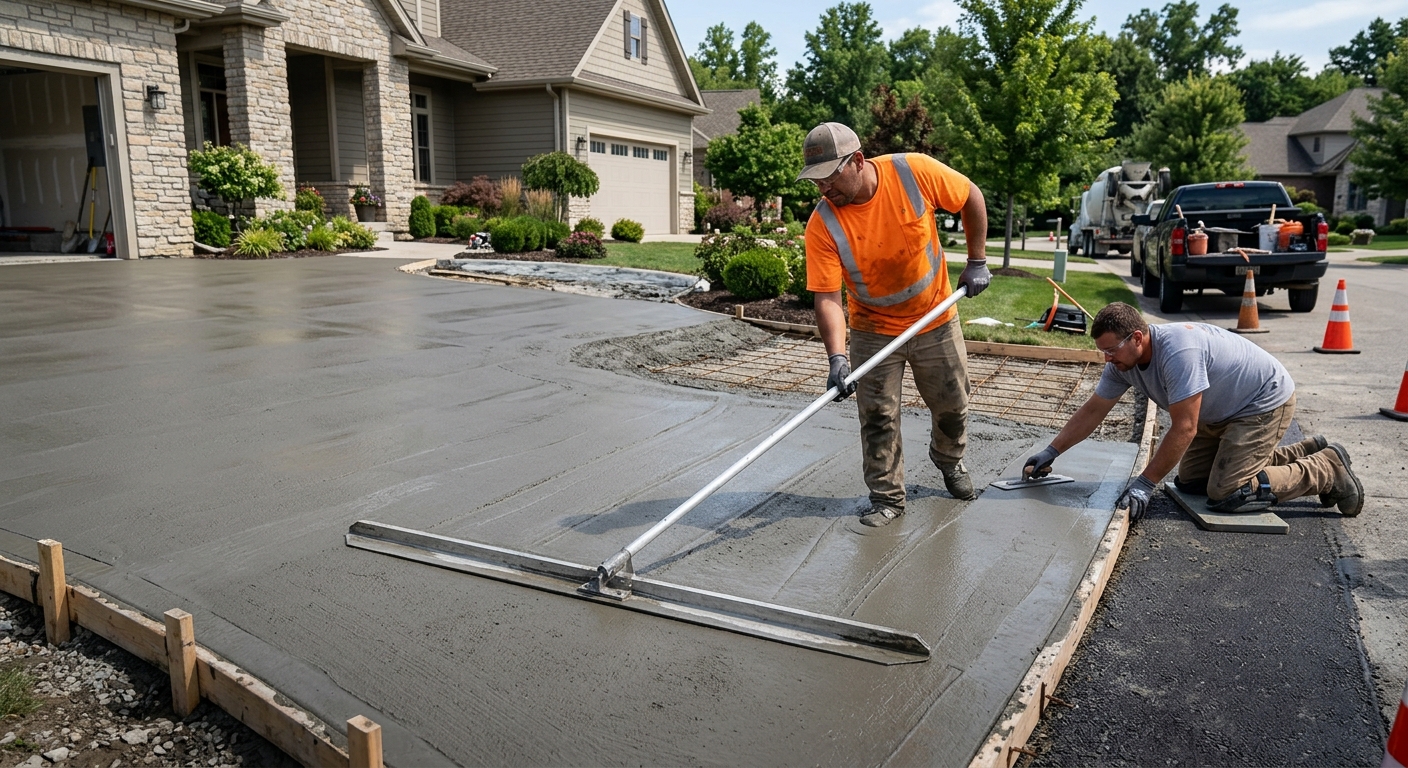
Concrete work options and costs in Willoughby
Concrete work in Willoughby typically falls into two categories: functional flatwork (driveways, patios, walkways, garage floors) and structural concrete (foundation footings and other below-grade items). The Lower Mainland–Southwest is a major growth corridor, and in Willoughby the housing stock is largely dominated by single-detached homes—so demand for concrete flatwork is steady year-round. With a population of 31,305 (Statistics Canada, 2021 Census), local contractors are busy and the competition is real, but so is the need for the right specs to handle our damp, freeze–thaw cycles.
Because Lower Mainland–Southwest has a shallow frost depth (commonly assumed around 450 mm / 18" in local practice), foundation and footing designs still place bases and thickened edges below frost to prevent frost heave. That said, the coastal-wet climate drives scheduling and curing costs: prolonged rain, cool nights and high humidity can delay pours and require curing blankets, sealers, and longer set times to reach design strength and surface durability. In Willoughby—especially around Abbotsford and the rapidly developing neighbourhoods near Maclure Road and the west side of town—driveways and patios are particularly in demand as older lots get refreshed.
Below are realistic cost bands for common jobs, with typical sizes and the key specs that usually change the price in our market. Use this table as a starting point, then compare itemised quotes before choosing a contractor.
| Application |
Typical Size |
Key Spec |
Finish Option |
Price Range |
| Concrete driveway (standard broom finish) |
400–600 sq. ft. |
Air-entrained exterior mix; compacted granular base |
Broom finish with control joints |
$18,000–$28,000 |
| Exposed aggregate driveway |
400–600 sq. ft. |
Air-entrained mix; careful surface exposure and curing |
Exposed aggregate finish with sealed surface |
$22,000–$32,000 |
| Stamped concrete driveway or patio |
300–600 sq. ft. |
Air-entrained mix; integral colour (when requested) |
Stamp pattern + release + sealer |
$24,000–$38,000 |
| Plain concrete patio or walkway |
200–400 sq. ft. |
Proper drainage/grade; compacted base |
Smooth or light broom with control joints |
$16,000–$26,000 |
| Garage floor (interior slab) |
480–650 sq. ft. |
Vapour barrier where needed; reinforced slab |
Light broom or trowel-float finish |
$14,000–$24,000 |
| Foundation footings (structural, below frost) |
Per house/engineered layout |
Footings formed and poured below design frost |
Structural concrete grade (engineer spec) |
$25,000–$45,000 |
Prices are estimates only and vary by project scope, site access and material selection.
What affects the price of concrete work in Willoughby
In Willoughby, you can see quote swings of 30–50% for what looks like the “same” concrete job, and it usually comes down to how the contractor addresses frost, drainage, and seasonal curing. In the Lower Mainland–Southwest, the frost depth is typically shallow (about 450 mm / 18"), but that does not eliminate freeze–thaw protection—especially where saturated soils and poor drainage keep the slab edges and footing zones wet. Meanwhile, labour availability and scheduling also matter: when contractors are booked and weather windows close, mobilization and rescheduling costs get baked into the price.
From a spec standpoint, every exterior slab and driveway needs air-entrained concrete to manage freeze–thaw cycling and reduce scaling. Footings and thickened edges still extend below the design frost depth, and that depth directly controls excavation, forming, and concrete volume. In colder Canadian regions, cold-weather curing precautions (heating, insulating blankets, longer holds) can raise costs significantly; in coastal BC we don’t face the same extreme temperatures, but cool nights and high humidity still mean more attention to curing control than many homeowners expect. De-icing salts, commonly used on driveways, can accelerate spalling if the concrete isn’t properly air-entrained and if surface sealing is skipped. That’s why a basic driveway might land nearer the lower end of $18,000–$28,000, while higher-end options like stamped work often shift toward $24,000–$38,000 when colour, stamping labour, and sealing are included.
Two practical Willoughby examples: (1) a sloped lot that needs extra grading and sub-drainage usually adds cost more than finishing upgrades do; (2) a driveway poured over inconsistent compacted fill may require deeper base prep and more granular import, pushing the total closer to the upper band even if the finish stays broom.
| Price Factor |
Why It Matters |
Cost Impact |
| Frost line depth — determines footing depth and form height |
Footings must sit below design frost to prevent frost heave |
Higher excavation and forming can raise foundation-related costs |
| Site preparation — excavation, grading, compacted granular base |
Compaction and base thickness control settlement and cracking |
Extra hauling, regrading and granular import increase labour and material costs |
| Reinforcement — rebar or wire mesh requirement |
Reduces cracking and improves slab performance under load |
Additional steel/fastening time can add to totals, especially for garage floors |
| Mix design — air-entrainment and compressive strength spec |
Air content and strength are key to freeze–thaw durability |
Air-entrained exterior mixes and higher specs cost more per yard |
| Finish type — broom vs. stamped vs. exposed aggregate |
Finishes require labour, curing steps, and sealing systems |
Stamped and exposed finishes increase time and materials |
| Pour size and concrete truck access to site |
Smaller access routes may require pumps or extended labour |
Crane/pump time, waiting, and extra crew time can add cost |
| Cold-weather curing precautions — heating and blankets |
Maintains strength gain when nights are cool or weather turns wet |
Blankets, heaters, and longer scheduling raise the price |
| Control joint pattern and sealing cost |
Joints guide cracking; sealing protects against moisture and salts |
More joints (and proper sealing) increase cost but reduce failures |
Permits & regulations in British Columbia
In British Columbia, structural concrete work generally requires a building permit. That includes footings, foundation walls, and grade beams—anything that supports the structure or forms part of the load-bearing system. Many projects also need engineered drawings reviewed through the municipal building process. For concrete flatwork like patios, walkways and driveways, a permit is often not required by default; however, it can be required if the work affects lot grading, changes drainage patterns, increases impervious surface beyond local limits, or impacts municipal right-of-way areas (for example, work tied to sidewalks or boulevard edges). Always confirm with the local authority before breaking ground in Willoughby.
Before you book a contractor, verify insurance and coverage. In BC, ask for (1) proof of liability insurance, (2) proof of applicable workers’ compensation coverage (WCB), and (3) evidence the contractor is properly registered for the kind of work being performed. Here’s a simple homeowner checklist: first, look up the contractor in the relevant online registry for business/contractor status (and any trade-specific registrations if applicable). Second, request a current certificate of insurance and check the expiry date and coverage limits. Third, request a clearance letter or confirmation of workers’ compensation coverage. Finally, ask for 2–3 references on projects of similar size and concrete type (exterior flatwork vs. structural). If the contractor can’t produce documents quickly, that’s a red flag.
Getting concrete right in Willoughby's freeze-thaw climate
Concrete in Willoughby can fail when it’s built on the wrong base, isn’t designed for moisture movement, or doesn’t protect the surface during our wet-to-cool swings. The biggest risk we manage is freeze–thaw cycling combined with saturated subgrades: water expands when temperatures dip, stressing edges, joints, and poorly drained areas. The fix starts at the base—excavate to the right depth and place compacted granular to the correct thickness and grade. Next is mix design: for exterior flatwork, specify air-entrainment (commonly 5–7% air content for durable exterior exposure) and minimum compressive strength (typically 32 MPa for many standard exterior applications, subject to the spec). Then control cracking with joints placed on a planned pattern instead of “where it happens,” and cure properly.
Curing is where homeowners often save money and then pay for it later. In Lower Mainland–Southwest conditions, you may not see extreme cold, but cool nights and high humidity can slow early strength development; we generally plan for at least 7 days under suitable curing conditions. After curing, sealing—especially with penetrating sealers applied about 28 days post-pour—helps repel de-icing salts and moisture. This is directly tied to spalling prevention; inadequate air-entrainment is a common cause of surface scaling and chipping.
To see cost justification: upgrading a plain patio to a sealed, properly jointed broom finish may cost only a few hundred to around a thousand dollars in the overall budget, while repairing a spalled surface later can easily become a full re-surface or replacement. Meanwhile, choosing stamped versus broom is a finish premium; it should be paid for aesthetics only—not for covering up poor base prep.
| Spec |
Why It Matters in Willoughby |
What to Ask For |
Impact if Skipped |
| Compacted granular base (depth?) |
Controls drainage and settlement under freeze–thaw moisture cycling |
Confirm base thickness by design and soil conditions; show compaction method |
Settlement, pumping fines, cracking and premature edge failure |
| Air-entrained concrete mix (target air %?) |
Reduces scaling/spalling under repeated wetting and freezing |
Ask for target air content (typically 5–7% for exterior flatwork) and mix documentation |
Surface scaling, spalling and faster deterioration |
| Compressive strength (MPa rating) |
Strength gain affects durability and load performance |
Request minimum 32 MPa (or project-specific spec) and test/QA approach |
Soft surfaces, increased cracking risk and reduced service life |
| Control joints (spacing per ACI guidelines) |
Keeps cracks within a planned pattern as moisture moves in winter |
Ask for the joint spacing plan and where they’ll be located relative to edges |
Random cracking and wider crack opening over time |
| Minimum 7-day curing period |
Ensures adequate strength in cool, humid conditions common to Willoughby |
Ask how curing will be maintained if it rains or nights are cool (blankets/sealers) |
Reduced strength, surface dusting and durability issues |
| Penetrating sealer (when applied after cure) |
Repels moisture and helps protect against de-icing salts |
Confirm sealer type and timing (commonly after 28 days) |
Faster staining, salt damage, and scaling at joints/edges |
How to choose a concrete work contractor in Willoughby
Choosing the right contractor in Willoughby means checking coverage and scope—before you sign. In British Columbia, verify three things: (1) licensing/registration for the type of concrete work being performed (and any trade-related registration that applies), (2) liability insurance with adequate limits and current expiry dates, and (3) workers’ compensation coverage through WCB for their workers. How to check: start with the contractor’s information on the appropriate online business/trade registry, then ask for a current certificate of insurance (COI) and review the coverage scope and dates. Finally, request proof/clearance of WCB coverage (or documentation showing they’re in good standing). If any of this is delayed or vague, slow down.
Next, get 2–3 itemised written quotes. Don’t accept only a lump sum—ask for a labour + materials breakdown and line items that explain excavation, forms, granular base, reinforcement, concrete mix type, finish labour, joints, curing method, and sealer (if included). Read exclusions carefully: is disposal included? Are permit fees included (if applicable)? Is traffic control or pump/crane access allowed for? Ask about warranty: workmanship warranty length, product/manufacturer warranty coverage (if any), and whether warranty is transferable to a new owner. Payment schedule matters—never pay more than 10–15% upfront, and hold a portion until the work passes final inspection and cleanup. Finally, request a written start date and completion estimate, not just a best guess.
- Request written scope with dimensions and finish type (broom, stamped, exposed).
- Confirm frost-depth approach for footings below frost (engineer spec when structural).
- Ask what air-entrained mix will be used for exterior flatwork.
- Verify compacted granular base thickness and compaction method.
- Insist on a control joint pattern plan (spacing and locations).
- Confirm curing steps for cool nights and rainy windows.
- Ask whether a penetrating sealer is included and when it’s applied (often after 28 days).
- Get an item for reinforcement (mesh/rebar) and what’s used for your slab thickness.
- Clarify concrete truck access—how they’ll place concrete on tight sites.
- Require line items for disposal/haul-away, not “allowance” language.
- Check warranty terms in writing (workmanship and any sealer product warranty).
- Use a milestone-based payment plan (limit upfront; holdback until completion).
Concrete red flags in Willoughby include: vague scopes with no granular base or air-entrained mix stated, quotes that ignore drainage at slab edges, skipping control joints “because they look better,” promising stamped results without colour/sealer systems, and pushing full payment upfront instead of milestone holdback.
Frequently asked questions — concrete work in Willoughby
Stamped vs broom-finish concrete — cost difference?
In Willoughby and the Lower Mainland–Southwest, stamped concrete is usually a premium over a basic broom finish because it adds colour/release materials and extra labour for imprinting and finishing. For a driveway-sized project, you’ll commonly see broom-finish pricing in the $18,000–$28,000 band, while stamped driveways or patios often land higher—around $24,000–$38,000—depending on square footage, base preparation complexity, and how many steps are included (integral colour vs. surface colouring, curing control, and sealing). The best value comes when both options are built with the same freeze–thaw durability specs (air-entrainment, proper joints, and curing). If a quote is cheaper but skips those durability elements, you’re likely paying later through spalling repairs or replacement.
When is the best time to pour concrete in Willoughby?
The best time to pour concrete in Willoughby is when you have consistent access to a good weather window and the contractor can control curing conditions. In this coastal BC climate, “winter” isn’t typically brutal like interior BC, but cool nights, fog, and prolonged rain can still slow strength gain and raise the risk of surface issues. We generally aim for periods with mild temperatures and forecastable conditions so curing blankets and plastic protection (if needed) can be managed without constant interruption. If the job is exterior flatwork or driveways, ask how they’ll handle rain during the pour and the first 24–48 hours. Even with a shallow frost depth (often around 450 mm / 18"), freeze–thaw cycles still drive durability specs, so timing must match curing and protection, not just whether it’s “above freezing.”
How long does concrete take to cure?
Concrete curing has two parts: initial set and strength gain. For most residential exterior work in British Columbia, you should plan on a minimum of 7 days of curing under suitable conditions (proper moisture and temperature management). However, design strength and sealer readiness are commonly tied to longer timelines—many sealers are applied about 28 days after the pour. In Willoughby’s damp coastal conditions, curing might take more effort even when temperatures look fine, especially after rainy spells. Ask your contractor how they’ll cure during cool nights (blankets, temperature protection, and avoiding rapid drying). If you’re planning to use the driveway or patio quickly, insist on clear curing milestones; rushing early can contribute to dusting, surface weakness, and premature scaling when freeze–thaw cycles begin.
Do I need a permit for concrete work in British Columbia?
In BC, structural concrete work—such as footings, foundation walls and grade beams—typically requires a building permit and often engineered drawings reviewed through the municipality. For concrete flatwork like patios, walkways and driveways, permits are often not required by default, but there are exceptions in Willoughby: if the work affects lot grading, changes drainage, impacts impervious surface coverage limits, or involves municipal right-of-way/sidewalk areas, you may need municipal approval. The simplest approach is to ask your contractor what permits are required for your specific scope and confirm with the local authority before excavation. Also, ensure the contractor carries liability insurance and WCB coverage; reputable crews can usually explain the permit process clearly.
Concrete vs pavers for a patio in Willoughby?
Concrete and pavers can both perform well in Willoughby, but they fail differently. Concrete patios are usually more predictable in cost and maintenance when built with proper base prep, air-entrained mix for exterior exposure, and a planned control joint layout. Pavers offer flexibility and easier localized repairs if one area shifts. In cost terms, a plain concrete patio or walkway often fits within $16,000–$26,000 depending on size, access, and drainage work needed. Stamped concrete pushes higher—closer to $24,000–$38,000—when you want patterns and added finishing steps. If you expect future utility access or want a “repairable” surface, pavers can be attractive. If you want a monolithic, clean look with fewer joints and edges to maintain, well-built concrete is typically the better fit.
How long does a concrete driveway last?
A well-built concrete driveway in Willoughby can last many years—often decades—when it’s designed for freeze–thaw exposure, properly jointed, and maintained. The biggest drivers of lifespan are air-entrainment, drainage, base preparation, and curing quality. If the concrete was poured with the right exterior mix and the contractor included control joints at an appropriate spacing, the slab is less likely to crack randomly and less likely to suffer scaling/spalling at the surface. Sealers also matter here because de-icing salts and moisture accelerate damage in coastal BC winters; many systems use a penetrating sealer after about 28 days. If your contractor is offering a low price in the $18,000–$28,000 band, make sure the quote still includes durable base prep, proper mix design, curing steps, and sealing (if recommended). A cheap finish with poor spec is what shortens driveway life.